Calculating the carbon footprint of wine: my research findings
Is that a whiff of raspberries and leather you get from that red wine–or a whiff of petroleum? With some premium wines consuming three times their weight in petroleum, don’t be surprised if it is the latter.
My previous postings on the carbon footprint of wine made me want to determine just how much carbon is involved in the making and transporting of our favorite beverage. So I collaborated with Pablo Paster, a sustainability metrics specialist, and we ran the numbers. Our findings have just been published as a working paper for the American Association of Wine Economists, available here as a pdf.
While I welcome your comments on the whole paper, I’ll post some of the key findings here:
* Organic farming has lower greenhouse gas (GHG) intensity than conventional farming but I was surprised that the difference wasn’t greater. Clearly there may be other differences in a local ecosystem but the GHG difference was surprisingly small. But on the whole, it was the transportation that played a more significant role from a GHG perspective.
* Regarding the “food miles” debate, we find that distance does matter.
* But not all miles that a bottle travels are the same. Efficiencies in transportation make container ships better than trucks, which in turn are better than planes.
* Shipping premium wine, bottled at the winery, around the world mostly involves shipping glass with some wine in it. In this regard, drinking wine from a magnum is the more carbon-friendly choice since the glass-to-wine ratio is less. Half-bottles, by contrast, worsen the ratio.
* Shipping wine in bulk from the source and bottling closer to the point of consumption lowers carbon intensity.
* Light packaging material such as Tetra-Pak or bag-in-a-box has much less carbon intensity.
* Using oak chips is a more carbon friendly alternative than oak barrels, particularly those that are shipped assembled and empty around the world
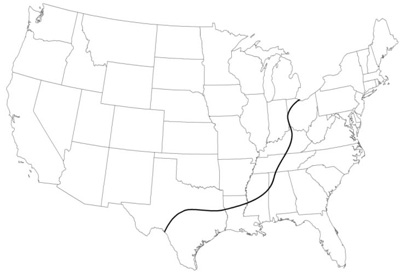
* There’s a “green line” that runs down the middle of Ohio. For points to the West of that line, it is more carbon efficient to consume wine trucked from California. To the East of that line, it’s more efficient to consume the same sized bottle of wine from Bordeaux, which has had benefited from the efficiencies of container shipping, followed by a shorter truck trip. In the event that a carbon tax were ever imposed, it would thus have a decidedly un-nationalistic impact.
What does this mean for the green wine consumer? Drinking a wine made without agrichemicals, from larger format bottles, or wine that has traveled fewer miles is the more “green” option. Beyond these points (or in addition to them), you could perform your own carbon offsets, for example, by giving up one bottle for another and saying no to bottled water.
“Red, White and “Green”: The Cost of Carbon In the Global Wine Trade,” By Tyler Colman and Pablo Paster
UODATE: This paper was been published in the March 2009 issue of the Journal of Wine Research
image 1: istockphoto.com





On October 30th, 2007 at 9:36 am ,Ray Isle wrote:
Jeez Louise, Tyler, you’re making me feel very lazy! The only question that springs to mind is whether, when shipping via reefer, the lengthier time something is on the water might actually make refrigerated trucks more energy efficient than refrigerated container ships—but I’ve no idea how high the energy cost of refrigeration is compared to fuel consumption. Hm. Maybe I’ll leave that for you to determine…
On October 30th, 2007 at 10:15 am ,Dr. Vino wrote:
Ha, funny, Ray! I did wonder about the difference with reefers (btw, don’t you love that colloquialism?). While I defer to my co-author for all things eco-numbers, we did take that into consideration in our calculations of the “green” line.
On October 30th, 2007 at 11:46 am ,Brooklynguy wrote:
Hi Doc – not sure i agree about the un-nationalistic impact of a carbon tax. I assume you mean that trucking wine east from Cali or Oregon would become more expensive. Some might then buy more French wine, but maybe it would encourage higher demand among us easterners for local wines, you know, the stuff they make in Long Island, the Finger Lakes, maybe even Virginia or New England. Probably a good thing, if it’s lower carbon foot print you’re interested in.
On October 30th, 2007 at 12:05 pm ,Dr. Vino wrote:
Hi BG –
Well, with 90% of American wine made in California, anything anti-California could be construed as “anti-American”! But you’re right that the 200+ wineries in NY state would benefit from their proximity to the great wine-guzzling city that is NYC–providing that such a tax if it were imposed at a level that had an impact to affect consumer behavior.
On October 30th, 2007 at 1:49 pm ,Tom Ferrell wrote:
I was very interested to see how you came to the conclusion that there was not a lot of difference between “organic” and conventional farming methods in greenhouse gas production. As a person who has done both, I think you really have to look at this in more detail than accepting an individual’s self serving analysis of his own operation. Organic farming, particularly “biodynamic farming” is far more carbon positive than modern sustainable viticulture.
Show me how the Joly gets 50 to 100 kg of equivalent strength nitrogen input per ton using a few farm animals. Sorry, the math doesn’t work out. From what I have seen, the animals on “biodynamic farms” are for show on a “pretend integrated farm” and do not relate to the real world of grape growing. Had Joly a thousand acres and had to raise a few thousand head of cattle to get the crap he needs for compost to fix nitrogen, he would soon see the negative impacts of cattle on the environment, their methane production, and compost transportation produced greenhouse gas. If all the world’s vineyard converted to true “biodynamic” it would be a colossal environmental disaster.
I looked into converting a vineyard of 350,000 vines to biodynamic for a client. It required a cu. ft. of “biodynamic” compost per vine to be certified. So figure it out…270 cu ft per 10 yard dump truck…over a thousand dump trucks just to haul the stuff on to the property…then you have to spread it and work it into the soil? Compare that to one flat bed distributing the same amount of N in the concentrated form to all the drip stations and feeding the vine through the drip system. And with pure NH3 thru drip you don’t disturb your cover crop.
What is the carbon footprint and GWP of producing and delivering 350,000 cubic feet of compost from animal crap and plant material versus a single truck of pure NH3 from natural gas? It’s all about transport and looking at the inputs scientifically not emotionally.
Fertilization is just one practice, we haven’t yet talked about other cultural practices.
You also have to look at labor per ton and it’s hidden carbon costs. Organic farming is more labor intensive and, usually, produces a smaller yield. Or so we say. Every farm worker you require has a carbon footprint. Just consider the commute carbon costs of 40 workers driving their beater cars to and from Vallejo to Saint Helena to work for a day on 200 acres versus a fully mechanized property of the same size that can do it with five of those workers. (I have.) Now look at each worker’s real and total carbon footprint. Just to feed a human is like a 100 watt bulb burning year round.
It’s a no brainer. Double your yield and you cut the acreage in half and can put the acreage you saved in old growth timber. Highly, mechanized, sustainable farming practices that minimize labor and maximize yield per acre and minimize all transportation costs are far less carbon positive than “organic” or “biodynamic” that do neither. It’s not even close.
In other matters, while we have not had a year too hot for high quality grapes in the Napa Valley since 1981, we have had several vintages too cool (1982, 1998, 2000, maybe 2007) Irrespecitive of a climatologists models, ask an Oregon or Washington grape grower this year if they want cooler or warmer weather in the future.
Finally you might find that how the wine is purchased by the consumer makes the biggest carbon difference above all else. Compare the carbon costs of driving to the Napa Valley or the specialty wine shop to buy your wine, versus picking it up along with everything else at the supermarket. A short, otherwise avoidable, drive by a customer in even a Toyota “Pious” to pick up a case of wine from a specialty shop uses more carbon than that case’s entire trip from the vineyard to that wine shop…whether from France or California.
If man is causing the world to overheat we will not solve it unless we look at things truly in a new ways without past bias.
TF
On October 30th, 2007 at 5:53 pm ,Steve Heimoff wrote:
Couple years ago I researched the issue of styrofoam, which many wineries use to send their wines out. Turns out it’s really nasty stuff. Big carbon footprint, lots of pollutants in manufacturing and burning, hard to dispose of because it stuffs up landfills, etc. etc. I took this issue up personally with the then head of Wine Institute, Mr. DeLuca, and others there. They basically said, Sorry, not our problem. It amazes me that we have wineries that make big green claims, biodynamic, organic, and then they send their wines out in styrofoam packaging. And the Wine Institute itself has their green initiative [or whatever it’s called]. I would love to see a concerted industry-wide effort to ban this stuff!
On October 30th, 2007 at 6:09 pm ,swirlingnotions wrote:
I’ve interviewed Drew and Myra Goodman, owners of the organic produce company Earthbound Farm, for a couple of articles over the past couple of years and have always been impressed for their “quest” to lessen their carbon footprint.
Already, they’ve transitioned thousands of acres of farmland to organic methods, but they’re always looking for ways to do better. I remember a conversation with Drew where he was talking about how he would love to switch over their transportation–both in the fields and for distribution–to “greener” fuels, and he was looking into options.
It was a lesson for me that making changes isn’t about one big slip. It’s about asking the questions and making the choices to move from one link in the chain to the next as you learn from each stage.
Thanks so much for this post!
On October 31st, 2007 at 11:18 am ,Jim wrote:
Hate to be picky, but that green line does not run down the middle of Ohio.
On October 31st, 2007 at 12:53 pm ,John Witherspoon wrote:
Wow – what a great post, I am glad to know someone (or group) has developed a tool to calculate this. I have a couple of questions as did previous commenters but I haven’t read the full paper yet so I will do that and maybe my questions will be answered.
Thanks – this is really neat.
John
On October 31st, 2007 at 10:11 pm ,Kevyn Moore wrote:
In the past we have had higher Co2 levels in the atmosphere.
In the past we have had higher world temperatures – and colder.
Climate is always changing.
In the 70’s we were warned of an approaching cooling and ice age.
It is some of the same scientists who are now claiming the world is warming.
It did from about 1900 to 1970 (0.7deg C) but has been cooling since then.
And so the world is about to spend $ trillions on a moving shadow.
On November 1st, 2007 at 1:26 pm ,Creative Loafing tampa » Eat My Florida » Blog Archive » Sustainable Buzz wrote:
[…] Vino has a new study that shows how much of an impact the wine we drink has on the environment. It’s a great study […]
On November 1st, 2007 at 10:09 pm ,Jack wrote:
“Yellow Tail is made in Yenda, New South Wales, and grapes come from all over the country to make the approximately 12 million cases sent”
How do you calculate the carbon cost of the grapes being transported from the vineyards to the YT facility in Yenda?
On November 2nd, 2007 at 6:18 am ,The Ethicurean: Chew the right thing. » Blog Archive » Digest - Blogsnacks: Raw milk, Alice Waters updates; wine’s carbon footprint, defining local wrote:
[…] Bring on that Michigan magnum: Dr. Vino runs the numbers on wine’s carbon footprint. This is no back-of-the-napkin guessing, but a working paper for the American Association of Wine Economists. Turns out we should heed an imaginary “green line” that runs down the middle of Ohio. (Dr Vino) […]
On November 2nd, 2007 at 11:15 am ,Chicago : Dining News Elsewhere: Padma, Meryl and More wrote:
[…] – How to calculate the carbon foot print of that bottle of wine. [Dr. Vino] […]
On November 5th, 2007 at 2:07 pm ,Los Angeles : Dining News Elsewhere: Wine Fridges, Disaster Relief Food wrote:
[…] – Speaking of, calculating the carbon foot print of that bottle of wine. [Dr. Vino] […]
On November 6th, 2007 at 9:18 am ,Modern Earthling » Blog Archive » THE COST OF CARBON IN THE GLOBAL WINE TRADE wrote:
[…] on this study, carbon-conscious, East Coast wine drinkers should be drinking French wines. Visit Dr Vino’s Wine Blog for a summary of the […]
On November 6th, 2007 at 2:18 pm ,Eco-Cide: Exploring Ecology wrote:
[…] wine blogger Tyler Colman, Ph.D. A.K.A. Dr. Vino and sustainability metrics specialist Pablo Paster examined the carbon footprint of wine. While not specifically a life cycle inventory (LCI), which gives us the green lowdown on energy […]
On November 6th, 2007 at 5:02 pm ,Beverly wrote:
What about drinking Ohio Wine? You did not mention that as an alternative to California Wines east of your imaginary line?
On November 6th, 2007 at 5:26 pm ,JohnO wrote:
Interesting study? Any idea how the line projects into Canada?
On November 6th, 2007 at 5:26 pm ,JohnO wrote:
Interesting study! Any idea how the line projects into Canada?
On November 7th, 2007 at 7:57 am ,Dr Vino’s wine blog » Blog Archive » Which wine would you like to see carbonanalyzed? wrote:
[…] or free monthly updates by email (right sidebar). Thanks for visiting!My posting last week on the carbon footprint of wine has generated a good discussion around them there internets. But one thing is missing: the wines […]
On November 12th, 2007 at 2:08 pm ,rob wrote:
Ahh, the Vinland Map
On November 12th, 2007 at 7:12 pm ,Bordeaux Gets Boost From Eco-Connoisseurs | BFG Blog wrote:
[…] to Dr. Vino, there’s a “green line†that runs down the middle of Ohio. For points to the West of that […]
On November 12th, 2007 at 9:26 pm ,Waldo Jaquith » Blog » Think locally. Drink globally. wrote:
[…] Virginia, it’s less carbon intensive to drink French wine than Californian wine. Better still? Virginia […]
On November 13th, 2007 at 2:04 pm ,Appellation Beer: Beer From a Good Home » Blog Archive » Stuff to read while drinking a winter beer . . . wrote:
[…] Dr. Vino partners on a paper to calculate the carbon footprint of wine. I’m hoping somebody does this for beer (because I’m too lazy). Notice the […]
On November 13th, 2007 at 7:38 pm ,episcopophagous » del.icio.us: November 10th - November 13th wrote:
[…] Dr Vino?s wine blog » Blog Archive » Calculating the carbon footprint of wine: my resear… environment wine sustainability food drink economics politics […]
On November 15th, 2007 at 4:00 pm ,Dr. Vino wrote:
Whoa! I’m overdue to respond to some of these comments.
Tom F – interesting points, clearly more research is needed. But my initial reaction is that manure is a by-product of a livestock farm so you couldn’t ascribe that greenhouse gas emission to wine production. There are often livestock farms within a close drive of vineyards.
Steve – Yes, as I’ve posted before, styrofoam is annoying–especially the peanuts! Styrofoam itself weighs practically nothing so it doesn’t add to the shipping mass. And it used to produce a lot of CFCs but production methods have changed to the best of my understanding now. There is the problem that it does not break down after (one) use, but that does not factor into the greenhouse gas calculations.
Jim – You are completely right that the line does not run down the middle of Ohio! The line is correct, however, based on our calculations. The text should read something like “to the edge of Ohio.”
Kevyn – sounds like you’ve been reading Bjorn Lomborg!
Jack – good point. There are economies of scale in Yellow Tail. The vineyards are not always a huge distance from the winery but that trucking of grapes (or must) does have a carbon factor.
Beverly – yes, drinking local is always a good option from a GHG perspective!
JohnO – Sorry, John, we didn’t make any calculations into Canada. How far do container ships can go down the St. Lawerence seaway? The farther it goes by boat, the farther that breakeven line goes west.
More questions? Post ’em!
On November 16th, 2007 at 11:03 pm ,Things I Learned This Week « Kreblog wrote:
[…] is more “eco-friendly” to drink wine from France than California (stop killing the planet California wine […]
On November 18th, 2007 at 5:47 pm ,Gil Friend wrote:
> Half-bottles, by contrast, worsen the ratio.
Unless you don’t drink much wine, in which case there’s left waste than with a magnum or even full bottle that goes bad.
On November 18th, 2007 at 5:54 pm ,Gil Friend wrote:
From the full paper:
> The third bottle comes from a hypothetical cult winery in Napa practicing sustainable agriculture (limited petrochemical inputs). This bottle is by far the heaviest of the three.
Why is this bottle “by far the heaviest of the three”? That’s not been my experience with Napa wineries. How would it effect the calcuations if all bottles were equivalent?
Also, if the Napa case is “sustainable ag,” should the land use and cultivation impacts (Fig2) be significantly lower?
On November 18th, 2007 at 8:29 pm ,Pablo wrote:
Gil, Based on our research “sustainable ag” does not make much of a difference from a GHG perspective. This is without looking at the emissions of NOx, which would further confuse calculations as research into NOx emissions from ag are inconclusive or highly dependent on specific local conditions. Also, the biggest impacts from wine cultivation is the use of equipment, the pumping of water, and the land-use change itself, not the application of a minimal amount of petrochemicals (Remember, this is a GHG perspective. Ecological toxicity is another issue).
On November 21st, 2007 at 9:21 pm ,philippe newlin wrote:
Styrofoam, as noxious as it is, does reduce the shipping weight of wine packages. It was also pointed out that the stuff doesn’t break down easily. I would encourage anyone who receives a shipment in this type of packaging to turn around and re-cycle it by offering it to your local wine store. Most will gladly accept the freebie, and you’ll be extending the useful life of this practical shipping material. You might even see some juice in exchange if you’re local store is enlightened!
On November 26th, 2007 at 5:01 pm ,Cheryl wrote:
Since I don’t own a car I have been drinking more and more wines out of boxes. My friends are appalled, but there are very good ones out there. They’re much easier to carry on public transportation and they keep longer than bottled wine. Now you’ve given me another reason to ignore my friends and drink what I want. Thanks!
On December 5th, 2007 at 2:11 pm ,Cityhop New Zealand’s first car share service - cars by the hour » Blog Archive » Eco-friendly drinking and a plug for NZ wine wrote:
[…] to select the best ‘green’ wine.It refers to a study by, wait for it, Dr. Vino on, “Red, White and ‘Green’: The Cost of Carbon in the Global Wine Trade.†Dr. Vino  covers the CO2 produced during fermentation to land use implications so that the […]
On December 11th, 2007 at 11:24 am ,Dr Vino’s wine blog » Blog Archive » Hope, big gulp, Chinese sommeliers, voting - tasting sized pours wrote:
[…] no merci English wine outsells than Bordeaux in England?!? So says supermarket Waitrose. Holy carbon footprint, Batman! […]
On December 30th, 2007 at 12:03 am ,Dr Vino’s wine blog » Blog Archive » In the New York Times suggesting a local wine wrote:
[…] bullet points and discussion of my research with Pablo Paster on wine’s carbon footprint, check here. Consider subscribing to the site feed or the monthly email updates on the right […]
On December 30th, 2007 at 6:15 am ,Dr Vino’s wine blog » Blog Archive » In the New York Times with a suggestion to “drink local” wrote:
[…] bullet points and discussion of my research with Pablo Paster on wine’s carbon footprint, check here. Consider subscribing to the site feed or the monthly email updates on the right […]
On January 7th, 2008 at 11:51 am ,» In the Bag: Is a Bag of Wine a Good Idea? InterWined — Where Life & Wine Intertwine: A wine blog and wine-lovers’ Web site wrote:
[…] is a perspective on wine shared in the United States by Dr. Vino, who suggests that a green line running through the middle of Ohio exists and splitting the country in half makes wines from France more less carbon intense and […]
On January 8th, 2008 at 8:01 am ,Dr Vino’s wine blog » Blog Archive » In Wine & Spirits talking about carbon footprint wrote:
[…] some bullet points and discussion of my research with Pablo Paster on wine’s carbon footprint, check here. Consider subscribing to the site feed or the monthly email updates on the right […]
On January 16th, 2008 at 4:32 pm ,I *Heart* New York « spume wrote:
[…] we call wine, I suggest spending some time at Dr. Vino. Here you can learn about everything from wine’s carbon footprint to the wine lover’s guide to the presidential […]
On February 20th, 2008 at 10:05 am ,Dr Vino’s wine blog » Blog Archive » This blog came THIS close to a mention in the NYer, WSJ! wrote:
[…] if this has made you thirsty for more on the topic, check out a summary of our research findings, my op-ed in the NYT suggesting a local drink, and be sure to come to the March 18 free talk and […]
On February 25th, 2008 at 11:51 am ,Dr Vino’s wine blog » Blog Archive » Meadowood: A hotel mini-bar that’s worth uncorking wrote:
[…] Tuscany. With bottled water available from five miles away in Calistoga I was tempted to break out my carbon calculator… Permalink | Share This | wine travel This entry was posted on Monday, February 25th, 2008 […]
On February 29th, 2008 at 9:54 am ,Dr Vino’s wine blog » Blog Archive » Nicole Kidman, French sails, global warming - sipped and spit wrote:
[…] 60,000 bottles of wine by sail from the Languedoc to the British Isles in an effort to reduce wine’s carbon footprint. Will gerbils power the refrigerated containers? […]
On February 29th, 2008 at 9:56 am ,Eco-friendly wine at Jonathan Watson wrote:
[…] Dr Vino has left a comment pointing to his excellent research on this topic. It includes the startling finding that if you live near the eastern coast of the US […]
On March 1st, 2008 at 11:36 pm ,Intoxicated Zodiac Blog » naturally green g & t - cappie’s st paddy’s day infusion wrote:
[…] that time o’ year again… everyone is irish! how about going naturally green, instead of chemically food coloring green? it’s […]
On March 2nd, 2008 at 10:01 am ,The Ethicurean: Chew the right thing. » Blog Archive » Thinking about carbon “foodprints” wrote:
[…] those who want to think about the carbon emissions related to their wine drinking, Specter mentions a study on wine miles by Friend o’ Ethicurean Tyler Coleman (a.k.a. Dr. Vino) and Pablo Paster (the man behind […]
On March 8th, 2008 at 3:54 pm ,Can the fine wine industry be sustainable? — WineEnabler.com wrote:
[…] There have been some excellent first steps to define the scope of the problem. For example, Dr. Vino, and Treehugger.com have both been talking about carbon footprint of wine and efforts to reduce it. […]
On March 14th, 2008 at 9:32 am ,Dr Vino’s wine blog » Blog Archive » Long Island: good things happening but what price local? wrote:
[…] neglected an interesting region in my own proverbial backyard for too long. As part studying the carbon footprint of wine and writing about it, I’ve resolved to learn more about wines made close to where I live. […]
On April 9th, 2008 at 8:06 am ,Dr Vino’s wine blog » Blog Archive » A new winery for Red Hook, Brooklyn wrote:
[…] said yesterday that some of the grapes will be shipped to the new winemaking facility. Not for carbon footprint reasons, mind you, but just because the slip is there easily presenting that […]
On April 21st, 2008 at 4:40 am ,Yellow + blue make green: a new organic malbec in TetraPak | Dr Vino's wine blog wrote:
[…] wine to the market at a reasonable price.” His interest in environmental issues and research on this site about wine’s carbon footprint pushed him to make a sustainable wine from beginning to […]
On May 1st, 2008 at 7:49 am ,From Japan, observations about wine, carbon and classrooms | Dr Vino's wine blog wrote:
[…] in Sustainability Science at the University of Tokyo. He contacted my co-author and me about our research into the carbon footprint of wine since he wanted to assign his students the same task but tracking three bottles of wine to Tokyo […]
On May 12th, 2008 at 7:09 am ,Blogger Challenge - Dig deep and investigate wrote:
[…] is another blogger that comes to mind in conducting investigative reporting with his look at wine’s carbon footprint. Granted, he’s really an exception, considering that his research resulted in a book. What I […]
On May 23rd, 2008 at 10:01 am ,A Passionate Foodie » Blog Archive » 360 Vodka: A Very EcoFriendly Alcohol wrote:
[…] from the transportation of wine and other alcohols can be high. For more information, check out Dr. Vino’s research findings in that area. Thus, enacting ways to reduce the transportation carbon footprint are very […]
On June 1st, 2008 at 12:17 am ,Illinois, France, freedom, jugs, corks in space - sipped and spit | Dr Vino's wine blog wrote:
[…] like old wine in new wineskins but because of the volume involved it will contribute to reducing wine’s carbon footprint. […]
On June 19th, 2008 at 9:48 am ,nomsense » Carbon Footprint of Booze: Stay Drunk, Eat Your Mexican Salmonella Tomatoes wrote:
[…] Vino just published a working paper that calculates the carbon footprint of wine. * There’s a “green line†that runs down the middle of Ohio. For points to the West of that […]
On July 17th, 2008 at 9:04 pm ,Easy Greening: The Buzz on Organic Wine | Healthy and Green Living wrote:
[…] from the efficiencies of container shipping, followed by a shorter truck trip. To see the map, click here. More on Drinks (54 articles available) More from Melissa Breyer (182 articles available) 3 […]
On July 21st, 2008 at 9:07 pm ,carbon footprint labelling in the wine industry « murray river life wrote:
[…] Vino (Tyler Colman) has covered this area extensively in his blog about all things wine, with a post from October 30 last year on calculating the cost of the carbon footprint of wine quoting from an […]
On July 24th, 2008 at 5:46 am ,Bill Reynard wrote:
Macadamia Nut Producers face a market glut in nuts. It may have economic causes, but many attribute it to climate change activists urging people to substitute local products for imported ones. They unfortuntely dont consider how much carbon the product has absorbed over the lifetime of an average tree. For 15 years the tree absobs some the carbon immitted over the past 150 years by developed countries. If raw nuts are shipped by sea, they arrive at your table carbon negative. The effect of the glut is that nut trees will be cut down to plant bannanas or sugar. How much carbon dioxide will now be sent into the atmosphere? It seems that climate change activists inadvertantly cause more global warming with their activism.
On August 18th, 2008 at 6:10 am ,In the NYT suggesting to drink inside the box | Dr Vino's wine blog wrote:
[…] First time here? Check out the “site highlights,” send in a question, subscribe to the latest posts by RSS, daily email, or free monthly updates by email (right sidebar). Thanks for visiting!I am an op-ed contributor to the New York Times today urging wine producers to upgrade the quality of wine available in boxes. If you’re new to the site, welcome and feel free to explore the site including wine picks. Also, consider subscribing to the site feed or get caught up on my joint research on the carbon footprint of wine. […]
On August 18th, 2008 at 12:25 pm ,Jim Wofford wrote:
As Sales and Marketing Manager for Brotherhood Winery in Hudson Valley’s Washingtonville, NY, I have calculated the freight cost differential to be about $1 retail on a 750 ml bottle, West Coast wineries vs Brotherhood. How do I calculate the carbon footprint difference?
Timely, thought-provoking piece in today’s Times, thanks for writing it.
On August 18th, 2008 at 5:51 pm ,NY Grapes » Blog Archive » Ecofriendly wine…but in a box? wrote:
[…] more on Dr. Vino’s findings on the carbon footprint of wine, visit here. This is one of the reasons why our group is getting a Wine Pod! We’re eco-conscious and we […]
On October 8th, 2008 at 10:16 am ,Talking and tasting climate change and wine at the AMNH | Dr Vino's wine blog wrote:
[…] flying in from Southern Oregon University. I’ll be talking my own research findings about the carbon footprint of wine. And Evan Springarn of David Bowler Wines, an importer and distributor, will talk about the various […]
On October 17th, 2008 at 7:04 am ,Boycott Beaujolais Nouveau — drink local | Dr Vino's wine blog wrote:
[…] my research on the carbon footprint of wine has shown, airfreight is hardly the best way to transport any wine even if it were good. A bottle […]
On October 27th, 2008 at 5:19 am ,Putting water in my own wine boycott | Dr Vino's wine blog wrote:
[…] you may recall, last week I called on you to ditch Beajolais Nouveau this year because of the high carbon footprint of the wine. The rush to bring this proto-wine to the world’s shops on the same day, November 20 this […]
On December 23rd, 2008 at 4:58 am ,Aison wrote:
I found a South African company, Stellar Cellars, that is organic, inexpensive and they use a growing process called “vituporous” or something like that. What is it?
On December 29th, 2008 at 2:09 pm ,Green Beer and Wine | Got2BeGreen wrote:
[…] helpful map to determine carbon content of wine from different parts of the world, or see the original report it’s based on. A green line runs roughly from Ohio to Texas. If you live to the East, drink […]
On December 31st, 2008 at 2:22 pm ,What I’m Reading: Policy and Mediocrity, Wine, Metro Readers « Beyond Rivalry wrote:
[…] Calculating the Carbon Footprint of Wine by Pablo Päster and Tyler Colman, who is DrVino.com. … The ‘good news’ is that […]
On January 16th, 2009 at 10:10 pm ,Local? Eco-Conscious New Yorkers Should Drink French Wine | PSFK wrote:
[…] an interesting twist on the concept of Local that Treehugger spotted: a new study by ‘Dr Vino‘ has looked at wine distribution methods including container ships, trucks, and planes and […]
On January 21st, 2009 at 7:19 am ,Bigger is better: Gru Vee in one liter | Dr Vino's wine blog wrote:
[…] of the gutter. When it comes to wine, the reason is at least twofold. First, a bigger bottle has a lower carbon footprint per ounce of wine because there’s a more favorable wine to packaging ratio. Second, more […]
On February 2nd, 2009 at 9:55 am ,Reignford Mwenda wrote:
Any comments on the Snake wine from China?
Snake wine (rưᔣu rắn in Vietnamese) is an alcoholic beverage that includes a whole venomous snake in the bottle. It originated in Vietnam and can be found around Southeast Asia. The snakes, preferably venomous ones, are usually not preserved for their meat. They are preserved to have the snake poison dissolved in the liquor. However, because snake venom is protein-based, they are unfolded and therefore inactivated due to the influence of the denaturing effects of ethanol.
A large venomous snake can be placed into a glass jar of rice wine, often with many smaller snakes, turtles, insects, or birds, and left to steep for many months. The wine is drunk as a restorative in small shots or cups
Body fluids of snake are mixed into wine and consumed immediately in the form of a shot. Snake blood wine is prepared by slicing a snake along its belly and draining its blood into a mixing vat with rice wine or grain alcohol. Snake bile wine is done through a similar method by using the contents of the gall bladder. Snake meat, liver, and skin can be prepared to accompany the drinks
On February 21st, 2009 at 6:19 am ,Oh’s Zany World » Wine or Beer? wrote:
[…] author used a 2007 study called “Red, White, and Green,†http://www.drvino.com/2007/10/30/calculating-the-carbon-footprint-of-wine-my-research-findings/ . It deals with the carbon costs of production and transport of wine. The report, […]
On March 10th, 2009 at 3:04 pm ,Roll out the barrel - or not | Dr Vino's wine blog wrote:
[…] my joint research into the carbon footprint of wine, there are two ways to achieve such efficiencies: lighter packaging or more efficient transport. An […]
On April 3rd, 2009 at 5:52 pm ,Climate Progress » Blog Archive » So you want a low-carbon holiday wine wrote:
[…] you are among those obsessed by their carbon footprint, you can read his post “Calculating the carbon footprint of wine: my research findings” and then download the study itself “Red, White and “Green”: The Cost of […]
On April 7th, 2009 at 5:15 pm ,Healthy Juices wrote:
I am a great taster of juice I like to learn the latest in natural beverages and wines that I think is good infornacion offered thanks poe me participate on your page
On April 14th, 2009 at 9:45 am ,The carbon footprint of wine in National Geographic | Dr Vino's wine blog wrote:
[…] Geographic has produced an excellent graphic in the May issue about wine’s carbon footprint (unfortunately, no link is yet available but the magazine is arriving in mailboxes and newsstands […]
On April 28th, 2009 at 5:40 pm ,Enrique wrote:
I’m definitely an advocate of living in a wine producing region, though i’m still saving for that chateau… I’d be interested to see an article on the effects of screwcaps on the cultivation of cork and consequent shrinking of wildlife habitats.
On April 29th, 2009 at 3:31 pm ,SkySea wrote:
I’ve just seen the Nat’l Geographic page, and am not sure I understand the values for trucking. The trucking portion of a Bordeaux shipment to L.A. is 2.7, but from Napa (similar to L.A., continentally speaking) to NY is 4.4? So I assume the Bordeaux ship lands in Chicago. But that doesn’t jive with the diagram on this site – I’d expect an eastward bulge from the Chicago area in the “green line”. Also, the NG diagram shows Napa to Chicago as 3.2.
On May 29th, 2009 at 10:16 am ,Five Easy Ways You Can Green the Planet From Your Desk « Digging in the Driftless wrote:
[…] transporting wine by sea is less carbon intensive than driving it long distances. They computed a green line across the U.S. that shows that wine drinkers in eastern part of the U.S. lower their carbon […]
On May 30th, 2009 at 2:10 am ,Carbon Footprint of Wine | Mindful Libations wrote:
[…] http://www.drvino.com/2007/10/30/calculating-the-carbon-footprint-of-wine-my-research-findings/ Rules of Wine 1. Buy Local 2. See where your wine comes from and assess shipping. Subscribe […]
On May 30th, 2009 at 2:11 am ,ML wrote:
Great article. Saw the piece in National Geographic too. I appreciate your work.
On June 9th, 2009 at 3:33 am ,Going Green With ‘Green’ Wines wrote:
[…] environment. However, no thanks to an interesting study on a wine’s carbon footprints (found here), it looks like there are other things to mull over my next glass, aside from […]
On June 11th, 2009 at 3:22 am ,JamesD wrote:
Thanks for the useful info. It’s so interesting
On June 22nd, 2009 at 9:27 am ,mental_floss Blog » The Secret Trick to Buying “Greener” Wines (it’s all about the new Mason-Dixon) wrote:
[…] all the way down to Texas. Colman, a PhD and professor at New York University, and wine blogger Dr. Vino, examined the carbon footprint of wine and found what they refer to as a “green” line. […]
On June 24th, 2009 at 10:36 pm ,Wine Carbon Footprint | Chris Hanrath wrote:
[…] Interesting visualization from the National Geographic on the Carbon Footprint of Wine consumption in the US based on numbers from a study by “Dr. Vino“. […]
On July 1st, 2009 at 11:22 am ,Britain Unplugged » Blog Archive » Britain Unplugged - Green Community, Green Blog, Tips & Videos wrote:
[…] out Live Science and Dr Vino. These guys also look at other importan factors – not just miles. But I’m still a bit […]
On July 23rd, 2009 at 2:45 pm ,Mark wrote:
Pretty amazing to think about that green line and where it could get pushed to if California wines were sent on a train to Chicago for transport to the midwest and east coast!
On July 30th, 2009 at 4:33 pm ,Wine bottle recycling is low – but some bottles getting lighter | Dr Vino's wine blog wrote:
[…] related note, longtime readers might be interested to note that the paper that I co-authored on the carbon footprint of wine has been published in the current issue of the Journal of Wine Research. Permalink | Comments […]
On August 9th, 2009 at 4:28 pm ,Traveling the Green Way » What makes a sustainable vineyard wrote:
[…] The carbon footprint of wine […]
On August 19th, 2009 at 1:38 pm ,Scottish wine, NY lobbying, tree planting, OWC – sipped and spit | Dr Vino's wine blog wrote:
[…] recent double issue, NY mag ran a long piece about ethical eating that included a mention of the carbon footprint of wine. Ditto Newsweek in their current double […]
On August 20th, 2009 at 8:17 am ,5 ways to choose local wine | The Red, White, and Green wrote:
[…] visit a local winery, you can still choose a wine with a lighter carbon footprint. According to Dr. Vino (wine expert Tyler Colman), there’s a “green line” that runs down the middle of […]
On September 1st, 2009 at 10:12 pm ,The Wine Mule wrote:
Anybody who buys wine for its energy efficiency rather than its sensory appeal should not be buying wine.
On September 15th, 2009 at 11:17 am ,Wine - Not Whining - and the Environment wrote:
[…] Mon Frere?” Tyler Colman, one of the minds behind the NG graphic, and a blogger at DrVino.com offers this suggestion, “Drinking a wine made without agrichemicals, from larger format […]
On January 20th, 2010 at 8:16 am ,Explosion, On the Rocks, lightest bottle, millennials – sipped and spit | Dr Vino's wine blog wrote:
[…] or, significantly less than normal bottles. That means more wine shipped around the world, and less packaging. Take a look at the bottle over on […]
On February 1st, 2010 at 10:56 am ,Jason Haas can’t find lightweight bottles that don’t look cheap | Dr Vino's wine blog wrote:
[…] he points out in his post, reducing the weight of each in half would make a real difference on the carbon footprint of the wine and bring it more into line with the winery’s efforts at environmental responsibility, […]
On February 8th, 2010 at 4:42 pm ,nature wrote:
This is a very interesting conversation and I think it will be the type of historical document that an internet historian of 2110 will find interesting. The world will surely have a much different perspective (i am not saying i know what it will be) on carbon foot prints by then.
On March 23rd, 2010 at 9:46 am ,Lightweights, Chile, Maryland, wine on TV — sipped and spit | Dr Vino's wine blog wrote:
[…] extra weight In the name of a smaller carbon footprint, the Champagne bureau has announced that 90% of Champagne bottles will be lighter weight within two […]
On April 12th, 2010 at 3:30 am ,What A Real Carbon Tax Should Look Like « Faceted Life, Faceted World wrote:
[…] We might have to reconsider the international trade too. Let’s take up an issue I am most familiar with: wine. California accounts for 90 percent of American wine and the majority of consumption is east of Mississippi, and the greatest climate impact from the wine supply side comes from transportation. Since ships produce the least (two-thirds less than trucks and trains per km), the carbon footprints of France and South American wines are smaller than those of American wines. (See diagram below, from National Geographic). Exact data here. […]
On May 12th, 2010 at 12:23 am ,Have Your Wine And Drink It Too « The Green Connoisseur wrote:
[…] decision. Even better, however, is wine shipped in barrels and bottled closer to your location. Dr. Vino, a website specializing in wine information, has discovered a green line across the United States. […]
On July 12th, 2010 at 12:28 pm ,2006 vintage: Part Two: Lightweigh(t)ing is now a verb | Il Palazzone wrote:
[…] http://www.drvino.com/2007/10/30/calculating-the-carbon-footprint-of-wine-my-research-findings/ […]
On August 4th, 2010 at 2:16 pm ,Drink Wine or Beer for Least Environmental Impact? « Henry Hoffman wrote:
[…] Vino’s wine blog offers some great research here. In his research he gives some carbon emission figures for a few different bottles of wine using a […]
On September 10th, 2010 at 1:06 am ,stainless steel castings wrote:
You seems to be great research doing person!
On October 12th, 2010 at 9:27 am ,bobby Carswell wrote:
“distance does matter” that is a factor that shoots down many plans. Bobby
On October 19th, 2010 at 5:56 am ,Rat Mataz wrote:
Salcheto (Montepulciano – Italy – http://www.salcheto.it/news.php?id=6) have just tried to evaluate carbon footprint of a wine bottle: 1.83 kg/bottle, most due to packaging. They aim also to reduce it by several ways.
On November 5th, 2010 at 9:54 am ,New Zealand wine stomps carbon footprint on the label | Dr Vino's wine blog wrote:
[…] calculations. Hopefully the estimates will be conservative since, as my own research has shown, the mode of transportation matters as much or more than the actual distance traveled, making it difficult to put one number on a […]
On November 15th, 2010 at 11:43 pm ,Anthony wrote:
This is quite interesting. This is actually the first time to read on the carbon footprint of wines. The most important thing here I think is to consume those produced locally to lessen the carbon footprint.
On December 14th, 2010 at 9:21 pm ,How green is your bottle of red? wrote:
[…] Tyler Colman and Pablo Päster, who we assume are both member of the American Association of Wine Economists, […]
On December 20th, 2010 at 9:48 pm ,Eric P wrote:
I think your comparisons are weak, thus so are your conclusions. I picked this up in Nat. Geo (May) and was intrigued. But comparing Napa shipped by air in a heavier bottle to other shipment methods is bogus. Plus, the reality is that most Austr. wines land on the West Coast anyway. Crap like this is why I’ll vote against cap and trade.
On January 6th, 2011 at 5:37 pm ,10 Minute Trainer Fan wrote:
This is a topic I’ve never even thought about before. I guess on a global scale, wine production and shipping can have a significant enough impact on our carbon footprint to warrant research like this. Great article!
On January 21st, 2011 at 1:22 pm ,Clos Ouvert Loncomilla: Chilean for savory carmenere | Dr Vino's wine blog wrote:
[…] final note for those of you who are into global wine logistics: the wine appears to have been bottled in France since it has a French tax stamp on the top of the […]
On January 24th, 2011 at 11:38 pm ,For Greener Dinner Parties, Think Beyond the Plate « Environment « Science & Tech « Peninsula Press wrote:
[…] your guests are like mine, you’ll need plenty of wine. Drinking locally makes environmental sense, too—and in Washington State, why wouldn’t you?—but spare a […]
On February 25th, 2011 at 10:00 am ,Una botella de vino consume mas de 600 litros de agua « Surfrider Foundation Asturias wrote:
[…] un buen vino. Además, puede darnos grandes sorpresas. En 2007, los estadounidenses Tyler Colman (Dr. Vino en la blogosfera) yPablo Päster (bloguero de Treehugger) calcularon la huella de carbono (CO2 emitido en su ciclo […]
On March 27th, 2011 at 3:31 am ,Dan Lyles wrote:
Very interesting article. What surprises me is how sharply they calculated that line (between buying from CA and Bordreaux).
On May 24th, 2011 at 8:03 am ,Vietnam Tours wrote:
Interesting study? Any idea how the line projects into Vietnam?
On May 26th, 2011 at 10:05 am ,vietnam tours wrote:
I think your comparisons are weak, thus so are your conclusions. I picked this up in Nat. Geo (May) and was intrigued. But comparing Napa shipped by air in a heavier bottle to other shipment methods is bogus. Why?
On June 13th, 2011 at 12:12 pm ,Ontario to big bottles: keep out! | Dr Vino's wine blog wrote:
[…] at the LCBO sell for less than C$15 so the move will have a big impact from a volume perspective on reducing carbon emissions of the wine trade. Perhaps the move will encourage high-volume producers to opt for lighter bottles for all of North […]
On June 14th, 2011 at 8:27 pm ,Ontario to Ban Big Bottles | Pull Corks wrote:
[…] of lighter bottles will be substantial. Eminent wine blogger Dr. Vino has a breakdown of the actual carbon footprint of wine and it will definitely give you some food (or drink, I suppose) for thought next time you are […]
On June 17th, 2011 at 11:20 am ,Getting Creative and Leading the Way in Sustainable Alcohol: Anheuser Busch & Yellow+Blue. | S-LUSH wrote:
[…] sustainable wine, he then developed a way to calculate a wines carbon footprint, check out his calculations! Kudus to any eco-nerds, (we count ourselves among you), if you want the whole report download it […]
On July 18th, 2011 at 11:30 pm ,Nigel Dickson wrote:
Thanks for sharing, this saved me a lot of research time!
On July 28th, 2011 at 10:22 am ,custom writing wrote:
Very interesting article. What surprises me is how sharply they calculated that line (between buying from CA and Bordreaux).
On October 11th, 2011 at 7:08 pm ,What is your carbon footprint? | Enviro Strides wrote:
[…] that allows you to measure and monitor how your choices and actions are affecting the environment.When you hear the words “carbon footprintâ€, what comes to mind? Many folks might not even know w…more and more press these days. So what does it mean to have a carbon foot print and how can our […]
On October 27th, 2011 at 6:46 pm ,Helicopter drying, Penn’s stores, sexy V&E – sipped & spit | Dr Vino's wine blog wrote:
[…] of transport or the weight of the glass bottles; my co-author neglected this in our calculation of wine’s carbon footprint: grape drying by helicopter in Napa! […]
On May 15th, 2012 at 12:28 pm ,Does drinking local wine always lead regions to make better wine? | Dr Vino's wine blog wrote:
[…] ago showed, while local wine is almost always the best option from a greenhouse gas perspective, the carbon footprint of wine is greatly reduced by a boat journey as opposed to truck, sometimes to a surprising degree, and […]
On May 29th, 2012 at 4:08 pm ,Wine in a can: boon or boondoggle? | Dr Vino's wine blog wrote:
[…] “Calculating the carbon footprint of wine“ Permalink | Comments (0) | | green wine This entry was posted on Tuesday, May […]
On October 20th, 2012 at 7:09 am ,Side effect wrote:
hello
On January 15th, 2013 at 2:59 pm ,Maker of Yellow Tail slips into the red | Dr Vino's wine blog wrote:
[…] A Bloomberg story recently reported that bulk exports shipped in giant plastic bladders overtook the volume of bottled wine exported from Australia. While this offers cost savings, it also reduces wine’s carbon footprint. […]