Steampunk wine opener, man’s cave, stars, wine bars – sipped & spit

SPIT: Metrokane’s The Rabbit
Install a machine such as in the above video and you will really one-up your neighbors in the corkscrew department.

SIPPED: reading
What? That LA Times is dropping stars for restaurant reviews? I’m 99+ points on that. [LAT]

NO LONGER SIPPING: wine bars
Lou on Vine, the LA wine bar and purveyor of “delightfully armpitty” wines, is closing after six years [LAT]. In Harlem, Nectar wine bar has closed. [Daily News]

SPIT: a man’s cave
Henry Tang, a candidate to be wine-drenched Hong Kong’s next chief executive, may have seen his hopes hoisted on his (illegal) wine cellar. [BBC]

CHOMPED: meat dress? “My favorite way to catch up with friends is to have wine and food nights. We cook together and drink six or seven bottles of red wine.” -Lady Gaga [Drinksbusiness]

PARKENTSTEIN: “I only awarded 19 perfect 100 point wines in THE GREATEST VINTAGE EVER! This is remarkable restraint on my part.” [hosemaster]

TASTEVIN: “A 100-point score for a young wine is just a cry for attention.” -Stephen Tanzer
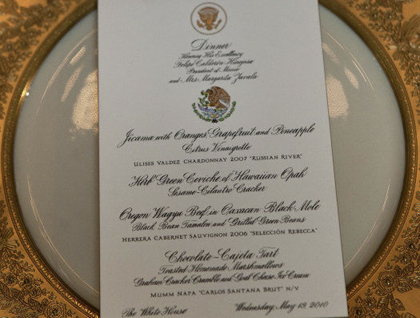
Cork and dagger: Should wines served in the White House be disclosed?

Remember the state dinner when the White House served green curry shrimp with a 15.6% alcohol grenache for the Indian premier? (and the typos!) Or a “Carlos Santana” brut sparkling wine with dessert for the Mexican president? Oh how we howled at those selections wondering if the White House wine steward was trying to derail diplomacy single-handedly.

Then, with the open-air state dinner for Angela Merkel, the White House stopped publishing the names of the wines served. Thanks to your contributions, we were able to determine two of the wines.

Was it the slings and arrows of the blogosphere that prompted the new policy? Probably not. It’s more likely that the White House doesn’t want to take the heat at this point in the economic recovery for pouring expensive wines: After the White House served a wine selling worth about $400 a bottle to President Hu of China, Stephen Colbert joked that it “should have been a sweatpants-potluck with box wine and a sleeve of Oreos.” Somehow, I doubt Colbert will ever be the White House usher.

The new policy of vinous non-disclosure prompted Bloomberg political reporter Margaret Talev to investigate. But she didn’t get a substantive response from either the usher or the First Lady’s office explaining the new policy.

This week, David Cameron will be in DC for a state dinner. Without knowing the menu, I think the White House should look to repay the courtesy of the Queen when the President visited London and underscore the “special relationship” between the two countries. After highlighting some up-and-coming producers, it would be appropriate to uncork some California cabernet with age, such as a top wine from the 1991 vintage, or reaching even further back to one of the gems from the 1970s. Subtle, elegant, distinguished and generous–it’s hard to argue with those qualities at the highest level of hospitality.

What do you think the White House should pour for Cameron? And do you think they should return to printing the wines on the menu or otherwise disclose the names of the actual wines poured?

More on Rudy K’s arrest on counterfeiting charges

The story of Rudy Kurniawan’s arrest on charges of selling counterfeit wine has been all over the news since the FBI arrested him on Thursday. Here’s some of the recent action:

* WineDiarist and Wine Spectator have published photos from federal prosecutors taken from the scene of the alleged crime; one of those, with stacks of Petrus 1950 and Lafleur 1947 labels among others, is reproduced above.

* The complaint states that Kurniawan had been living illegally in the US since 2003. He tallied $16 million in American Express bills between 2006 – 2011. He ran up $11 million of debt in 2007 alone. At the time of the arrest, he had a Lamborghini, a Mercedes-Benz and a Range Rover in the garage.

* Eric Asimov writes in the NYT about the arrest and recalls the go-go days, when Rudy Kurniawan apparently used his tasting ability to make him an arbiter on what on the table was fake and what was not. Asimov also tweeted a link to this 2008 Men’s Vogue piece by Jay McInerney on “billionaire winos.”

* Dirty South Wine wonders which California wines were found at the scene that were intended to be passed off as Bordeaux?

* Be sure to check out that fascinating comments on WineDiarist, where Bill Klapp calls the whole thing a “victimless crime,” Laurent Ponsot says he has been working with the FBI for years, and Paul Wasserman describes his former association with Rudy K. at the Wine Hotel, an LA wine retail and storage facility.

UPDATE: Robert Parker posted this on this site over the weekend: “It will be interesting to discover if RK was just an independent operator or part of an entire network….I can’t remember the exact date when two FBI agents spent much of a day with me discussing fraud in fine wine after I had written an article about it in my Bordeaux book, but I think it was the early or mid-90s…while they revealed little of what they knew, it was apparent this was an active case,and centered around the fabrication of fraudulent bottles…I wonder if the RK case is part of that same investigation of nearly 17-18 years ago….any ex-FBI people out there that know how long they will keep a case open?”

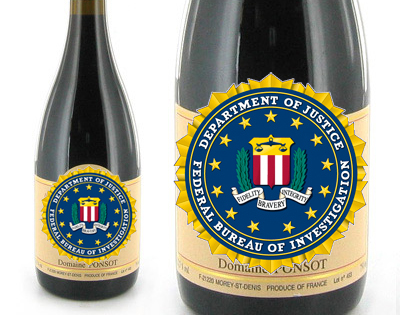
Arresting development: FBI charges Rudy K of counterfeiting fine wine

The FBI arrested the man known as Rudy Kurniawan at his home in Arcadia, California yesterday on charges of selling counterfeit wine. Inside the home, the authorities found materials used for making counterfeit wine bottles. They charged him with selling $1.3 million of fake wine but in 2006 alone, Kurniawan sold $33 million of wine at auction. They also charged him with “fraudulently obtaining millions of dollars in loans to finance what prosecutors called his ‘high-end lifestyle.” Check out all the details to this fascinating story in this piece at nytimes.com.

One thing that baffles me is how a fraudster could sell wines that, in fact, were never made. One example: the feds have charged Kurniawan with selling a bottle of 1929 Ponsot but Ponsot only started estate bottling in 1934. If one were to make and sell fake wine, don’t you think you’d take the time to make sure that the wines you were counterfeiting actually existed? And what of the auctioneers, did they not this or did they turn a blind eye to it? It will be interesting to learn more details as they emerge.

For those who think the FBI just roots around for terrorists, there’s apparently an elite unit that targets fraud in art and collectibles. I don’t know about you, but I can’t wait for the movie version of this story. Against a background of wealth porn, a brash young collector emerges on the scene; a go-go auction atmosphere; duplicity and gullibility; an angry billionaire seeking vengeance; and members of the elite FBI unit. We’ve discussed casting options for the first part of this saga before but hopefully someone in Hollywood will give this project a green light. I’m ready to head over to Starbucks right now with my Mac to play the part of screen writer right now!

The case is U.S. v. Kurniawan, 12-MAG-606, U.S. District Court, Southern District of New York.

Put “at rest” to rest in NY

What if you could not buy a book at a bookstore in New York if it had come from a New Jersey warehouse? Or fill your car up with gas in New York if the truck that brought it to the gas station came from New Jersey? We can agree that would be silly. About as silly as trying to prevent wine wholesalers who sell wine to NY wine stores and restaurants from going about their business if they have a warehouse in New Jersey.

But that is exactly what is happening. A large wholesaler is trying to prevent smaller wholesalers from using their existing warehouses in New Jersey by inserting an “at rest” provision in the state senate’s 2012 budget. This would require all wines to come from warehouses in New York. While I do care about the provenance of my wine, I do not care one whit if it comes from a (climate-controlled) warehouse in NY or NJ. Some specialty shops and small wholesalers are uniting to try to stop this before Friday, March 9. An email that has been making the rounds today follows after the jump: Read more…

Have breathalyzer, will travel

If you’re thinking of doing the rounds at en primeur in Bordeaux, or domaine hopping in Burgundy, forget the corkscrew: the one essential thing you’ll need if you’re behind the wheel is a breathalyzer.

New legislation goes into effect in July (though enforcement with a $23 fine for not having one won’t begin until November) that requires all cares, even rentals to have a new, disposable breathalyzer in the vehicle.

France has been cracking down on drunken driving. It became an issue briefly in the last presidential campaign yet road fatalities have remained high. And it’s election year again in France and President Sarkozy is a teetotaler, law and order type. France is now the first country in the world to have such a law on the books.

It’s not as restrictive as an “alcolock” that would require a clean breathalyzer test before being able to start the ignition. The aim is to boost awareness; the blood alcohol level is 0.05%. Being caught above 0.08% BAC (the limit in many states in the US) could result in a $6,000 fine and jail time.

Breathalyzer on Amazon

Ten refreshing wines for after a ride – Bicycling.com

I love cycling. I live in the rolling country of Westchester County, NY and one of the perks of the freelance life is having the flexibility to rack up the miles on two wheels.

I also love a good craft beer. As do the editors of Bicycling magazine who write often about many delicious brews to pop after a ride. While beer is refreshing, it’s not the only drink in town: head over to Bicycling.com for my list of “10 refreshing post-ride wines.” It was a fun assignment, blending two of my passions. Given that we’ve had a mild winter here, the list focuses on lower-alcohol and higher acidity wines. I only included one full-bodied wine but it is still refreshing in its category.

Do you cycle? Do you ever pull a cork after a ride? Or after a ride and a recovery drink?

Parker perfection: 100 points for 19 Bordeaux 2009s

Robert Parker’s The Wine Advocate has started arriving in mailboxes and issue #199 aas published on their site late yesterday. The top scores are mind-numbing. If you thought his love of Chateauneuf du Pape’s 2007 vintage was the high-water mark for his scores, think again: Parker hands out 100-point scores to 18 red wines, with several others (including first growths, Mouton, Lafite and Margaux) getting a mere 99 points.
Underwhelmed by the list, commenters on wineberserkers reacted, saying “Smith Haut Laffite. Wow.” and “It’s only March 1st – not April 1st. Is this serious?!?” and “When will Mouton Cadet [$8] join the list?” and “Who cares about any of the 99-point crap?” Tim Atkin tweeted, “Where does RP go from there? Explode in a puff of ludicrous hyperbole? 2010 is a better vintage.”

It will be interesting to see if these push prices any higher (as will likely be the case for Fourtet and Smith Haut Lafitte, which were originally forecast to have scores of 98 maximum) or lower in the case of Lafite-Rothschild, which had been coveted by Asian auction bidders before slowing but is not on the list of those receiving perfect scores. Or if it will elicit as much of a yawn from buyers has it does from the online commentariat–after all, 20 wines had received scores as possible 100 pointers based on barrel tastings. In January, I suggested that rampant score inflation posed the biggest threat to the use of scores and eighteen 100s do not reverse my view. What’s your take?

Parker confronted the issue of “hype” and inflation head on, saying: Read more…


winepoliticsamz

Wine Maps


Monthly Archives

Categories


Blog posts via email

@drvino on Instagram

@drvino on Twitter


winesearcher

quotes

One of the “fresh voices taking wine journalism in new and important directions.” -World of Fine Wine

“His reporting over the past six months has had seismic consequences, which is a hell of an accomplishment for a blog.” -Forbes.com

"News of such activities, reported last month on a wine blog called Dr. Vino, have captivated wine enthusiasts and triggered a fierce online debate…" The Wall Street Journal

"...well-written, well-researched, calm and, dare we use the word, sober." -Dorothy Gaiter & John Brecher, WSJ

jbf07James Beard Foundation awards

Saveur, best drinks blog, finalist 2012.

Winner, Best Wine Blog

One of the "seven best wine blogs." Food & Wine,

One of the three best wine blogs, Fast Company

See more media...

ayow150buy

Wine books on Amazon: