Energy in the wines at the Return to Terroir

Nicolas Joly’s talk wasn’t the only thing packed on Monday; the tasting itself at Return to Terroir, NYC edition, was really crowded in the latter half.

I didn’t get a chance to taste all the wines (I hear I really missed out by not hitting the German area), but I did taste some really good ones. Biodynamics comes in for some flack, perhaps rightfully as some of the statements are unfalsifiable, but two things are hard to dispute: the growers are very attentive to their vineyards and it’s often hard to argue with is the quality of many of the wines in the glass.

Since walk-around tastings offer only glimpses of a wine, not the progression over an evening, I offer you some literal snapshots here.


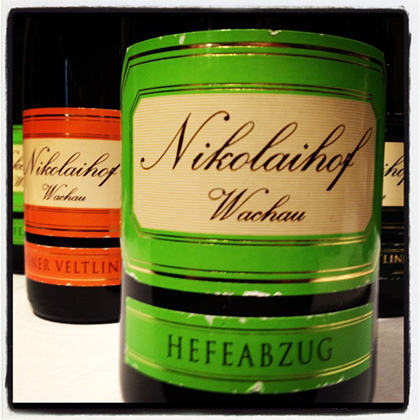
Nikolaihof: Terrific energy and acidity in these Gruners–even the 2010 Hefeabzug, which was from a more challenging vintage, has great snap.

Read more…

Nicolas Joly on appellations, life forces and electromagnetic fields

“The concept of taste linked to a certain place has been totally destroyed by technology,” Nicolas Joly told a standing-room-only audience yesterday. Joly, author of two books on Biodynamic winegrape cultivation, owns the Coulée de Serrant in the Loire where he is “nature’s assistant” (according to his business card.)

Back in New York for another edition of Return to Terroir, a roving show of Biodynamic wine producers, Joly leveled criticism at the appellation system (as he did three years ago at the event). He decried the system that has a tasting by committee, which tolerates wines with “technological” intervention, such as herbicides, pesticides and commercial yeasts and enzymes, which can boost over 350 aromas in wine when they are young. “The concept of appellation has lost its meaning,” he said.

He also fired a salvo at the wine media for not drawing any attention to these issues. “I regret that there is not one wine guide in the world that does not tell which wines have been made with commercial yeast,” he said. (It’s worth noting that, in fact, blogs and a growing number of wine books have discussed the subject.)

Next in his sights were herbicide producers and sales people whose products, he said, cause the plants to get sick but do not let the disease actually run its course, since they have another product to sell you for that ailment. He also pointed the finger at them for trying to demonize copper, allowed in Biodynamics to treat some vine maladies, saying copper at a low level (“one or two kilograms per hectare”) is safe. “Yes, in excess, it’s bad, just as too much oxygen in the air would be!”

As he talked about life energies, he got more positive. “Earth doesn’t produce growth; earth receives growth” from the sun and the moon, he said. He elaborated, saying that if he covered the earth in black plastic, there would be no life. “Earth receives life.” And it costs nothing: “Life comes free, if you catch the forces.”

He decried “technological” wines that are made in the winery saying that 98% of wine comes from photosynthesis. “If the work in the vineyard is well done, you have nothing to do in the cellar.”

He suggested that when deciding if a wine is good, there are several moving parts, akin to a music: playing a stratavarius in the subway would not be an ideal performance. So consider the musician, the instrument, and the acoustics, he advised. Biodynamics can turn a vineyard into a beautiful instrument, but not always if the soil and varieties are not matched right, he said.

In closing, Joly expressed concern about the prevalence of electromagnetic fields, particularly cell phones. “We are enormously changing the forces of life with satellites! Gigahertz are everywhere!” He fears they disturb cosmic energy and could reverse the earth’s polarity. “That is climate change.” He added that stainless steel vats capture and conduct too much of “electromagnetic pollution” and thus he does not use them.

He then dismissed us saying that we haddn’t come to listen to him and that we should all go taste some wine.
Home brewing, yes. But where’s the home winemaking?

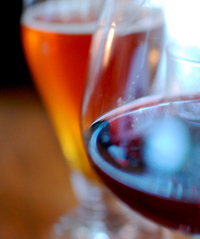
One of the most exciting drink stories in America is the craft beer revolution and its related rise in home brewing. An article on Slate details that policy held back the hops: banned after Prohibition, it wasn’t until President Carter signed legislation in 1979 that allowed households to brew up to 200 gallons a year. Unregulated by laws such as Germany’s famous beer purity law of 1516, American home brewers experimented (as had the Belgians who were similarly unfettered by regulations) and today we have arrived at the point where the US is seen as the most innovative craft beer market in the world. Indeed, Belgian breweries are even buying American hops.

In the piece, the author says there are 27,000 home brewers who pay $38 a year to be members of the American Home Brewers’ Association. Home brewing is wildly popular, even among wine geeks. Josiah Baldivino, sommelier at Michael Mina is so confident in his brewing skillz that he whipped up an IPA to serve at his wedding. Jim Clarke, somm at Giorgio Armani restaurant had a couple of brews going when I spoke with him recently. The Slate author suggests the motivations of home brewers include “self-reliance, community-building, autonomy, independence from monopolies, an alternative to rampant consumerism, innate curiosity, and the desire to make something cool.”

So here’s my question: given how popular home brewing is, why is home winemaking not more popular, particularly with younger wine hipsters? Wine is certainly popular and would be cool to make. And we wine geeks like both community and autonomy (an odd mix) and are just as self-reliant as home brewers. Home winemaking is popular as judged by the fact that three of the regular, top-selling wine titles on Amazon have to do with home winemaking. Even though some outfits such as Crushpad and City Winery have altered the demographic somewhat, it appears me, anecdotally and generally speaking, that the demographic is older and people who are more into drinking rather than sipping. Even though I have made neither at home, it seems that it would be much harder to make good wine than it would be to make good beer because it is hard to get good grapes, especially if you live some distance from a vineyard. And most home-made wines that I’ve tasted have gotten 99 points for effort and decidedly fewer for what’s in the glass. Whereas, I’ve had some quite good homebrews.

In your experience, who makes wine at home? Will urban hipsters be making wine any day soon?

Huet, Corks, White Castle, Skinnygirl, Quarts-de-Chaume — sipped & spit

BREAKING: After thirty vintages, Noel Pinguet has decided to leave Domaine Huet, the world-class producer in Vouvray. La Revue du Vin de France cites differences with the owners about the role of dry white wine in the production. [larvf.fr]

SPIT: corks
Paul Pontellier of Chateau Margaux has been so frustrated with bottles under cork that have gone bad that the esteemed estate is seeking another closure has begun tests with screwcaps. Maybe he should follow Henschke and say bonjour to Vino-Lok? Also: Ch. Margaux is “very close” to being organic. [Decanter.com]

SIPPED: mmm, brand extensions
A “real” housewife of New York, who was probably thin to start with, is launching a low-alcohol wine called “Skinnygirl.” It builds on the success of her low-calorie ready-to-drink margarita. [Drinks Business] Related, Drew Barrymore is launching a new wine called, Barrymore. And, yes, it includes a pinot grigio! [HauteLiving.com]

Don’t cryo-selection for me, Qaurts-de-Chaume
A new grand cru designation has been approved in the Loire for sweet wines. Yet conflict has shaken the nobly rotten zone as one producer has sued to stop the process at the eleventh hour over “cryo-selection.” [NYTimes.com]

SIPPED: An insight into why White Castle is testing wine: “The burgers cost $2.49, the wine $18.” [WSJ.com]

SIPPED: R&R
Was on break much of the week with family…Back in full next week!

What’s a go-to supermarket wine? [Reader mail]

Heading to visit a non-wine friend who graciously offered to pick something up for us. I don’t know the market in Florida and she didn’t indicate that she wanted to go to a specialty shop (that’s fine–not everyone can take our habit as seriously as we do). So what’s the best I could ask her to pick up at a supermarket?

It is generous of your friend to give you such a warm, Florida welcome. But it is really hard to know what’s at the store she is going to as the selection could range from dire to quite acceptable. Maybe try a throwing out a Champagne name since there are some good ones that may be available and, at least, it will add to the celebratory air. Or a domestic sparkler, such as Roederer Estate? Of course, it depends what you like or are in the mood for, too.
Perhaps the best idea is carefully put a nice bottle in your checked luggage. It will get a tossed around in transit, obviously, so make it still and make it young. Also, when visiting a different state, I always like to check out wine shops to see what their selection and pricing is like. Sometimes I find wines that I don’t see a lot at home. And when you’re on the ground, you might have a better idea of what your dinner plans are or what the weather is going to be to make a great selection. So put a shop on your first day’s itinerary, if you can.

Veau chaud – veal hot dog – impossible food-wine pairing?!?

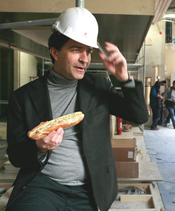
Chef Yannick Alléno, recipient of three Michelin stars, adores New York hot dogs. According to a piece in the NYT Dining section, he loves the hot dog so much that he wanted to make a French version, out of calf heads. Instead of calling it literally a “chien chaud,” he opted for truth in labeling, going with “veau chaud” (hot calf). Site reader Caleb Ganzer writes in to see if we might try to pair it up. And to that we reply “fo sho with the veau chaud”

So here’s a bit more on the dish that can be eaten without a plate. The nine-inch sausage is made from “edible bits of a cooked calf head, or tête de veau” (brains and eyes excluded). Served on a mulitgrain (!) baguette, the dog, or calf, is topped with gribiche sauce, which is a vinaigrette with capers, cornichons, and hard boiled egg, herbs and mustard.

“I have adapted the ‘dog’ to the true ambience of Paris,” Alléno told the Times. “There is nothing more Parisian than tête de veau.”

And there’s nothing more French than wine! So which wine would you pair with it? Or is it…impossible?!?

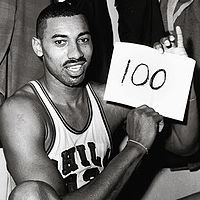
Who invented wine’s 100-point scale?

We quite often talk about the 100-point scale and its impact on wine, but is it correct to say that Robert Parker “invented” it? He certainly popularized the approach and it has come to be large part of his legacy as other magazines shifted to the numerical system.

In “The Emperor of Wine,” Elin McCoy writes that Parker and his friend Victor Morgenroth tried various systems of rating and evaluating wines in their (blind) tasting group in the mid-seventies. They tried letter grades from A to F as well as the UC Davis 20-point scale, which had already brought numerical ratings to wine with the gravitas of an institution. McCoy continues that “one of the men–Parker isn’t sure who–came up with the 100-point idea, which was really a 50-to-100 point scale…” (For international readers, the scale follows the system that we have in American schooling for most tests.) McCoy says that Parker and Morgenroth thought that the system was “much less likely to result in the inflated wine ratings they saw all around them.” Ironically, score inflation is the most likely threat to the 100-point system today.

Back on a thread in 2009, a commenter flagged Dan Murphy, an Australian, as pioneering a 100 point system. The retailer that bears his name today describes Murphy’s 100-point system as predating Parker’s use. Another commenter on the thread, Claude Kolm, relayed that in Maynard Amerine and Maynard Joslyn’s Table Wines (1970 edition) they discuss various scoring systems including a 50-point, 100-point and even a 200-point system.

Just for laffs, here are a few tasting notes and scores from one of first issues of the Wine Advocate: “a terrible wine…very thin and acidic with a dull, dumb bouquet and taste. A poorly made wine that should be avoided” (55 points). And another one: “atrocious wine devoid of any redeeming social value” (50 points). Care to guess which they were?

The Internet has “shrouded [wine] in ignorance”

“The Internet has changed the way we think about wine. Once shrouded in mystery, it’s now shrouded in ignorance.”

That’s in the latest post from Hosemaster of Wine. Needless to say, I think it has been a huge net (pun intended) positive, since increasingly knowledgable consumers posting online is one of the most exciting things about the wine world today. BS be gone! But click through for context; it’s funny.


winepoliticsamz

Wine Maps


Monthly Archives

Categories


Blog posts via email

@drvino on Instagram

@drvino on Twitter


winesearcher

quotes

One of the “fresh voices taking wine journalism in new and important directions.” -World of Fine Wine

“His reporting over the past six months has had seismic consequences, which is a hell of an accomplishment for a blog.” -Forbes.com

"News of such activities, reported last month on a wine blog called Dr. Vino, have captivated wine enthusiasts and triggered a fierce online debate…" The Wall Street Journal

"...well-written, well-researched, calm and, dare we use the word, sober." -Dorothy Gaiter & John Brecher, WSJ

jbf07James Beard Foundation awards

Saveur, best drinks blog, finalist 2012.

Winner, Best Wine Blog

One of the "seven best wine blogs." Food & Wine,

One of the three best wine blogs, Fast Company

See more media...

ayow150buy

Wine books on Amazon: