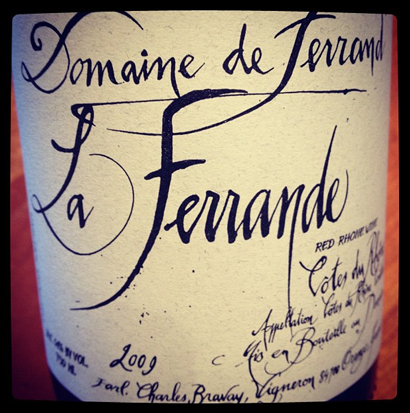
Domaine de Ferrand, La Ferrande, 2009

domaine ferrand ferrande

To poll at 90 percent is unheard of in a democracy. So it’s a good thing this wine isn’t running for office since all but three out of 30 or so in my NYU class liked it when I poured it this week.

We had a quick tour de France I was looking for an example of a Rhone that would fit within our budget. I opted for this 2009 Cotes du Rhone from Domaine de Ferrand, a small producer in Chateauneuf-du-Pape. “La Ferrande” is a tiny anomaly from the area known for blending since it is 100% syrah. The wine has some definite ripeness to it–indeed, a tad much for me–but the class participants welcomed the layered flavors of fruit, a hint of bitter notes such as coffee and warming alcohol at 14%. And with only 50 cases imported to the US, according to Chambers Street Wines, where I bought it, the class was surprised to learn that it was only $18 a bottle on a case purchase. If the scene were a cartoon, you would have heard tires squealing as they peeled off to score a bottle for themselves.

Millennial foodies, check. But no love for the millennial wine geeks?

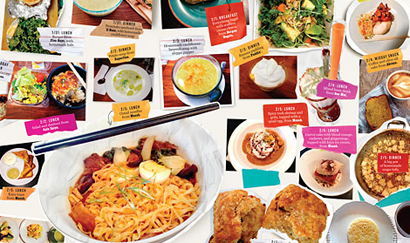
“When Did Young People Start Spending 25% of Their Paychecks on Pickled Lamb’s Tongues?” Such is the headline of a New York magazine article about young foodies. Or, rather, one young foodie, the 27-year-old Dine Chang. While the story tried to make larger points about the millennial generation’s love of food, casting the story in the light of this one character bogged it down with her quirks (detailed here).

Still, a few items stand out: her oversized spending on food, her curiosity to try various types of food, her iPhone fixation, her proud ignorance if not disdain for most critics, her reliance on the internet and word of mouth for information about where to go, and the shift of culinary excitement away from an older, moneyed crowd to a younger, hipper set. That last point is worth underscoring, as the author writes, “An abiding interest in food was something for old people or snobs, like golf or opera.”

It’s too bad the story didn’t at least mention what Chang drinks along with her dining; if she got into wine, she could easily double the portion of paycheck devoted to dining. There are lots of parallels with young people getting into wine these days. In my classes at NYU, there are mostly twenty and thirty somethings who feel that wine is an integral part of coming of age. Moreover, it’s cool and knowing about it boosts social capital. If millennials are driving wine consumption as survey data show, then I can’t wait for the NY mag article profiling a budding wino, posting pics of Jura labels to Instagram.

Wine circa 1933, LOLz, Cheval Blanc ’47, lite beer — sipped & spit

SIPPED: circa 1933
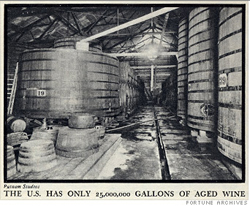
Fortune.com republished a lengthy archive article from 1934 over the weekend. There’s lots to savor: the author suggests American wine can handily undercut French wine on price, urges an Eastward expansion of vineyards in the US, and notes that Champagne wasn’t considered wine by government policy.

SIPPED: LOLz
“Jay McInerney writes for the 1%–that is, the 1% who are happy he replaced John and Dottie.” A snippet from a hilarious roundup by the Hosemaster. See also: Dr. Conti, Prison M.D.

SIPPED: Cheval Blanc ’47
Well, not by me, sadly! But Sotheby’s is offering the wine (in 750 and magnum!) among others offered directly from the Chateau cellars. How big will the authenticity premium be on the bottles?

SPIT: lite beer
A Bloomberg article suggests the increased interest in wine is, in part, spurring America’s thirst for craft beer. And in Canada, wine’s popularity is growing much faster than the flat suds. Over the past decade, beer sales have slipped while red wine has grown 181%. Maybe one day wine will outsell beer. Now that would be something, eh?

SIPPED: more laffs
A propos of nothing wine, put this NYer humor piece (“Vive la France“) in your queue. Here’s a taste: “In France we do not even have a word for fat. If a woman is obese, we simply call her American.”

The experts strike back?

There’s something of a cottage industry that has emerged in trashing the reputation of wine experts. Richard Quandt of Princeton wrote an hilarious essay entitled “On Wine Bullshit.” Bob Hodgson had his two devastating papers about wine competitions. The Wine Trials books suggest high-volume, low-priced wines are all that you’ll ever need. The WSJ got in on the action too a while back.

So at some point, someone had to ride to the rescue of the experts, right? Well, now we have it: a new study suggests that “wine experts” can discern more flavors than regular Joes. Yay, experts, right? Well, not really, the authors say:

“What we found is that the fundamental taste ability of an expert is different,” said John Hayes, assistant professor, food science, and director of Penn State’s sensory evaluation center. “And, if an expert’s ability to taste is different from the rest of us, should we be listening to their recommendations?”

Oh noes! We’re back to the wine-experts-as-useless line! Granted, there’s a lot of pretension and bluster worth bashing but let’s not throw the Burgundy out with the bathwater.

Looking at the details of the study published in the American Journal of Enology and Viticulture, the authors had volunteers identify themselves as wine experts or not. Fully a third of them were classified as “experts,” which seems not quite a representative sample of America (or perhaps Canada, where the data collection occurred.) Moreover, these self-selected experts showed a higher rate of detected the bitter compound, PROP, thus possibly making them “super-tasters.” As Mike Steinberger pointed out in his lengthy (self-)exploration of the physiology of taste, having a sensitivity to PROP does not make one a supertaster and being a supertaster does not make more of a wine expert. (As we’ve seen, blind tasting can have more bitter outcomes than PROP.)

So, yes, there may be biological differences in tasting ability. But in this nature-versus-nurture discussion, I vote for nurture as being more influential: it’s the catalogue of knowledge and tasting references, the experiences with wines in the glass, that make most of the great tasters I know really good. Also, many wine experts are self-styled and have varying capabilities, so I am skeptical there’s a genetic explanation for superior wine tasting ability. And what about the disconnect Hayes suggests between the masses not picking up on tasting note descriptors? Well, for some notes, there may be more than a whiff of what Quandt was talking about.

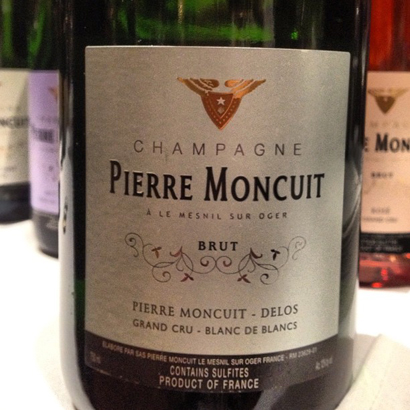
Moncuit, Roagna, Cascina della Rose, Arnot-Roberts – Polaner highlights

It’s the time of year when distributors and/or importers have annual (or semi-annual) portfolio tastings. These are opportunities for breadth, not depth, as hundreds of current release wines (and occasionally some older ones) are put out on tables, often with the winemaker pouring. Yesterday was the Polaner Selections tasting and I dropped by for a while in the second half. Below are a few impressions and photos.

moncuit champagne Read more…

Wholesalers beat a retreat on CARE act

After appearing in two sessions of congress, a legislative proposal that would have threatened the legal, direct shipment of wine is dead according to Shanken News Daily. They cite Tom Cole, president of Republic National Distributing Co., who says “The CARE Act is officially off the table.”

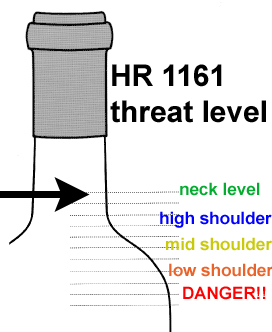
Wine lovers can breathe a sigh of relief. And we are dialing the official HR 1161 threat level back to neck level! (See backgrounder here and here). We were concerned that in the “lame duck” session when oh-so-much wheeling and dealing is likely to be done, that it could have squeaked through in some form. It still might, but the wholesaler will appears to have slackened.

I wonder what led the wholesalers to pull in their legislative claws? The brief Shanken News piece had no insights in this regard. But in this Super PAC era, it would be delightful to think that possible voter outrage trumped campaign contributions. It is interesting to note that wholesalers recently did an about-face on a restrictive reform in New York State. Hit the comments with your take on the situation.

The etiquette of pouring a counterfeit wine

Mike Steinberger, friend of the blog, started a series of posts on his blog wherein he plays Wine Ethicist, answering (or posing) questions on etiquette in the wine world. Since Mike has fallen off the face of the internet (actually, I think he’s traveling) and has let his blog idle this week, we’re happy to pick up the slack on etiquette with a timely topic: the serving of counterfeit wine.

The arrest of Rudy Kurniawan was all the buzz everywhere I went this week (well, except my local grocery store, where nobody cared). As the talk led to counterfeiting, many in the wine world shared stories with me of dodgy or legendary bottles they’d had, the suspicious people they’d met, or why, like those at my grocery store, they couldn’t give a rip. I largely agree with that last point: while the tale of bling, duplicity and gullibility has undeniably enticing details and wine is deliciously multifacted, I spend my professional life tasting wine and writing about principally because I like to drink it with dinner. I’m not interested in chasing down magnums of ’47 Lafleur; I’ll stick with Lapierre Morgon because it’s not only more affordable but there’s there no chance of it being fake.

One sommelier told me this week that he opened a bottle that a collector had brought in. Although it had a celebrated 1947 Bordeaux was written on the label, when he pulled the cork, it read 1966 Rioja. So, here’s the etiquette question/ethical quandary: should the somm have alerted the diner to the fake right away or let the him and his companions enjoy the wine as if it were what was on the label?

Hit the comments with your thoughts. And I’ll share what the somm did after you’ve had a chance to weigh in.

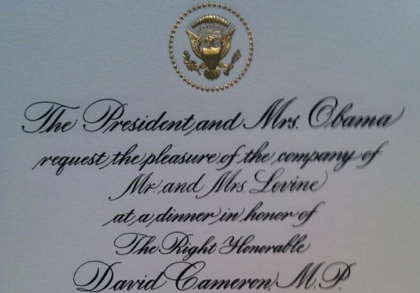
Deep throat reveals Cameron state dinner wines


Even though the White House is no longer printing the names of the wines on the menu nor releasing them after the fact, it turns out that we had our own “deep throat” at the event: none other than the wine person of the last decade, founder of Cellertracker, Eric Levine.

Sure enough, Eric posted the wines served, complete with tasting notes. For the full menu (pdf), click here. And, on a related note, what Michelle Obama has done with the organic garden at the White House is terrific.

Appetizers: crostini
Eric says there were a range of options at the bar and he opted for the Thibaut-Janisson Brut NV (limited availability; about $29). USA, Virginia, Central Region, Monticello. This seems to be a staple at the White House since it was on the menu (back when the wines were on the menu) for Prime Minister Singh.

Halibut course and salad course
2009 Peter Michael Chardonnay Ma Belle-Fille (about $80) USA, California, Sonoma County, Knights Valley
Eric describes the wine as “Prototypical Cali Chard.” Peter Michael also has appeared before at state dinners. In fact, the Bush White House served the Peter Michael “Les Pavots” 2003 (about $275) to none other than Queen Elizabeth when she visited in 2007.

Second course: bison Wellington
2008 Leonetti Cellar Cabernet Sauvignon Walla Walla Valley (about $65) USA, Washington, Columbia Valley, Walla Walla Valley
Eric has a lot of experience with the producer but laments how young it is, saying while it worked with the food, the wine is “not so civilized yet at this stage.”

Dessert: steamed lemon pudding atop a bed of apples
2007 Iron Horse Vineyards Russian Cuvée (about $30) USA, California, Sonoma County, Green Valley
The White House usher has frequently poured sparkling wines with dessert; as I’ve said before, I’m not a fan of the idea as I think the dessert’s sweetness is likely to leave the wine tasting too tart, even in this case. Just let dessert be the dessert. Eric says “a nice idea but a tough pairing to really appreciate.” Iron Horse has also been poured numerous times at the White House; this wine, which has a higher dosage (the amount of residual sugar is unspecified), was developed for the Reagan-Gorbachev summits.

I’m still puzzled by the White House not listing the wines on the menu. If there was too much negative reaction to the wines served at the Hu dinner, which seems to have prompted this bizarre cork and dagger policy of not listing the wines, why not list these wines since none was over $100?

And why not be more original and creative? It’s not about simply spending more (as Bush did on the $600 Shafer Hillside select), it’s about being creative, even if you have a (artificially) tight budget. There’s a lot of excitement in American wine. Find it. Serve it. Otherwise, to paraphrase George W. Bush, it’s as if the White House usher is saying “Message: I don’t care.”
winepoliticsamz

Wine Maps


Monthly Archives

Categories


Blog posts via email

@drvino on Instagram

@drvino on Twitter


winesearcher

quotes

One of the “fresh voices taking wine journalism in new and important directions.” -World of Fine Wine

“His reporting over the past six months has had seismic consequences, which is a hell of an accomplishment for a blog.” -Forbes.com

"News of such activities, reported last month on a wine blog called Dr. Vino, have captivated wine enthusiasts and triggered a fierce online debate…" The Wall Street Journal

"...well-written, well-researched, calm and, dare we use the word, sober." -Dorothy Gaiter & John Brecher, WSJ

jbf07James Beard Foundation awards

Saveur, best drinks blog, finalist 2012.

Winner, Best Wine Blog

One of the "seven best wine blogs." Food & Wine,

One of the three best wine blogs, Fast Company

See more media...

ayow150buy

Wine books on Amazon: