New Hampshire State Liquor Stores – a sample of one

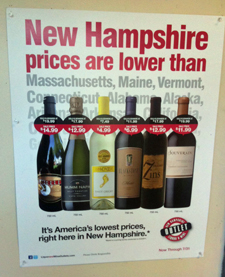
Coming back from a terrific weekend in Maine, where blueberries are fresh and the lobsters still pair as well with white burgundy as ever, I steered the Dr Vino mobile into the last exit for the New Hampshire State Liquor Store off of I-95. (Incidentally, the state store is also paired at the rest area with a “Made in New Hampshire store,” as opposed to the “Christmas Tree Shops” along the way that might as well be called the “made in China store.”)

My curiosity was piqued: was this state store a wine lover’s nirvana, delivering on the promise of great prices thanks to their bulk buying? Or was it a dreary place, with low inventory, poor selection, surly or ignorant staff? Read more…

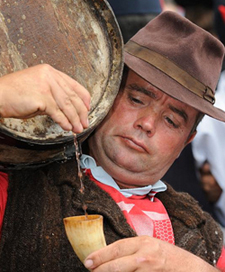
Caption this: horn & cask edition


There are some fun pics from last year’s harvest festival on Madeira over on Flickr. Madeira is a fortified wine built to withstand the abuse of sea voyages, so this cask-over-the-shoulder approach is probably child’s play for the beverage.

For your, amusement caption the one to the right. While we would probably all approve of his generous pours, Max Riedel probably wouldn’t approve of the stemware…

Pin-up winemakers, smashed shiraz, a map, WBC – sipped and spit


BOOSTED: …awareness!
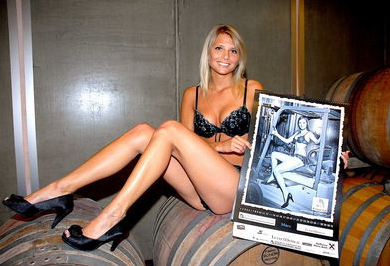
Young Austrian winemakers have posed scantily clad for a calendar to boost…awareness! Of Austrian wine. Which one is Miss Gru Vee again? Appearing later this year: a calendar of old hag winemakers from the mountains. [Decanter]

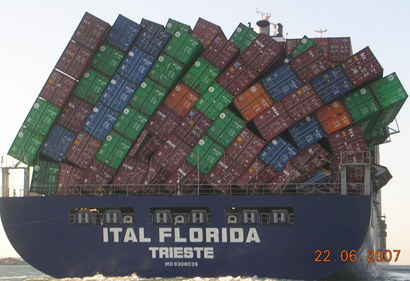
CRASHED: shipping container
A forklift lifted 462 cases of wine 20 feet in the air! No, this isn’t the Guinness World Record for machinery; instead, the load fell to the ground destroying the Australian shiraz therein. Although the vintner, Sparky Marquis, is crying over spilled wine, he was also insured. [NYT]

SPIT: infomercials
RJonwine has a detailed account of this past weekend’s conference of wine bloggers in Charlottesville, VA. He decried the preponderance of “paid-sponsor presentations” on the program. Another blogger who is disenchanted with blogging finds the whole event salvaged by hanging out in the wee hours with fellow wine enthusiasts.

MULLED: deposits
Massachusetts may expand its bottle deposit program to include more beverages. If they were really serious about encouraging recycling, they’d raise the rate too.

SIPPED: me on the teevee
Well, sort of. Thirteen.org has a new magazine called MetroFocus, which has an article on NY wines. Spot the Dr, Vino quotage, more or less accurate!

SIPPED: informative infographics
A very cool map of world trade in wine from Rabobank. Just wish it were higher res!

What’s greater: “cooked,” “corked” or counterfeit wines? Some evidence


Heat damage might be the biggest silent killer in the wine industry–more even than corked wine, which has much greater renown.

In our recent discussion on “cooked” wine, Louise from eProvenance joined the discussion. Founded by Eric Vogt, a wine collector formerly of Boston Consulting Group, eProvenance can provide a detailed history of wine’s temperature during transit via an RFID tag inserted into either a case or tacked on to a pallet of wine.

Tracking 1,450 shipments in and between the Northern and Southern hemispheres, they assembled a fascinating report: eProvenance found that almost 10 percent of shipments were exposed to temperatures of 30 degrees celsius (86 degrees Fahrenheit) or more for 18 hours or more, a threshold ETS Labs found as significant a perceptible damage in wine. The report generously does not declare all that wine to be “cooked,” instead saying it is merely “at risk”; they suggest 2.8 percent of shipments as having perceptible damage.

Interestingly, some of the highest heat exposure comes not from the journey in the refrigerated container but rather the first and last miles of the journey, as the wine gets to and from the loading bays of wineries and shops. They estimate the monetary value of “at risk” wine to be about $9 billion and the heat-damaged wines to be worth about $2.5 billion.

While eProvenance clearly has an innovative technology to sell and thus may overstate the size of the problem, I am willing to go out on a limb and say that the quantity of heat-damaged wines represents a greater problem for wineries and consumers than counterfeiting. While the Jefferson bottles and their ilk may pose problems for the pinnacle of the wine world, heat-damage may be much farther reaching, especially as cheaper, high-volume wines are less likely to benefit from temperature control.

Heat damage, with its diminution of wine’s aromas and freshness that leads to bad consumer experiences, could well be on par with or a greater problem than TCA, or “corked” wines. If I were a vintner, I would strongly consider adding temperature tracking to every delivery and take corrective measures if problems arose in the supply chain. As a consumer, I’d welcome heat shipping data or a third-party certification on each bottle. But then again, I like data–almost as much as I like sipping a glass of wine that isn’t flawed. Read more…
How much wine outside the winery is cooked? #heatwave

These muggy days in the high 90s have New Yorkers sweltering. So it’s as good a day as any to wonder out loud how much of the wine we drink is at least partially heat-damaged, or, in wine geek vernacular, “cooked.”

It’s also been an extremely hot summer in much of Europe. Antonio Galloni considered the implications of this when at a domaine in Burgundy recently, as he saw an unrefrigerated truck hauling away wine bound for America via Dijon, a four-hour drive. Even if it joins a refrigerated container for trans-Atlantic travel, Galloni wrote on eBob, saying, “It doesn’t take a genius to figure out that 4 hours in a truck at 100 degree temps means those wines will probably be cooked before they ever have a chance to oxidize, prematurely or not.”

Fortunately, most conscientious importers do ship in refrigerated containers today. But some warehouses in the US and/or delivery trucks Read more…

The pork belly contract is dead. Now pair it with wine.

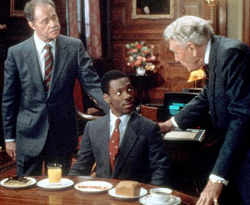
As of today, the venerable contract for pork bellies is no longer trading on the Chicago Mercantile Exchange. So important was the contract at one point, the CME was once known as the “House that Bellies Built.” But it was Eddie Murphy who cemented the contract in popular culture using it in his explanation of market dynamics (see below). Even though bacon has off-the-charts popularity today, interest in the contract had dwindled to two a day–both from the same trader.
So let us honor the now-defunct contract as only Bacchus would–pairing it with wine! Let me use my blogger’s privilege to launch the thread by suggesting…a great off-dry Riesling. The sweetness and acidity are a magical pairing (assuming you’re not a vegetarian) with the saltiness and fattiness of the pork. Which wine say you?

More Eddie Murphy after the jump! Read more…

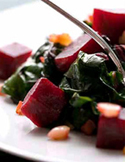
Beet salad: impossible food-wine pairing?!?

Beets are contentious. Not because one variety can be made into sugar cubes or ethanol. But because some people don’t like them!

I was at lunch with a friend who has fine taste when a beet salad appeared. And a zinfandel. He didn’t touch the beets. I asked him if it was the unflattering pairing with the wine. He said no, he just not a fan.

But some people are. And summer is a great time for a beet salad as a part of a buffet or a picnic (don’t spill them on the blanket, however). They are good for you, packed with folate, featuring in the number one slot on a list of “The 11 Best Foods You Aren’t Eating.” So if “eat your beets” is the new “eat your peas,” then we should at least know which wine to pair with them! Complicating factors in the beet salad for the wine pairing are the sugars in the beets as well as a vinegar dressing. After many trashyimpossiblepairings, here’s a healthy one to help us all look awesome in our swimsuits.

Which wine would you pair with a beet salad–or is it impossible?!?

Congressional Wine Caucus sips under the radar

The New York Times ran a front-page story on Congressman Mike Thompson recently. Thompson’s district includes Napa and he is also a grape grower; the article made this seem like a conflict of interest. I’d dissect the story and its shortcomings but Mike Steinberger has already done that on his blog, thus saving me the trouble.

The article did remind me of the Congressional Wine Caucus, an informal, bipartisan group of over 200 members of Congress–“the anti-Tea Party” as @sippingsister put it–that Thompson heads. Although most caucuses rarely meet, I placed a call to Thompson’s office (as well as the Wine Institute) requesting the names of the members of the Caucus. My thinking was that these members would presumably be stalwarts in supporting wine consumers and opposing the nefarious HR 1161 if that well-financed bill should ever see the light of day in the chamber. Sadly both responded to say that the list of members is not available to the public. That’s too bad since wine is becoming more popular in congressional districts every year across America as we are now the thirstiest wine country in the world. Also, wine in America is frustratingly intertwined with political machinations. Since it’s not hard to find out who is on, say, the Congressional Bike Caucus or the Congressional Black Caucus, you’d think wine would be no different.

If the membership list ever does surface, I hope there’s no overlap between Caucus members and the 94 cosponsors of HR 1161. That would have more than a whiff of inconsistency.


winepoliticsamz

Wine Maps


Monthly Archives

Categories


Blog posts via email

@drvino on Instagram

@drvino on Twitter


winesearcher

quotes

One of the “fresh voices taking wine journalism in new and important directions.” -World of Fine Wine

“His reporting over the past six months has had seismic consequences, which is a hell of an accomplishment for a blog.” -Forbes.com

"News of such activities, reported last month on a wine blog called Dr. Vino, have captivated wine enthusiasts and triggered a fierce online debate…" The Wall Street Journal

"...well-written, well-researched, calm and, dare we use the word, sober." -Dorothy Gaiter & John Brecher, WSJ

jbf07James Beard Foundation awards

Saveur, best drinks blog, finalist 2012.

Winner, Best Wine Blog

One of the "seven best wine blogs." Food & Wine,

One of the three best wine blogs, Fast Company

See more media...

ayow150buy

Wine books on Amazon: