Wine Politics video from the New School

If you have 51 minutes that you just don’t know what to do with, you can now check out a video of a talk I gave at the New School recently. Andy Smith, editor of the Oxford Companion to American Food & Drink among many other book projects, had assigned my book to his class, “Drinking History.” It ended up becoming a public talk at the university, filling the room, and even being taped! So here it is, including a discussion of contemporary topics such as the primary source bill in New York. While I certainly don’t challenge Martin Luther King’s legacy of oratory, perhaps there’s a nugget or two of interest in there.

What are friends for? Pimping pinot, apparently

Lettie Teague posted on her blog at WSJ.com that her Fourth included an “explosively good pinot noir.”

One thing she neglected to mention is that her friend and travel partner Scott Manlin is a co-owner of the winery. Teague has featured Manlin in both her Food & Wine columns over the years and recently had a gratuitous mention of him in a WSJ column. So it is odd that in the context of her review, the Journal would not compel her to disclose their friendship and Manlin’s ownership of the winery (of course, not mentioning her friend’s wine in print at all would certainly be another option). Point of irony in this non-disclosure: the pinot in question is called “Nevertell.”

This week in wine – a quiz!

In honor or “Wait, Wait, Don’t Tell Me” bringing their weekly news quiz to the NYT, we offer a news roundup this week in quiz format.

1) According to a new study released, the Napa Valley will be “unsuitable” for what by the year 2040?
a) Luxury resorts
b) Walnut trees
c) Premium grape growing
d) Honeymoons

2) Surveillance cameras captured a former sommelier attempting theft, casually walking off with a Read more…

When a wine fails to age, who’s to blame?

Can you successfully sue a synthetic cork producer for a wine’s inability to age? Robert Parker suggests yes. In the context of a discussion about how 2001 California wines are tasting ten years on, he posted on his web site’s discussion board that synthetic cork producers would have “serious liability issues” if the closure is the cause of the “failure” of a ten-year old wine.

Is there a legal precedent here? I don’t know the case history. But it seems to me that unless the product poses a health risk, there would be little negligence on the part of the wine producer or the closure manufacturer. And why would producers of synthetic closures have more liability than cork producers? An off bottle is an off bottle whether it is excessively oxidized or plagued by cork taint (TCA). All this is assuming perfect storage, which is usually the top cause of a wine’s not aging well.

Parker is heading down a slippery slope if he going to start haphazardly assigning blame on wine “failures” after 10 years. At what point might the critic be liable if the optimal drinking window (e.g. “anticipated maturity: 2017-2051”) results only “failure”? Or for lavishing points on a wine made in a style that does not ultimately prove age-worthy? Interestingly, Parker seems to have inoculated himself on this score since in his recent review of the 2001s, he significantly boosted the scores of several wines made in what might be called a “Parkerized” style.

What to call English sparkling wine? [poll]

The mere thought of “English wine” may sound like an oxymoron. But 400 vineyards now produce grapes for wine, much of it sparkling.

Should British bubbly be called anything other than “English sparkling wine”? Christian Seely, a partner in Coates & Seely, a producer of sparkling wine in Hampshire, recently told Decanter.com that calling it simply “English sparkling wine” is “like calling a Jaguar a Smart British Motor Car.” (Presumably, he doesn’t mean to imply that English sparkling wine has foreign ownership the way Jaguar is now owned by Tata Motors.)

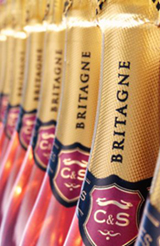
Seely proposes the name “Britagne” and has emblazoned the term on the neck of Coates & Seely bottles. The preferred pronunciation, however, is not “Brit-ane” to rhyme with Champagne, but rather “brit-an-yuh,” as in Rule Britannia. It turns out that there’s not consensus on the term as another has been floated: Merret. Apparently Mr. Merret was a pioneer in the nascent industry. But the bookmakers are giving this term long odds despite the fact that it rhymes with claret.

What do you think? Since the use of the term Champagne is prohibited for bubblies made outside the Champagne region, other terms such as cava or Sekt have been popularized. Come to think of it, California sparkling wine doesn’t have a category name. Given our love of acronyms, such as driving your SUV in the HOV to the ATM, I’m surprised it hasn’t it hasn’t come to be abbreviated CSW. But anyway, back to Britagne–what do you think? I am pessimistic that any one term will work.

[poll id=”21″]

Where in the wine world are we? Grape elevator edition

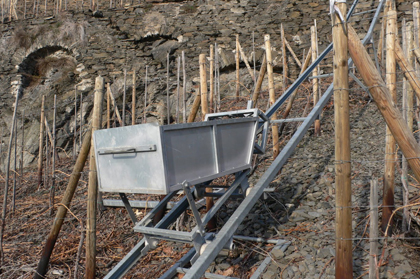
Given that we had fun with our weekend edutainment a couple of weeks ago, we bring you an encore edition. Last time, it was grapes transported down the steep vineyard via something akin to a ski gondola. This time, we present steep vineyard transportation via something like a dumbwaiter.

Where in the wine world do they do that? Hit the comments with your thoughts. Answer and photo attribution to follow.

And one day, in our steep vineyard series, we do hope to run a photo of someone sliding down on the seat of his pants.

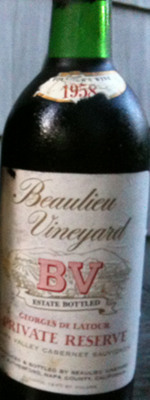
Beaulieu Vineyard, Georges de Latour, 1958

I always relish the rare opportunity to taste a California wine from the 1970s, the era before rising temperatures and fruit bombs. But I recently had something even more rare: tasting the BV, Georges de Latour, Private Reserve, Napa Valley, Cabernet Sauvignon, 1958.

The wine was made by the venerable Andre Tchelistcheff, the “dean” of California winemakers of his day. Georges de Latour, a Frenchman, bought Beaulieu in 1899 and apparently made a fortune selling sacramental wine during Prohibition (people were so devout during Prohibition!). With the end of the Prohibition profits, de Latour decided to embark on the quality route and went to France to find the best Frenchman for the job. But in 1938, he returned with Andre Tchelistcheff, a Russian refugee as winemaker. The Private Reserve slightly preceded Tchelistcheff’s arrival (the first vintage was 1936), but it as the flagship for the estate, it was his signature wine for much of his career. In 1969, Beaulieu sold to Heublein; now it is owned by Diageo.

The 1958, a legendary wine, was showing gloriously at a recent tasting at a collector’s house. Easily one of the best California wines I have ever tasted, the gorgeous mature cabernet from start to finish was spectacular: the wine was still structured and very much alive. Some dark fruit remained but there was also a a dose savory, earthy notes. More than anything, it was the texture of the wine and the finish that just wouldn’t quit that really set it apart and made it so downright drinkable, enjoyable, and worth savoring every drop. It was so outrageously good that even showed better than the 1971 JJ Prum that was at the same tasting–and this was according to one of Riesling’s most ardent fans was was also at the tasting.

Incidentally, I checked out the back label and was amused Read more…

J.J. Prum, Wehlener Sonnenuhr, 1971


With the year almost half over (um, where did it go?), I thought it about time to post about a few memorable wines that I’ve tasted so far this year.

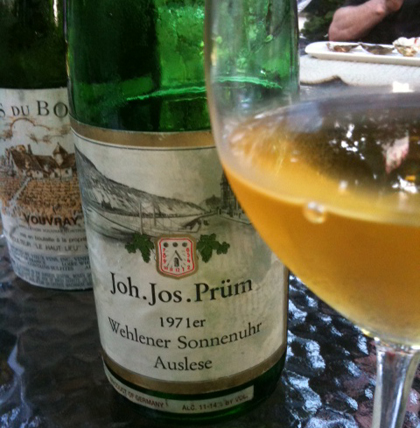
First among these needs to be the J.J. Prum, Wehlener Sonnenuhr, Auslese, 1971. In the vernacular of the day, the wine is epic, though not an #ecpicfail mind you but an epic success. Forty years young, I’ve had the good fortune of tasting the wine twice this year. The first was in Vegas celebrating a high school friend’s fortieth birthday party. I saw it on the list at Lotus of Siam and had to buy it for him. Although he’s not that into wine (it does happen from time to time but he’s still a great guy), he loved the wine as did the others in our group who don’t even usually drink white wine. It was really fun to reach back in time the way wine can so joyously. My buddy tells me he keeps the empty bottle on his desk.

I had the wine again recently (actually, it was the “gold capsule” bottling this time) with a small tasting group and it was singing. The wine is a golden color with a deliciously honeyed nose, terrific purity, weight, and an astoundingly integrated blend of acidity and sweetness. Truly, if you remain unconvinced about the soaring greatness of Riesling, get your hands on one of these bottles. Among the world of collectible wines, it remains a relative bargain for the superb quality.

Search for this wine at retail


winepoliticsamz

Wine Maps


Monthly Archives

Categories


Blog posts via email

@drvino on Instagram

@drvino on Twitter


winesearcher

quotes

One of the “fresh voices taking wine journalism in new and important directions.” -World of Fine Wine

“His reporting over the past six months has had seismic consequences, which is a hell of an accomplishment for a blog.” -Forbes.com

"News of such activities, reported last month on a wine blog called Dr. Vino, have captivated wine enthusiasts and triggered a fierce online debate…" The Wall Street Journal

"...well-written, well-researched, calm and, dare we use the word, sober." -Dorothy Gaiter & John Brecher, WSJ

jbf07James Beard Foundation awards

Saveur, best drinks blog, finalist 2012.

Winner, Best Wine Blog

One of the "seven best wine blogs." Food & Wine,

One of the three best wine blogs, Fast Company

See more media...

ayow150buy

Wine books on Amazon: