Dr Vino's wine blog
wine talk that goes down easy
Red state, blue state wines on Forbes
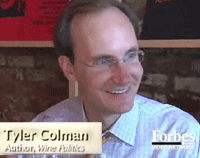 With convention season now upon us, Eric Arnold and I got in the mood and tasted some wines from blue states and the more difficult–viticulturally speaking–red states over on Forbes.com (with videos!).
With California, Washington, and Oregon making something like 95 percent of American wine and coming up as blue on the electoral map, the challenge is to find good red state wines. I won’t steal the thunder of the piece but I will say that the wines we tried were surprisingly good. Here’s the quick list:
* Galena Cellars, General’s Reserve, from Obama’s home state of Illinois (find this wine)
* Heron Hill, Riesling, Finger Lakes, NY (find this wine)
* Caduceus, Arizona Stronghold, McCain’s home state, yes, but also now where Tool lead singer Maynard Keenan is growing vines (find this wine)
* Barboursville, Barbera, 2006 from Virginia, a state that swung red last time but is very much in play this year (and former Governor Mark Warner, a vineyard owner, is the Keynote speaker in tomorrow’s Democratic convention; find this wine).
I tried to recreate this lineup for a corporate tasting while I am in Chicago next month but none of the three non-Illinois wines were available in the market via wine-searcher. And none of the retailers I checked online even stocked the Illinois wine. It’s really too bad I can’t ship the wines there from an out of state retailer now that it is illegal. So I had to choose another theme for that tasting, alas.
Aug
25
2008
1
Philippe Pacalet, a rule breaker making natural Burgundy
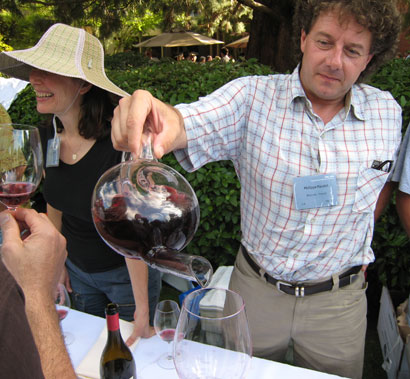 Mike Steinberger posted a piece to Slate.com on Friday detailing the folly French appellation politics (entitled “How Bureaucrats Are Wrecking French Wine”). I’m glad to see the topic getting a broader airing since it is at the heart of my book, Wine Politics, which Mike kindly mentions. But go check out the article and see Mike’s plan for AOC reform if he were French wine czar for a day.
Mike mentions the growing ranks of quality producers who have had wines refused by the tasting portion of the appellation process. When the list includes names such as Jean Thevenet, Didier Dagueneau, Eloi Dürrbach, Marcel Lapierre, Thierry and Jean-Marie Puzelat, Marcel Richaud, Georges Descombes, and Philippe Jambon, you’ve got to wonder if that doesn’t say more about the appellation politics itself. But there’s one other notable rule breaker who could be included in that list: Philippe Pacalet. Read more…
Aug
24
2008
In the NYT suggesting to drink inside the box
 I am an op-ed contributor to the New York Times today urging wine producers to upgrade the quality of wine available in boxes. If you’re new to the site, welcome and feel free to explore the site including wine picks. Also, consider subscribing to the site feed or get caught up on my joint research on the carbon footprint of wine.
Overall, I’m disappointed with the quality of box wine here in the U.S. But the time for good box wine has come for environmental as well as economic reasons as I argue in the piece.
There are some rays of hope in the box wine landscape. Unfortunately, the $40, 3-liter D-Tour wine, made by Dominique Lafon of Burgundy and imported by Daniel Johnnes, wine director at Daniel Boulud’s restaurants, has been temporarily withdrawn from the market (search for this wine). However, the Cuvee de Pena, an old vine grenache from the French side of the Pyrenees, is still available (find this wine). And the newest and brightest star is the $11 unoaked, organically grown malbec called Yellow + Blue sold in a 1-liter TetraPak (not bag-in-box; find this wine). There’s also the Bandit from California (find this wine).
So what do you say about boxed wine? Have your say in the latest poll! And hit the comments with your preferred box selections.
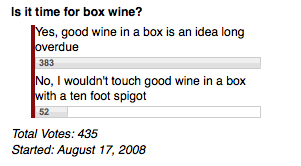
poll now closed
Related: “Drink outside the box” NYT
“An open letter to Jorge Ordonez” [Dr. V]
“How I gave up bottled water and lived to tell the tale” [Dr. V]
Drinking box rosé in the south of France
The excellent image is by Grady McFerrin and ran with the story.
Aug
18
2008
What I learned on my summer vacation
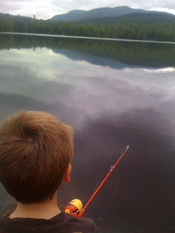 I’m just back from a week in the woods of the Adirondacks. It was a fun time with my siblings and families though at times the theme of seven days with seven kids under seven seemed like something dreamed up as the next reality TV show. But nobody got thrown off the proverbial island. Here are some things I learned on my summer vacation:
* If a tree falls in the woods and you’re there, it does make a noise.
* The 2007 Von Volxem Saar Riesling disappears in a scant few minutes when uncorked with a group! And deservedly so with a beautiful balance of sweetness and acidity. (find this wine)
* A lambrusco from an artisanal, however, remains unfinished. Fun, purple, fizzy wine but a tannic monster!
* The Domaine Guion 2005 cuvee prestige from Bourgeuil in the Loire is a red that everyone can enjoy. (find this wine)
* The Marcel Lapierre Morgon 2006 that I have enjoyed previously was also a big hit! (find this wine)
* I found a new favorite wine for my sister who claims not to like wine! More on that later.
* Lots of kids fishing from the same spot can lead to tangled lines.
* Junipero gin from San Francisco (find this gin) is superb on the rocks, not so good with Schweppes Tonic water (because of the Schweppes) but quite good with Pom juice and a dash of simple syrup on the rocks though the alluring aromas are compromised.
* Use the iPhone camera only if you leave the other camera in the car.
 And one final observation: in the small town where we were staying, deep in the woods where it took three people to determine the location of tofu in the supermarket, there’s a new wine bar opening! Unfortunately it wasn’t open yet but I take it as yet another indication of how far enthusiasm for wine is going in America. We’ll see if it’s still open next summer!
Aug
18
2008
Fighting snakes and bears: Matt Mavety makes Pinot Noir in British Columbia
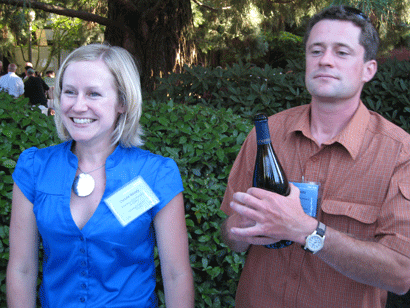
At the recent IPNC, I had the chance to taste a tasty pinot from British Columbia–my first! The pinot (find this wine) was from Blue Mountain Vineyard & Cellars. I caught up with Matt Mavety (pictured above with his wife, Christie) to find out about making Pinot in the North American frontier–and how he protects his Pinot from bears and rattlesnakes.
How long have you been making wine at Blue Mountain Vineyard & Cellars?
The winery has been making wine since 1991, commercial vintage. Read more…
Aug
12
2008
The best American rosé
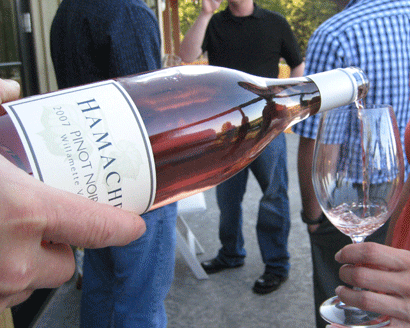
As a category, rosé wine has had to fight for respect. But unlike Rodney Dangerfield, the category has actually gotten respect recently as it has become more popular in the US and the rosés now surpass white wines to be the best sellers in France.
Rosé has been seen as a “not serious” wine primarily because–with few but notable exceptions–it doesn’t age. Just buy the most recent vintage, chill it and toss it back while on the deck, patio, veranda, picnic blanket, or outdoor cafe. And lest I need to clarify, it’s dry rosé that I’m talking about, not white zinfandel or its predecessor, the original white zin, rosé d’Anjou.
Even separating the dry from the sweet, there are still a lot of rosés that don’t cut it for me. Some common faults as I see them are: too high alcohol, too thick, too short a flavor, and too expensive.
So now we arrive at perhaps the most burning August wine discussion: what is the best rosé? And since I usually drink roses from France or Spain, why not add a patriotic twist and try to determine the best American rosé? Read more…
Aug
6
2008
Get your Bojo working – 2006 Lapierre, Roilette edition
Last year, I was loving the serious 2005 Beaujolais from many of the ten “crus,” or sub-zones of the downtrodden region. I’ve tasted a few 2006s (and look forward to more) and wanted to highlight this excellent duo.
 Marcel Lapierre, Morgon, 2006. $21 (find this wine) Importer: Kermit Lynch.
This beautiful wine comes from Marcel Lapierre, one of the qualitative leaders of the region known for a long period of barrel aging. This extended élévage, as it is known, provides the wine with complexity and the ability to better combat oxidation since Lapierre bottles without sulfur, an antioxidant commonly used for stabilizing the wines during shipping. This vintage is particularly succulent and Mrs. Vino had the good sense to demand that I buy more of the wine after her first sip. I happily obliged. The wine will make a good gift not only because of what’s inside but also because of the handsome presentation–along with the wax cap. I’m a sucker for wax caps.
IN the glass, the wine is light in color and actually tastes like a really superb gamay as opposed to many of the best Beaujolais that end up tasting like pinot noir (hey, I’m not complaining, just observing). But gamay has such alluring fruit, lively acidity and smooth tannins when done right that it is hard to refuse. The traditional food pairing is dried sausage but it’s really hard to go wrong since it is so food-friendly.
Of note, Marcel Lapierre is one of the qualitative leaders in the Beaujolais. Check out this excellent article from the Saveur archive on Lapierre and his damascene conversion at the hands of Jules Chauvet.
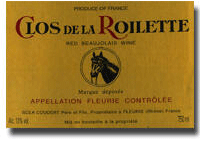 Clos de la Roilette, Fleurie, 2006. $20 (find this wine) Importer: Louis/Dressner
This wine is darker and more concentrated, a twist on the traditional reputations of the “masculine” Morgon and the “feminine” Fleurie appellations. The concentration does not sacrifice the overall tastiness and, although rich, the wine still has good acidity. I brought it to some friends’ house and they were rapturous in their praise. And to think I got it for only $16! I’ll definitely buy this one again–and look for the Cuvée Tardive, which is more age worthy. Yes, age-worthy Beaujolais! More on that in a future post.
Jul
22
2008
Red, white, and recession: two bargains under $10
You don’t have to have been long financials for most of 2008 to want a good bargain; great wines under $10 are always in demand, and increasingly hard to find. Here are two for weathering the financial downturn–and beating the summer heat.
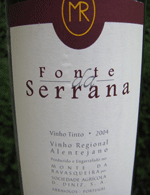 Fonte da Serrana, Alentejo, Portugal, 2004. $5.99 (find this wine)
Alentejo is a hot, dry part of Southern Portugal that, when it comes to wine, traditionally has been more known for making closures–corks–rather than what goes in the bottle. But this wine will make them consider planting more vines. The alluring nose of dried herbs precedes the all-berry attack the attack, which, in turn, is followed by a surprising degree of bright acidity and gentle tannins. A GREAT summer quaffer. And our new house burrito wine. Day two it was still going strong and poured at fridge temp, marvelously refreshing on the deck. The blend is mostly Aragonez (a.k.a Tempranillo) and the indigenous Trincadeira.
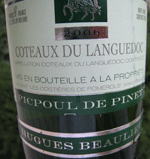 Hugues Beaulieu, Picpoul de Pinet, Coteaux de Languedoc, 2006. $7.37 (find this wine)
Picpoul de Pinet is a blast of summer freshness that comes from a stone’s throw away from the Mediterranean. With a citrus zip of tart acidity, a light saline quality, this wine, from a cooperative producer, is refreshing to pair with 95 degrees–as an aperitif or with seafood. It’s easy to understand why Picpoul is known as the Muscadet of the south both for flavor profile as well as wallet-friendliness. I got this bottle from a sale that is now, sadly, over (bringing the price up to $8.99) but I will definitely get more for the dog days of summer.
Jul
18
2008

Wine Maps
Monthly Archives
Blogroll
Categories
- American wine
- announcements
- Argentine wine
- auctions
- Australian wine
- Beer
- best wines
- Bling
- books
- Bordeaux
- bottled water
- Box wine
- Burgundy
- business of wine
- Celebrity wine
- Champagne
- Chicago
- China
- cocktails
- cognac
- corks
- corkscrews
- dining
- eco wine
- events
- foie gras
- food and wine
- French wine
- German wine
- giveaway
- grapes
- green wine
- guest post
- highlights
- how to
- Italian wine
- leaders and liters
- Mature wine
- meetups
- New York City
- On notice!
- photo captions
- podcasts
- Polls
- Port
- Portuguese wine
- power list
- reader mail
- rose
- sake
- Sommeliers
- South Africa
- Spanish wine
- spirits
- tasting sized pours
- The real wine world
- TV and movies
- Uncategorized
- videos
- vinexpo
- Weather
- wine and health
- wine and sports
- wine and tech
- Wine Blogging Wednesday
- wine blogs
- wine classes
- wine collecting
- wine gifts
- wine in india
- wine labels
- wine picks
- wine politics
- wine quizzes
- wine random
- wine science
- wine scores
- wine shops
- wine technology
- wine travel
- Wine under $10
- wine writing
- winemaking
- winespeak
 Blog posts via email
@drvino on Instagram
@drvino on Twitter
Advertise

quotes
One of the “fresh voices taking wine journalism in new and important directions.” -World of Fine Wine
“His reporting over the past six months has had seismic consequences, which is a hell of an accomplishment for a blog.” -Forbes.com
"News of such activities, reported last month on a wine blog called Dr. Vino, have captivated wine enthusiasts and triggered a fierce online debate…" The Wall Street Journal
"...well-written, well-researched, calm and, dare we use the word, sober." -Dorothy Gaiter & John Brecher, WSJ

Saveur, best drinks blog, finalist 2012.
One of the "seven best wine blogs." Food & Wine,
One of the three best wine blogs, Fast Company
Books for wine geeks
Wine books on Amazon: