CONTAINS SULFITES: meant to frighten rather than inform
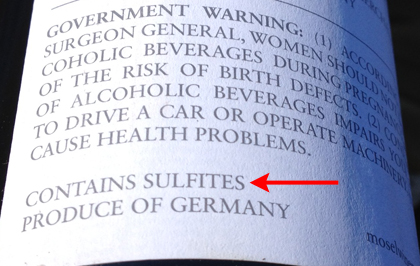

Have you ever wondered why a bottle of wine states “CONTAINS SULFITES” on the label while other foods that have sulfur get no such warning?

In A History of Wine In America, Volume 2, Thomas Pinney recaps some of the maneuvering from the 1980s that led to this warning. A group tried to have ingredients listed on wine labels as early as 1972. After over a decade of ping-ponging between agencies, proposals getting rebuffed from the industry, and ultimately a legal challenge that succeeded in striking it down, ingredient labeling was off the table.

But the forces of “neoprohibitionism” had started gathering steam and in Senator Strom Thurmond, they found their man. This time, Pinney writes, “their goal was not to inform but to frighten.” Initial efforts to get a government warning were stymied, but they scored a victory in getting “CONTAINS SULFITES” to appear on labels starting in 1987. The following year, the government warning language on labels also passed and went into effect. While a small portion of the population is allergic to sulfites, an allergist once told me that those who are allergic generally have preconditions, such as asthma. Further, the reactions are most often severe and may include anaphylaxis (note: they don’t cause headaches).

So if you’ve ever wondered why dried fruits that have higher levels of sulfur than wine contain no government warning, know you know why. First, they’re regulated by different agencies (TTB vs FDA). Second, there’s no anti-dried fruit lobby.

As the topic of ingredient labeling for wine is making the rounds again, its worth bearing in mind that the track record of “contains sulfites” verbiage on labels has raised more questions than it has answered and perhaps, as its original proponents intended, scared more people away from wine than it has protected asthamatics.


Bud Selig, major league champagne hater!

Bud Selig watched the San Francisco Giants spray themselves with bubbly and tut-tutted. The owner of the Milwaukee Brewers and MLB Commissioner told the LA Times, “This is something I am not happy about: spraying champagne all over. I’m not a fan of that.”

I agree; the ritual is a little absurd at this point. Allow me to quote myself. Here’s what I wrote in the wake of new rules on locker room celebrations that went into effect in 2010:

While I am generally all for defending wine consumption in the public eye, I find it difficult to get too worked up about this latest MLB ruling. Clubs decided to forego champagne in favor of cheaper sparkling wine long ago. And while wine producers might want to bask in the aura of victory, what vintner would want to have their wine consumed out of an athletic cup while wearing ski goggles? I mean really, that would make even more people shudder than just Max Riedel!

The victors certainly deserve a celebration. But they have all off-season to savor the Champagne, with food and friends, without having to wear goggles.

What do you think–are you in favor of players chugging bubbly in the locker room? Try not to let sour grapes influence your point of view…

The “Champagne” ritual in baseball gets icy reception
Yankees and Rangers spray Champagne–or is it?

Rally car plows through vineyard

Forget horses plowing vineyards; an Alsace vineyard had a rally car plow through it during a race.

The above video shows one perspective of Petter Solberg’s vineyard tour. But the best video a trio of camera angles over at The Guardian (be sure to catch the navigator’s reaction at the end).

For those vine huggers out there, the vineyard owner wasn’t concerned about the damage.

Is Garagiste sui generis? The NYT profile of Jon Rimmerman

The NYT magazine has an extensive profile (and terrific photo) of Jon Rimmerman, owner of Garagiste, a wine retailer that operates exclusively by email. The article says that he has over 136,000 subscribers to his emails and that he does “on average” $30 million of sales each year out of his office in Seattle. Even though his “florid, self-mythologizing” emails go out daily, he only ships twice a year in the cooler months. Since he doesn’t have a traditional storefront and is able to source the wines directly and often pre-sell the wines months before delivery, he has some efficiencies that can either increase his margins or decrease the price to consumers, sometimes both.

I don’t subscribe to his emails but I’m glad that he has been able to make a successful business connecting consumers with wines from the far-flung corners of the wine world (in this 2009 video, he said he has 3 million air miles). His style is akin to the erstwhile J. Peterman catalogue. But just as you might have gotten caught up in prose of J. Peterman and end up with a sun hat you might not ever wear, so too Read more…

Has the economic slowdown killed the oak monster?

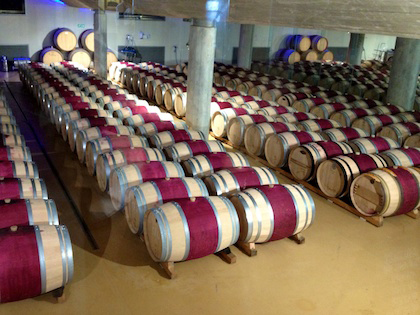
Winemakers across three continents and various importers have echoed a similar refrain to me of late: the economic slowdown of the past few years has led to less new oak. New 225-liter barrels (“barriques”) can cost $1,300 a pop–or about $4 per bottle of wine if only used once. Some producers say they hear talk from producers dialing back the oak about getting more natural. But at root, the decision is often economic. (Just wait until they learn about the waning influence of critics who championed such styles, most notable in Spain.)

Whatever the reason, nine times out of ten, it’s a good thing. Instead of tasting expensive oak, we can taste the grape and the terroir. Oh, and nice not to see those obnoxiously heavy bottles much any more too. Of course, there are regions where adding $4 in oak costs or $2 for bottles doesn’t really matter since the finished wine prices are so high. But those are the exception, not the rule.

What do you see in terms of new oak in your corner of the wine world?

South African cabernet franc: Bruwer Raats #video

What’s the best red variety for South Africa? Bruwer Raats would vote for cabernet franc. Listen to him explain why in the above video.

His wine, made from 25-year-old, unirrigated vines and stylistically more St. Emilion than Saumur, is a strong example of cabernet franc with meaty, floral character with perky tannins. Unfortunately, Raats’ enthusiasm for the grape hasn’t been infectious: I only came across one other example of it as a varietal wine. But since I didn’t get to try the one from Buitenverwachting, this makes the Raats the best cabernet franc that I tasted from South Africa!

Raats also makes the Mvemve Raats de Compostella with Mzokhona Mvemve. A fuller-bodied wine than the straight cabernet franc, the 2009 manages to strike an alluring balance between fruit, acidity and tannin. And, true to his passion, it’s a quarter cabernet franc. Read more…

Pairing pinotage with the elephant in the room


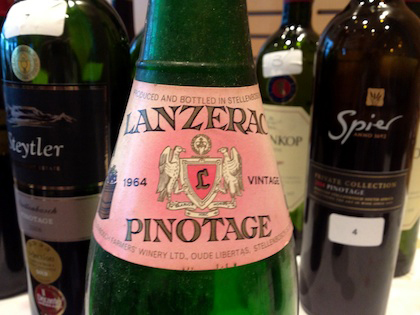
One of the questions that I had going to South Africa was what gives some red wines, notably pinotage, a smoky, burned rubber smell. Pintoage is quite polarizing in the US; Lettie Teague of the Wall Street Journal, for example, categorically states that she loathes the variety.

So I attended a pinotage seminar last week at Cape Wine 2012 with an open mind, hoping to learn more about the causes of these polarizing aromas. Read more…

Kids and wine education: Bordeaux program hits the vines, holds the wine

Here’s a question that we have addressed over the years on this blog: what’s the best, most responsible way to teach kids about wine? We’ve talke about an American approach that treats wine like a drug and an Italian approach that has kids singing songs and drawing pictures of Chianti fiaschi.

You’d think that wine would part of everyday education in France since the country boasts a high per capita consumption rate and we’ve all seen that picture of the kid with a bottle of wine under each arm. But, in fact, the French education system has, along with much of French bureaucratic attitude toward wine, had a shift for the puritanical in the past couple of decades.

So it is terrific to see the Bordeaux wine trade council is offering classes about wine “heritage” to kids aged 6 – 10. It’s optional, and the piece on decanter.com notes that they won’t be pitching it to schools, so it is a far cry from being a mandatory class. But let’s hope some schools do partake; learning about making wine seems like a great idea in a wine-making region/country. And what kid doesn’t love a tractor ride?


winepoliticsamz

Wine Maps


Monthly Archives

Categories


Blog posts via email

@drvino on Instagram

@drvino on Twitter


winesearcher

quotes

One of the “fresh voices taking wine journalism in new and important directions.” -World of Fine Wine

“His reporting over the past six months has had seismic consequences, which is a hell of an accomplishment for a blog.” -Forbes.com

"News of such activities, reported last month on a wine blog called Dr. Vino, have captivated wine enthusiasts and triggered a fierce online debate…" The Wall Street Journal

"...well-written, well-researched, calm and, dare we use the word, sober." -Dorothy Gaiter & John Brecher, WSJ

jbf07James Beard Foundation awards

Saveur, best drinks blog, finalist 2012.

Winner, Best Wine Blog

One of the "seven best wine blogs." Food & Wine,

One of the three best wine blogs, Fast Company

See more media...

ayow150buy

Wine books on Amazon: