Say champagne, mean Champagne
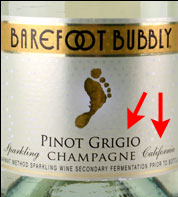
Almost half of the sparkling wine sold in the US says champagne on the label. The only catch: that’s “California champagne,” usually with the “California” in 2-point font and the “Champagne” in 36-point bold.

So says the Champagne Bureau USA, the DC-based arm of the CIVC, the Champagne trade association. Although the term is banned in Mexico and Australia for domestic sparkling wine, and Canada will phase out the use of any domestic use of “Champagne” in 2014, the US–the third largest market for Champagne after France and the UK–has no such sunset. Six years ago, the EU and US agreed to allow no new labels to use the term thus limiting the term to existing labels (about 16 comprise almost all the volume). Sam Heitner, director of the Champagne Bureau, thinks it’s time to tighten the laws and ban “California Champagne” on labels.

“US law agrees with protecting communal names such as Napa Valley,” he says. “Yet it permits duplicity with Champagne.” Read more…
Give him a hand: man carries 51 wine glasses

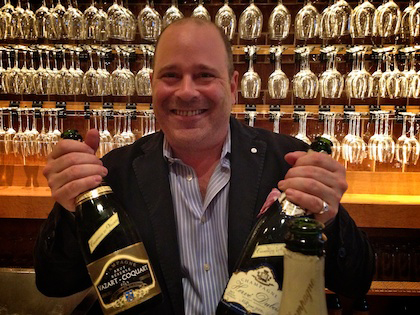
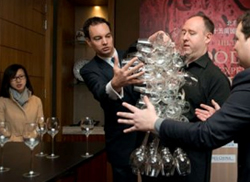
A British sommelier shattered the world record for carrying wine glasses in one hand: Philip Oseton carried 51 wine glasses, many stacked on top of each other.

Give him a hand! Oh wait, I guess he doesn’t need one.

Image: reduced-sized crop from AFP

Auction price drop, learning to love wine, end of discounts — sipped & spit

SIPPED: satire
“Why do I need a book about “How to Love Wine?” Who the hell needs to know how to love wine?” The HoseMaster does a blind book review–a review without reading the book.

POPPED: bubble pricing?
Wine auction prices to decline by 20%? Might happen, insiders say. [Decanter.com]

SPIT: cost cutting
In the name of reducing “irresponsible drinking,” the government may prohibit supermarkets in Britain from offering discounts on multi-bottle purchases. The resulting price hike may be difficult for some to swallow. [Telegraph]

SIPPED: cost cutting
Beck’s beer sold in the US is now brewed in St. Louis. Scandale! A Bloomberg BusinessWeek story on how CEO Carlos Brito is running AB InBev “like a private equity investor.” That leaves a big opening for craft beer.

SPIT: timely phrasing
NY Gov Andrew Cuomo said he will put promotion of the state’s wine and beer “on steroids.” Jeesh, next thing you know he will want them to win the Tour de France! [AP]

A lightstruck rod of controversy

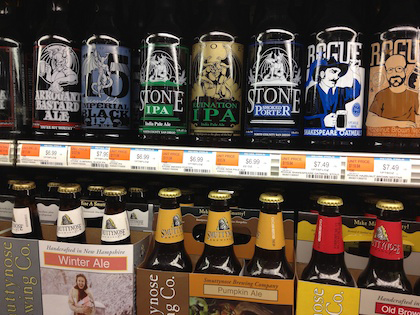
In yesterday’s post about the advantages that craft beer has over wine, I mentioned both price and more consistency from a lack of cork taint as well as vintage variation. However, even in the series of articles over on San Francisco magazine, a group of tasters blind tasted three bottled beers vs draft pours of the same beer and two of the bottled beers were “lightstruck” (including one in a brown bottle). Read more…

Craft beer is overtaking wine: SF mag

“Craft beer is overtaking wine as San Francisco’s beverage of choice,” writes Jordan Mackay in San Francisco magazine’s lengthy spread on the topic.

It’s no surprise: the craft beer story in America is wonderfully exciting, a grass-roots story of bubbling worts in basements, with the rewards of many shades relatively easy to find in the glass. Last year, while beer sales sagged overall, craft beer was up 18% according to Nielsen data and craft beers sell for a 60% premium to mass-market beer (not bad since they have 100% more taste). It’s still a niche market with just 8% of beer sales in 2011, but the core consumer are 21-34 higher income males, a crucial demographic for wine too.

Frankly, the headline that craft beer is overtaking wine in select markets is not surprising. Once you find one that you like, craft beer offers relatively more consistency (no TCA) than wine and a good amount of complexity especially given the value. Sure, given my druthers, I’d have wine. But a good bottle of wine for a weeknight might be $15-$20 for two people while a couple of good beers would be $3-$5. Repeat that most nights for a month and, in an economy that has yet to find a firm footing, it’s not surprising on that calculus alone that craft beer is having its moment. I know that I have reached for some suds from Bavaria, Belgium, Brooklyn and other places that don’t start with B in the past few months.

What do you think: is craft beer a big threat to wine? Is it an either/or proposition? (While wine drinkers might try beer, I’d be interested to know how much “hop heads” experiment with wine.) How often do you crack open a nice cold one?

Peanut butter & pickle: impossible food-wine pairing?

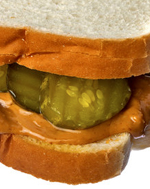
Dwight Garner, the astute book reviewer for the NYT (be sure to check out his hilarious review of The 4-hour Body from last year), ventures into the food section this week with what he calls a “thrifty and unacknowledged American classic”: the peanut butter and pickle sandwich. Or PB&P, if you will. He delights in the “vinegary snap of chilled pickle cuts, like a dash of irony, against the stoic unctuousness of peanut butter.”

I can’t say that I’m swayed by this description and remain skeptical of the appeals. Nonetheless, given that the NYT spotlight is now focusing on this, the question everybody’s going to be asking–sort of the Rule 34 for bizarre foods–is which wine goes with PB&P, or is it impossible?!?

Hit the comments with your thoughts! Thanks, @trouty for the suggestion!

A vote against disgorgement dates: Peter Wasserman

In the ongoing debate about whether champagnes should have disgorgement dates on the labels, discussion has mostly been in favor of the practice. Some critics refuse to review a nonvintage wine without a disgorgement date. (What is disgorgement?)

At the portfolio tasting of Pas Mal Selections in New York last month, Peter Wasserman expressed hesitations about the sole focus on disgorgement dates. Peter works for Becky Wasserman Selection aka Le Serbet (his business card reds “head of anti-marketing and sales prevention”), the Burgundy-based exporter that represents almost 20 Champagnes. He said that the disgorgement date alone doesn’t reveal anything about the base wine, which vintage it is or how long the wine has been on the lees. Nor does it say whether the wine has been aged in the bottle with a cork closure or a bottle cap. He estimates some of his growers disgorge 20 times per wine, so if a critic reviewed only one disgorgement date and consumers sought out only that one, he would be at a “commercial disadvantage.” Thus he has invited critics interested in including disgorgement dates to review a wine from each disgorgement date. “They do it for Jacques Selosse,” he says.

For nonvintage cuvées, Wasserman favors the vintage of the base wine as the most important information for consumers. Thus the champagnes of Le Serbet will have the base wine and the year of disgorgement on the label (though not all of his US distributors were on board with this at the time we spoke). More information will be available about each wine on the Le Serbet web site, a good move to engage the tiny percentage of consumers who care to find out more.

While he prefers more information on the label, he feels that the focus on disgorgement dates can lead consumers to seek out the freshest. That’s unfortunate, since, in his view, many retailers have excellent storage and nonvintage cuvées are complex, often tasting better with one or two years on the cork.

Sherryfest floods New York with fino

sherryfestSherryfest, a series of tastings and events lasting four days, is set to capture the attention of wine geeks in New York. I had fun writing a story about the festivities and the state of sherry in America today for the new magazine over at wine-searcher.com. Check it out! They haven’t enabled comments over there so if you have anything to add, hit the comments here. Are you a fan of sherry?

Here’s a link to the list of activities, including free tastings at 30 wine shops on Saturday.

“Sherry fever grips New york”


winepoliticsamz

Wine Maps


Monthly Archives

Categories


Blog posts via email

@drvino on Instagram

@drvino on Twitter


winesearcher

quotes

One of the “fresh voices taking wine journalism in new and important directions.” -World of Fine Wine

“His reporting over the past six months has had seismic consequences, which is a hell of an accomplishment for a blog.” -Forbes.com

"News of such activities, reported last month on a wine blog called Dr. Vino, have captivated wine enthusiasts and triggered a fierce online debate…" The Wall Street Journal

"...well-written, well-researched, calm and, dare we use the word, sober." -Dorothy Gaiter & John Brecher, WSJ

jbf07James Beard Foundation awards

Saveur, best drinks blog, finalist 2012.

Winner, Best Wine Blog

One of the "seven best wine blogs." Food & Wine,

One of the three best wine blogs, Fast Company

See more media...

ayow150buy

Wine books on Amazon: