Bonny Doon’s labels bare all – Randall Grahm, part I

bonny_doon_albarino
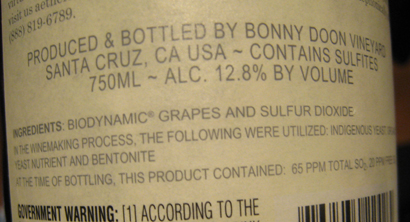
Spotted yesterday at a trade tasting: Bonny Doon’s labels are now baring all and putting a full “ingredient” list. This is not a legal requirement but more comprehensive labeling for wine is a subject that is in play. While more information on labels is a probably good thing, it would be helpful to have some context about some of lesser-known aspects of winemaking. But maybe that’s what the internet is for, researching things like wine ingredient lists. What do you think about more information on wine labels?

I asked Doonmaster Randall Grahm what prompted him to take this extra step. He said his reasoning was twofold. While admitting it was a little bit “pious” on his part, he said that he was doing it in part to encourage the industry to do more with less and to be more natural while “trumpeting our own virtue.” Further, he said that it is kind of an enforced discipline: “if you have to add it to the label, you think twice before doing anything.” He added, “It makes a better wine.”

Stay tuned for more with the Randall Grahm as I ask him about screwcaps and his new project!

In case you can’t read it from the blog-blurry photo of his 2008 Albarino (find this wine), here’s the text after the jump: Read more…

Free NYC wine tastings – March edition

libertywineRemember, wine stores in New York can’t charge for tastings on premises. So take advantage of these free tastings!

March 12: I’ll be signing my book, A Year of Wine, at Pasanella & Son near the South Street Seaport, 7 – 9 PM. Four free wines! Hope to see you there.

March 21: Several producers from one of my favorite importers, Louis/Dressner, will be heading to Chambers Street Wines. Includes: Jean-Paul Brun, Domaine des Terres Dorées;Marc Ollivier, Domaine de la Pépière; Pierre Breton; Matthieu Baudry, Domaine Bernard Baudry; Evelyne de Jessey, Domaine du Closel; Catherine & Claude Maréchal; Jean Manciat; Alain Coudert, Clos de la Roilette; François Pinon; Eric and Christine Nicolas, Domaine Bellivier. There are also a couple of interesting winemaker dinners around that time arranged through the store, although they’re not free.

March 24: Several producers from another of my favorite importers, Kermit Lynch, will be heading to Thirst Wine Merchants in Fort Greene, 6 8 PM. Includes: Reynald Delille from Domaine Terrebrune (Bandol) in Provence, Laurent Barrera from Dupéré Barrera and Domaine de la Procure (Côtes de Provence) in Provence, Isabelle Champart from Domaine Champart (Saint-Chinian) in Langedoc-Roussillon, Cinzia Sommariva from Sommariva (Conegliano) in Veneto, Guido Porro from Azienda Agricola Guido Porro (Serralunga d’Alba) in Piedmont, and Jean-Yves Bizot (Vosne-Romanée) from Domaine Bizot in Burgundy.

Roll out the barrel box

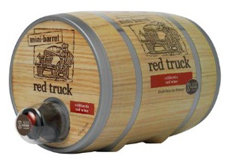
redtruckbarrel1Red Truck, a high volume brand from California, has decided to roll out the barrel. Their new three liter bag-in-barrel wine will appear this month at Sam’s Clubs across the country. Their press release claims that this packaging is “convenient, eye-catching and environmentally-friendly…[and] a terrific wine value.” Let’s check the truthiness of these claims.

Convenient? Sure, it probably keeps the wine fresh for a month with the bladder and spigot.

Eye-catching? Yes, it looks better than a box, at least from the photos. Maybe in person it is nasty, plastic-y looking but for now, yes, eye-catching.

Environmentally friendly? [NOTE: because the Red Truck press representative misunderstood my query about the weight of the packaging, this portion has had to be altered.] In my joint research into the carbon footprint of wine, we found that lighter packaging can greatly reduce the overall carbon footprint of wine. This barrel puts 3,000g of wine in 250g of packaging, so it vastly improves the wine-to-packaging ratio over bottles. (The PR person had previously told me the weight of the whole barrel, full of wine, was the weight of the packaging alone. So even though I had to redo this part, she buttered me up by saying that my NYT op-ed had inspired their their 3L package.)

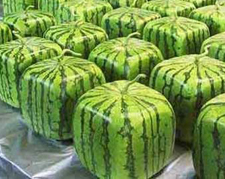
square-watermelonBut the cylindrical casing still leaves more dead air in the truck so it’s not quite as efficient as the rectangular box. (That’s why watermelons are square, right?) The packaging is all #5 plastic, which some municipalities may recycle. The plastic bladder is #7.

Value? At $29.99, it’s the equivalent of $7.50 per bottle. Although it can be found for $6.99 a bottle, many retailers appear to have it for $8.99 a bottle. So, yes, some savings. But you should probably experiment with a bottle of it first to see if you like it.

Bordeaux futures, wine investment, waste, insurance – sipped and spit

bordeaux_futures_prices
SPIT: Bordeaux futures
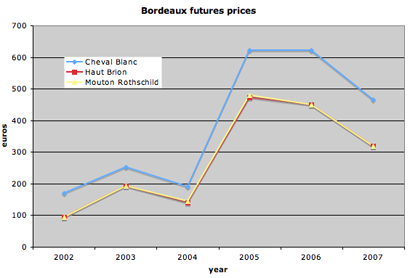
In recent years, Bordeaux futures ran up to tremendous highs (see above chart above for three top chateaus ex-cellars; compiled from data from The Times of London). Now, they may be poised to fall back to 2002 prices, which is what British buyers told the Times they were willing to pay. A Bordeaux insider told me recently that the first growths really should not cross the €100 threshold. But he admitted that they probably will after they hear nice things about their wines at the en primeurs tastings in early April.

SIPPED: Bordeaux past
In a blast from what seems a distant past, a new investment fund for wine is opens this month with allegedly 15 to 20 million pounds of assets. Investors will need to meet the 500,000 pound minimum for the closed-end fund. Send checks to Richmond Park partners Steven Berger and Pascal Maeter who will manage the Lunzer Wine Investments Institutional Fund. [Bloomberg]

SIPPED: industrial waste over Givry
The Burgundy village of Givry has to contend with plans for a new industrial waste treatment plant on the outskirts of town. Last year’s mayoral campaign was fought largely around this issue with an anti-plant activist winning town hall. But the regional authorities later approved the plant, winemakers sued, and now a tribunal has suspended the approval. Score one for the winemakers! Check out the story at washingtonpost.com.

SPIT: excise tax
California’s legislature approved a new budget without increasing the excise tax on wine.

SIPPED and SPIT: wine blogs
The wine blog award winners have been announced. Alas, this blog is not among them. But thank you for your clicks of support! And hearty congratulations to the winners! [Fermentation]

SIPPED: insurance!
A “Master of Coffee” (not Mister Coffee) in England has insured his tongue for £10 million ($13.95 million) via Lloyd’s of London (not to be confused with the newly nationalized Lloyds Banking Group, ahem). Take that Robert Parker–his policy is 14 times bigger than your policy! [BBC via sdelong]

Taylor’s Quinta de Vargellas port – a vertical, 1958 – 2005

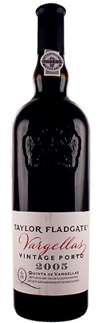
What kind of a vintage port pairs with a recession? Well, in the case of Taylor’s, it’s the Quinta de Vargellas: this single vineyard wine’s most recent edition, the 2005, is about $45 compared with the current vintage port, the 2003, which is still north of $100. (Of course, for there’s also the Late Bottled Vintage, for $20, but I’ve already mentioned that.) It’s funny that in port country a single vineyard sells for less than a regular old vintage.

taylor_vargellasAt a vertical tasting this week of Quinta de Vargellas dating back to 1958, I asked Adrian Bridge, managing director of the Taylor-Fladgate Partnership, how the economic downturn would affect the company.

“We’ve survived 300 years through wars and pestilence,” he said. “We can make it through this downturn. Fortunately we are not as dependent on restaurant sales as other categories, such as Champagne. If the next release doesn’t sell this year, we can always hold on to it for a couple more years since we have a lot of experience aging wines.”

I asked him whether there were too many offerings of high-end ports, fighting for a dwindling number of consumers. But he sad that specialty ports are actually a growing category, expanding 30% in recent years.

Vargellas is a steep single vineyard that came Taylor’s acquired in 1896. Today it has 255,000 vines, a common way of measuring a vineyard in the Douro, and some of those are over 100 years old. The grapes are foot-trodden, and wines typically are more approachable earlier than classic vintage port, according to Adrian, at about 12 years and typically only last about 35 years.

If you’re interested in assorted tasting notes and reactions, read on! Read more…

Frankly Wine’s Christy Frank – NY wine shops – a 2,400 part series

christyfrankChristy Frank of Frankly Wines–last seen in front of her cork wall–returns with some answers to a few of my questions about the possible changes NY wine retail.

Size of store: 320 sq feet, possibly the smallest in Manhattan [66 West Broadway; Tribeca]

Style of selections: well-edited! My version of the well-stocked wine closet: including daily essentials, quirky finds, and higher end treasures. Selection skews toward the Southern Hemisphere.
price average: 50% of stock is $20 or less

A cool bottle: “Syrocco” Syrah 2006 (Zenata, Morocco) – eye-rolling aside at the clever, rhyming name, the wine is a great value at $16.99. Alain Graillot of Northern Rhone fame is the man behind this project.

Date store opened: December 14th, 2007

Position on proposed reform to allow food stores to sell wine: There’s a Whole Foods around the corner, so the possibility that this will pass, combined with the current economic environment does worry me. Prior to opening my wine store, I ran the national business for several wine brands, so I understand that independent wine/liquor stores can co-exist with large, corporate grocery chains that also sell wine. However, given the current economic environment, this is probably not the best time to test the entrepreneurial spirit of the existing independent retail base to adjust to a drastically changed regulatory landscape. What I find interesting about this proposal is that the benefit (or possible lack of benefit) to the consumer barely enters into the discussion. The proposal was issued as a way to raise state funding, and as such, I think the financials need to be given real, detailed scrutiny.

I’ve seen top-line numbers from both sides, but the devil is in the details – and the only detail I have seen is the written testimony submitted by Whole Foods on 11/30/07 in preparation for last year’s budget (found herein pdf). I hope that unlike the scenario in that document, the State’s calculations take the negative consequences of existing store closures into account. I hope that “700 full-time-equivalent jobs” are enough to off-set the jobs lost due to those closings. And I hope that if passed, the actual franchise fee per location isn’t actually 10% – 0.2% of location sales for small stores ($500K or less per year) and only 0.05% – 0.06% of sales for the largest stores.

My suspicion, although I welcome hard numbers that firmly indicate otherwise, is that this plan will transfer wine sales from small, local retailers to large, corporate chain grocery stores at the time when these retailers have the least chance of success to successfully adjust their business models.

What you might do differently if passed : I already focus on smaller, boutique brands and offer a very high level of service. Ideally, the legislation would allow me to sell high-end beer and a small selection of gourmet goods – without turning myself into a full-on grocery If a grocery store gets to tag wine onto their existing business model, I should think I should have the opportunity to tag beer and cheese onto mine.

And if grocery stores are now allowed to sell wine in multiple locations under the same corporate license, shouldn’t wine stores be given the same ability to gain scale and compete? I’d love to see Frankly Wines logos in locations across the city….I bet I can pick up some old Starbucks leases on the cheap…if only I could find the funding.

Leaders and liters…at Quinta de Vargellas

taylor_quinta_vargellas_sat
Yesterday I attended a vertical tasting of single vineyard, vintage ports from Taylor’s Quinta de Vargellas. Adrian Bridge, managing director of Taylor-Fladgate, was in attendance in NYC and regaled our group with stories not only about the wines but also about how a local town’s population astonishingly dwindled from eight to three and how an enormous St. Bernard slashed a local realtor’s pride.

More details to come on the wines, the Quinta de Vargellas, and Adrian’s comments on specialty port.

But what grabbed my attention for immediate posting was the fact that they keep a guest book at the winery at Vargellas where visitors are requested to write a poem. I don’t know if these are impromptu poems or if they are told about this before lunch and then have to produce one after lunch–indeed, some of the poems seemed quite “lunch” influenced.

Most of the poems do not have the author’s name attributed in the brochure, but a few did. In the latest addition to our series “leaders and liters of wine,” consider this poem from a visit (during a war!) by the sitting Defense Secretary of the United States. I’ve redacted his name and his wife’s for your guessing pleasure in the comments.

“From out of the sky they flew into Vargellas,
Richard Cheney, his party and Lynne.
But the hosts in Oporto forgot to tell us
the numbers we had to fit in.
Mais Cabirto called “Gilly,”
the hostess so cool,
as forty turned seventy three.
While the wine-hacks with training stood by at the pool
serving port to all they could see. “

Philip Laffer of Jacob’s Creek on Riesling, petrol, and screwcaps

philip_lafferIn January, I tasted one of Australia’s most well-regarded wines, the Jacob’s Creek, Steingarten Riesling. Unfortunately, the bottle was not showing well that day. But, fortunately, I was with Philip Laffer, the Chief Winemaker of Jacob’s Creek so I sat down with him and talked about Riesling. Given John Gilman’s previous comments about Australian Riesling on this blog, I had to ask him about screwcaps (Stelvin closures) and reduction (anti-oxidation). He also shared his thoughts how many years he likes on a Riesling, why “petrol” is a bad thing, and why Australia is a good place for Riesling.

In switching to screwcaps have you replaced one problem, TCA taint, with another problem, reduction?

Yes, in a sense. But in the main, I think we’ve managed the reduction problem by changing our yeasts and by making sure the wines are scrupulously clean when we bottle. Now, having said that, Read more…


winepoliticsamz

Wine Maps


Monthly Archives

Categories


Blog posts via email

@drvino on Instagram

@drvino on Twitter


winesearcher

quotes

One of the “fresh voices taking wine journalism in new and important directions.” -World of Fine Wine

“His reporting over the past six months has had seismic consequences, which is a hell of an accomplishment for a blog.” -Forbes.com

"News of such activities, reported last month on a wine blog called Dr. Vino, have captivated wine enthusiasts and triggered a fierce online debate…" The Wall Street Journal

"...well-written, well-researched, calm and, dare we use the word, sober." -Dorothy Gaiter & John Brecher, WSJ

jbf07James Beard Foundation awards

Saveur, best drinks blog, finalist 2012.

Winner, Best Wine Blog

One of the "seven best wine blogs." Food & Wine,

One of the three best wine blogs, Fast Company

See more media...

ayow150buy

Wine books on Amazon: