Coenobium – a hard to pronounce wine made by nuns
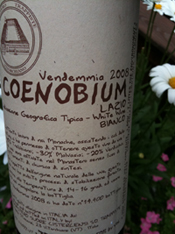
“Pass some more of the nun wine.”

I overheard someone say that at the other end of my table recently. Not Blue Nun, mind you. But a wine actually made by nuns!

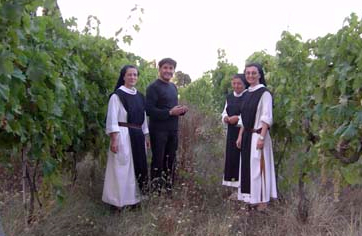
Since the Trappist monks in Belgium still make (and market) Chimay beer, I was pleased to discover that Trappist (Cistercian) nuns still make wine in Lazio, a little to the north of Rome.

The wine in question, Coenobium from the Monastero Suore Cistercensi, is a blend of Trebbiano, Malvasia, and Verdicchio. If you’re looking for a fresh, breezy, fruity, summer quaffer, look to other wines. This white has an oxidative quality that blankets layers of minerals, faint nuttiness, and acidity. The reason these grapes produce such complexity is in large part because the consultant winemaker, the acclaimed naturalista Giampiero Bea, has left the wine in contact with the skins, unusual for a white. They actually make another wine with even longer skin contact called “Rusticum.”

It’s a wine of contemplation that I happened to serve on my deck on a cool summer evening, a context that I think made it more appealing than on a searing hot day.

To finish off our unofficial women and wine week, here’s a picture of the nuns in the vineyards with Giampiero Bea.

Wine rack bra, Jets wine, leafroll, pinot breakup — sipped & spit

SIPPED: jug wine
A sports bra modified to contain 25 ounces of wine and fitted with a nozzle is making the rounds again. Dubbed the “Wine Rack,” it is the companion to the “Beer Belly” for men.

SPIT: New York wine
An Albany blogger throws a flag on the new Jets wine play for not being a wine from New York State, especially after state funds subsidized their pre-season training.

SPIT and a SHRUG: leafroll virus
The leafroll virus is attacking vines in Napa Valley, reducing yields and slowing sugar development. While most producers lament this, some producers don’t mind. [SF Chron]

SPIT: pinot noir
Wine journoblogger Blake Gray pens a break up letter to Pinot Noir. Here’s a taste: “It’s not only because you’ve gained weight, although I won’t deny that’s a big factor…But that’s not the only reason. You’re sleeping with Syrah.” [Gray Market Report]

Tasting note generator given 99+ pt rating!

Wine writers, already about as endangered as the Iberian lynx thanks to the sagging media world (not screwcaps), have something new to fear–automatically generated tasting notes! Have a taste of what the site spits out:

Fully refined almost corpulent Chenin Blanc. Hits you with sage, boggling cardboard and bashful mint. Drink now through 2009.

Now, a sample of “extra silly:”

Neo-classic but equally longingly elegant Zinfandel. Forces smoked oyster, acidic monster gasoline and corpulent jack cheese. Drink now through eternity.

Greg Sumner, the site’s creator and soon-to-be wine overlord, pulls back the curtain to reveal the formula:

How it works.
It’s very simple. I put word types into arrays, then chose a word at random out of the array. The tasting note comes out in the following structure:

(Intro) (Modifier) (Adjective) (Varietal).
(Adverb) (Adjective) (Flavor) flavors, (Adjective) (Flavor), and (Strength-word) (Flavor).
Drink (When) through (EndWhen).

Whoa, keep this thing away from sommelier robots! At least they don’t have a random score generator–yet.

Every time you open a screwcap, a kitten dies!

It’s almost as if cork producers have hired Glenn Beck to present their $22 million marketing campaign! The campaign, mostly in Britain, links a switch to synthetic wine closures to the decline of the endangered Iberian lynx.

If you are interested in the Iberian lynx, surf over to SOS Lynx. It discusses the causes of their dwindling lynx numbers (chiefly, a decline in wild rabbits and 70% of their natural habitats allowing hunting), a doubling of females in recent years, and how most of Iberian lynx live in Spain, not Portugal, which produces over 50% of the world’s cork.

Aria wine bar: Brix by chicks served by guys with… [poll]

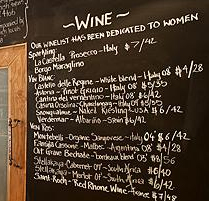
Aria wine bar, opened last month in the West Village, emphasizes wines made using organic using biodynamic methods as well as wines made by women. Christy Frank, who owns a small wine shop downtown, tweeted that she was heading there last week to sample the all-women wine list, seeking out “Brix by chicks” (geek alert: Brix are a measure of sugar in grapes). Eric Asimov chimed in: “No pricks?” I asked Christy on Twitter if there was estrogen on tap. After her visit, she replied: “I was expecting a little more estrogen over all. Evenly split patrons. Manly staff. Tasty squid.”

While more details and opinions about Aria are forthcoming (check out some photos on urbandaddy), the nature of the wine list does raise an interesting question: should a wine list be structured to highlight almost exclusively women, who are woefully underrepresented in winemaking, or is that just a gimmick? Have your say in the comments or the latest poll!

[poll id=”16″]

Choose up to two responses

Divers find old champagne and immediately chug it


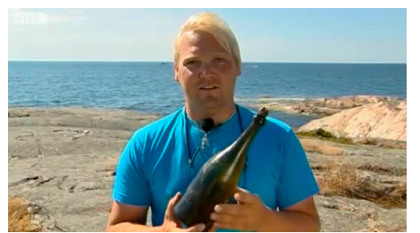
Nordic divers have found a cache of old champagne bottles on a shipwreck in the Baltic Sea. Christian Ekstrom (pictured above via BBC) and his dive partners could not contain their enthusiasm at finding the intact bottles that may date from the late 18th century. So they brought one to the surface, uncorked it, and had a swig. Which statement below captures their reaction?

A) “Damn, it’s only nonvintage yellow label, which hardly keeps from one Christmas to the next. Oh, and the bloody thing is corked!”

B) “It was fantastic… it had a very sweet taste, you could taste oak and it had a very strong tobacco smell. And there were very small bubbles.”

Well, if you guessed (B) then you are right! I personally hate it when the oak doesn’t integrate after 220 years though.

In shades of Rodenstockian abundance, a Reuters story says that the diver does not yet know the number of bottles in the cache. The same story quotes Champagne expert Richard Juhlin saying that he thinks it is late-18th century, from the Clicquot house, and valued at about $68,000 a bottle.

Related: “Cristal at 20,000 leagues under the sea

Opening wine with a shoe–is a Croc

Various notes have come to the Dr. Vino World Headquarters recently: “Is it possible?;” “I am expecting some dr. vino independent trials;” and “Hilarious, can it be done?”

Of course, they are all referring to the most discussed wine topic of today–not Bordeaux 2009 futures, not even natural wine–but how to open a bottle of wine with a shoe.

It all started with a video last fall of a drunken Frenchman and a group of his thirsty friends, which had tens of thousands of views on Youtube before being removed for some reason. Then came this sober French video:

Inspired, challenged, bored and thirsty on a summer afternoon, I grabbed a bottle of six-year-old Italian Pinot Grigio and three-year old California Sauvignon Blanc, both closed with real corks, and headed to the nearest sturdy tree. I banged the bottles against the tree with Crocs, Keens, dress shoes, cycling shoes, dish towels and, finally, straight-up, bottle against tree. Neither of the corks budged. Not a millimeter. Now I was sweaty, annoyed, chagrined and thirstier than before. And the wines had angry bubbles swirling around the bottles.

I’m not saying it can’t be done. I’m just saying I couldn’t do it that day. So my advice to you: at picnics, hiking, when you need to open a bottle without a corkscrew, bring a screwcap. Or champagne.

After the jump, check out the collection of “how to open a bottle of wine without a corkscrew” videos for your your summer time-wasting needs! Read more…

James Suckling, Le Tour, Amazon – sipped and spit

SPIT: en primeur scores?
James Suckling is retiring from Wine Spectator after 29 years. An announcement states that reviewers James Molesworth and Bruce Sanderson will assume the duties for Bordeaux and Italy respectively. Further, “The wines will be reviewed in our standard blind-tastings in the company’s New York office.” Given that Molesworth does not rate barrel samples, is the the end of the magazine’s participation in en primeurs, the system of selling Bordeaux wines two years before the arrive? When asked about it on Twitter, Molesworth indicated it is still an open question.

SIPPED: new owners
Evesham Wood, a small producer in Oregon, has been sold. Russ and Mary Raney have sold their 24-year old, 13-acre vineyard and winery to Erin and Jordan Nuccio. The Raneys will consult as well as spend more time in France. [Avalon wine]

SIPPED: Le Tour pairings
The Tour de France is, in many ways, a rolling promotion for France’s regions. David McDuff makes the link to wine and gastronomy for each stage with maps, photos and guest posts. [McDuff’s Wine & Food Trail]

SPIT: HR 5034
A hearing before a subcomittee about HR 5034 has been postponed, hopefully indefinitely. We maintain our existing threat level.

SIPPED: Amazon sells wine
…in Britain.


winepoliticsamz

Wine Maps


Monthly Archives

Categories


Blog posts via email

@drvino on Instagram

@drvino on Twitter


winesearcher

quotes

One of the “fresh voices taking wine journalism in new and important directions.” -World of Fine Wine

“His reporting over the past six months has had seismic consequences, which is a hell of an accomplishment for a blog.” -Forbes.com

"News of such activities, reported last month on a wine blog called Dr. Vino, have captivated wine enthusiasts and triggered a fierce online debate…" The Wall Street Journal

"...well-written, well-researched, calm and, dare we use the word, sober." -Dorothy Gaiter & John Brecher, WSJ

jbf07James Beard Foundation awards

Saveur, best drinks blog, finalist 2012.

Winner, Best Wine Blog

One of the "seven best wine blogs." Food & Wine,

One of the three best wine blogs, Fast Company

See more media...

ayow150buy

Wine books on Amazon: