Mondo barrel, Bordeaux reorganizes, Enomatics thwarted – sipped and spit
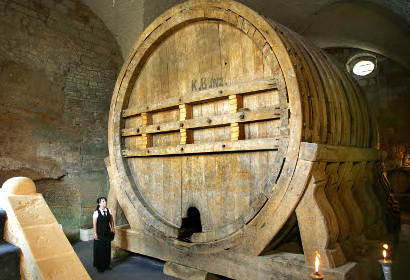

CHUGGED: Dornfelder
Nothing says par-tay like 4,000 liters of Dornfelder! Or so a German chef thought when he partially filled a 140,000 liter barrel for the first time in 400 years. The cause was a two-day bash called the Riessen Weinfass. [TheLocal.de]

SPIT: classified growths?
In an effort to help sales beyond the top wines of the region, local trade authorities in Bordeaux have proposed a four new price categories: Art, Exploration, Fun, and Basic. Move over, classified growths, here comes exploration and fun! [AFP]

SIPPED: bottoms up
Gallup released its annual poll about the drinking patterns of Americans. Wine’s slightly down, but the data show the amount of people consuming alcohol at a 25 year high (hello, recession?). See our discussion about last year’s data.

SIPPED: A Year of Wine
Stevie at the blog wierdcombinations.com has a review of my book, A Year of Wine. He writes, “Like a refreshing Chablis on a warm day, the book is cool, smooth and easy going down with enough earth and interest to keep you wanting more.” Very nice–but it sounds like he should have gotten the magnum edition!

SPIT: fine wine; SIPPED: regulations
Fancy enomatic machines can store and open bottle of wine for days, if not weeks. Thus stores (and bars) can use the system for dispensing tasting sized pours of expensive wines, amortized over days. However, in Vancouver, regulations appear to thwart this: The anonymous bloggers at Winecouver report that authorities are now enforcing regulations that make stores dump all sample bottles 30 minutes before closing, including those in Enomatics. Also, consumers may be limited to two one-ounce pours–in plastic cups.

SIPPED: under the influence
UPDATE: The WaPo follows the beer distributor money on HR 5034.
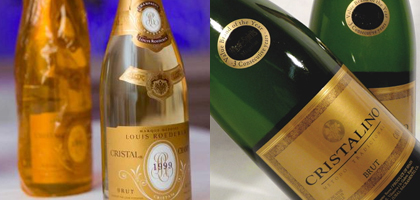
Before the courts: Cristal ($299) defeats Cristalino ($5.99)


Last week, a judge ruled in favor of Cristal champagne over the cava Cristalino. And it wasn’t a taste test.

The makers of the two wines have been sparring in court for the past four years. In the latest round, according to twincities.com, U.S. District Judge Joan Ericksen has barred the makers of Cristalino from “using any mark, word, or name similar to the Cristalino name that is likely to cause confusion, mistake or deception with Roederer’s Cristal marks.” She also ordered them to change the brand’s name, lose the colors, and change the font on the label.

It would be interesting to hear the legal arguments for both sides. But on the face of it, do you think the makers of the $5.99 cava had constructed their product to free ride on the association with the $300 Cristal?

J. García Carrión, the maker of Cristalino, produces and markets fruit juices and wines in Spain. Champagne Louis Roederer has several wine properties outside of Champagne including Domaine Ott in Provence, Chateau Pichon-Lalande in Bordeaux, and Roederer Estate in California.

“A Beaujolais-style Zinfandel” — Paul Draper & Julia Child

Paul Draper appeared on the program “Dinner with Julia” with Julia Child in 1983. As you might expect, he brought along some wines from his Ridge Vineyards. The trip back in time is complete when he offers Julia a Ridge, Amador, 1980 Zinfandel, which he describes as “a Beaujolais-style Zinfandel.” Watch the brief clip to catch a glimpse of Ridge White Zinfandel (who knew!) and to see what Paul pairs with artichoke and lobster!

Bottle deposit reform could add $200 million to NY’s coffers

Governor Paterson and legislators in Albany are trying to reach compromises to close the yawning gap in New York’s budget. Although the proposal to sell wine in grocery stores is back on the table, there is another drinks-related area our officials have yet to uncork: bottle deposits.

Last year, a reform bottle bill passed–largely unnoticed–that included significant changes, notably extending the deposit to include water containers and sport drinks. Further, and more importantly, the system for unredeemed deposits was redirected to send 80% of those funds to the state’s Department of Finance; previously, unredeemed funds rested with the deposit initiators (often beer and soda distributors). This long-overdue reform will bring in an estimated $90 million this year to the state.

But at five cents per container, the deposit remains low, unchanged since the program started in 1982. During the first decade of the bottle bill, redemption rates hovered around 80%. As inflation has eroded the value of the deposit amount, the redemption rate has fallen (details in this pdf).

Raising the deposit rate to ten cents (about even with inflation) even twenty cents per container would have the effect of raising recycling rates and raising revenues for the state through unclaimed redemptions. In 2006 (before water and sport drink bottles were included), deposits collected totaled $289 million while $196 million were redeemed, a 67.8% rate. Doubling the per bottle deposit to 10 cents, would mean $600 million in deposits, while raising the rate to 20 cents would gross $1.2 billion. Even assuming that were to bring the redemption rate back to 80 percent, that would still result in an additional $96 million or $192 million in uncollected deposits for the states coffers. (Raising the state’s share of unredeemed deposits to 90% or higher, would boost state revenues even further.)

That’s a kind of win-win we don’t see too often in Albany. And one that legislators and the governor could proudly raise a glass to.

Related: “Should a bigger better bottle bill include wine bottle deposits?

Woman tries to recycle her cork lingerie [video]

Rather than scaring you about the Iberian lynx, some cork enthusiasts have put out a video to try to save…foxes? Foxes and forests? Bottles sporting wood? Something like that. I am confused.

Holy spritz! Water delivers flavors

In a NYT story entitled, “To Enhance Flavor, Just Add Water,” Harold McGee explains–perhaps counterintuitively–that adding water to (alcoholic) beverages amplifies their flavors and aromas. To the tape:

How can water reduce one sensation and amplify another? Both alcohol and aroma molecules are volatile, meaning they evaporate from foods and drinks and are carried by the air to the odor receptors high up in the nasal cavity.

Aroma molecules are also more chemically similar to alcohol molecules than they are to water, so they tend to cling to alcohol, and are quicker to evaporate out of a drink when there’s less alcohol to cling to.

This means that the more alcoholic a drink is, the more it cloisters its aroma molecules, and the less aroma it releases into the air. Add water and there’s less alcohol to irritate and burn, and more aroma release.

Given that there’s a notion that “alcohol delivers flavors” in wine, this is a useful contribution to the discussion. Read more…

A glass a day…keeps sobriety away

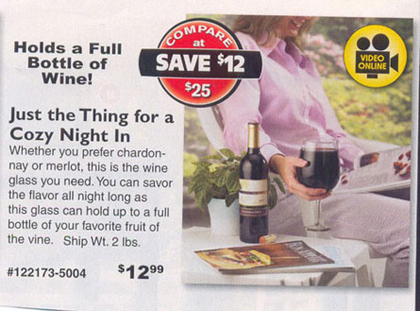
Have you ever thought, “Gee, I’d love to drink this whole bottle of wine–but not right out of the bottle since that’s not classy–and I don’t want to get up from the couch to do so.”

Then the inventors of the supersized, Kotula’s giant wine glass had you in mind! It fits an entire bottle in the glass, right up to the rim. Be sure to check out the hilarious video. (That’s also a party trick you can perform with some of the enormo glasses from Riedel or Bottega del Vino.)

A downside: you sure need a lot of Wine Away if it’s full of red wine and gets knocked over.

Related: “Big glasses make you drink more
Thanks, Leah!

Canadian cows drink red wine for better flavor

The world wine glut just found a new category of consumer: cows.

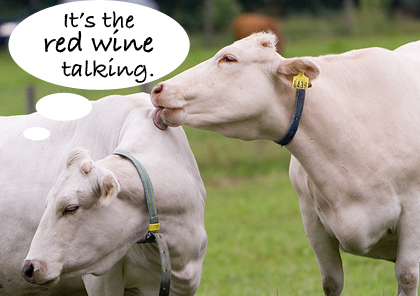
A farmer in British Columbia’s Okanagan Valley is feeding her cattle red wine for the 90 days before slaughter. According to the Vancouver Sun, Janice Ravndahl of Sezmu Meats stumbled on the idea while watching chef Gordon Ramsey feed beer to pigs on his show, The F Word. Because she thought her Angus would get bloated from the carbonation in beer, she started feeding her cows a liter of local red wine a day, sometimes mixed in with their food, sometimes straight. Here’s how the cows reacted:

“When the cows first drink the wine, it’s like ‘what is this?'” says Ravndahl.

“But once they have it, they’re happy to have it again. They moo at one another a little more and seem more relaxed. There are a few that lap it up out of the pail. After they’ve had it for a while, when they see us coming with the pitchers, they don’t run, but they come faster than usual.”

A little more relaxed? And they seem to “talk to each other”? Hey now–I think someone is asking for a candlelit stall for two in the back.

Why do it? Local chefs attest to the subtly more complex flavor. One even remarked that it came “pre-marinated.” If in boeuf bourguignon, the meat cooks in the wine, boeuf a la canadienne must put the wine in the beef first.


winepoliticsamz

Wine Maps


Monthly Archives

Categories


Blog posts via email

@drvino on Instagram

@drvino on Twitter


winesearcher

quotes

One of the “fresh voices taking wine journalism in new and important directions.” -World of Fine Wine

“His reporting over the past six months has had seismic consequences, which is a hell of an accomplishment for a blog.” -Forbes.com

"News of such activities, reported last month on a wine blog called Dr. Vino, have captivated wine enthusiasts and triggered a fierce online debate…" The Wall Street Journal

"...well-written, well-researched, calm and, dare we use the word, sober." -Dorothy Gaiter & John Brecher, WSJ

jbf07James Beard Foundation awards

Saveur, best drinks blog, finalist 2012.

Winner, Best Wine Blog

One of the "seven best wine blogs." Food & Wine,

One of the three best wine blogs, Fast Company

See more media...

ayow150buy

Wine books on Amazon: