Dr Vino's wine blog
wine talk that goes down easy
Reporting from the Wine Media Guild annual dinner
Jancis Robinson, Robert Parker, Hugh Johnson, Burton Anderson, Frank Prial, Kevin Zraly, and Ed McCarthy were inducted into the Wine Media Guild Hall of Fame on Monday night at a ceremony in New York City (there were also posthumous inductees; see the full list and bios). It was the inaugural class inducted into the HoF and therefore the first ceremony.
Members, various guests and two of the inductees poured into the event at I Trulli restaurant. Read more…
Jun
20
2008
5
Six summer sippers under $20
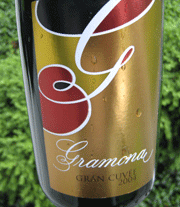 Gramona gran cuvee ($18, find this wine)
In the quest for affordable bubbly, cava often appears. But this 2004 gran cuvee from Gramona is a cut above, softer and rounder than champagne but lacking the sweetness often found in other, lesser cavas. Handsome packaging also makes this a good gift to bring to a lawn party.
Luneau-Papin, Clos des Allees, Muscadet 2005 $12 (find this wine)
One of the unanimously popular wines from my last NYU class, this Muscadet has the vaguely saline allure of good Muscadet yet weaves in a layer of creamy richness. A no brainer with seafood.
Kurt Darting, riesling, Durkheimer 2005 (about $13, find this wine)
From the Pfalz, one of the warmest growing areas in Germany, comes this value riesling from Kurt Darting. The warmer climate makes it have more tropical fruit notes and makes the off-dry wine a great match for spicy foods. It was the most popular wine at a recent tasting I did for 130 people who applauded, cheered and threw panties on stage for this wine when I asked them which was their fave. Riesling appears on the inside track fo the Grape of the Year 2008!
Thierry Puzelat PN ($18, find this wine)
I always love finding a great pinot noir under $20 and this stealth find doesn’t say the grape variety or place on the label. That’s because the naturalista winemaker Thierry Puzelat in the Loire has made this wine as a humble vin de table rather than as a traditional appellation wine so it can’t even provide the vintage either (you can read more about these crazy French wine laws in my new book, Wine Politics). This PN has good pinot character with lively fruit and acidity, which make it a perfect pairing for dining on the deck.
 Yellow + Blue malbec, Mendoza 2007 (about $11 for a liter, find this wine)
This is my first taste of the YB, an unoaked malbec from grapes grown organically in Mendoza that comes in a one-liter TetraPak. Unlike most box wines that have little to distinguish them other than the packaging, this wine has good poise and intensity with berry, plum and herbal freshness. Because it’s a third more wine than a regular bottle, this is a crazy-good value. The ultra-light packaging means it’s easy to throw it in your backpack or picnic basket when you need wine on the go. Try serving slightly chilled.
Chateau d’Oupia, Minervois, 2006 $11 (find this wine)
Fuller bodied than the malbec, this natural wine from Languedoc should be a staple of tightwad grillers everywhere. Grilled meat–preferably without sauce–has met it’s match.
Related: “Which wine pairs with 98 degrees? Australian riesling edition”
“Kickin assyrtiko in Santorini“
Jun
12
2008
Which wine pairs with 98 degrees? Australian riesling edition
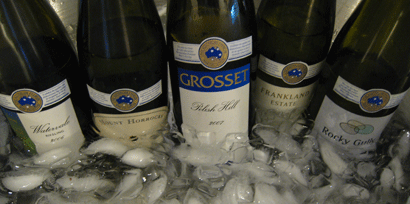
Yikes, it was a scorcher this past weekend and temperatures remained in the “excessive heat warning” levels for four days. So the most pressing question for wine lovers was: which wine pairs with 98 degrees? For us, the answer was dry Aussie riesling.
These young wines were wildly refreshing. Read more…
Jun
11
2008
Croft Port – 1945, 1960, 2003
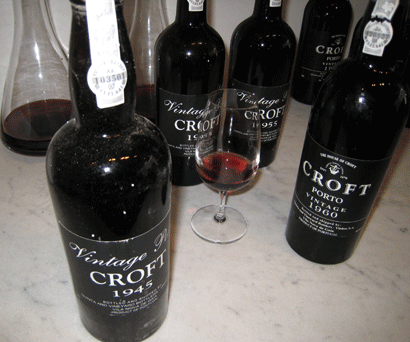
Something amazing happens to a port after about twenty years. And in my case, that’s a good thing since I have several bottles from the excellent 2003 vintage stashed away to celebrate our oldest son’s twenty-first birthday in 2024.
But the absence of aging the wine myself and waiting twenty years, I was able to have an extraordinary tasting experience last week of vintage ports from the producer Croft. Their 1945 is something of a legend — no ’47 Cheval Blanc but you get the idea. So when I heard it was being poured at a press event in Manhattan, I was there in a flash.
In short, it was amazing (find this port). This port, which, if it were human would be gearing up for retirement at age 63, was still going strong with fantastic depth, color and finish. It had beautiful notes of orange zest, aniseed, spice, fig, all in beautiful harmony with great poise.
Although recent records have shown that Croft dates back to 1588 making it the oldest port house, it had fallen on a rough patch for much of the second half of the twentieth century. Among other things, the then-owners installed automated stomping machines and, as I posted last year, when it comes to port, nothing beats the foot. When The Fladgate Partnership purchased Croft in 2001 to bring it under the same ownership as Taylor Fladgate, Fonseca, and Delaforce, one of the first changes, um, underfoot was to rip out all the automatic crushers and install stone lagares for the resumption of foot treading. The 1945 was stomped by foot.
We tasted a few intervening vintages during the automation era and the vintage 1960 stood out as an impressive one (find this port). It was slightly richer brick-red hue and had more notes of anise mocha with supple tannins. But with the 1994, we were clearly on the more youthful side with the color still more the intense purple of youth rather than the faded, brick red that comes with age. The palate impressions were of more youthful intensity too and hadn’t entered the ethereal world of the mature. The first vintage under the new ownership, the 2003, had tremendous color intensity, ripe fruit concentration, viscosity and vigor. I would gladly tuck one of these away in the cellar and at $60 retail (find this port) it’s even a good bargain.
So there you have it: a magical transformation happens to port with more than twenty years of age. It may not be something that you might have been thinking about on a hot June day, but it’s something I can look forward to with my son twenty years hence. And you can enjoy it relatively sooner since vintage port with some age on it continues to be one of the better values at wine auctions.
Jun
9
2008
Six natural wines for summer
 Hot weather. Cold wine. And patchouli.
That’s the subject of a short piece that I did for the new Hearst website, The Daily Green. Well, OK, I didn’t get to mention any patchouli. Click through and see the six “natural” wine producers that I did mention!
Actually, here, I’ll spare you the click through and list them here. But you still have to click through for the pretty slide show and descriptions! One day I’ll learn how to do a slide show here…
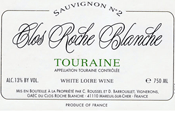
Clos Roche Blanche, Touraine, sauvignon blanc 2006 (about $14, find this wine)
Albert Mann, cremant d’Alsace (sparkling pinot blanc; about $20 find this wine)
Ocone Falanghina del Turbano, 2007 (find this wine)
Cooper Mountain, pinot gris 2006 (about $15, find this wine)
Porter Creek, Fiona Hill Vineyard, Russian River Valley, pinot noir. (about $39, find this wine)
Chateau Oupia, Minervois, 2006. (about $10, find this wine)
May
29
2008
Soft shell crabs: impossible food-wine pairing?!
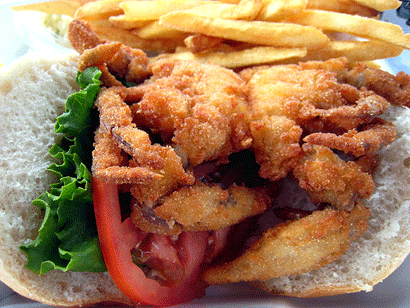
Last week I was chatting with a food writer who was all about the soft shell crab. Then I was cleaning up over the holiday weekend and intercepted Saveur on its way to the recycling bin: “American Crab: A celebration of our favorite spring catch” read the cover. Crabs, they’re everywhere! Perhaps even on your plate.
Since we are now unofficially in summer, when blockbuster movies turn our brains to mush, I thought I’d give you an easy one for our “impossible” foods series: which wine would you pair with softshell (blue) crabs?
(image)
May
28
2008
Two wine classes in Chicago this fall – with books!
 This fall, I’ll have the good fortune to return to Chicago. No, I won’t be contender on Top Chef though I do hope to eat in some of the city’s great restaurants or BYOBs.
Both of the trips will be anchored by classes at the University of Chicago’s Graham School, which are open to everyone who chooses to register. On September 20, I’ll lead a Saturday afternoon seminar called “France and America: Wine Politics and a Tasting Showdown.” We will talk about themes from my upcoming book, Wine Politics, and then have a wildly fun, blind and competitive tasting of wines from the two countries. The wine budget for these events is good and in the past we have had some excellent mature wines in a variety of sizes. All participants will receive a signed copy of the book as part of the enrollment. Details and registration.
On December 6, we’ll be talking and tasting holiday wines in another Saturday seminar. This time the discussion will be centered around my second wine book, “A Year of Wine,” which will be published in November by Simon & Schuster. As with the September event, the wines will be fun and participants will receive a signed copy of this book too. Details and registration.
Although this may seem like eons from now, apparently we get a nicer room if signups are strong early. So sign up! See you there!
May
16
2008
Kickin assyrtiko in Santorini
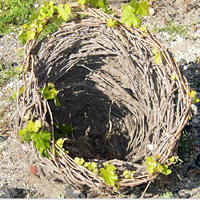 I had a wine that came from a nest today. The vineyard manager would probably call it basket or even ampelies. But to me it looked like a nest. Granted, I was only looking at a photo–if only I could have arranged a field trip to the vineyard.
Blown to bits by a volcano in 1640 BC, the sliver of a Greek isle that is today Santorini has many old vines. They struggle. They cling to the earth. And the vineyard workers prune them into these nest/baskets intentionally to help them against the elements, notably the near-constant wind blowing over the treeless slopes. The other element is water. The vines survive the scorching summer days by collecting moisture in the nests at night when the fog rolls in. Sounds quite dramatic and I’ll have to check it out with Mrs. Vino one day. And the sunsets. And the food. But back to the wine!
Domaine Sigalas, Assyritiko-Athiri 2007, $16 (find this wine)
This dry wine has a nice creaminess on top of good acidity that makes it extremely user friendly. The importer, Ted Diamantis, told me that it’s the Athiri grape that gives it that richness. The Domaine farms organically.
For wine geeks, the other wine, a straight assyritiko varietal wine (find this wine), has some off-the-charts briney qualities with a faint smokiness and minerality–the gout de terroir of Santorini, no doubt. Ted suggested pairing it with shellfish with high iodine-levels, like oysters. Sounds like a plan.
In lieu of their own winery website, here’s a link to Domaine Sigalas on the useful site All About Greek Wine.
Check out a nice pic of a Santorini vineyard over here.
May
15
2008

Wine Maps
Monthly Archives
Blogroll
Categories
- American wine
- announcements
- Argentine wine
- auctions
- Australian wine
- Beer
- best wines
- Bling
- books
- Bordeaux
- bottled water
- Box wine
- Burgundy
- business of wine
- Celebrity wine
- Champagne
- Chicago
- China
- cocktails
- cognac
- corks
- corkscrews
- dining
- eco wine
- events
- foie gras
- food and wine
- French wine
- German wine
- giveaway
- grapes
- green wine
- guest post
- highlights
- how to
- Italian wine
- leaders and liters
- Mature wine
- meetups
- New York City
- On notice!
- photo captions
- podcasts
- Polls
- Port
- Portuguese wine
- power list
- reader mail
- rose
- sake
- Sommeliers
- South Africa
- Spanish wine
- spirits
- tasting sized pours
- The real wine world
- TV and movies
- Uncategorized
- videos
- vinexpo
- Weather
- wine and health
- wine and sports
- wine and tech
- Wine Blogging Wednesday
- wine blogs
- wine classes
- wine collecting
- wine gifts
- wine in india
- wine labels
- wine picks
- wine politics
- wine quizzes
- wine random
- wine science
- wine scores
- wine shops
- wine technology
- wine travel
- Wine under $10
- wine writing
- winemaking
- winespeak
 Blog posts via email
@drvino on Instagram
@drvino on Twitter
Advertise

quotes
One of the “fresh voices taking wine journalism in new and important directions.” -World of Fine Wine
“His reporting over the past six months has had seismic consequences, which is a hell of an accomplishment for a blog.” -Forbes.com
"News of such activities, reported last month on a wine blog called Dr. Vino, have captivated wine enthusiasts and triggered a fierce online debate…" The Wall Street Journal
"...well-written, well-researched, calm and, dare we use the word, sober." -Dorothy Gaiter & John Brecher, WSJ

Saveur, best drinks blog, finalist 2012.
One of the "seven best wine blogs." Food & Wine,
One of the three best wine blogs, Fast Company
Books for wine geeks

Wine books on Amazon: