Forget web 2.0 — some wineries need web 0.9 (plus some wine picks)
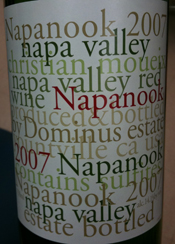
More Americans are drinking wine today than ever before. However, increasingly confident and interested wine consumers are thirsty not just for wine, but for reliable information about the wines they consume. Sadly, winery (and importer and trade association) websites don’t always provide the information we now crave. Forget social media and “web 2.0”–too many wineries haven’t even mastered web 0.9 yet.

Consider the recent discussion about Corbieres that emerged following my post about a wine from the region last week. Readers debated the percentage limits for the grape Carignan in the wine. Since this is a statute of the AOC regulations, you’d think it would be on the AOC/syndicat web site. But it’s not.

Or consider the six wines I was putting together my NYU wine class for last night. I was looking for some basic information about the wine I was serving, the vineyards, the cellar masters, and a photo for the slide show. Here’s what I found: Read more…

SPAM, Pop Tarts, crab meat – emergency impossible pairings!

A Carnival cruise ship headed on a seven-day tour of Mexico’s Pacific coast had a fire and was adrift for two days. Mexican tugboats and American Coast Guard and Navy ships have come to the aid of the 4,500 people on board Carnival Splendor. No one was hurt, but the AP reports that they were without air conditioning, cell phone service, and internet access! Here’s more from the story:

U.S. Navy Seahawk helicopters were ferrying supplies, including Spam, crab meat, croissants and Pop Tarts to the ship from the USS Ronald Reagan, an aircraft carrier that reached the Splendor after it was diverted from training maneuvers to help.

My goodness, are they trying to rescue these people or kill them? Pairing those with wine sound…impossible! (Crab meat is the easiest by far, though.) So in this emergency edition of our impossible pairings, consider which wine you would send these marooned vacationers to pair with their emergency rations and plight. Which wines would you send along if you were the Coast Guard sommelier?

reduced size crop of AP/Gregory Bull image.

Wine Politics, now in paperback! [giveaway]

My book, Wine Politics: How Governments, Environmentalists, Mobsters and Critics Influence the Wines We Drink, is now available in a new version: paperback! Not as lightweight as the existing Kindle edition and about the same weight as the Korean translation, the paperback is at least lighter–and cheaper!–than the original hardback edition.

Get background information and analysis on important wine topics such as why French wine advertisements aren’t allowed to show women looking sultry, how appellations can strangle originality, and why it’s easier to ship a case of wine from Bordeaux to Berlin than from Napa to New Jersey.

I’m giving away three personally inscribed copies of the new paperback to three people here! To qualify, leave a comment on this post noting the state or country where you live and if you’re happy with the ability (or not) to have wine shipped to you. Fortunately, books can be shipped to all 50 states but we request domestic addresses only for the giveaway; leave your comment by midnight Thursday to qualify for the drawing of three random winners on Friday.

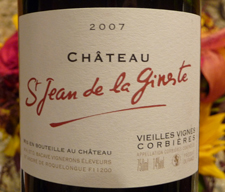
St. Jean de la Gineste – a value vielles vignes carignan

Carignan. When Bacchus was handing out the mellifluous names of grape varieties in French–Cabernet, Chardonnay, and Merlot roll easily of the anglophone tongue–he had apparently run out by the time he got to Carignan. In America it is often called carignane when planted, if at all, on domestic soil. But even in the Languedoc, in the south of France where the grape proliferates, reasonable people like Jancis Robinson have dumped on the grape for tasting like battery acid (or something).

By contrast, Becky Wasserman told me she considers Carignan to be “the Pinot Noir of the south,” especially given its high natural acidity. Wasserman, an exporter of French wine, includes one Carignan in her portfolio and it is a value, particularly now as the weather turns chilly. The family-run St. Jean de la Gineste, in the Corbieres appellation, cultivates some old vines of Carignan, ferments the grapes in a neutral, concrete vessel, and blends in 15 percent grenache. I purchased the resulting 2007 wine at New York Vintners for about $14 and found this true taste of Carignan to be worthy of respect. Dark in the glass, the un-pinot-like 14% alcohol makes it a bigger wine but the rustic grape tannin is unadorned by oak and then there’s the good acidity. Now if only I could rustle up some cassoulet…

New Zealand wine stomps carbon footprint on the label

Starting early next year, some consumers will be able to buy a wine with a carbon footprint analysis on the label. Mobius, a new sauvignon blanc from New Zealand’s Marlborough region, will sport a calculation of greenhouse gas emissions on a per glass basis. Bottles destined for Australia will be the first to receive the notations; other markets will follow with custom calculations from the Carbon Trust, a nonprofit. The wine is made by New Zealand Wine Company, which also owns Grove Mill, run by emissions-guru Dave Pearce.

With so little space on the label, the graphic and number are helpful for a cursory indication. But it would be even more useful if carbon-label.org provided more information about the calculations. Hopefully the estimates will be conservative since, as my own research has shown, the mode of transportation matters as much or more than the actual distance traveled, making it difficult to put one number on a bottle for countries as big as Australia or the US, where a lengthy truck journey can add more to the GHG calculations than an even longer sea voyage.

Providing the methodology is acceptable, it is a step in the right direction. Given that wines entered in the Air New Zealand Wine Awards must now be certified “sustainable”, perhaps the industry will similarly provide some sort of carrot for other wineries to adopt carbon emissions labeling.

See the full label after the jump. Read more…

Hong Kong buyers pay four times retail for Lafite 2009

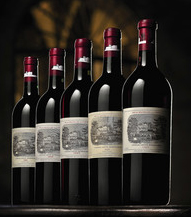
Last week, Sotheby’s held an auction of wines from Chateau Lafite-Rothschild in Hong Kong that broke many records.

As has been covered elsewhere, one Asian telephone bidder snapped up three bottles of 1869 Lafite for $232,000 each–a new per bottle record. Other rarities appeared in the sale of 2,000 bottles spanning 139 years.

But one aspect of the sale that struck me was the premium paid over retail prices. Decanter.com has a helpful rundown on the spreads, many of which are justifiable given the provenance of the wines (they were coming directly from Lafite’s cellars in the Medoc.) Most notable for me were the 2009s and 2008s which are still only available on a futures basis–the wine has not even been put in the bottle, much less left the property yet. In other words, whether you buy it in New York, LA, Hong Kong or London, the wine has yet to be shipped so you’d think the prices would harmonize (with the exception of duties). Yet Decanter reports the prices paid for 2008 futures were 102% over retail and the 2009s were almost 300% over retail. Similarly, Hong Kong hammer prices frequently fetch higher prices than the same wines in New York of London.

I called Jamie Ritchie, Head of Wine at Sotheby’s New York office, to ask why. He described the scene last week in Hong Kong as “the best you can get” as an auctioneer: the room was full to capacity, with a lot of excitement, and a lot of bidding in the room and on the telephone. As to the premium for the 2008s, he said they announced the new Chinese character on the bottle and there was “a lot of appreciation for that gesture.” And why pay $70,000 a case for the 2009s (that sell for $17,000 a case in New York)? “Sheer unbridled enthusiasm,” he said.

How much does it cost to physically ship a case of wine to Hong Kong from either New York or Bordeaux to Hong Kong? Depending on volume, Ritchie said about $15 to $40 a case. There are no duties.

Sotheby’s next auction in Hong Kong will be January 22 and 23.

The “Champagne” ritual in baseball gets icy reception

Major League Baseball seeks to make the absurd ritual of victors spraying each other with drinks a non-alcoholic one. Korbel weeps. Catawba producers may break out the bubbly.

The NYT reported on the new guidelines over the weekend: “Teams must limit Champagne; offer a non-alcoholic version; beer and other types of alcoholic drinks are banned; and teams are not allowed to bring the drinks on the field.”

Sadly, the Times echoes most other sports reporting, calling the bubbly uncorked and sprayed all over the players “Champagne” when, as you know, the Dr. Vino spy cam has yet to see an actual bottle of champagne in a plastic-draped locker room this post season.

While I am generally all for defending wine consumption in the public eye, I find it difficult to get too worked up about this latest MLB ruling. Clubs decided to forego champagne in favor of cheaper sparkling wine long ago. And while wine producers might want to bask in the aura of victory, what vintner would want to have their wine consumed out of an athletic cup while wearing ski goggles? I mean really, that would make even more people shudder than just Max Riedel!

The victors certainly deserve a celebration. But they have all off-season to savor the Champagne, with food and friends, without having to wear goggles.

Pumpple pie: impossible food-wine pairing?!?

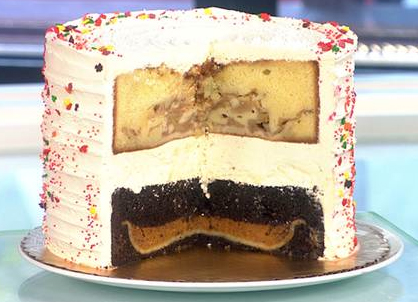
Tired of having to decide between apple pie and pumpkin pie? A Philadelphia baker now gives you the chance to try both–at once.

As Kathy Lee and Hoda demonstrated on the Today Show, the “pumpple” pie bakes a pumpkin pie inside a chocolate cake, an apple pie in a vanilla cake and slathers the two pies in buttercream icing. Move over turducken! A slice is purported to have 1,800 calories.

Which wine would you pair with this dessert that eats like a meal? Or is it…impossible?!?


winepoliticsamz

Wine Maps


Monthly Archives

Categories


Blog posts via email

@drvino on Instagram

@drvino on Twitter


winesearcher

quotes

One of the “fresh voices taking wine journalism in new and important directions.” -World of Fine Wine

“His reporting over the past six months has had seismic consequences, which is a hell of an accomplishment for a blog.” -Forbes.com

"News of such activities, reported last month on a wine blog called Dr. Vino, have captivated wine enthusiasts and triggered a fierce online debate…" The Wall Street Journal

"...well-written, well-researched, calm and, dare we use the word, sober." -Dorothy Gaiter & John Brecher, WSJ

jbf07James Beard Foundation awards

Saveur, best drinks blog, finalist 2012.

Winner, Best Wine Blog

One of the "seven best wine blogs." Food & Wine,

One of the three best wine blogs, Fast Company

See more media...

ayow150buy

Wine books on Amazon: