Illinois, France, freedom, jugs, corks in space – sipped and spit
wine lightSPIT: freedom in Illinois!
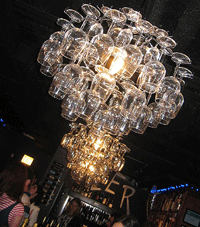
Wine-loving residents of the Land of Lincoln now have fewer choices: It’s confusing, but in a law effective today, wineries (both out-of-state in-state) will have caps on the amount they can ship to Illinois and out-of-state retailers will be banned from shipping to the state. While it’s a sad day and you can chalk one up for special interests let’s just hope this legislative folly goes the way of the foie gras ban soon enough. [Chicago Tribune]

SPIT: freedom in France
Liberté takes a back seat in France too where wine ads are strictly controlled in France and Microsoft has taken the unusually cautious step of removing wine ads from their ad service (Google ads still include wine on the internets in France). If anyone is looking at this site in France, remember, ceci n’est pas une pub! [thepost.ie]

SIPPED: wine education
An inside look at wine education at the Sommelier Society of America. [NYT]

SPIT: jugs!
Almaden and Inglenook, two wines known for their big jugs, will now come in the lightweight bag-in-box format. It sounds like old wine in new wineskins but because of the volume involved it will contribute to reducing wine’s carbon footprint. [Bizjournals]

SIPPED: corks in space
Schramsberg winery reports that Navy Commander Kenneth Ham is flying with bottles of the bubbly on board the space shuttle Discovery! If only. But he is taking some corks and labels from the Napa sparkling wine producer on the flight with him.

SIPPED: Wine books
A review of three wine books today in the NYT Book Review section follows one by Eric Aismov from ten days ago to review the spring crop of wine books. And, yes, my reviews will follow soon before you head to the beach this summer!

RIP: Robert Mondavi, the American wine colossus, who died at 94. [SF Chron, NYT]

(image)
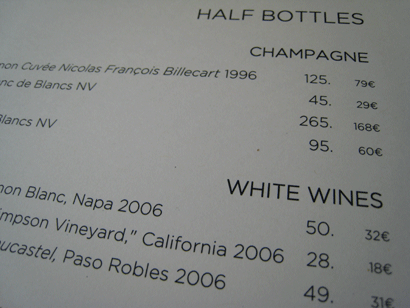
Wine list at The Modern has prices in euros

modern wine list
In a further sign of how our currency is rapidly becoming the American peso, the wine list at The Modern restaurant on West 53rd Street (below MoMA) in Manhattan now lists the euro equivalent pricing.

During lunch there yesterday, I asked if they actually accepted euros for payment. They said it is for informational purposes only to help their European guests make the conversion. Must be a pretty picture for the Europeans! The only catch for them as they order their magnums is that the price on the menu does not include service and tax as is the norm in Europe, which could lead to a 25 percent upside surprise when the check comes.

Six natural wines for summer

crbsbHot weather. Cold wine. And patchouli.

That’s the subject of a short piece that I did for the new Hearst website, The Daily Green. Well, OK, I didn’t get to mention any patchouli. Click through and see the six “natural” wine producers that I did mention!

Actually, here, I’ll spare you the click through and list them here. But you still have to click through for the pretty slide show and descriptions! One day I’ll learn how to do a slide show here…

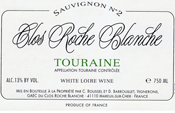
Clos Roche Blanche, Touraine, sauvignon blanc 2006 (about $14, find this wine)
Albert Mann, cremant d’Alsace (sparkling pinot blanc; about $20 find this wine)
Ocone Falanghina del Turbano, 2007 (find this wine)
Cooper Mountain, pinot gris 2006 (about $15, find this wine)
Porter Creek, Fiona Hill Vineyard, Russian River Valley, pinot noir. (about $39, find this wine)
Chateau Oupia, Minervois, 2006. (about $10, find this wine)

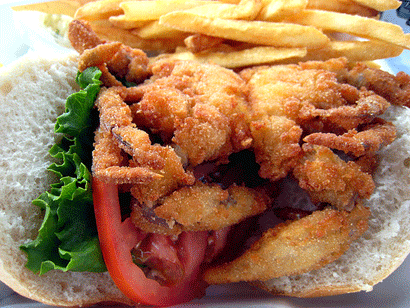
Soft shell crabs: impossible food-wine pairing?!

soft shell crab
Last week I was chatting with a food writer who was all about the soft shell crab. Then I was cleaning up over the holiday weekend and intercepted Saveur on its way to the recycling bin: “American Crab: A celebration of our favorite spring catch” read the cover. Crabs, they’re everywhere! Perhaps even on your plate.

Since we are now unofficially in summer, when blockbuster movies turn our brains to mush, I thought I’d give you an easy one for our “impossible” foods series: which wine would you pair with softshell (blue) crabs?

(image)

Is wine service in American restaurants going to the dogs?

sommelier smallBad news comes in threes, allegedly. After a third high-profile, stinging rebuke, can America’s wine servers now breathe a sigh of relief? The main issue in all these critiques is tempo and how diners feel rushed. Polemicist Christopher Hitchens, who last attacked God and now brings his wrath down on America’s wait staff, is the most recent critic of wine service calling it “cruel abuse” (um, yikes) in Slate. To the tape:
The vile practice of butting in and pouring wine without being asked is the very height of the second kind of bad manners. Not only is it a breathtaking act of rudeness in itself, but it conveys a none-too-subtle and mercenary message: Hurry up and order another bottle.

The same thing bothered Roger Cohen who took his complaints to the unlikely location of the op-ed page of the New York Times:

I was dining the other night with a colleague, enjoying a respectable Russian River Pinot Noir, when he said with a steely firmness: “We’ll pour our own wine, thank you.” This declaration of independence was prompted by that quintessential New York restaurant phenomenon: a server reducing a bottle of wine to a seven-minute, four-glass experience through overfilling and topping-up of a fanaticism found rarely outside the Middle East.

Finally, the generally sunny John and Dottie dropped the hammer on wine pairing menus in the WSJ in February saying that at Le Bernardin “the wines came and went as a blur” and that, in general, ordering the wine pairing menu “can mean being treated like a rube.” Although tempo was their biggest gripe, they also criticized other aspects of the service including glassware and wine freshness.

So is wine service in American restaurants going to the dogs? Eric Asimov did note a labor shortage two years ago in skilled staff. But Mike Steinberger argued convincingly that American sommeliers were better than their French counterparts.

One thing is for sure: markups are high and a recession is nigh. Gallo, not a name one usually thinks of in restaurants, recently admitted that a weakening in dining out was crimping their overall sales. If diners start staying home then maybe wait staff will be able to linger longer.

(image)

Poll: bringing wine home in an age of baggage charges

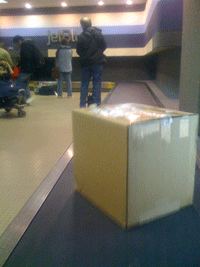
wine shippingLast February, after some time in Napa and Sonoma, I checked my bag and a case of wine at Oakland airport. The nice guy who helped me at JetBlue asked me if I wanted a “fragile” sticker on my box o’ wine. I asked, “Does it really make a difference?”
“Nah,” he replied. I appreciated the honesty!

It turns out that trip was the last of a golden era, the era of “free” checked luggage. Now almost all airlines charge $25 for a second bag and American Airlines continues the Ryanairification of American air travel by imposing a $15 fee on the first bag. (Southwest, of all airlines, still allows two checked bags at no additional charge!)

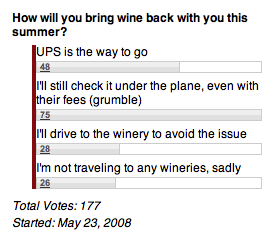
As travel season kicks off with $4-a-gallon gas this Memorial Day, many wine enthusiasts might be giving thought to how we’ll bring wine home from our travels. UPS certainly looks better with these new airline surcharges (no schlepping!). But then there’s the heat of summer to contend with and it’s withering effect on wine–at least the short airline trip would minimize that.

If your travel takes you to a domestic winery this summer, how will you bring the loot home?

Poll now closed

Related: Bringing wine home from overseas

Is there a consensus about good wine?

parker“Wine guru Parker says he’s happy with a $20 bottle,” blared a Reuters headline from a Tokyo stop on Robert Parker’s Asian trip. Yay! Before heading to a $3,000-a-head tasting dinner, he suggested to locals that it was OK to drink Beaujolais Nouveau, zinfandel starting at $18, and malbec from Argentina.
But buried in the story, Parker said, “You hear the argument you can’t go through a museum and say, ‘The Monet gets a 90 and the Cezanne gets 88.’ But there is a general consensus to what is good wine. I’m not trying to replace your taste, or the person buying the wine…”

Really? Unlike Parker, I find few “good” examples of Beaujolais nouveau (cru Beaujolais is an entirely more rewarding category, however). And some tasting panels can’t agree on what constitutes “good” either: Consider the recent Times panel on Soave where one taster said ”I was shocked at how many of the wines I didn’t like” to which Eric Asimov replied, “Needless to say, I disagreed.” Consensus? And remember the controversial 2003 Chateau Pavie? Finally, I doubt Parker and Alice Feiring would have many overlapping examples of “good” wines. When have you not agreed with someone else about a wine’s being “good”?

Speaking of lack of consensus, it’s also sometimes hard to determine what is “typical” as a portion of Jean-Paul Brun’s Beaujolais has been denied the appellation, ostensibly for being atypical. Or, in his case, good.

Hangovers, congeners and cures

doggie bagIt’s not even January 1 and there’s an article about hangovers! Joan Acocella writes in the New Yorker about the phenomenon that Egyptians call “still drunk,” the Japanese “two days drunk,” the Chinese “drunk overnight” and the Danes “carpenters in the forehead.”

While drinking to excess without a resulting hangover might sound like something technology should have fixed by now (in a world of fat-free desserts, how could they not?), Acocella doesn’t suggest much in the way of a cures. But she does talk about various causes. To wit:

The severity of a hangover depends, of course, on how much you drank the night before, but that is not the only determinant…And what kind of alcohol did you drink? In general, darker drinks, such as red wine and whiskey, have higher levels of congeners—impurities produced by the fermentation process, or added to enhance flavor—than do light-colored drinks such as white wine, gin, and vodka. The greater the congener content, the uglier the morning.

Does that red-white difference ring true for you? What about “natural” winemaking? Partisans of sake often tout its purity and some even go so far to say that it doesn’t give headaches. I’ve never put that to the test.

And as to the cure, she suggests wearing sunglasses and moping around. Just kidding. Folklore often dictates the “hair of the dog.” But I’d steer clear of this morning-after twist from a Ukrainian in the story: “two shots of vodka, then a cigarette, then another shot of vodka.” She counsels to avoid Tylenol since it increases toxicity to the liver. For prevention, she points to advocates of drinking lots of water, a glass of milk or eating a meal prior to drinking. And, of course, consuming alcohol in moderation.

A Few Too Many,” By Joan Acocella, The New Yorker


winepoliticsamz

Wine Maps


Monthly Archives

Categories


Blog posts via email

@drvino on Instagram

@drvino on Twitter


winesearcher

quotes

One of the “fresh voices taking wine journalism in new and important directions.” -World of Fine Wine

“His reporting over the past six months has had seismic consequences, which is a hell of an accomplishment for a blog.” -Forbes.com

"News of such activities, reported last month on a wine blog called Dr. Vino, have captivated wine enthusiasts and triggered a fierce online debate…" The Wall Street Journal

"...well-written, well-researched, calm and, dare we use the word, sober." -Dorothy Gaiter & John Brecher, WSJ

jbf07James Beard Foundation awards

Saveur, best drinks blog, finalist 2012.

Winner, Best Wine Blog

One of the "seven best wine blogs." Food & Wine,

One of the three best wine blogs, Fast Company

See more media...

ayow150buy

Wine books on Amazon: