Inflation through the wine glass
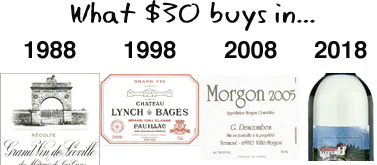
What $30 would buy in…
1988: Second growth Bordeaux
1998: Fifth growth Bordeaux
2008: Cru Beaujolais
2018: Vinho verde?!?
Jun
23
2008
11
What $30 would buy in…
1988: Second growth Bordeaux
1998: Fifth growth Bordeaux
2008: Cru Beaujolais
2018: Vinho verde?!?
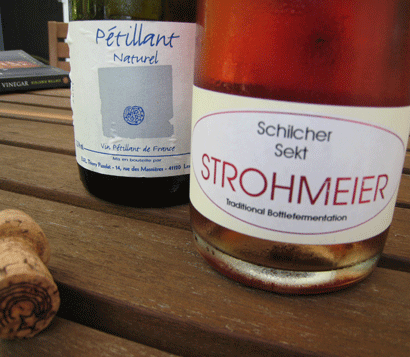
An $18 bubbly showdown! Well, it was and I didn’t even plan it. Some friends came over recently and we each had a bubbly ready to go. So what are wine lovers to do? Why, open them both, of course!
First up, from the Loire was Thierry Puzelat, naturalista wine maker who made it through to the quarterfinals in the Wine Madness tourney back in March. I was ready for Thierry to bring the shazam since I am a fan of his wines. But the cork on the Vin Pétillant de France Naturel Non-dosé released with a whimper rather than a bang. The mousse–the foamy part–was weak! This pétillant did not have the gas (literally) to keep it frothing! Upon tasting, it was more like cider than Champagne–that non-dosé stuff can be tough to make. A bummer! One person dumped her glass! (Ahem!) Puzelat, upended! Shades of Wine Madness all over again!
Then it was on to the Strohmeier…I mean come on, who’s ever heard of Strohmeier? They’re an Austrian producer founded in 1990, which is practically a New World time frame. And it’s not even from the esteemed Wachau–it’s from Styria! Some southern part of Austria that has produced, among other things, the Governator! And the grape in this Schilcher Sekt nonvintage–Blauer Wildbacher? Let’s get serious! Now to the pour: major mousse! Frothing all over the place. Bright pink effervescence in the glass! Now on to the taste. Oooh, it’s got hints of strawberry, it’s juicy, it’s got good acidity–in short, a delightful summer sipper on the deck! No glasses dumped on the geraniums! Strohmeier takes home the trophy in this spontaneous $18 bubbly showdown!
Find the Puzelat petillant
Find the Strohmeier Schilcher Sekt nonvintage
Jancis Robinson, Robert Parker, Hugh Johnson, Burton Anderson, Frank Prial, Kevin Zraly, and Ed McCarthy were inducted into the Wine Media Guild Hall of Fame on Monday night at a ceremony in New York City (there were also posthumous inductees; see the full list and bios). It was the inaugural class inducted into the HoF and therefore the first ceremony.
Members, various guests and two of the inductees poured into the event at I Trulli restaurant. Read more…
 The United States of America will soon become the largest wine drinking country in the world. It depends on whom you ask, but some time in the next year or two or five, we will be downing more of the fermented fruits of the vine than any other country–including France and Italy. Of course, they still tower over us with 52 and 46 liters per person respectively while we manage only about 13 liters per American (somewhere between a third and a half of Americans claim never to drink alcohol).
So we have to be ready: we need a motto. Britain did it. Then Freakonomics blog urged their readers to come up with one for America in six words. Collectively, we drink and now YOU can decide: Post your suggestions in the comments here for America’s new motto as the top wine consuming country.
Ray Isle, who writes his own excellent blog (now with pictures!) when he’s not giving wine seminars in Aspen or writing his wine column for Food & Wine magazine, will join me as a mini-panel of flag pin-wearing judges. We will cull through your suggestions and select some finalists for your voting, starting next Tuesday.
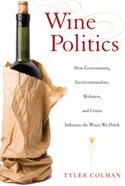 And to up the ante from our usual prize of mere “glory,” whoever submits the winning slogan will win a signed copy of my just-about-released book, Wine Politics: How Governments, Environmentalists, Mobsters, and Critics Influence the Wines We Drink. That’s right, the book that tells the story of wine in France and America through the lens of industry politics could be yours for the Fourth of July.
So put down your flag for a second and start typing your slogan for America as world wine leader!
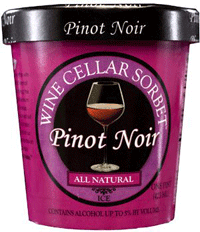 SPIT: wine ice cream!
Move over Cherry Garcia, here comes pinot noir ice cream! Well, assuming you’re over 21. Yes, the New York legislature passed a law preventing minors from getting their hands on the stuff since two gallons of the ice cream contains as much alcohol as one glass of wine according to one producer. Can’t be too careful, New York!
SIPPED: wine and war
Faced with budget cuts for veterans, the fabled French Foreign Legion has gotten into the wine biz to raise funds from the sale of a wine called “Esprit de Corps.” An officer who overseas the property had this tasting note for the wine: “Strong when attacked, solid on the onslaught, full of grapeshot on the frontline.” [AFP]
SPIT: tasting notes!
“From now on, wine drinkers, you get to mention three things you smell in a wine, max. Then you have to tell me something more interesting.” I guess he’d like the note for the “Esprit de Corps.” [Chicago Tribune, thanks, Stephen!]
SPIT: liquid soap!
A restaurant in New Zealand mistakenly served dishwashing soap to two customers thinking it was mulled wine. Courts awarded the stricken customers $752 each for their emotional harm. [AP News, thanks, Casey!]
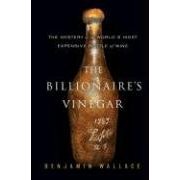 In 1985 at Christie’s auction house in London, Kip Forbes–dispatched by his father Malcolm to bring home a bottle of 1787 Bordeaux on the Forbes private jet–finds surprising competition from a then-upstart publisher: Marvin Shanken of the fledgling Wine Spectator. A spectacular bidding war ensues over the bottle that may have belonged to Thomas Jefferson and one of them takes the bottle back to New York in an extra seat on the plane, strapped to a mattress (read the book to discover which one) after winning it for $156,000.
Such is a great scene near the beginning of the fantastic book Billionaire’s Vinegar: The Mystery of the World’s Most Expensive Bottle of Wine. Released last month, this page-turning book that reads like fiction has already reached the extended NYT bestseller’s list. It’s a wine book that has a lot of appeal beyond simply wine geeks since the book’s verve derives not from tasting notes but a mystery over whether the bottle that Shanken and Forbes bid on was real or fake. Read more…
 As the American dollar has come to resemble a peso, a zloty or another currency that needs an infusion of iron (or gold), Champagne producers may be heading for other countries that can actually pay full price for the stuff. To wit, from today’s NYT, comes word that champagne shipments have fallen six percent this year, the first decline since 2001. But it gets worse. To the tape:
“The euro is rising and the dollar is falling, and soon we’ll have a real structural problem if the cost of the grape keeps increasing every year,†said Ghislain de Montgolfier, the departing president of the Champagne maker Bollinger and leader of the Union of Champagne Houses, a trade industry group.
Within the elite world of Champagne makers, there is discreet debate about shifting strategies in the United States, including possibly reducing volumes or shipping bottles to other countries with stronger currencies.
Boizel Chanoine Champagne, for example, closed its subsidiary in New York. “The U.S. today is not our priority,†Céline Voide of Boizel said. “We prefer to concentrate on Europe and Asia.â€
Don’t leave us! Take our fistful of dollars but don’t bid us farewell! Stay for the all brides and grooms out there and all those who need to christen boats. The rock stars, real estate moguls, and the hedge fund managers. And don’t forget us wine geeks. What are we going to put in our American flag encrusted champagne flutes? Key words for American bubbly enthusiasts in 2008 remain: prosecco, cremant d’alsace, cava, and sparkling wine.
Related: “Talking Champagne with Peter Liem of Wine & Spirits“
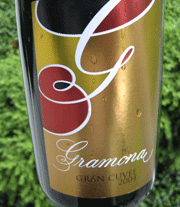 Gramona gran cuvee ($18, find this wine)
In the quest for affordable bubbly, cava often appears. But this 2004 gran cuvee from Gramona is a cut above, softer and rounder than champagne but lacking the sweetness often found in other, lesser cavas. Handsome packaging also makes this a good gift to bring to a lawn party.
Luneau-Papin, Clos des Allees, Muscadet 2005 $12 (find this wine)
One of the unanimously popular wines from my last NYU class, this Muscadet has the vaguely saline allure of good Muscadet yet weaves in a layer of creamy richness. A no brainer with seafood.
Kurt Darting, riesling, Durkheimer 2005 (about $13, find this wine)
From the Pfalz, one of the warmest growing areas in Germany, comes this value riesling from Kurt Darting. The warmer climate makes it have more tropical fruit notes and makes the off-dry wine a great match for spicy foods. It was the most popular wine at a recent tasting I did for 130 people who applauded, cheered and threw panties on stage for this wine when I asked them which was their fave. Riesling appears on the inside track fo the Grape of the Year 2008!
Thierry Puzelat PN ($18, find this wine)
I always love finding a great pinot noir under $20 and this stealth find doesn’t say the grape variety or place on the label. That’s because the naturalista winemaker Thierry Puzelat in the Loire has made this wine as a humble vin de table rather than as a traditional appellation wine so it can’t even provide the vintage either (you can read more about these crazy French wine laws in my new book, Wine Politics). This PN has good pinot character with lively fruit and acidity, which make it a perfect pairing for dining on the deck.
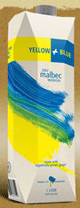 Yellow + Blue malbec, Mendoza 2007 (about $11 for a liter, find this wine)
This is my first taste of the YB, an unoaked malbec from grapes grown organically in Mendoza that comes in a one-liter TetraPak. Unlike most box wines that have little to distinguish them other than the packaging, this wine has good poise and intensity with berry, plum and herbal freshness. Because it’s a third more wine than a regular bottle, this is a crazy-good value. The ultra-light packaging means it’s easy to throw it in your backpack or picnic basket when you need wine on the go. Try serving slightly chilled.
Chateau d’Oupia, Minervois, 2006 $11 (find this wine)
Fuller bodied than the malbec, this natural wine from Languedoc should be a staple of tightwad grillers everywhere. Grilled meat–preferably without sauce–has met it’s match.
Related: “Which wine pairs with 98 degrees? Australian riesling edition”
“Kickin assyrtiko in Santorini“
 Blog posts via email

One of the “fresh voices taking wine journalism in new and important directions.” -World of Fine Wine
“His reporting over the past six months has had seismic consequences, which is a hell of an accomplishment for a blog.” -Forbes.com
"News of such activities, reported last month on a wine blog called Dr. Vino, have captivated wine enthusiasts and triggered a fierce online debate…" The Wall Street Journal
"...well-written, well-researched, calm and, dare we use the word, sober." -Dorothy Gaiter & John Brecher, WSJ
Saveur, best drinks blog, finalist 2012.
One of the "seven best wine blogs." Food & Wine,
One of the three best wine blogs, Fast Company