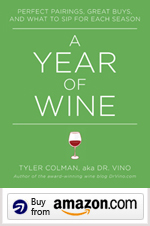
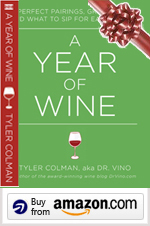
Signed copies of my books available for gifting!
ayow150buygift

Dear Dr. Vino,

My parents live in the San Francisco Bay Area, and are huge wine connoisseurs. I would like to give them a copy of “Wine Politics” for the holiday season, and it would be quite special if I could procure a signed copy; do you sell signed copies of your books for fans and admirers?

Thanks! All the best,

– Leigh

winepoliticsamzgiftAbsolutely! Getting into the holiday spirit, I’d be happy to sign copies of my books for site readers. I’ll do what I did for Leigh: just ask you to PayPal me $25 (tyler at drvino dot com), which covers the Amazon price, New York sales tax, and then USPS priority shipping back to you (domestic orders only). Please note that I can fit two books in a flat rate mailer so you can supersize your order and get two signed copies for the bargain $45–woohoo! Unfortunately, my elves can’t do gift wrapping for you so you may want to have it sent to your own address. Make haste since this offer expires on December 20!

Also of note, there’s also a Kindle edition of A Year of Wine! I can’t sign that one though.

Thanks for your support of this blog with your purchases of my books, either signed or unsigned! Cheers.
Thanksgiving wines – what was on your table?

After so many suggestions in magazines, food and dining sections about which wines should be on your table, and probably a fair amount of going back and forth, which wines did you pour for Thanksgiving? What worked and what didn’t?

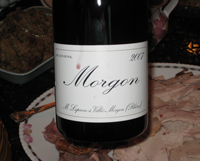
Some local friends and their extended family welcomed us to their celebration this year so it was an “away” Thanksgiving for us. We brought some wine, which included a Taittinger brut nonvintage champagne (find this wine), a magnum of Marcel Lapierre Morgon 2007 (find this wine), and a bottle of the (in)famous Palin syrah (find this wine). The Champagne was very good and well received. The Lapierre was lighter than I recall the ’06 being but still excellent and even my friend who really prefers “big reds” admitted that it was a really fine wine (someone else said it was the most beautiful wine bottle he’d ever seen!). The Palin syrah was horribly corked, not much different than the erstwhile veep candidate. Fortunately some more Champagne emerged from the other guests.
In case you’re curious what other people around the world tried, click here to see the 5,500 bottles consumed on 11/27/08 and entered (so far) into cellartracker. Domestic wines prevailed with Kistler, Kosta Browne, Peter Michael, Ridge, Seghesio, and Turley coming the first six places.

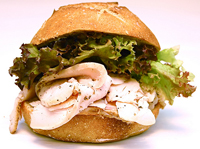
Impossible food wine pairing: leftover turkey sandwich!

turkey sandwichNow that you’ve worked out of your calorie overload torpor from yesterday, it’s on to the mall! Oh wait, we’ll leave that part for you. We’re concerned about your lunch here and with it being a quasi-holiday and all, wine with lunch sounds like a great idea. So just which wine would you pair with a leftover turkey sandwich? Or is it…impossible?!?

Barbera, two ways: Conterno and Sandrone

Barbera is one of the most food friendly red grapes since it can have wonderful red and black fruit aromas, invigorating acidity and lightness in tannin. Sandwiched between the “lesser” Dolcetto and the late-ripening Nebbiolo in the hierarchy of Piedmont red grapes, Barbera sometimes gets overlooked. But after tasting two impressive examples recently, I’m going to keep an eye out for it.

Old school choice
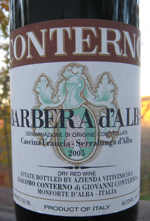
G. Conterno, Barbera d’Alba, Cascina Francia, 2005 ($30; find this wine)
A traditional producer, Giacamo Conterno makes some of my favorite Barolos and this Barbera from the Cascina Francia vineyard is also a gem–at a fraction of the price of the Barolos. Light in color, with aromas of dark fruits and some savory notes, the terrific wine has great poise through good acidity, some youthful vigor, and a well integrated, lingering finish. I really liked it now (a great choice for fall) and bought some extra bottles for continuing to watch it evolve over the next decade. Pairs well with fatty foods–how could you go wrong with a mushroom risotto?

Less old school choice
Sandrone, Barbera d’Alba, 2006 ($35; find this wine)
Luciano Sandrone is a self-described modernist and a traditionalist. This is another style of Barbera, one with more oomph, but attractive nonetheless in its more sultry rendition, particularly for drinking in the nearer term. Barbara Sandrone told me that they had good acidity but ripeness in 2006; the twenty day fermentation occurred in stainless steel then the wine proceeded to a malolactic fermentation in 500 liter oak barrels. The aromas really soar from the glass in this showy wine with richness and integration on the palate.

Many a slip twixt the plastic cup and the lip

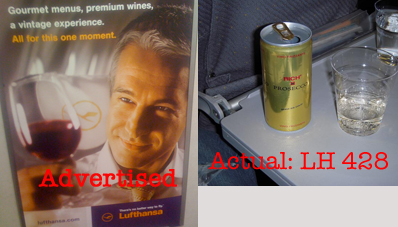
Friend of the blog and über travel blogger Mark Ashley sent in this photo from his flight from Munich last week: yes, he ordered the infamous Rich prosecco in a can! (We captioned their poster girl Paris Hilton last year.) Oddly enough, I’d just been noticing an increase in wine appearing in airline ads from Qantas to Air France to Lufthansa. Your theories as to why are welcome in the comments; perhaps it is because wine is a relatively cheap feelgood for marketing, certainly cheaper than giving you a seat that could, say, comfortably fit a human being.

In a jab at other airlines, Mark writes, “In Lufthansa’s defense, despite the wine being… middling… at least the wine is free.”

The white muscat of the red stone, barbaresco, Bull’s blood

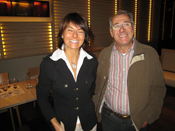
The most recent session of my six-week introductory wine class at NYU wrapped up last week. We like to end the class in style: a giant edition of show and tell and taste. For some odd reason, Mrs. Vino always refers to this as the party, but no! It is an assignment!
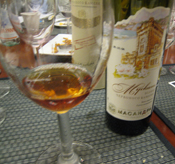
Each participant brings in a wine to present to the class, which means we get to taste about 25 wines that evening. Good times! And ever since I banned people from getting wines at the closest store to our venue, a store that seems to specialize in unearthing wines that have been stored next to the boiler for several winters, the quality of the wines has risen tremendously and people really have a lot of run exploring the wine shops of the city. Some people brought in bottles from trips to wineries in New York and California, and others were looking to try something out on us before pouring it at Thanksgiving. Here are a few of the highlights from last week: Read more…

Winespeak: scores, music and Brazilians

Eric Asimov had a thoughtful column on Wednesday. If you didn’t get a chance to see it, he interviews a leading violinist and discusses, among other things, the difficulty of describing both wine and music in words. “A great piece of music, and a great wine, holds your attention and has more than you can say in words,” says the musician, David Chan. And somehow “sluicing a mouthful of pebbles” doesn’t quite capture the whole grandeur of a fifteen year old Puligny Montrachet either, Eric says. Indeed.

But one point that Eric does not bring up so I will: if words can’t even cut it, then how on earth can scores even pretend to be satisfactory in evaluating a wine?

I met with a Pierre-Emmanuel Taittinger yesterday who is not wild about the thought of reducing a wine to a score. He wondered, how can you say which is better, Brigitte Bardot or Marilyn Monroe? Rembrandt or Renoir? Indeed. He made the point that, in an evening, wine is a part of the whole with his ratio running at 10 percent food, 10 percent wine, and 80 percent company. Three cheers for context!

Over the course of the tasting of four of his excellent tetes de cuvee, the superlative blanc de blanc Comtes de Champagne, he offered his tasting notes for the wines. Usually vintners offer cautious notes, if any, but Pierre-Emmanuel’s ebullient side shone through in his notes, which were:

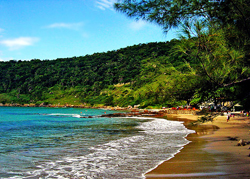
1998: A young Brazilian woman running on the beach (find this wine)
1993: A monk who has led a pure life and suddenly the fruit comes alive and he is running on a beach in Brazil too (find this wine)
1989: Like a beautiful, elegant 55 year-old Italian woman with no “lifting” (find this wine)
1988: Sunlight streaming in a stained glass window, spirits mixed with light, a lot of transparency in the wine mixed with a gentle breeze (find this wine)

Come on, would you really prefer to see those wines with scores?

Cru Beaujolais: some factoids

A few quick things about cru Beaujolais, the smaller, distinctive growing areas of Beaujolais.

1. The Burgundy producers are coming!
Prices are relatively low for grapes and real estate. That fact has attracted investment to the region from producers looking to expand: Earlier this year the Champagne (and Burgundy) house Henriot purchased the Chateau de Poncie, a key property in Fleurie. When I asked Joseph Henriot earlier this year about the motivation for the purchase, he pointed to the distinctive terroir (he loves Moulin-a-Vent and Morgon as well as Fleurie) but also the tremendous discount the property had compared to land in Burgundy.

2. Cru Beaujolais can age, maybe even longer than you think
Louis Jadot was one of the earliest notable Burgundy producers to acquire property in the Beaujolais region, notably in Moulin-A-Vent. I tried their Chateau des Jacques 1996 a few months ago and was wildly impressed. Jacques Lardiere, the winemaker (pictured right), told me that the best wines can last decades!

3. I’ve got a cru Beaujolais vertical going–in magnum

Magnums, twice the size of regular bottles, are generally baubles for captains of industry. But you can get a top cru Beaujolais in magnum for less than a lot of second label Bordeaux. Combine this price appeal with the age-worthiness and you can understand why I have several magnums of Deccombes, Desvignes, and a mini-vertical (three vintages!) of Clos de la Roilette cuvee tardive. Cru Beaujolais magnums also make great gifts; to wit, I just got a magnum of Lapierre Morgon 07 at Appellation Wine and Spirits yesterday.

4. Gamay is wildly food friendly!
And at 12.5 percent alcohol, you can have a couple of glasses too and still be able to function after dinner.

5. It’s mostly less expensive than red Burgundy!

6. How would you change the region?
In 1395, Duke Philip the Bold outlawed the humble gamay grape from Burgundy, protecting the premium pinot noir by fiat. What would you do differently if you were the Duke of Beaujolais? I asked Jacques Lardiere what he would do differently if he made his wine in Moulin-a-Vent outside of the appellation system, which mandates certain controls, such as planting the grape gamay. He said, “I would plant pinot noir.”

Don’t forget to join us tonight at 8 PM on Twitter Taste Live raising a glass of local wine or a cru Beaujolais! use #ttl in your comments or follow me.


winepoliticsamz

Wine Maps


Monthly Archives

Categories


Blog posts via email

@drvino on Instagram

@drvino on Twitter


winesearcher

quotes

One of the “fresh voices taking wine journalism in new and important directions.” -World of Fine Wine

“His reporting over the past six months has had seismic consequences, which is a hell of an accomplishment for a blog.” -Forbes.com

"News of such activities, reported last month on a wine blog called Dr. Vino, have captivated wine enthusiasts and triggered a fierce online debate…" The Wall Street Journal

"...well-written, well-researched, calm and, dare we use the word, sober." -Dorothy Gaiter & John Brecher, WSJ

jbf07James Beard Foundation awards

Saveur, best drinks blog, finalist 2012.

Winner, Best Wine Blog

One of the "seven best wine blogs." Food & Wine,

One of the three best wine blogs, Fast Company

See more media...

ayow150buy

Wine books on Amazon: