Winespeak: The opposite of sweet is dry
dry
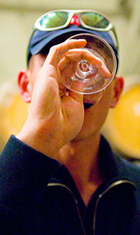
It’s pretty easy to call a wine sweet: it has a perceptible level of residual sugar in it (five grams of residual sugar is often considered the threshold of perception). Sweet wines generally start at about 45 grams of residual sugar (RS). Some wines, such as Tokay, have require a minimum level 60 grams of RS and rate wines by sweetness with six puttonyos being instant diabetes.

What’s the opposite of sweet? Dry. All the discernible sugar has been converted to alcohol during the fermentation process. Tricky since you might think the opposite of dry is wet and, well, all wine is wet. Dry doesn’t have to do with high tannins, which might make you go “chomp, chomp” and think “OMG, my mouth is drying out! I need water!” It’s just close to zero grams of residual sugar.

And there’s a middle ground of “off-dry,” or slightly sweet. Silly term, I agree (what is it, moist?). Slightly sweeter than that can be called medium dry. If you want to get all wonky geeky, off-dry might be five to fifteen grams of RS and medium dry, from fifteen to forty. Some countries and/or regions are so wonky geeky that they have specific terms and laws for these levels.

Oddly enough, a wine with a lower amount of residual sugar can sometimes taste sweeter than one with a slightly higher amount; it’s often a question of balance with acidity and one category that can be hard to discern in this regard is Champagne, which also as carbon dioxide zooming at your palate as well.

I bring this up because it came up in the comments of this recent posting about “light” as a wine style. And it comes up regularly in my NYU class. If you want to see sweet and dry in action, try tasting these two Leitz wines or a Northern Rhone syrah against a ripe, sweet version of the same grape from somewhere in the New World (but not all are ripe and sweet).
Let them sip Hillside Select, KJ, Thanksgiving, dogs- sipped and spit

SIPPED: too much
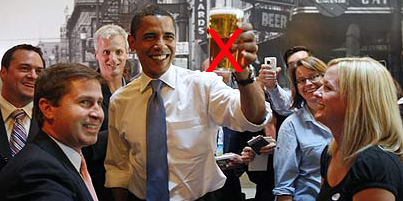
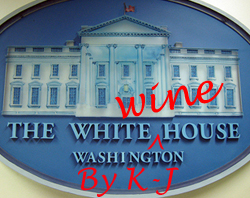
As G-20 leaders met in Washington this weekend while the economic world burns, they sipped Shafer Hillside Select 2003, a $250 Napa cab (find this wine). This raised the hackles of bloggers at CNN (perhaps because they could only find it for $500?). The era of the teatotaler-in-chief is soon over! (Thanks, Arthur!)

white_house_kjSPIT: too little
An eagle eyed publicist at Kendall-Jackson spotted a mention of their Chardonnay in an interview the Obamas did with People magazine. The maker of this supermarket staple then sent “a few congratulatory cases of the brand” to the Obamas, care of the Democratic National Committee. Celebrate a historic victory such as his with a $12 chardonnay? But what did Shafer send them?

SPIT: Sauvignon blanc
NYT restaurant critic Frank Bruni goes public about his dislike of Sauvignon Blanc as he tasted one from California, “he offered a grimace and a cry of anguish.” And what did his colleagues do to him after that. Why, laugh at him. Get the full story and their wine picks for turkey day in Eric Asimov’s column.

SPIT: 2008 Hospice de Beaune
The climate, both meteorological and economic, put a damper on the annual charity auction for barrels of red Burgundy. [Reuters]

SPIT: celebrity wine
Michael Vick’s 22 dogs will appear on a new wine line called “Vicktory Dogs.” A portion of the proceeds benefit the shelter in Utah where the dogs now reside. [ESPN]

Free wine tastings, a tonic for the times

blindtasterA couple of weekends ago, I attended the grand re-opening of Wine Connection in Pound Ridge, NY. Max Marinucci moved his store to a handsome, custom-built facility and it was an amazing tasting by any measure. There were about six Barolos available from producers that ran the modern-traditional axis, E. Pira, G. Mascarello, G. Conterno, and Sandrone among others. They also poured the 2004 Hudelot Noellat Richebourg (about $259; find this wine), and several current release Bordeaux. Then there was the amazing 1985 Leoville Las Cases (about $379; find this wine), whose aroma was so enticing with tannins were smooth as silk.

And the price for this tasting? Free.

In this tough economy, even seeking solace in a wine glass can still cost a lot. But there is one place where you can still taste fine wine for free: New York wine stores. Granted, you’re standing up and the pours are sometimes barely enough to cover the bottom of the glass, but they are a great opportunity for broadening your tasting experience–as well as talking with some interesting people who are usually doing the pouring.

While there are many silly (separate entrances for separate licenses) and annoying (not being able to to sell cheese in a wine shop nor wine in a food shop) aspects of New York wine retail laws, the free tasting is a definite boon for consumers. Stores can’t charge for tasting since that would be profiting from the sale of liquor on-premises, which requires a different license. Other states have different rules about in-store pourings and they are not always free, but are often a good value. (Sadly, one place where free tastings may someday be illegal is the little-known wine country called France.)

And the downturn in the economy means that some shops are eagerly pouring wines (or, technically, having the distributor reps pour the wines) to attract foot traffic. So check out your local retailers and see what’s on the calendar. Here’s my map of my favorite NYC wine shops.

Wine vote carries Obama to victory!


Obama beat McCain by 53 – 46 percent in the popular vote. The logic of the electoral college broadened this to a 68 – 32 percent victory. But there’s one core constituency where Obama thrashed McCain by an even wider margin: the wine vote.

Obama took nine of the top ten wine consuming states (Texas, the fourth largest wine market, was red) as well as 17 of the top 20 (Georgia and Arizona are 13th and 14th) using 2006 data on wine consumption from Adams Wine Handbook. Those states alone would have been enough to win the electoral college with 276 electoral votes for Obama. Overall, blue states this year were thirsty for wine, putting back a total of 80.8 percent of all wine consumed in America.

McCain captured nine of the ten states with the lowest consumption (Vermont was blue).

And in case half-bottle sized Vermont raises the question of whether the data per capita (of drinking age) were different, Obama actually took all of the top ten thirstiest states per capita and 18 out of the top 20. McCain took 14 of the bottom 15.

Drink wine, vote Democratic? Forget Joe Six-Pack, this year the path to the White House was through the wine glass.

Finally, and prosaically, Illinois was the number two state (behind much larger California) for Champagne and sparkling wine. I’m sure that figure went up after last Tuesday night.

Total gallons of wine consumed in blue states: 228,563,000 or 80.8 percent of the total. The top twenty wine consuming states roll after the jump. Read more…

Is “light” as a wine term the kiss of death?

I like light reds. Pinot noir, gamay, barbera all make food-friendly wines that can be light in style as compared to, say, cabernet sauvingnon or zinfandel, which are fuller bodied (and often higher in alcohol).
Talking about the flavor profile of wines, from light to full bodied is, in my view, a really constructive way to talk about wine. Heck, entire stores such as Best Cellars in Manhattan and wine lists at numerous restaurants arrange wines this way.

So I was surprised to hear a boutique wine distributor tell me the other day that “light” is verboten! Here’s what he said:

“Light is bad. It’s the kiss of death for a wine. I instruct my sales staff to never describe a wine is light–it’s not beer after all! Succulent and fruit forward and food-friendly, yes, but light, no.”

It’s probably just a question of semantics since he does have many light-bodied (my term!) wines in his portfolio, which I don’t think even has one Aussie shiraz or Cali cab. But I was struck by his hostility to the term and, needless to say, I don’t think it is the kiss of death; rather, it’s a strong endorsement in my view! What do you think?

My new book, A Year of Wine, is now officially available!

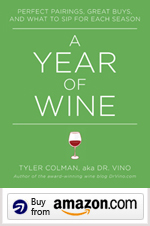
ayow150buyTimed strategically to drop after the election and before the holidays (but on Veteran’s Day, a holiday itself!), today is the official release date of my new book, A Year of Wine: Perfect Pairings, Great Buys, and What to Sip for Each Season!

Instead of traversing the familiar terrain of regions or grape varieties, I forge a new path by plotting a seasonal arc for wine consumption. This ties in to the way that I enjoy wine, by emphasizing the context of how, where, when (and with what and with whom) we drink wines, as well as linking to the trend of seasonal cooking that is so prevalent today among professional chefs and home cooks. I’m glad that this theme resonated with so many of you in our previous discussion.

The book has short essays and hundreds of wine recommendations across the twelve months of the year. There should be something for wine lovers of all levels, newbie to full-on wine geek. There’s also some information for all seasons about wine style, wine service and how to actually find good wines near you. And twelve wine travel sections help you even change your context for maximum wine enjoyment.

Alex Eben Meyer contributed the great illustrations. Check out his excellent portfolio at his site!

And a total of thirteen sommeliers lent their thoughts to the volume. They include: Richard Betts (The Little Nell, Aspen, CO); Shayn Bjornholm MS (Washington Wine Commission); Thomas Carter (Blue Hill Stone Barns, Pocantico Hills, NY); Belinda Chang (The Modern, NYC); Christie Dufault (Quince, SF); Erik Liedholm (Seastar, Seattle); Rajat Parr (Michael Mina Group, SF); Shelley Lindgren (A16 restaurant, SF); Roger Morlock (Park Avenue Seasons, NY); Virginia Philip, MS (The Breakers, Palm Beach); Tysan Pierce (The Herbfarm, Woodinville, WA); Juliette Pope (Gramercy Tavern, NYC).

So check out the book’s page over at Amazon (or Barnes and Noble or Powell’s if you prefer) and see what Kermit Lynch, Eric Arnold, David Lynch, and Bobby Abreu had to say on the back cover. Or ask for the hardcover at your local bookstore and check it out in print. And if you do get it, let us know what you think of it here!

Three questions with…Yves Cuilleron


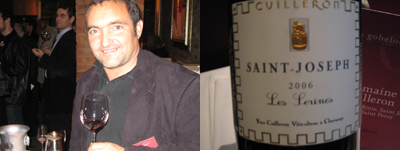
I caught up with winemaker Yves Cuilleron today at a tasting of fourteen youngish and noteworthy French producers dubbed “Les Gobeloteurs” at the Tribeca Grill. Yves makes highly regarded red and white wines from the Northern Rhone appellations of Condrieu, Cote Rotie, Saint Joseph, Cornas, and Saint Peray. I really liked his ’06 Saint Joseph, “Les Serrines,” which is made from small berry Syrah and has great aromas of tar and black olives on the nose. (find this wine)

He paused from his pouring to answer three quick questions:

What’s your favorite Northern Rhone appellation that’s not Hermitage? Condrieu (and Saint Joseph for reds).

New oak, good or bad? It’s a good thing when it’s well done but it depends how it is done. It’s very difficult to work with new oak.

How was the 2008 vintage for you? It was a very good vintage for the whites, which have very good acidity. The wines have high intensity but without too much alcohol. Vintages 2006 and 2007 were nearly 15%. But 2008 was a very late harvest. There was good, slow maturation and they ended up 13.5 percent.

The reds were mixed; there was lots of rain in early September, which caused problems in the early-ripening areas. But in the late ripening areas, there were six weeks of beautiful weather after September 13 and I harvested those in October.

A list of all the “Gobeloteurs” follows after the jump. Read more…

This fall, some of the best wine values might be at auction

hammer“I guarantee you all these prices will be significantly higher this time next year,” John Kapon, president and auctioneer at Acker, Merrall is reported to have said between bids at an auction last December. The buyers who paid $8,000 for six bottles of the ’61 Dom Perignon and $22,000 of for eight bottles of the ’66 Cristal might be wondering if that was a money-back guarantee.
Prices of all kinds of assets have declined precipitously since last December. Wine appeared somewhat immune as recently as September but evidence is now emerging that prices for collectible wines are entering a correction after many years of strong growth. The Liv-ex 100 Fine Wine Index fell 12.4 percent in October.

A close observer of auctions told me yesterday that two recent sales only sold 35 and 43 percent of lots. And some lots are going for well below the low price estimate. At another auction, someone else told me that a case of 1998 Grand Cru Chablis sold for $60. Even though there’s a risk of premature oxidation with that wine, $5 a bottle certainly seems like it’s worth a flier. Such a low selling price indicates that there was no reserve.

While many shops may have locked in higher costs, making them unwilling or unable to discount, some specialty shops do broker private collections too and can have faster turnarounds than auction houses. Provenance is always an issue with mature wine, so feel free to ask where the wines came from.

But some sellers at auction may be eager to liquidate making the secondary market may be the best place for wine deals this fall. Of course, if the global economic malaise continues into next year or beyond, declines in fine wine prices could continue. So you may not want to step in and catch too many falling magnums.

Some upcoming auctions: Zachys, Nov 6-8; Acker, Merrall Nov 7; Christie’s Nov 17 and 21; Sotheby’s Nov 22; Hart Davis Hart Dec 5.


winepoliticsamz

Wine Maps


Monthly Archives

Categories


Blog posts via email

@drvino on Instagram

@drvino on Twitter


winesearcher

quotes

One of the “fresh voices taking wine journalism in new and important directions.” -World of Fine Wine

“His reporting over the past six months has had seismic consequences, which is a hell of an accomplishment for a blog.” -Forbes.com

"News of such activities, reported last month on a wine blog called Dr. Vino, have captivated wine enthusiasts and triggered a fierce online debate…" The Wall Street Journal

"...well-written, well-researched, calm and, dare we use the word, sober." -Dorothy Gaiter & John Brecher, WSJ

jbf07James Beard Foundation awards

Saveur, best drinks blog, finalist 2012.

Winner, Best Wine Blog

One of the "seven best wine blogs." Food & Wine,

One of the three best wine blogs, Fast Company

See more media...

ayow150buy

Wine books on Amazon: