Trading down: recession and wine trends [poll]

An op-ed in the Times yesterday puzzled over why beer sales are down while the economy is also in the dumps; there’s a perception out there that people drink more alcoholic beverages during a recession but a slump in beer sales defies that logic. The author pays a passing mention to wine, indicating that Constellation, the world’s largest publicly traded wine producer, has said they will have to “recalibrate” sales expectations.

But have Americans gotten so into wine that even a recession can’t take wine off the table? It appears that wine sales sales for 2008 may be up fractionally by volume but the value is likely to be down since many consumers are “trading down,” or reaching for less expensive wines.

We last checked in with you about your buying habits on September 29. Lots has happened in the economy since then. Tell us how your wine buying and consumption is now! And with the new polling software, you can now select two answers!

[poll id=”3″]
60 Minutes on red wine, 1991

In 1991, the CBS show “60 Minutes” ran an influential segment of possible health benefits of red wine. Entitled “The French Paradox,” correspondent Morley Safer looked at how on earth the French could eat high fat food, such as cheese, and have low rates of heart failure. Research concluded the key variable was not only the type of fat but also red wine. The resulting demand for red wine, the New York Times wrote a few years later, was seen as “potentially the biggest boon to the wine industry since the repeal of Prohibition.”

Morely Safer was at it again earlier this evening, talking about red wine and lab rats. The subject of the piece tonight was about resveratrol (it’s everywhere!), a component found naturally in red wine that may hold the key to a longer, more slothful life in concentrated pill form, not necessarily wine. So great is the potential for the company making the pills, Sirtris, that Glaxo Smith Kline acquired them for $720 million last year. The pills are five years from being on the market they say in the piece.

Anyway, I’ll leave you to explore tonight’s 12 minute segment over on CBS. Here instead is a flashback to see the original four-minute segment from 1991. How naive we were then, back before certain types of fats were taxed! And how funny that the story features the French paradox and they show bottles of Lopez de Heredia from Rioja!

Wine for the Super Bowl: Tampa edition

Last year, supermodel Gisele Bundchen caused a stir by sipping wine during the Super Bowl. Some even thought this act caused the Patriots’ star quarterback Tom Brady, her beau, to crumble, bring the team down with him.

bernsFans of the Steelers and the Cardinals who make it to Tampa for this year’s Super Bowl on February 1 are, given the scant attention paid to wine at stadiums, likely to have few such vinuous distractions. But Tampa does have one wine destination worth flagging: Bern’s Steakhouse.
The restaurant has a legendary wine list with about 600,000 bottles that have been accumulated constantly since the restaurant opened in the 1950s. Some are housed in the 3,000+ square foot wine cellar in the restaurant but the bulk of the collection is stored in two temperature controlled warehouses off premises. Stars of the collection include an 1851 bottle of Gruaud Larose, some Madeiras from the 18th century, and large verticals of Bordeaux.

I’ve never been to the restaurant but I was talking with an NYC wine collector last year and he told me about weekends that he and his wife like to take in Tampa to visit Bern’s. They go with four to eight friends and make reservations for Friday and Saturday night. They have a lengthy meal on Friday, sleep in on Saturday, get manicures or play golf (they said there’s not a lot to do), then go back for a huge, long dinner on Saturday that can last ten hours at the table as they plunder the cellar. Whoa! Who knows if they are keeping this up hedonism in recessionary 2009 but it shows what damage wine lovers could do at the restaurant. A lot more than in the stadium, that’s for sure!

Related: “Eric Renaud Senior Sommelier” [WSJ.com]

Three questions with Christine Saahs of Nikolaihof, Wachau

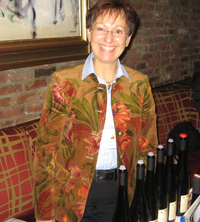
christine_saahs_nikolaihofChristine Saahs of Nikolaihof was the first to apply Rudolph Steiner’s philosophy to viticulture, thus cultivating her vines in Austria’s Wachau region biodynamically. The Im Weingebirge Smaragd bottling is always one of my favorite gruner veltliners and indeed the 2006 I tasted had great, rich intensity and a long minerally finish. The 2007 Hefeabzug for half the price offered great zip and zest overlain on a mineral core. Nikolaihof also makes several very good Rieslings. I was happy to have the chance to chat about three things during a busy trade tasting on Tuesday.

How was the 2008 vintage for you?
For the biodynamic growers it was fabulous. There was a lot of rain; it rained every day for three months. But it wasn’t often a heavy rain and the leaves were just wet, which caused fungus problems for many growers. But we are so happy with the quality of our wines and harvested our Smaragd in the third week of September, earlier than many others. For us, the vintage was less quantity but great quality.

Describing her Gruner Veltliner “Hefeabzug” (about $25; find this wine):
It’s such a refreshing aperitif. The wine has such energy that customers say they can’t sleep after a glass. It’s much better than anything from the pharmacy–it’s a natural energy drink!

Is Austrian Riesling too high in alcohol? [Hers are 12.5%]
No Austria is one of the best places for Riesling in the world. Rising alcohol is not a problem of global warming; it is a problem of wine journalists who give high scores to high alcohol wines. Customers are always asking me for low alcohol wines because they want to be fresh after a bottle. Have a bottle of 14.5% alcohol wine and you’re dead! Well, not you because you are young, but me, I’d be dead!

As a side note, Christine told me she doesn’t say “cheese” for photos; she says Riesling!

Resveratrol binge: Strange Cru, part 2

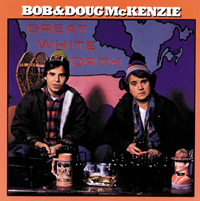
bobanddougRemember resveratrol and its life extending qualities, guilt-free gluttony and cardiovascular-improving sloth in laboratory mice? Oh yeah, that was if had the equivalent of 35 bottles of red wine a day.
Such is the premise for a hysterical essay in the “shouts and murmurs” column in the New Yorker. The author, Noah Baumbach, pretends to go on a bender with his mouse and the drunk dialing, sloth-inducing binge is well worth the read. It’s even better than my screenplay, Strange Cru.

Bigger is better: Gru Vee in one liter

berger_hoferWe all know bigger is better. No, not that way; get your mind out of the gutter. When it comes to wine, the reason is at least twofold. First, a bigger bottle has a lower carbon footprint per ounce of wine because there’s a more favorable wine to packaging ratio. Second, more wine!
I’m not sure how important the first of these two reasons is for wine consumers but the second is one of those things that everybody can agree is a good thing.

And so they have. Jonathan Schwartz, the hirsute portfolio manager of Terry Theise wines for distributor Michael Skurnik, says that sales of his five one-liter Gruner Veltliners from Austria have been zooming. “Restaurants like them because it’s an extra glass and a half per bottle for wine-by-the-glass pours. Wine shop customers like them because it’s a glass and a half more wine.” (A standard bottle has 750 ml.)

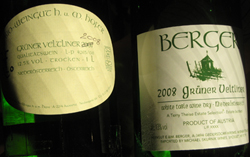
crown_cap_bergerHe said that people are interested in the closure too, which on the Hofer and the Berger, the two best selling of the wines, is a crown cap (think: beer).

So which is better? I tasted them at the Skurnik tasting today. Both are simple versions of Gruner Veltliner, clean and zesty with a minerally verve. The 08 Berger (about $11; find the 2007 or the 2008) is slightly softer and the 08 Hofer slightly more tart (about $11; find the 2007 or the 2008). The wines are both an easy extension for people who love pinot grigio but are looking for something new. Hofer is made biodynamically, which goes to show that biodynamics and low price are not antithetical to each other. Berger is practicing organic. Gru Vee.

Holy Jerobaum! Look at the size of Jay-Z’s…

jayz_aceOne of my friends told me on chat that he’s bringing a bottle of booze to the office tomorrow to pop after the inauguration. He didn’t say what he’s bringing in.

Here’s a pic of Jay-Z at a DC nightclub on Sunday after his belle, Beyonce, performed at the Lincoln Memorial. Hard to top that for sheer size–or quantity! Or price! (find Ace of Spades Champagne) Obviously he didn’t get the memo that Cristalino is the wine for our times…

Are you allowed to bring wine to work? If so, what’s in your bag for tomorrow?
(Photo: FILMAGIC via concreteloop)

Three French reds under $10: Montirius, Heretiques, Fenouillet

Everybody always wants a good wine under $10. And that’s never been more true than now. The sad thing is that it’s so hard to find good wines under $10. But here are three reds from the South of France!

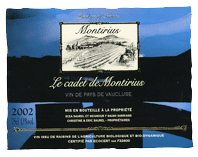
montirius_lecadetMontirius, Le Cadet, vin de pays de Vaucluse, 2005 ($9.99; find this wine)
This blend of 50% Grenache – 30% Syrah – 20% Cinsault comes from a couple in the Southern Rhone who make their wines biodynamically. This particular cuvee is fermented in cement (!) tanks. When I met Christine and Eric Saurel, the owners and winemakers, a few years ago at a trade show, they told me that cement is more “alive” than stainless steel but doesn’t impart the flavors of oak. It is a great value with good acidity, fun dark berry notes, and tannic poise. I need to restock, probably by the case.

heretiquesLes Hérétiques, vin de pays de l’Hérault, 2007 ($9; find this wine)

Made from Carginan grapes, this wine hails from the Languedoc region. It has a whiff of that bretty barnyard thing, which some might find off-putting and others alluring. But on the palate there’s not much to argue with since the wine has good fruit and tannins. It’s not as smooth or rewarding as the Chateau d’Oupia, from the same producer, but this one would make a solid party wine. Importer: Louis/Dressner.

Domaine de Fenouillet, vin de pays de Vaucluse, 2007. ($9; find this wine)
Marcelan? Yeah, I hadn’t had that one either. But it’s the main grape in this wine, also from the Vaucluse like the Montirius. The wine is a little less structured more tannic than the other two so I would use this wine as “ballast,” i.e. when there are four of you and two bottles are already empty and you need to crack open a third bottle of something decent that’s not too expensive. Importer: Neal Rosenthal.


winepoliticsamz

Wine Maps


Monthly Archives

Categories


Blog posts via email

@drvino on Instagram

@drvino on Twitter


winesearcher

quotes

One of the “fresh voices taking wine journalism in new and important directions.” -World of Fine Wine

“His reporting over the past six months has had seismic consequences, which is a hell of an accomplishment for a blog.” -Forbes.com

"News of such activities, reported last month on a wine blog called Dr. Vino, have captivated wine enthusiasts and triggered a fierce online debate…" The Wall Street Journal

"...well-written, well-researched, calm and, dare we use the word, sober." -Dorothy Gaiter & John Brecher, WSJ

jbf07James Beard Foundation awards

Saveur, best drinks blog, finalist 2012.

Winner, Best Wine Blog

One of the "seven best wine blogs." Food & Wine,

One of the three best wine blogs, Fast Company

See more media...

ayow150buy

Wine books on Amazon: