A 100 point moment – wine in tropics edition
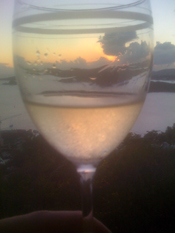
muscadet_momentI’m in an undisclosed location where rum is cheaper than Yellow Tail.

We have the good fortune of being on a family vacation in the tropics. But what’s a wine lover to drink?

If you’ve read my book, A Year of Wine, you’ll know that I’m a fan of pairing wine with context, which includes the food, the mood, and the people. So if you’re on sun-drenched vacation, it’s easy to insert any wine, be it fetid or feted, and you’re bound for a great time since the setting is ideal, right? Perhaps. But this trip, I brought my own to make sure we had a good pairing.

Seeing some space in one of our bags, I threw in three wines from the Loire: two bottles of Muscadet and a bottle of Gamay. Low in alcohol, with refreshing acidity, and all under $15, I thought they would do the trick nicely when we grew tired of umbrella drinks and beer. (You can tell I am a wine geek since I was probably the only one bringing alcohol to the islands as opposed to returning with bottles–although I don’t rule that out.) I put them in a three-bottle wine shipper and they were still refreshingly cool to the touch when I unpacked. So I kept them that way by putting them all in the fridge on arrival.

The real stand out was the Domaine de la Pepiere, Clos des Briords, 2007 (about $15; find this wine), a superb wine in its own right that I’ve mentioned before. Throw in a sunset, 80 degrees, grilled fish, family and you really have a perfect wine moment. I rate it 100 points.

What’s one of your 100 point wine moments?
G20, Bordeaux pricing, Cake wine, Australia – sipped and spit

jamieoliverSIPPED: English wine
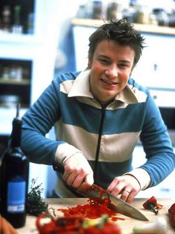
Well, now that all the serious business of the G20 meeting is over, we can turn to what wine lovers wanted to know all along: what did they drink? Gone were the lavish dishes of last year’s G8 summit. Jamie Oliver, chef for the dinner at Downing Street, put together a menu showcasing the “best of British cuisine,” which was expected to include Nyetimber, a sparkling wine from West Sussex. (The spouses’ table seemed like the most laughs that evening–Joachim Sauer excepted.) [timesonline.co.uk]

SIPPED: a shot glass of sanity?
Chateau Angelus is the first of the top Bordeaux properties to release their 2008 vintage: 50 euros a bottle, or 40% less than the 2007, which was not a strong vintage in the region. Our previous discussion highlighted how mush pricing is relative and based on perception, rather than actual costs. And Simon Staples is back again, quoted as saying that he wouldn’t even be a buyer of Angelus at 30 euros. [Decanter]

SIPPED: wine in the USA
While worldwide wine consumption fell by one percent, Americans tacked on a 1.8% gain in wine last year, the fifteenth consecutive annual gain according to the new edition of Impact Databank.

SPIT: cakes!
On March 23, we laid out the Layer Cake/Cupcake confusion/silly naming. March 26, Layer Cake’s producer (One True Vine) sues the Cupcake producer (The Wine Group) for trademark infringement claiming the name is “confusingly similar.” [Wines & Vines]

SWIRLED IN CONTEMPLATION: Australia
Australian wine “has moved from being revered to being reviled” with tremendous speed, writes Jancis Robinson at FT.com. She asserts this is largely because of the success of “ubiquitous and vapid” low end wines and the high alcohol wines that receive big scores from the Wine Advocate. Then add a glut followed by a drought and fires, industry consolidation and a global recession and it’s not difficult to see why the sledding has gotten a little rough. I’m quite interested in the story of Australia, particularly the one that is not much exported to the US. That’s why I’ll be joining a group wine writers and sommeliers there in June for the Landmark Australia tasting.

Has the wine auction market bottomed?

One thing we’ve learned the past few weeks is that markets love a good bottom. As the stock market has bounced off a low on March 9, the financial news is full of bottom talk–“the bottom is in,” cried euphoric trader! “Baby’s got back,” shouted another! (Oh, wait, that wasn’t from the trading pits.)
The wine auction market followed other asset prices in a sharp descent over the past six months. The theory that wine was a different type of asset class, immune from corrections, has suffered.

But in three auctions last weekend, the market showed signs of stabilizing. In Chicago, Hart Davis Hart sold 100% of lots for $2.2 million, toward the high end of estimates. In New York, Christie’s sold 95% of lots for an aggregate of $1.27 million. In Hong Kong, Acker Merrall boasted over 95% of lots sold for $4.36 million gross. Press releases for all three talked about how “it seems the wine market has sprung to life” (Christie’s), how it “sizzled” (Acker), and “it’s been a long
time since I’ve seen such spirited competition as we saw today” (Hart Davis Hart).

In my casual observation of a catalog, it seemed to me that the estimates were priced according to the recent sell-off, that is to say, lower. I even submitted a couple of low-ball bids, below the low estimates, and was not successful.

So has the wine auction market touched bottom? While it was the first place to pick up deals in the fall as the economy took a nose dive, it seems to be perking up now. But is this a false dawn? My guess is that it pretty much follows the equities markets and the macroeconomy.

An olde tyme wine tasting scene


For your time wasting needs today, we bring you a mildly amusing wine tasting scene with Vincent Price and Peter Lorre. It may be from 1972 and be based on the Edgar Allan Poe short story “The Cask of Amontillado.” But if you know for sure, hit the comments.

The best wine glass is the one wine comes in: a bottle

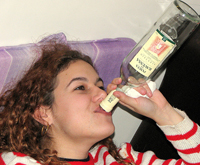
wineglassbottleWine consumers often fret over the best glass to serve their reds, whites and rosés. I’m here to tell you: the best glass is the one that the wine comes in, namely the bottle.

Drinking wine from the bottle is a pleasure that no Austrian crystal maker will tell you about. But it is the right olfactory, environmental, and economic choice.

The best crystal wine glasses have a wide balloon that narrows toward the top. That’s also the case for wine bottles where the aromas are conveniently concentrated through the bottle neck.

And because heavy glass has a larger carbon footprint than box wine, drinking directly from the bottle bypasses the need for crystal glasses that may have been sent via airfrieght with excess packaging.

Economically, the costs are clearly lower. And it also provides greater mobility to drink on the go although open container laws do interfere.

Paul Grieco of the NYC hipster wine bar Terroir says that bottles as glasses are all the rage at his bar. “The only hard part is getting people to stop after the equivalent of one glass,” he said. “And you really don’t want to be the last one to order a glass from a given bottle.”

For more details, click here.

How much does that bottle of wine cost to make? Where $13 becomes $500

Simon Staples of Berry Bros & Rudd, a patrician wine shop in London, has an estimate in today’s NYT on the actual cost to make a bottle of Lafite, which sells for about $500 retail (find this wine). To the tape:

Mr. Staples pointed to the example of Château-Lafite Rothschild, a first-growth Bordeaux, which soared from £675, or $955, for a 12-bottle case in the 2002 futures to £4,000 a case for 2005 — which he called “the best vintage I’ve ever tasted.” But despite merely average years subsequently, the price only fell back to £3,500 in 2006 and £2,800 in 2007. He estimated it cost the château €10, or $13, to make a bottle of the wine.

Wow, talk about return on investment! I actually get asked the question a lot about whether a winery’s costs are really reflected in a higher priced bottle. Certainly, there are expensive ways to make wine and there are inexpensive ways to make wine.

But according to a fascinating exposé in the Revue de Vin de France, even the expensive way to make wine is wildly profitable. Consider some of their examples: the cost of Petrus is 30 euros and it retails for 4,500€; Dom Perignon costs 22.80 to make and retails for 129€; a generic Bordeaux wine might cost 1.38 euros to make and retail at a supermarket for 1.86€.

Le veritable prix des grandes bouteillesRevue de vin de France, February 2009.
Bordeaux futures, wine investment, waste, insurance – sipped and spit

Rosé, box wine, bling, Puss in Boots – sipped and spit

roseglassSIPPED: Rosé
Rosé wine is popular the world over. But in Britain sales of the pink drink have been particularly strong, increasing 64% between 2003 – 2007 according to the BBC. To the victor go the spoils: rosé now joins rotisserie chicken and DVDs ordered on the internet in the country’s “basket of goods,” a measure of inflation. To make room in the index, the Office of National Statistics removed box wine from their figures. But that may be premature, as I told the Financial Times last week, since box wine is not only growing in popularity and quality but might be a better fit with the times.

SPIT: Rosé
“A Rosé by Any Other Name Is Not a Rosé,” runs the headline on this AP story. True dat. According to an EU proposal floated last week, the lower-cost method of blending red and white wines to make rosé may soon be allowed alongside the traditional method of “bleeding” rosé off of red grapes. Furor ensues and the method of making the rosé will appear on the label if approved in a May vote.

SIPPED: sanity in restaurant wine prices

A “hot, newish” restaurant in San Francisco may soon roll out wine at retail prices. That’s a fantastic idea and one that would likely fill up many a seat in the restaurant. Key question: do they allow doggy boxes? [Spume]

SIPPED: economic indicators
Forbes, known for their lists of billionaires, ran features on 10 wines under $10 AND box wines last week. What has the world of bling come to?

SIPPED: China
Domaines Barons de Rothschild, maker of the Bordeaux first growth Lafite, has announced they will be developing a 60 acre vineyard in China, specifically the peninsula of Penglai, Shandong province.

SIPPED: yet another celebrity wine
Antonio Banderas buys a stake in a winery in Spain’s Ribera del Duero. It will be renamed “Puss in Boots” after his role in Shrek. Oh no, scratch that–it will be called Anta Banderas.

Randall Grahm – the way back is the way forward – part II

randall_grahm
Randall Grahm is one of America’s most fascinating winemakers and winery owners. From his base in Santa Cruz, he rose to fame (and a good bit of fortune) by following the path of grape varieties traditionally from the Rhone and Italy–with a dose of Zinfandel. Puns and cute labels helped make the wines fun and approachable. Consider that in 1992 he bought a vineyard in Soledad, a town then best known for a large prison, and decided to call the resulting wine “Big House Red” complete with a cartoon jailbreak on the front. Or Cardinal Zin, a Zinfandel with a Ralph Steadman depiction of a cardinal on the label.

But Grahm has had a change of heart. A thorough profile in Inc magazine last summer indicated that, in close succession, he became a dad and had health problems that led to what they call a “do over.” He sold off Big House and Cardinal Zin to The Wine Group two years ago. He ramped up his appreciation of Biodynamics, an organic approach to vineyard management that blends in a dose of the celestial. He toned down the humor on his labels and has added graphic depictions of crystal formations that map the terroir of a vineyard on the Ca del Solo labels.

He’s also experimenting more with winemaking. Many wines are matured in small oak barrels that are new. Grahm is using slightly larger casks, called puncheons, that are old. The older and bigger barrels slow the exchange with oxygen, which can make the resulting wines more age worthy and can express the grape and the place more clearly without so much barrel influence. But his biggest experiment is with his 2008 wine called Le Cigare Volant, a blend of Grenache, Mourvedre and Syrah. He has held some of this wine to mature after fermentation in a series of large bottles known as demi-johns that allow virtually no exchange with oxygen.

I caught up with him at the recent tasting of his NYC distributor, Michael Skurnik. We talk about screwcaps, the wave of the future, and…England.

Nearly seven years ago, you held a ceremonial funeral for the cork and started bottling all Bonny Doon wines under screwcap. Did you replace one problem, TCA tainted corks, with another, reduction [which can lead to rotten-egg smell in some cases]? Read more…


winepoliticsamz

Wine Maps


Monthly Archives

Categories


Blog posts via email

@drvino on Instagram

@drvino on Twitter


winesearcher

quotes

One of the “fresh voices taking wine journalism in new and important directions.” -World of Fine Wine

“His reporting over the past six months has had seismic consequences, which is a hell of an accomplishment for a blog.” -Forbes.com

"News of such activities, reported last month on a wine blog called Dr. Vino, have captivated wine enthusiasts and triggered a fierce online debate…" The Wall Street Journal

"...well-written, well-researched, calm and, dare we use the word, sober." -Dorothy Gaiter & John Brecher, WSJ

jbf07James Beard Foundation awards

Saveur, best drinks blog, finalist 2012.

Winner, Best Wine Blog

One of the "seven best wine blogs." Food & Wine,

One of the three best wine blogs, Fast Company

See more media...

ayow150buy

Wine books on Amazon: