Wine editorial as advertisement – from France to the US?

For enophiles, one of the great travesties of the past few years has been the rise of a new puritanism in France. Yes, the country perhaps most associated with wine has, paradoxically, also seen increasing amounts resistance to wine from some parts of society. In my book Wine Politics, I’ve compared this (French?) twist with America and how the two countries seem to be headed in opposite directions; many others have also commented on these changes.

Perhaps the most jaw-dropping of the actions relates to wine and the internet. A French court ruled early last year that Heineken’s web site was illegal to display in France, which sparked fears and confusion among wine web sites and Microsoft pulled wine ads. Also, in another decision last year, a court fined the newspaper Le Parisien €5,000 for a champagne review article claiming that it was no different than an advertisement and should run the disclaimer: “Alcohol abuse is dangerous to your health.”

it-can-happen-hereThat could never happen here, right?

Well, not entirely. According to this article on ABCnews.com, under new Federal Trade Commission regulations on Consumer Product Testimonial and Endorsement Rules, product reviews on blogs may soon fall under the same liability standard as advertisements. (Given the various claims to the tune of “lose thirty pounds in thirty days,” one might easily be forgiven for not even realizing that there even were advertising standards.) The most obviously affected category would be paid reviews, but those, rightfully, shouldn’t count as editorial anyway.

“It would only affect bloggers who are paid to write reviews but the sticky issue that is raised is what happens if a product is given for free,” an FTC spokesman told ABC News.

That could raise a host of issues for wine bloggers as well as wine journalists whose articles appear on the internet. But whether a review of a free sample wine (as opposed to a purchased wine) could ever be seen as basis for liability, as it might in an infant car seat as the focus of the ABC story, seems like an incredible long shot. The subjectivity of reviews (what, you couldn’t find notes of raspberry and saddle leather?) and the bottle variation among consumers in different states would be two strong aspects running against any enforcement of this FTC act. As they probably say in fine print on the weight loss ads, results may vary.

One way to connect the dots more closely might be if the blogger in question were, say, a wine retailer or a winery who also happens to sell wine. There’s a lot of web content, be it blogs or Twitter or Facebook updates, emanating directly from wine sellers and marketers that might fall under this increased stringency from the FTC.

As Matt Drudge might say, “developing…”

Corks, NY tax, fraud, Bordeaux 2008 – sipped and spit

bottle_noSPIT: corks in Champagne!
Champagne house Duval-Leroy has announced that they will be replacing the cork with a “revolutionary” metal cap. Full details will be announced next month. The BBC reports that it will “still produce the familiar “pop” and spray beloved of generations of racing drivers on the winner’s podium.” But how will this affect the Japanese corkslinger?

SIPPED: wine as a tax revenue source
New York State will raise the excise tax on wine sold or made in New York from $0.18 a gallon to $0.30 a gallon, effective May 1. This rate increase of roughly two cents a bottle may be too little to pass on to consumers thus may fall to producers or wholesalers. In order to avoid channel stuffing, there will be a “floor tax” levy imposed on warehouse inventory as of May 1. So will there be mega sales in NY wine stores between now and then to draw down said inventory? [NYT]

SIPPED: fraud
Fraudsters posing as buyers for British wine retailers have bilked French producers out of an apparently large amount of wine. Sad. [Decanter]

SIPPED, surprisingly: Bordeaux 2008
If in 2008 grapes were, in the words of Jancis Robinson, “swollen with summer rain,” vineyards are “ravaged by mildew and threatened by rot,” would that make for a good vintage in Bordeaux? Despite all odds, Robinson in the FT and Elin McCoy on Bloomberg attest to finding some surprisingly good wines. McCoy asks the money question: “But dropping prices dramatically in a good vintage? It’s not in the Bordelais DNA.” But some have gotten the message as she quotes Chateau Ducru-Beaucaillou, owner Bruno Borie: “We have to go back to basics, go back to the consumer, instead of the speculators.” Subsequently, Decanter reports several releases down 20 – 40% from last year’s prices. What will happen ultimately to the weak and expensive 2007 vintage? A caution against buying wine as futures…

Changes at The Wine Advocate? Correspondence with Parker and Miller

Robert Parker set an admirably high standard for ethics in wine journalism. In the introduction to the latest edition of his Wine Buyer’s Guide, he emphasizes the need for wine critics to avoid potential conflicts of interest and lays out the ethical guidelines that he believes they must adhere to. Among other things, he says that is “it is imperative for a wine critic to pay his own way. Gratuitous hospitality in the form of airline tickets, hotel rooms, guest houses, etc., should never be accepted either abroad or in this country.” He also writes: “While it is important to maintain a professional relationship with the trade, I believe the independent stance required of a consumer advocate, often not surprisingly, results in an adversarial relationship with the wine trade. It can be no other way. In order to pursue independence effectively, it is imperative to keep one’s distance from the trade. While this attitude may be interpreted as aloofness, such independence guarantees hard-hitting, candid, and uninfluenced commentary.”

In his correspondence with eRobertParker.com moderator, Mark Squires, Mike Steinberger brought up the “Weekend at Bern’s,” a road trip to the Tampa Bay wine mecca, Bern’s. Click through to read a first-hand account in the erobertparker forums. The Wine Advocate’s Jay Miller, whose editorial ambit includes reviewing the wines of Spain, Australia, and Argentina, was among the attendees. Also there were three importers whose Spanish wines Miller reviews: Eric Solomon, Patrick Mata, and Jose Pastor. Miller’s participation in this purely social event would seem to be distinctly at odds with Parker’s stated policy regarding interaction with the trade.

This isn’t the only example of Wine Advocate contributors deviating from Parker’s guidelines. Last year, Mark Squires, who reviews the dry wines of Portugal as well as the wines of Israel, Greece, Lebanon, Cyprus, Bulgaria and Romania for the Advocate, went to Israel on a trip, in his words in the forum, “”paid by the Israeli government…approved by Bob in advance.”

To the best of my knowledge, Parker has not given any indication, in print or online, that he has relaxed the Wine Advocate’s ethical standards. But in light of these examples, and given that so much of Parker’s authority derives from the perception that his integrity is beyond reproach, it seems fair to ask if the Wine Advocate has changed its policies regarding gratuitous hospitality and interaction with the trade. So I put the question to Robert Parker via email and post his reply here. I also sought clarification from Jay Miller. Further down, I post our exchange.

—–Original Message—–
From: Tyler Colman
To: wineadvocate@erobertparker.com
Sent: Tue, 14 Apr 2009 4:51 pm
Subject: request for clarification

Mr. Parker,

I have always admired your independence. I am curious about some perceived changes at The Wine Advocate and would welcome a comment from you.

In a recent thread, Jay Miller was shown to be on a road trip that included three dinners at Bern’s restaurant in Tampa Bay in the presence of, among others, three importers (Eric Solomon, Patrick Mata, and Jose Pastor) whose wine he reviews for the Advocate. [link]

Separately, Mark Squires admitted last year that he took a trip to Israel that was not paid for by the Advocate–with your approval, he says. [link]

I’m curious how these actions square with the policy in the Wine Buyer’s Guide, which reads in part: “It is imperative for a wine critic to pay his own way. Gratuitous hospitality in the form of airline tickets, hotel rooms, guest houses, etc., should never be accepted either abroad or in this country…In order to pursue independence effectively, it is imperative to keep one’s distance from the trade. While this attitude can be interpreted as aloofness, such independence guarantees hard-hitting, candid, and uninfluenced commentary.”

The recent actions of Squires and Miller have left me wondering: Has there been a change in policy for The Wine Advocate reviewers? If so, have you disclosed that to your readers? What is now allowed?

Best regards,

Tyler Colman, Ph.D.
www.DrVino.com
Read more…

The X’d files: an exchange not seen on eRobertParker.com

eboblogoThe forums at eRobertParker.com are a lively place. Unfortunately, they are often moderated with a heavy hand: several voices have been expelled and some threads that have even a whiff of criticism are deleted in their entirety.
Such was the case with a thread last week concerning Mike Steinberger’s recent Slate column about the state of Australian wine. Mark Squires, who moderates the Parker board, accused Steinberger of selecting “biased” retailers for the story. One of the retailers shot back with a stinging rebuttal of the bias claim. Shortly thereafter, the thread was deleted in its totality.

Subsequently, Steinberger had an email exchange with Squires. Steinberger questioned the decision to delete the thread and said it had unfairly deprived him of a chance to respond to Squires’s assertions. Squires was unmoved, and a spirited discussion followed. With Steinberger’s permission, I am posting the exchange here. Sit back and pass the popcorn.

****
From: mhsteinberger
To: msquires
Sent: Thursday, April 9, 2009 11:21:34 PM Read more…

The carbon footprint of wine in National Geographic

carbonwine_sm

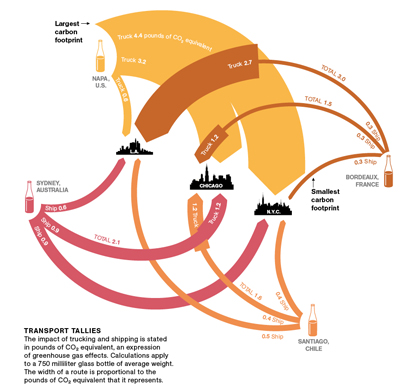
National Geographic has produced an excellent graphic in the May issue about wine’s carbon footprint (unfortunately, no link is yet available but the magazine is arriving in mailboxes and newsstands now). Pablo Paster and I provided the numbers for them based on our joint research on the subject.

We previously discussed the “green line” for wine and how it is more carbon efficient for a New Yorker to raise a glass of Bordeaux rather than a glass of California wine. Well, New Yorkers can now also raise a glass of Australian wine to achieve the same result: holding production method and bottle weight constant, the efficiencies of container shipping from a CO2e standpoint are such that a bottle of wine from Sydney arriving in New York City has a less than a quarter of the carbon emissions as one from California, which had a long journey by less efficient truck. The efficiencies even stretch to Chicago, assuming the bottle went through the Panama Canal to New Jersey and then had the shorter truck journey.

Astute readers will note that this finding was not in our original working paper. This updated version reflects the correction of a typo in one of our source materials (a reader of this site actually tipped us off to that), which, when corrected, made the efficiency of shipping even greater.

The week of the takedown – spit and spit

superflysnukaSPIT: quotes!
Ray Isle, wine editor at Food & Wine, is ticked. He previously posted about some wipes that claim to remove wine stains from teeth (saying, among other things, that “they fill the mouth (mine, at least) with a searing citric acid note, overlaid with a kind of strange metallic dissonance”). His comments were modified, taken out of context and then used in the product’s promotional materials, which he is shocked to discover. So he goes for the takedown. Click through for the whole thing; here’s a taste: “I hope you discover that your product poisons peoples gums and makes their teeth fall out, and that you get sued into nonexistence as a result.” [foodandwine.com]

SPIT: wine store websites
John and Dottie, often positive, go negative on wine store websites citing many problems: phantom inventory, slow delivery, cluttered and old fashioned sites, and too many emails (round of applause for that one). At the end, they offer some suggestions for improvement. [WSJ]

SPIT: Australia
“Foster’s may be Australian for beer (mate); it appears that screwed is now Australian for wine.” But ends on a positive note. [Slate]

SPIT: Mondavi, Constellation edition
Paul Gregutt, wine writer for the Seattle Times, tastes through the lines of Robert Mondavi wines and sums up the experience: “Perhaps some hidden treasures are out there; I did not find them.” [Seattle Times]

SPIT: 2007 Bordeaux and 2008 prices
We leave you with a “glimmer of hope” (Friday’s catch phrase in Washington). Jancis Robinson calls the 2007 vintage of Bordeaux “wildly overpriced” and “rather scrawny.” The big question is if and by how much the 2008s will come down in price. Angelus dropped by 40%. But the glimmer is that Jancis says next week she will reveal “why such a miserable summer [2008] produced such cheer in the thousands of tasting glasses emptied last week (at the en primeurs in Bordeaux).” [FT.com]

Oxidative wines – vin jaune – Domaine Berthet-Bondet, Jura

Oxidative wines are an essential wine tasting reference point. Too much oxygen during winemaking (or bottle aging) and a wine becomes oxidized, a flaw; just enough and it is oxidative, a sort of nutty character that people generally love or hate. In my multi-week wine classes, I always try to pour one, usually a sherry, just to provide the distinctive tasting experience. Since we’ve been talking about reductive wines and screw caps recently, the other side of the coin (barrel?) should receive a little love here too. And why not a vin jaune from the Jura?

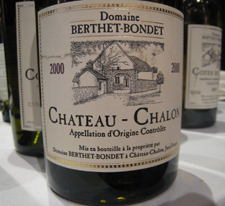
berthet-bondet-vin-jauneLocated about half way between Dijon and Geneva, the pocket-sized region of the Jura makes some of France’s most distinctive wines. At a recent trade tasting, I sampled a few of the wines from Domaine Berthet-Bondet, a winery founded by Jean Berthet Bondet on the relatively New World time frame of 1985. The Cotes de Jura Chardonnay 2006 is matured in neutral oak barrels and has a vein of minerality so rich it would out Chablis out of business if the world craved minerally chardonnay.
But the piece de resistance was the 2000 vin jaune (a type of “vin de voile” ) from the micro-appellation of Chateau-Chalon. Made entirely from the Savignan grape, the wine is matured for six or seven years in small neutral barrels, which are intentionally not filled all the way nor replenished (as barrels usually are to replace the “angels’ share” that evaporates). This creates further exchange with oxygen. But a film of beneficial yeast forms on the surface to moderate the oxygen exchange and prevent it from heading on a crash course to becoming vinegar. The aging happens in a well-ventilated room so there are wide temperature fluctuations through out the long aging. A complex wine emerges from the process, with aromas of walnuts, dried apricots, daisies. The nutty finish lingers for hours. Really. Truly a wine of contemplation. The oxidative process girds the wine for decades or centuries in the cellar.

Unfortunately, the wine sells for north of $100 for a 62cl bottle (find this wine). Their Cotes de Jura Tradtion 2003 provides the oxidative wine character, but at a fraction of the price (about $22; find this wine). I’d try both with Comté cheese.

Now if only we could come up with a sexier term than “oxidative”!

Wine, yes tanks

wine_tanks

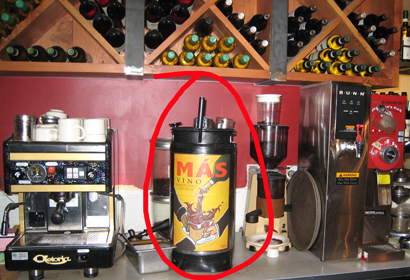
The NYT ran a story yesterday about wine served in restaurants from refillable tanks. It’s a win-win idea since it lowers the cost per glass of wine reduces wine’s carbon footprint with less packaging mass, similar to the bag-in-box idea I detailed in the Times last summer.

Let’s just hope the restaurants that do use the system pass on the lower costs to diners. Such is the case of those detailed in the story. Last spring, I also saw an affordable tank wine (“Mas vino,” pictured above) offered by the glass at Small Shed Flatbreads in Mill Valley. I didn’t try it because I was too busy trying a prosecco.


winepoliticsamz

Wine Maps


Monthly Archives

Categories


Blog posts via email

@drvino on Instagram

@drvino on Twitter


winesearcher

quotes

One of the “fresh voices taking wine journalism in new and important directions.” -World of Fine Wine

“His reporting over the past six months has had seismic consequences, which is a hell of an accomplishment for a blog.” -Forbes.com

"News of such activities, reported last month on a wine blog called Dr. Vino, have captivated wine enthusiasts and triggered a fierce online debate…" The Wall Street Journal

"...well-written, well-researched, calm and, dare we use the word, sober." -Dorothy Gaiter & John Brecher, WSJ

jbf07James Beard Foundation awards

Saveur, best drinks blog, finalist 2012.

Winner, Best Wine Blog

One of the "seven best wine blogs." Food & Wine,

One of the three best wine blogs, Fast Company

See more media...

ayow150buy

Wine books on Amazon: