Australian Riesling – Can it age? – Grosset, Steingarten and Leo Buring
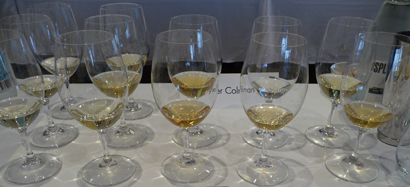
riesling_glasses
One question that led me to Australia is whether Australian Riesling can age. The wine is almost always released within a year of harvest so the tendency is to drink it young when it can be very refreshing. Riesling from Australia tends to be dry and is almost always bottled under screwcap now.

The youngest Riesling I’ve tasted was a tank sample of the 2009 Jacob’s Creek Steingarten Riesling. The Steingarten vineyard was originally about 1000 vines planted in the 1960s at the top of Trial Hill, a windy spot on the edge of the Eden Valley. At the outset, it was a single vineyard wine of tiny production. But now although most of the vines come from an altitude of 500 meters, it makes no claim to be site specific; the Steingarten name is a brand. The tank sample was brimming with citrus intensity but not yet really formed as a wine. The 2005, by contrast, was in a very nice spot, exhibiting more muted lime and floral character. The 1998 was oddly phenolic and, while quite solid, not as rewarding today as the 2005. Read more…
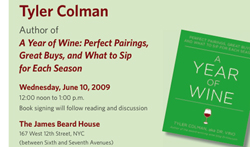

At the James Beard House to discuss A Year of Wine

beard_smNext Wednesday I’ll be at the James Beard House to talk about my new book, A Year of Wine: Perfect Pairings, Great Buys, and What to Sip for Each Season. It’s part of their monthly author series called Beard on Books.

I was fortunate enough to have been able to give a talk there last year for my other book, Wine Politics, and the turnout was great and the discussion was excellent. Because A Year of Wine dovetails on the seasonal food movement by suggesting varying the wines you drink with the seasons, I’m thrilled to be heading to this gastronomic institution for this discussion. Hope to see you there!

Wednesday, June 10, Noon – 1 PM
167 W. 12th Street
Suggested donation: $20; students free. Event page on their site.

I can’t believe it’s not Albariño!

albarino1Down under, thousands of liters of a certain white wine are resting in tanks right now. The only trouble is that nobody’s sure what to call it once it’s bottled.

In the 1980s, the Australian research institute CSIRO imported what they thought were Albariño vines from Spain. Eventually, market demand led to propagation of the vines; about 70 producers make it today.

But a couple of years ago Jean-Michel Boursiquot, a expert vine identifier (who knew?) from the University of Montpellier, spotted the vine thought to be Albariño and suggested that it was, in fact, the savagnin blanc grape often found in the Jura region of France (who in Australia will be the first to make it in an oxidative, vin juane style?). The Australian authorities confirmed this earlier this year, after the harvest but before bottling. Thus the producers can no longer call it Albariño and there’s no consensus on whether they should adopt the Savagnin Blanc labeling or even try Traminer, it’s genetic twin. But time is ticking as bottling time approaches.

Any thoughts? Here were some suggestions that came up in our seminar this afternoon:
* Albari-not
* The grape formerly known as Albariño (actually a symbol)
* I can’t believe it’s not Albariño! (Credit goes to Max Allen)

Further reading: “Albariño and Savagnin, Mencía and Jaen” [Jancisrobinson.com]

Ernest Gallo, behavioral economist

Just rediscovered this oldie but goodie in a decade-old article from The Economist:

ERNEST GALLO, the 91-year-old patriarch of the eponymous American wine company, tells a story about his early days of selling wine, just after Prohibition had been lifted. On visiting a buyer in New York, he offered him two samples of the same red wine. The man tasted the first glass, asked its price, and was told it was five cents a bottle. He tried the second sample, asked the price, and was told it was ten cents a bottle. “I’ll take the ten-cent one,” said the buyer.

Related: “Why so few tasty American wines under $12? Wine importer Bobby Kacher

The state of Australian wine – and Landmark Australia

kangaroo_vinesOver the past couple of decades, Australian wine has seen two tremendous, parallel booms, one at the low end and one at the high end. But now the industry is now suffering through a bust, particularly acute at the higher end.
This epic tale has received attention from other wine journalists recently including Jay Miller’s February article in the Wine Advocate (“Australia: Into the Abyss”), Jancis Robinson in the FT (“How Australia went down under“), and Mike Steinberger in Slate (whose memorable line was “Foster’s may be Australian for beer (mate); it appears that screwed is now Australian for wine.”). Read more…

Hitler, translation, corks, France, ID – sipped and spit

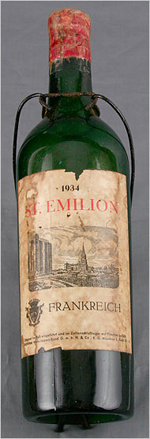
hitler-wine150SIPPED: Stalinist architecture in St. Emilion!


A bottle of wine allegedly in Hitler’s cellar at the Berghof sold for $900 at Alexander Autographs recently. The label might have raised some questions since has only St. Emilion, Frankreich (German for France) emblazoned on the front with no producer name, a vintage of 1934, and what a blog at the NY Times describes as a “Stalinist-style structure towering over the church.” Donald and Petie Kladstrup, co-authors of Wine and War: The French, the Nazis, and the Battle for France’s Greatest Treasure, told the NYT blog that Hitler “occasionally drank wine, though he preferred beer.” What ever happened to his being a teetotaler?

SPIT: translation
A lot of wine descriptors could be interpreted as bedroom talk. But Jim Boyce writes about a case worthy of Engrish.com, a Chinese back label that cuts to the chase: “Yellow flowers and a beautiful apricot color with a strong musk. Rich texture with sweet f*ck in sweet orange peel and apricot flavor at the end of a clean. Drink now.”

SPIT: Champagne corks
Champagne, perhaps the last regional holdout (ex-Portugal) from the assault of screwcaps, now has The Maestro. Although we mentioned it previously, details are now out: The new closure, which hides a crown cap (think: beer) under a plastic cover and lever, will soon adorn select bottles of Duval-Leroy champagne. TIME says that it is “far easier to use than a conventional stopper— no struggling to hold the heavy bottle as you twist, no worrying that you’ll take someone’s eye out with the cork.” But, really, a lever doesn’t add to the bottle’s aesthetics–get a grip! [see video of the Maestro in action]

SPIT: wine
In France, consumption continues to fall. So do exports. “French households drank almost 10 percent less wine last year than in 2007, and exports by French vintners sank 15 percent by volume and almost 30 percent by value in the first quarter of 2009, the agriculture ministry reported.” [AP]

SIPPED: ID
Equifax, a credit rating agency, is developing a service to strengthen online identities, which could be particularly useful to verifying the age of someone who wants to buy wine on the web. [Bits blog]

Photo: Alexander Autographs

Wine Advocate Writers Spark Ethics Debate – Wall Street Journal

wsj_logo_big
The Wall Street Journal has a story today on page D1 entitled, “Wine Advocate Writers Spark Ethics Debate: While Newsletter’s Founder Champions Independence, Two Reviewers Accepted Trips.”

Reporter David Kesmodel details the divergence between policy and practice at Robert Parker’s Wine Advocate. He acknowledges reporting on this blog that initially raised the questions (see my original correspondence with Parker and critic Jay Miller here and a follow up here).

The Wall Street Journal story adds details that Miller accepted trips to Australia and Chile paid by wine industry groups. I contacted Wines of Argentina last month and their staff in Mendoza verified that they had also had paid for two trips for Miller to visit the country. Other parties verified that he was ferried around the country by private jet on one of those trips.

The WSJ story says that Parker declined to respond to interview requests, as did Miller and Mark Squires who has admitted to taking press trips to Portugal, Israel and Greece. Joining a press trip from a regional or national association is not out of ordinary for wine writers; it’s that Robert Parker laid down ethical standards years ago that state “It is imperative for a wine critic to pay his own way” and “it is imperative to keep one’s distance from the trade.” Parker’s lack of response to the reporter seems odd since not only would it clarify the situation but he encouraged reporters to call him just last month, writing in his forum “Today…most journalists don’t even call if they want to write about me…no sense having me provide a well documented rebuttal that undermines their story line……”

Wine Advocate Writers Spark Ethics Debate” [Wall Street Journal]

Why so few tasty American wines under $12? Wine importer Bobby Kacher

bobby-kacherWe recently discussed why there are so few tasty low priced wines from America, particularly compared to imports. Later, I decided to put the question to wine importer Bobby Kacher. Robert Kacher Selections is strong in bargains from Southwestern France; I highlighted the Tariquet Sauvignon (find this wine) in my book with wine recommendations, A Year of Wine, as one of 10 great wines under $10 (REDS from Patrick Campbell was also included).

Question: why there are so few good American wines under $10 while there are many more imports at that price point?

Bobby Kacher: A related question is why do so many American wineries make such expensive wines? So many American wineries have developed new, highly-allocated wines from very young vineyards that sell for $150 or more a bottle. They are trying to sell you the spin of romance and lifestyle. I visited a winery in California once and calculated just how much it cost to make Read more…


winepoliticsamz

Wine Maps


Monthly Archives

Categories


Blog posts via email

@drvino on Instagram

@drvino on Twitter


winesearcher

quotes

One of the “fresh voices taking wine journalism in new and important directions.” -World of Fine Wine

“His reporting over the past six months has had seismic consequences, which is a hell of an accomplishment for a blog.” -Forbes.com

"News of such activities, reported last month on a wine blog called Dr. Vino, have captivated wine enthusiasts and triggered a fierce online debate…" The Wall Street Journal

"...well-written, well-researched, calm and, dare we use the word, sober." -Dorothy Gaiter & John Brecher, WSJ

jbf07James Beard Foundation awards

Saveur, best drinks blog, finalist 2012.

Winner, Best Wine Blog

One of the "seven best wine blogs." Food & Wine,

One of the three best wine blogs, Fast Company

See more media...

ayow150buy

Wine books on Amazon: