Slate: how the Internet has democratized wine drinking

wine_web_criticsMike Steinberger posted a synopsis earlier today of the recent policy transgressions, policy changes and general tone deafness at Robert Parker’s The Wine Advocate. It advances the discussion since his angle is that the moment of the Internet is now:

But while the online world has clearly changed the way in which wine information is disseminated, the notion that it might fundamentally alter the critic-consumer dynamic was, until recently, mostly a matter of prognostication—everyone agreed it was bound to happen, but at some indeterminate point in the future. What the Parker imbroglio demonstrated is that the future has arrived…

We are moving from a monologue to a dialogue, and this reflects a fundamental truth about wine: It is a matter of taste, and taste differs from one person to the next. There’s still a need for expert opinion, but authority is going to have to be worn a lot more lightly going forward, and it isn’t going to command quite the deference that it used to.

Check it out. And also be sure to check out, if you haven’t already, the lively discussions by the “purged and the disaffected” over on Wine Berserkers!

“We’re All Wine Critics Now: How the Internet has democratized drinking.” [Slate] (Crop of image from Slate)
Dominus Estate, Napa Valley – photo post

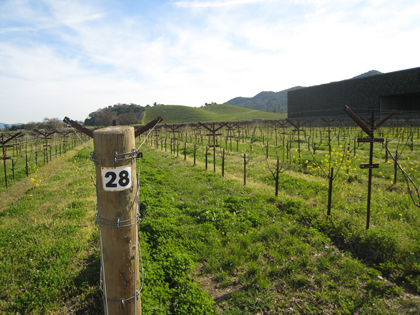
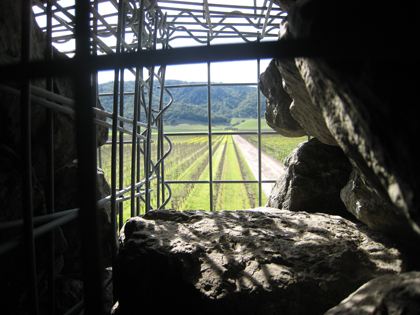
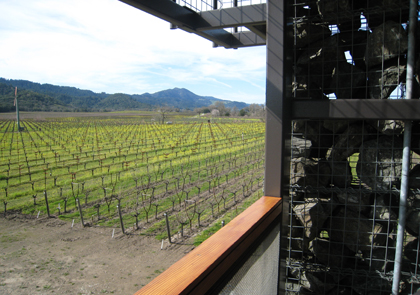
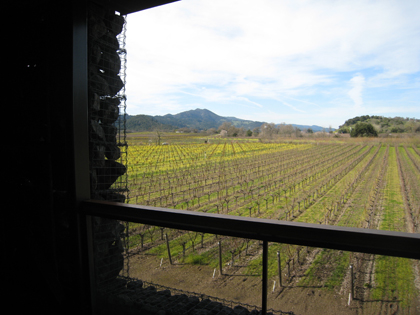
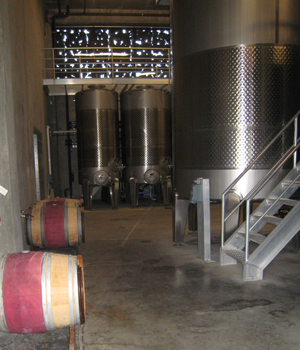
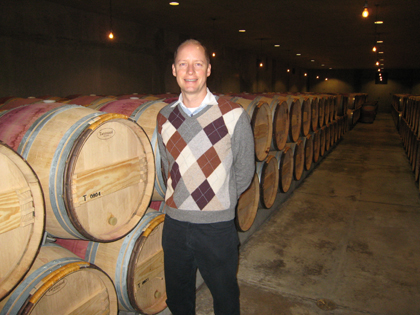
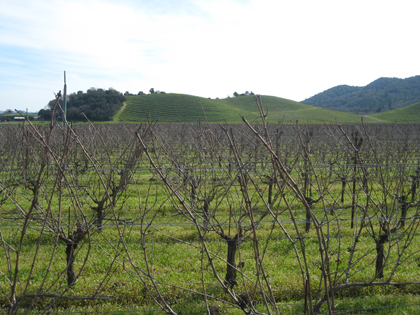
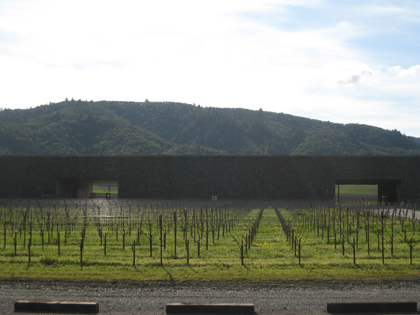
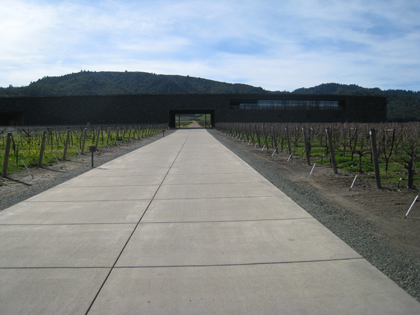
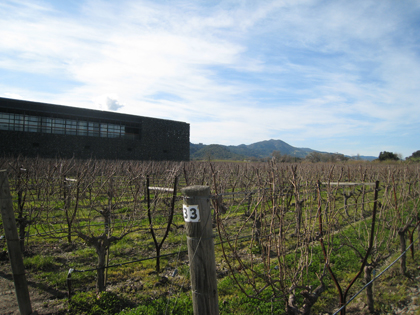
I’ve wanted to visit the Dominus Estate in Napa since it was built in 1997. But it’s not open to the public. So when I was in Napa in February as a speaker at the Symposium for Professional Wine Writers, I inquired about visiting and was glad that they offered me the chance. So here’s an edition of Dr. Vino inside! (And a change for trying out a new photo “gallery;” background and annotation appear after the jump.)


Read more…

Cahors: does the Malbec comparison help or hurt?

cahors_malbecPromotional authorities in the French region of Cahors are mounting a campaign that ties their little-known region to the well-known grape, Malbec. Is it a good move?

Known as “the black wine of Cahors” for its inky character, Cahors wines had their heyday in the early 14th century when production was high and half of it was exported. Then, rivalry with downriver Bordeaux led to taxes and levies that severely crimped exports and thus renown.

The marketing campaign today exclaims, “Cahors is back, Cahors is black, Cahors is Malbec!”

Hitching the Cahors wagon on to Malbec train is easy to understand. The grape has experienced sharp growth in popularity over the past few years. But Malbec has also become the signature grape of Argentina, which has almost three-quarters of the world’s Malbec plantings and is stylistically and literally oceans apart from Cahors.

So I wonder if the folks from Cahors are setting expectations incorrectly since Malbec is often understood to be big, soft, and gentle (a Bloomberg story suggested it was “stealing” Merlot sales). Those are not terms usually used to describe the wines of Cahors, which, though some can be charming and surprisingly age-worthy, can have fearsome tannins and acidity. In fact, in my book, A Year of Wine, I suggest trying a Malbec from Argentina and “black wine” of Cahors as a way to understanding the term “rustic.”

I brought a couple of Malbecs to a late summer grill-fest at some friends’ house, bagged them and poured them blind. The two wines were the Clos la Coutale 2007 for about $11–a firm but somewhat modern Cahors–and the Bodegas Salentein for about $19–not the most over-the-top Malbec form Mendoza. Generally speaking, I described the Cahors style as having higher tannins, less fruit, lower alcohol and more “rustic” and the Argentine style as having more fruit, higher alcohol, and generally a plusher feel. Although the assembled group was able to nail each for what it was, they were divided on which they liked better, particularly with the grilled meats, which improved the Coutale for those who favored the Salentein.

Maybe the new slogan should emphasize food? “Cahors Malbec: meat, your match.”

In other news, a friend who has consumed many Argentine Malbecs over the past couple of years recently admitted to getting bored with them. So maybe Cahors should just play the Cahors card in case the seeds of a Malbec backlash are germinating?

Peanut butter and bacon sandwich – Mayor Bloomberg – impossible pairing?

Peanut-Butter-Bacon-Sandwic
In a piece entitled “Mayor Doesn’t Always Live by His Health Rules,” the Times reported yesterday on Mayor Bloomberg’s diet. To the tape:

HE dumps salt on almost everything, even saltine crackers. He devours burnt bacon and peanut butter sandwiches. He has a weakness for hot dogs, cheeseburgers, and fried chicken, washing them down with a glass of merlot.

Whoa–talk about impossible food-wine pairings!! Surely we can do better for Mayor Mike than merlot? Which wine with you pair with burnt bacon and peanut butter sandwiches? Or are they…impossible?!? Answer well and it could lead to Senior Pairings Expert in a possible future Bloomberg administration?!

Related: Elvis’ version of the peanut butter, bacon, banana (!) and butter (!!) sandwich

Chenin Blanc vs. Sauvignon Blanc – a battle royale? [poll]

french_whitesOver on Forbes.com, I just contributed a short piece about the wines of Vouvray. Almost entirely, the wines of Vouvray are from the Chenin Blanc grape and Vouvray is in many ways the apogee of Chenin Blanc. The wines from this 5,000 acre appellation can be very rewarding, as a sparkling wine or dry, off-dry, and sweet. Moreover, the best examples are extremely age-worthy and global warming has made them more accessible in their youth.

My thoughts drifted to regional rival, Suavignon Blanc, which is considered one of the three “noble” white grapes (Riesling and Chardonnay are the others). I’ve never really cottoned to the whole aristocratic anthropomorphism for grape varieties but if I were drawing it up today, I’d prepare Sauvignon for a defenestration in favor of Chenin. Let’s measure it up:

Multiple expressions (sparkling to sweet)? Chenin has the edge
Age-worthy? Chenin
Multiple layers of complexity in the glass? Chenin
The top examples of each? Chenin has the edge
More accessible when young? Sauvignon
More popular? Sauvignon
Ability to be planted more widely? Sauvignon

Have your say in the latest poll! (note: selecting two responses is possible)
[poll id=”8″]

Big oaky monsters, imports, burcak, medals – sipped and spit

burcak
SPIT: big oaky monsters
Wine importer Kermit Lynch: “I think we have two kinds of wine markets today. One of them is what I like to call the pop wines…You’ve got your big oaky monsters trying to get 100 points. Then you have a winemaker trying to express his idea of what beauty is. Yeah, the pendulum has really swung back. For instance, a year ago we ran a sampler case of low alcohol wine. The response was enormous. I was shocked. There’s a real backlash to those oaky monsters going on.” [FT.com]

SPIT: Canadian wine from Canada
Canadian wines can contain 70% imported wine and still say “cellared in Canada” on the label. Big companies are for the practice according to The Economist, who calls it “Blended deceit from the nanny state.”

SIPPED: pre-wine!
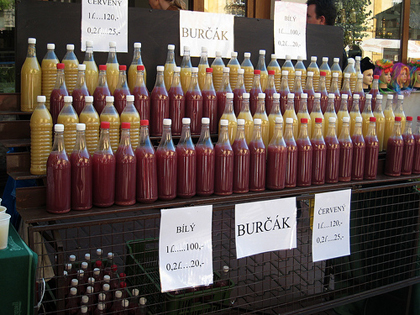
The Burcak is flowing in Prague. The cloudy proto-wine grape drink (pictured above) is a pre-fermentation wine that revelers delight in drinking. Legend has it that the Burcak continues to ferment in your stomach, leaving a lasting buzz, er, impression. [Globespotters]

SPIT: imports
Beverage Information Group reports that overall wine consumption in the U.S. rose 0.9 percent in 2008 to 294.7 million 9-liter cases. In a reversal of a recent trend, they report that imported wines dropped 1.8 %, while domestics rose 1.9%. Their culprit: the weak dollar.

SIPPED: Stomp!
The WSJ has a round-up of wine festivals around the world that include many grape-stomping opportunities.

Alert Hodgson!
A Fresno State student wine wins “record” 49 medals. [Collegian]

High stakes and alleged fakes – Koch sues Kurniawan

William I. Koch, the billionaire wine collector at the heart of the story The Billionaire’s Vinegar (buy on amazon), has taken yet more legal action in the world of fine wine. In an extensive complaint lodged in Los Angeles court last week, Koch makes some significant allegations. The complaint is available here as pdf and it makes for great reading. In the name of fairness and balance, these are simply allegations and it will be interesting to see how it all plays out. Whether or not you are into the fine and collectible wine market, these are fascinating developments as the cast of characters expands beyond those in The Billionaire’s Vinegar.
Koch alleges that five bottles he purchased through Acker Merrall & Condit were fake. The bottles were: 1947 Château Pétrus, a bottle of 1945 Comte Georges de Vogüé Musigny Cuvée Vielles Vignes, 1949 Lafleur, and two bottles of 1934 Domaine de la Romanée-Conti. Koch paid Acker $77,925 for the five bottles, purchased through private sales and auctions. He now claims they all came from Kurianwan but that source was not stated at the time of purchase.

Koch maintains that Kurniawan was the source of two Acker auctions in 2006 hailed only as from “THE cellar.” The two auctions grossed over $35 million. The complaint points to this LA Times profile of Kurniawan, which describes his preferred wardrobe is jeans and gray tshrits but that he has a Bentely and a Ferrari. The article also says that he got into wine only in the year 2000 but had already amassed a cellar of 50,000 bottles and that, “Since he started buying, prices for rare wine have skyrocketed.”

In reference to the two 2006 auctions, the filing says, “Buying and selling the same wine at the same time could also be an effort to manipulate wine prices, a scheme to pump up the price and then dump wine into the inflated market.”

Koch’s filing also states that Kurniawan owed Acker and Acker clients $10.4 million as of a November 2008 court proceeding. Acker accepted fine art and wine as collateral. Emigrant Bank also lent Kurniawan $3 million, according to the filing, and sued Kurniawan to get it back.

The filing also elaborates on sales of magnums of 1982 Le Pin and 122 bottles of red Burgundy from Domaine Ponsot. However, both sets of wines were withdrawn after winery principals raised doubts about the authenticity of the wines. Jancis Robinson has since called Laurent Ponsot “Burgundy’s Sherlock Holmes.” But where Kruniawan got those bottles remains unknown.

And to think that the movie rights for The Bilionaire’s Vinegar have already been sold! Looks like they’d better get working on the sequel already…

Corkfinger and cork recycling

2504578128_0c39415c60_mIn the classic Bond film, Goldfinger tries to corner the world market for gold. Is Amorim trying to do the same thing for cork?

Already the largest producer of wine bottle corks, ripped from the bark of trees in Portugal, now they want their corks back!

Amorim operates a newish program under the name ReCORK America that claims to keep post-consumer corks out of landfills, a laudable goal. They have already signed up some Whole Foods locations in Northern California and they recently announced the addition of American Airlines Admirals Club lounges. Soon to be heard in taxis everywhere, “Yes, honey, I’ve got the passports but let’s go back and grab the corks and bring them to the lounge!”

Despite language in the press release to the contrary, ReCORK America currently has no specific plans on what to do with the corks they receive other than to store them in a warehouse in Napa, as stated on their web site. Contacted via email to see if their plans had congealed, they only pointed out that their partners pay to ship the corks back to the warehouse.

By contrast, the green building firm in Missouri, Yemm & Hart has collected almost 8,000 pounds (about one million corks) of post consumer corks since 2004. They make them into cork tiles for flooring and are still accepting donations. Let’s hope one day they start making cork iPhone cases!

With 13 billion corks pulled from wine bottles every year by Amorim’s estimate, there are still a lot of corks headed to landfills. Because corks are a natural product, they can also be shredded and used as mulch in the garden or added to compost as a way to keep them out of landfills. And don’t forget cork art!


winepoliticsamz

Wine Maps


Monthly Archives

Categories


Blog posts via email

@drvino on Instagram

@drvino on Twitter


winesearcher

quotes

One of the “fresh voices taking wine journalism in new and important directions.” -World of Fine Wine

“His reporting over the past six months has had seismic consequences, which is a hell of an accomplishment for a blog.” -Forbes.com

"News of such activities, reported last month on a wine blog called Dr. Vino, have captivated wine enthusiasts and triggered a fierce online debate…" The Wall Street Journal

"...well-written, well-researched, calm and, dare we use the word, sober." -Dorothy Gaiter & John Brecher, WSJ

jbf07James Beard Foundation awards

Saveur, best drinks blog, finalist 2012.

Winner, Best Wine Blog

One of the "seven best wine blogs." Food & Wine,

One of the three best wine blogs, Fast Company

See more media...

ayow150buy

Wine books on Amazon: