The best white wine under $15
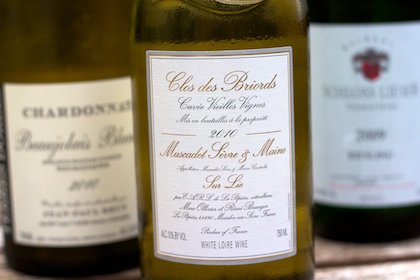

What’s the best white wine currently in the US market for about $15? I’ll make a case for the 2010 Clos des Briords from Marc Ollivier (Domaine de la Pépière).

The 2010 is electric. After the 2009 had more ripeness, I find 2010 a reversion to the exciting norm of citrusy freshness and minerally, iodiney verve. Pairing it with seafood, particularly shellfish, is probably about as much fun as you can have with a $15 white wine. (search for this wine at retail) The wine comes from a single vineyard in Muscadet, one of vines planted in the 1930s. The wine stays on its lees up until bottling, which also helps account for more depth than your average Muscadet. It’s also particularly age-worthy, and I’m scouting out some magnums to tuck away. Emphasizing the minerailty over fruitiness means this wine isn’t for everyone. But for those who love wines so taut you could play a DVD on them, check out what is the best white value out there.

A runner-up would certainly be the Terres Dorées Beaujolais Blanc, a Chardonnay, also from 2010 (above, left). The wine is a perennial better value, but the 2010 exhibits a value chardonnay in its minerally, unadorned form that is stunning. (On a related note, I was a huge fan of the 2009 red Terres Dorees, but didn’t find the 2010 red to have the same snap.)

Which wine would you nominate as the best white wine around $15 in the market today?
NYT: wine consumers “brainwashed” into thinking they need education

Writing in yesterday’s NYT, Eric Asimov delivered wine education a puzzling broadside in the last paragraph of a story about beer:

Beer consumers are a far more confident lot than wine consumers. They’re at ease with beer, mostly because they’ve had a solid grounding in their subject, unlike wine consumers who’ve been brainwashed into believing they must be educated or taught how to “appreciate” wine before they can enjoy it.

Who are these “beer consumers” and “wine consumers”? Are they the average consumer, who drinks mostly Bud and Yellow Tail or are they the dedicated hop heads and wine geeks? Some specificity would help the discussion.

Further, how did “beer consumers” gain such confidence–through Super Bowl ads? Doing keg stands in college? I assume through tasting, talking, reading and perhaps taking a class; I doubt they were born with a knowledge of the effects of dry-hopping and decotion on the finished beer or knowing differences between a saison, a pils, a kölsch, and a Berliner Weisse. As exciting as the craft beer revolution is, it takes some education to successfully navigate increasingly complex beer menus or beer selections at specialty stores. And, fortunately, it’s the kind of research that a lot of people can take pleasure in.

Finally, which “wine consumers” feel “brainwashed” into thinking that they have to have studied wine to enjoy a wine? (And who is doing the brainwashing–the wine education/book publishing/bulletin board industrial complex?) This sounds like a straw man to me as I have never met a wine consumer who couldn’t simply pull a cork, pour, and enjoy a wine without having a categorical knowledge of its production. And I’m not really sure where his advancing the brainwashing position takes the discussion. Surely Asimov is not arguing that tasting, talking, reading and perhaps taking a class about wine is a waste of every one’s time–how did he gain his knowledge, after all?

The comparative question of how craft beer enthusiasts and wine geeks, the most die-hard of the two constituencies, achieved their knowledge is interesting and worth pursuing. If I were to look into it it variables I would examine include: the role of critics in each beverage; the role of online discussion boards and user-generated reviews/ratings; the extent of home wine making or beer making; the availability of formal classes or training; and the geographic proximity of an enthusiast to a microbrewery or winery. Hmm, thinking about this makes me want to go crack open a nice cold wine and enjoy it without angst.

Downfall of a Cult California Winery [video]


Sometimes these spoof wine videos come in waves–remember the animated wine trade videos? Now, the meme of the moment appears to be “Hitler yelling” videos, such as the one we saw recently.

This new one, entitled “Downfall of a Cult Californian Winery,” depicts the plight of a cult winery owner during this time of a changing of the critic at the Wine Advocate. A little “inside baseball,” but pretty scathing and some good LOLz to start your day.

Fine wine datapoints: Lafite price falls, DRC rises, HK-NYC spreads remain

Checking in with the fine wine market, a few datapoints:

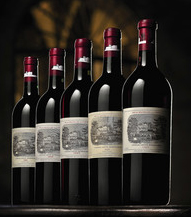
* Lafite-Rothschild still commands large dollar amounts, but the bloom may be coming off the rose. Liv-Ex chronicles recent softness in Lafite prices. Perhaps the Asian buyers are no longer willing to pay exorbitant premiums to other Bordeaux wines. Of note, a case of 1961 La Mission Haut Brion just sold for US$59,000 in Hong Kong last weekend.

* Interest in Burgundy appears to be increasing. DRC just hit new highs in London and New York.

* But spreads remain across venues with Hong Kong buyers paying on aver 48% more for DRC than in New York. As a reminder, shipping a case shipping a case of wine from NY to HK costs less than $50.

Joe Dressner, importer of “real” wines, dies at 60

Whenever my wife sees that a wine’s back label is from importer Louis/Dressner, she gets excited about the wine to follow. Rightfully so: Louis/Dressner has a portfolio bursting with terrific wines, from vineyard owners making their own wines with few, if any, interventions in the cellar. While Joe Dressner touted this side of his wines, calling his portfolio one of “real” wines, one aspect that receives less attention is that the book of his wines includes some of the best values on the planet, particularly in the $12 – $20 range. Jean-Paul Brun. Marc Ollivier (Dom de la Pepiere). Bernard Baudry. The Puzelat brothers. These vignerons have brought me great joy at reasonable prices. Thus it is sad that Joe Dressner died over the weekend.
Since I was always a fan of his wines, it was hurtful when Joe started leaving caustic comments on this blog in late 2008, a practice that he continued for about a year. It bugged me–and my wife. During that time, his wines became less fun to us. Joe had a brain tumor at that time and used a blog, The Amazing Adventures of Captain Tumor Man, as a way to cope. Eventually, he did apologize to me on Twitter. I was sorry not to have been able to penetrate his prickly, irascible persona better since I know that he had a razor-sharp, irony-drenched wit and was a man of conviction.

He was a pioneer in popularizing natural wines in this country. I offer my condolences to his family and his business associates. I look forward to raising a glass in his honor tonight.

A remembrance at Diner’s Journal
Louis/Dressner

One-year supply dehydrated food — impossible food-wine pairing?

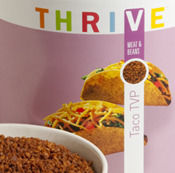
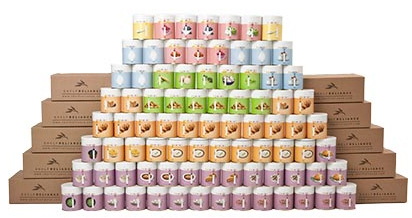
With gold at $1,800, Ron Paul polling third among the Republican candidates, and people flocking to a wine cellar for safety, is it any wonder that Costco is currently marketing a one year’s supply of food? Called Shelf Reliance THRIVE, it’s dehydrated, freeze-dried, and comes in big cans. All the better for storing in your bunker! (One commenter points out that it’s a lean 1,220 calories a day amortized over a whole year. And the ability to boil water is required for some of them!)

So, if you had to tuck away a year’s supply of wine to pair with such delicacies as Taco TVP–textured vegetable protein–what would it be? Or is it…impossible?!? Given that all the food costs $799, ratchet up the degree of difficulty by trying to keep under that number. (Needless to say, a $10 bottle every night in your bunker would cost $3,650 for a year.)

Prohibition, Puritanism, NYC harvest, remembrances — sipped & spit


SIPPED: Prohibition
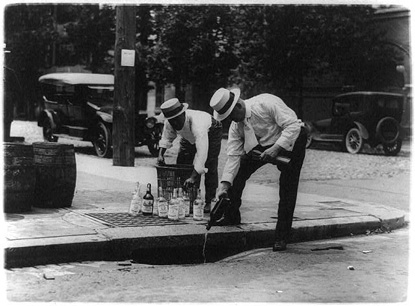
PBS has a three-part documentary airing next month about Prohibition. It’s directed by Ken Burns and based on the book “Last Call” by Daniel Okrent. Fire up the TiVo to see the battle of the “wets” vs the “drys”: the first episode is entitled “A Nation of Drunkards.” [WITF]

SPIT: Puritanism
Professor Lena Brattsten has offered a wine appreciation course to Rutgers undergrads for twenty years. And for twenty years, it has had an outlandishly long wait list. Remind me: Why aren’t there more undergraduate wine classes? [Rutgers.edu]

SIPPED: Manhattan harvest
A blogger joins what is perhaps Manhattan’s only grape harvest, 350 pounds from a single labrusca vine on the UES dubbed Chateau Latif. [Treehugger]

SIPPED: a Riesling rap
“My Riesling’s so tasty/I drink it so hasty/because it plays well with sausages in their casings.” [youtube]

SIPPED: remembrances
A touching piece that balances the pleasure of learning about wine with the horror of 9/11. [esquire]

The best bottles are the quickest emptied: Mugnier edition


The best bottles are the quickest emptied. But you knew that.

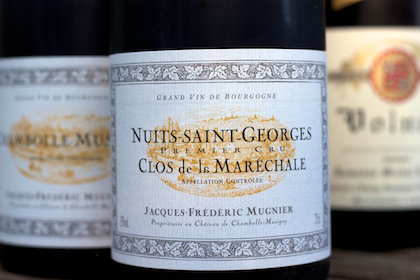
Last week, I made my wife a birthday dinner. But before I started covering the kitchen counter and, inadvertently, the floor and my clothes with flour to make fresh pasta, I popped open a bottle of slightly chilled Mugnier Clos de la Marechale 2007. By the time we got to the table, I was dismayed to find most of the wine had evaporated!

The 2007 Clos de la Marechale is drinking very well now. I had the good fortune of tasting the 08 and the 09 this week too at a trade tasting. While the 07 is the least heralded of these vintages, it is certainly not one to overlook with delicious balance of fruit, acidity and tannin. The ’08 has more red berry notes, acidity, tannin, balance and gorgeous oomph that bodes well for a long cellar life. The ’09 has more dark fruit character, slightly more ripeness and roundness and elegant concentration, with a spice note that culminates an a faint whiff of pepper. All bear the signature of Frédérique Mugnier for the “bargain” price of under $100. (Find these wines)

Peter Wasserman, who works to export the wines, told me that “Freddy” Mugnier, the winemaker and a former petrochemical engineer, has undertaken a geological survey of the vineyard this year. While the wine making remains very hands-off, for the first time, he will be harvesting the grapes from similar soils and making the wines by those parcels instead of by vine age (45 – 70 years old). All the vats will still be blended in to the 2011 Clos de la Marechale.


winepoliticsamz

Wine Maps


Monthly Archives

Categories


Blog posts via email

@drvino on Instagram

@drvino on Twitter


winesearcher

quotes

One of the “fresh voices taking wine journalism in new and important directions.” -World of Fine Wine

“His reporting over the past six months has had seismic consequences, which is a hell of an accomplishment for a blog.” -Forbes.com

"News of such activities, reported last month on a wine blog called Dr. Vino, have captivated wine enthusiasts and triggered a fierce online debate…" The Wall Street Journal

"...well-written, well-researched, calm and, dare we use the word, sober." -Dorothy Gaiter & John Brecher, WSJ

jbf07James Beard Foundation awards

Saveur, best drinks blog, finalist 2012.

Winner, Best Wine Blog

One of the "seven best wine blogs." Food & Wine,

One of the three best wine blogs, Fast Company

See more media...

ayow150buy

Wine books on Amazon: