Wine tasting at Caves Auge – Tissot and Binner edition [Paris]


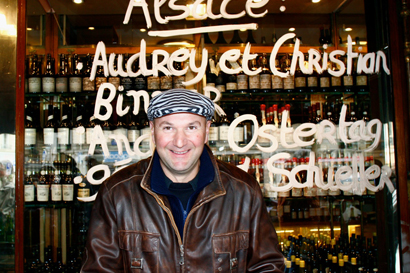
Stephane Tissot from the Jura outside Les Caves Augé in Paris.

Les Caves Augé, the excellent Paris wine shop, has fun, free wine tastings that spill on to the sidewalk. The shop is crammed with so many fine and fun wines that they mainly have to do these free tastings outside of the winter months, so the broad pavements of Boulevard Hausmann are at their most hospitable. For anyone traveling to Paris, there are three remaining Saturday tastings this season at Augé, “Wonder women” on June 5, “Loire” on June 19, and “bubbles” on July 10.

Although we’ve never met, Tim Eustis is a friend of a friend. He worked in wine retail in New York City and did wine consulting for seven years. About a year ago, he and his family moved to Paris. Back in March, he dropped by the first of the spring tastings. Over to Tim for photos and comments from his tasting some wines from the Jura and Alsace. I have liked some wines from Tissot (old vine Poulsard) and Binner (notably, the gewurztraminer) in the past so was pleased Tim had the chance to taste them.

By Timothy Eustis Read more…

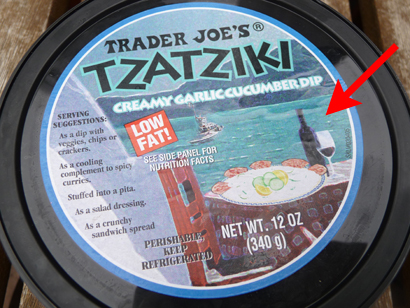
Help Trader Joe’s pair wine with tzatziki!

Who would ever think about pairing wine with tzatziki? Why, the good folks at Trader Joe’s! (Or should I say, Trader Iosif, as is their wont.) They put it right there on the packaging–a platter of tzatziki and pita, a view of a bay, and some red wine…

Is that what you would go for pairing wine with this “creamy cucumber garlic dip”? Or is it…impossible?!? Hit the comments!

Steve Case, recorking, Prohibition, wine weather — sipped and spit

SPIT: the wrong end
In Tuesday’s post about wine closure preferences, some commenters expressed frustration about not being able to reinsert a synthetic cork back into an unfinished bottle. That reminded me that a winemaker once told me that if you do that with a regular cork, be sure to keep the same side facing down, since the top may no longer be sanitary.

SIPPED: cash
Vinfolio, a wine retailer buffeted by financial crisis in January, has received an investment (amount unspecified) from Steve Case, founder of AOL, through his investment company, Revolution, LLC. Even though he’s far from investing his whole fortune, Vinfolio must feel that half a Case is better than none.

SPIT: past merger
Foster’s announced that it will split its beer and wine businesses, considered a prelude to selling one or both of the units. Foster’s wine portfolio includes Penfolds, Lindemans, Wynns, Rosemount, and Beringer. The shares leaped 7% in Australia. While speculation about suitors for the beer business quickly emerged, the future of the wine brands was less clear. UPDATE: Ray King, who ran the wine unit for three years, told The Australian that the merger was a “disaster,” adding, “It proved the old adage that you don’t mix the grape and the grain.”

SIPPED: exploring the “noble experiment”
Ken Burns will release a new documentary about Prohibition. I explored the the odd but astoundingly important chapter in American wine in my book Wine Politics. The subject gets a fuller treatment in a new book, Last Call: the Rise and Fall of Prohibition. Hear a podcast with the author here.

SIPPED: wine weather
Yesterday’s New York weather was scorching with a chance of vinho verde. Today, it’s cloudy and warm, with a chance of Chablis.

Which closure do you hate the most? [poll]

A few weeks ago, the Wall Street Journal ran a story about Nomacorc, a producer of synthetic corks. The story ran a graphic depicting market share by closure type, with data from Nomacorc. Corks were listed at 69%, plastic corks at 20%, and screw caps at 11%.

That struck me as not at all my experience: I would have guesstimated that screw caps outnumbered synthetic corks by two-to-one instead of the other way around. Finding data on closures is surprisingly difficult, especially data over time or by different world regions. In part, the difficulties lie in whether to limit the the wine market by bottle price or by size (e.g. are jug wines included).

A representative from the Cork Quality Council indicated that synthetic corks have an even larger market presence than Nomacorc’s estimates but underscored that a handful of purchasing directors control the lion’s share of synthetic closures.

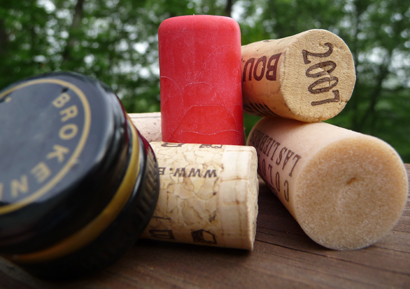
Wine Business Monthly runs an annual report about closures. The 2009 report included responses from 229 wineries. Their data show a shift over five years toward “technical” corks (agglomerated granules of natural cork with natural cork disks glued to the ends) and away from synthetic corks (Nomacorc is extruded, making it a bit softer, whereas other plastic corks are injection molded, forming a more solid form; the red one in the photo above is injection molded. Read more about the differences here.). The report shows screw caps gaining market share.

While it is difficult to determine the precise relative market shares of each closure, we can express our opinions about closure type. The major downside of corks is the problem of cork taint (TCA), which can produce pungent aromas of moldy newspapers. Screw caps eliminate TCA but may create a virtually anaerobic environment that the wines become plagued by “reduction”–John Gilman expressed his dislike of screw caps here.

But plastic closures draw the most ire. Jancis Robinson has begged producers to stop using them, calling them “utterly infuriating.” David Schildknecht of the Wine Advocate has lamented in a review the loss of aromas over time in wines using this closure. Tom Matthews of Wine Spectator recently tweeted “2005 white Rhone + synthetic cork = 3 maderized bottles and several sad and angry wine lovers.”

What do you say–which closure type do you like the least? And feel free to add a comment with your thoughts on market share based on your experiences.

[poll id=”14″]

Seeking Closure: Plastic Stoppers Crack 400-Year-Old Natural Cork” [WSJ]

Wine Blog Awards, 2010 edition

It’s that time of year again: the wine blog awards! A panel of (unnamed) judges has selected some finalists in eight categories. The awards are always a good way to discover some new blogs or check in with older ones.

DrVino.com has been named a finalist in the “Best Wine Blog” category. The other finalists are the New York Cork Report, Palate Press, the San Francisco Chronicle’s The Cellarist and 1winedude.

Check out all the nominees and cast your ballot. Voting ends Sunday, May 30.

Traditionalists vs modernists: a battle royale?


The current copy of The World of Fine Wine just landed on my desk with a thud. Since it’s based in London and costs $169 a year, it’s not something you can readily pick up at Hudson News. In this issue, the 216-page glossy magazine/journal compiles provocative essays and tasting reports from independent journalists and some people in the trade.

One essay that caught my eye was about the stylistic struggle between modernists and traditionalists that has been roiling the wine world for some time now. (For those who haven’t been following, “modern” wines are often characterized as having abundant, ripe fruit, lots of extraction, quite a bit of oak influence, and higher in alcohol while “traditional” wines are construed as being less overtly oaky, having much less extraction and manipulation in the cellar.)

In the piece, Mike Steinberger argues that the polarization has been overplayed–too bad since it could really do well in a Broadway adaptation, perhaps besting the Sharks vs Jets! Further, there’s a vast gray area between these two poles. Finally, he argues that the rise of modern wines has actually been largely beneficial by getting the traditionalists to clean up their cellars and pay more attention to their vineyards. Here’s a snippet:

It is wrong to depict this modern-versus-traditional split as a kind of Manichean, zero-sum battle. It is something far more mild: a push here, some push-back there. Not only that; it has largely redounded to the benefit of both wine and wine consumers.

As to the state of play in the non-war, he argues, the pendulum is swinging back to the traditionalists. As evidence, he cites, on the one hand, general fatigue with Super Tuscans and garage wines of Bordeaux. On the other, he notes the tremendous regard for traditional Piedmont producers such as Giacosa, G. Conterno, and G. Moscarello, a tsunami of articles about Lopez de Heredia in Rioja (I’ll add that the crowds are always deep at their annual distributor tasting in NYC), and a “greater demand for authenticity–for wines that are made by people who actually get their hands dirty in the vineyard.” Check out the whole article in print if you get a chance.

What do you think? I find it a convincing argument while also admitting the evidence is still contained to something of a niche. But with all the interest in natural wines, making wine in amphorae, resurrecting heirloom varieties, and a greater respect for the vineyard more generally, that niche could expand noticeably over the coming decade. Moreover, the amount of column inches (remember those?), blog posts and tweets in favor of traditionally styled wines must sooner or later spark some demand, thus leaving some modern producers wondering if they might want to cancel their next order for new oak barrels and experiment with something a little more olde tyme.

UPDATE: the article is now available online at The World of Fine Wine website. Also, they are extending a 20% discount to the readers of this site; enter WFW5 into the subscription form (DrVino.com receives no compensation).

cropped image from lopezdeheredia.com
State dinner numero dos: Brut-al wine pairings

Last night, the Obamas welcomed President Calderón of Mexico and Mrs. Margarita Zavala to the White House for a state dinner, the second of this administration. As with the first menu, the dishes served offered a tip of the toque to the visiting dignitaries’ cuisine. This time they brought in Chef Rick Bayless who is known more for his exploring the regional foods of Mexico than for his Burger King ad.

For his part, Daniel Shanks, the White House wine steward, tried once again to derail international relations with the wine pairings. When will they start color coding the menus to warn the guests? The theme, apparently, was California wines with ties to Mexico. Given that, here’s the range of California wines they could choose from: almost all of them. The California wine industry would produce few bottles of wine if it weren’t for the work of Mexican viticultural laborers. Raising any glass of California wine then on this august occasion could be accompanied by a mention of their enormous contributions. They could save the discussion on immigration policy for lunch.

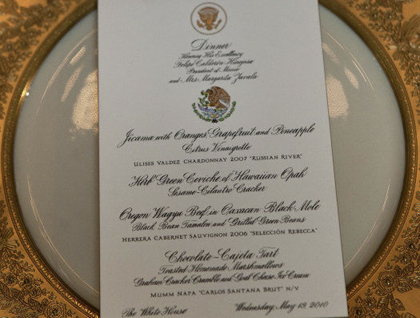
Here’s the official menu, with wine pairings:

Jicama with Oranges, Grapefruit, and Pineapple
Citrus Vinaigrette

[Paul Hobbs?] Ulises Valdez Chardonnay 2007 “Russian River”

Herb Green Ceviche of Hawaiian Opah
Sesame-Cilantro Cracker

Oregon Wagyu Beef in Oaxacan Black Mole
Black Bean Tamalon and Grilled Green Beans

Herrera Cabernet Sauvignon 2006 “Selección Rebecca”

Chocolate-Cajeta Tart
Toasted Homemade Marshmallows
Graham Cracker Crumble and Goat Cheese Ice Cream

Mumm Napa “Carlos Santana Brut” N/V

For the first two courses, nothing pairs with citrus and ceviche like a 14.7% alcohol Chardonnay! Ulises Valdez has a compelling story, no doubt, but perhaps his Sauvignon Blanc might have made a better pairing? (Assuming, that is, that the Chardonnay on the menu was made by Ulises Valdez–there is no mention of the wine on his website, but there is a 2007 Ulises Valdez Chardonnay made by Paul Hobbs.) The third course might actually work, given the chocolately sweetness of the mole that may be reflected in the wine. But with the dessert course, it’s hard to know what’s the most disastrous, pouring a celebrity wine or offering a brut sparkling wine with chocolate and marshmallows!

If you were the sommelier for the day, what would you pour?

reduced-size, cropped image from huffingtonpost.com

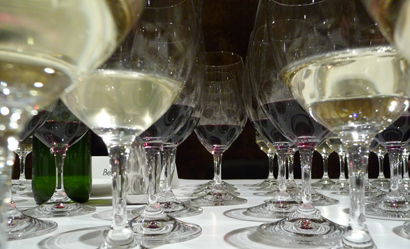
Which white wine would convert a fan of reds?


Ray Isle posts an interesting question on his Facebook page. Since Facebook as all the appeal of a leper with cooties these days thanks to their recent privacy decision, why not bring it up here as well? Here’s his question: “if you want to convert a red wine drinker to drinking white, what do you think is the best white wine out there for the job?”

I’ve contemplated this very question several times. It probably matters which type of reds the person is accustomed to drinking. If it is a lighter-bodied red, the conversion is most likely painless since the shift would be changing some fruits on the same chassis of high-acidity. So it probably is someone who likes low-acid, “big” reds who doesn’t like the acidity of some whites. In which case, there are white Rhone varieties such as viognier, marsanne, roussanne that might fit the bill. It’s hard to say in the abstract, but that seems plausible in theory.

There’s also the context: put the red-wine drinker with lunch under an umbrella on a 90-degree day and see if the white wine doesn’t just have a little more appeal.

And Champagne is always a good fallback–perhaps a blanc de noirs, to be tricky! Any which way, there’s probably little chance of weaning a dyed-in-the-wool red wine-ophile to a steady diet of whites–I was aiming for admiring and ordering a glass from now and then.

What do you think?


winepoliticsamz

Wine Maps


Monthly Archives

Categories


Blog posts via email

@drvino on Instagram

@drvino on Twitter


winesearcher

quotes

One of the “fresh voices taking wine journalism in new and important directions.” -World of Fine Wine

“His reporting over the past six months has had seismic consequences, which is a hell of an accomplishment for a blog.” -Forbes.com

"News of such activities, reported last month on a wine blog called Dr. Vino, have captivated wine enthusiasts and triggered a fierce online debate…" The Wall Street Journal

"...well-written, well-researched, calm and, dare we use the word, sober." -Dorothy Gaiter & John Brecher, WSJ

jbf07James Beard Foundation awards

Saveur, best drinks blog, finalist 2012.

Winner, Best Wine Blog

One of the "seven best wine blogs." Food & Wine,

One of the three best wine blogs, Fast Company

See more media...

ayow150buy

Wine books on Amazon: