Dr Vino's wine blog
wine talk that goes down easy
James Suckling’s $8,500 briefcase of stemware
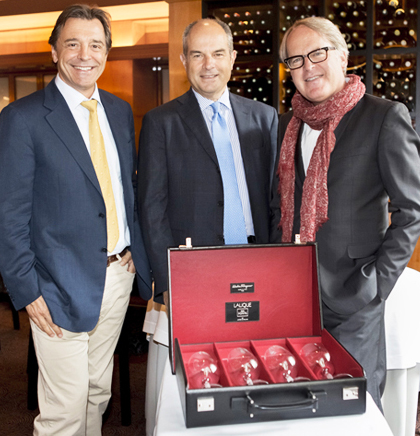 JAMES SUCKLING’S $8,500 FERRAGAMO BRIEFCASE FOR LALIQUE STEMWARE
Really, need we say more? No, but we should point out there’s no scarf included.
Here are some other wine-y things you could do with $8,500:
* Build a 12′ x 5′ wine cellar in your basement with a cooling unit and double stacked wooden racking for 1,000 bottles and a dozen Zalto crystal wine glasses. (Local labor rates may vary.)
* Buy a ten bottles of Domaine de la Romanée Conti, Echézeaux, 2011.
* Buy a Eurocave 5290 + one case of Dom Pérignon 2004 and two cases of Billecart Salmon rosé Champagne.
* Buy 284 bottles of Pierre-Yves Colin-Morey’s 2012 white Burgundy.
* Buy 531 bottles of Domaine de la Pepiere Clos des Briords Muscadet 2012.
Oct
2
2014
5
Dr. Vino’s verdict: one glass to rule them all
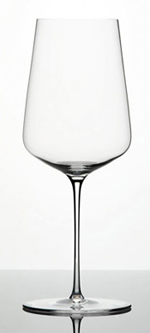 I think I mentioned previously my regular space over at foodandwine.com called “Dr. Vino’s Verdict.” In the series of short posts, I render judgement on pressing issues of the wine world. I can’t promise the wisdom of Solomon with my verdicts, but I do aim for more than Judge Judy.
Anyhoo, in my post over there this week, I strongly urge you to cut through the marketing clutter that suggests a different glass for each grape variety. Instead, reach for one glass–the Zalto Universal–to elevate your wine drinking experience.
Don’t you think varietal stemware is just a tad overkill?
In related news, not from The Onion, Riedel announced a $20 glass for Coca-Cola this week. But will it work for Diet Coke?
Related: “The urge to splurge”
Durability test – youtube
Jan
17
2014
War on wine gadgets
 It’s that time of the year: Merry War on Christmas, everyone!
If Fox News were to channel its resources to a vinous purpose, they could do well to declare a war on wine gadgets. Fortunately, Marketplace picks up the slack in the Marketplace Morning Report today. In it, the reporter tracks down a shop manager who admits he’s not wild about wine aerators but he stocks them (and more!) nonetheless because people want to give them as gifts! The same gent has actually placed a moratorium wine paraphernalia from his family after he got a ceramic dog that holds a bottle of wine.
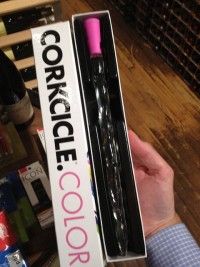
I agree there are so many useless wine gadgets, such as the corkcicle (right). Keep that long, probing thing out of my wine bottle–oh, my! Why not just give a bottle of wine to a wine-loving friend? So much the better if you can share it together.
Merry, merry!
Dec
24
2013
The urge to splurge: Zalto Universal stemware
I can tell that Father’s Day is rapidly approaching: my email box is full of pitches about wine suitable for the occasion. Wait, isn’t pretty much any wine suitable?
Well, as I’ve written before, all wines are enhanced by good stemware. The titanium-infused line of “impact-resistant” stemware from Schott-Zwiesel have their virtues. At about $10 a stem, you could even break a few but they really are pretty resistant.
I recently splurged on a pair of gorgeous Zalto Universals, hand-crafted crystal stems from Austria. They are so elegant and weightless that they almost take the glass out of wine drinking–somehow, the fermented grape juice is constrained beautifully on display, the aromas concentrated, and the wine ultimately swishes over the palate while hardly sensing the glass rim. They are so thin it took my wife a couple of weeks to overcome a fear that they would shatter merely upon casting them a wayward glance. But we’ve had the set for a couple of months now, enjoying Champagne, Burgundy and Barolo in them, with nary a break (hope I didn’t just jinx it). I have yet to find more pleasurable stemware.
I bumped into Aldo Sohm, the head sommelier at Le Bernardin whose signature adorns the glasses, a few weeks after I got mine. He shocked me by telling me to throw them in the dishwasher to clean them. Eeegad! I continue to hand wash but good to know that the dishwasher is authorized by the highest authority.
Even though they are pricey at $60 each it sure would be nice to share a pair with a wine geek dad.
Available at Crush and Winemonger.
Jun
10
2013
The Rabbit and its ilk
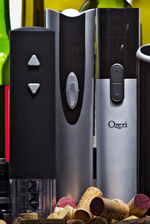 William Grimes laments the fact that wine geeks are so frequently the recipients of “unwanted gifts, of gizmos and gadgets,” especially this time of year. In his sites this time are mechanical corkscrews “a baroque solution to a problem that has baffled no one for the last five centuries.”
Indeed, while mechanical corkscrews may help people with limited mobility, you’re better advised to spend your money on wine and buy simple a Pulltaps (or decent stemware) instead!
“The Newfangled Corkscrew: It Comes With a Twist” [NYTimes.com]
Dec
15
2012
Sharing a birth year wine, 1983 edition
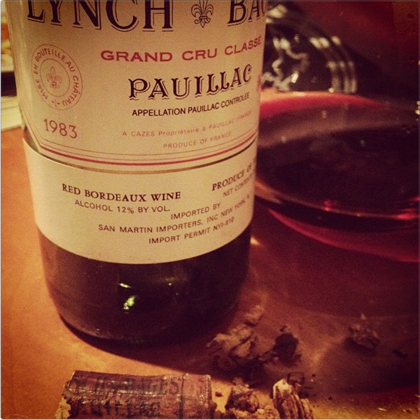
I always enjoy drinking a birth year wine, particularly if it is a wine from my birth year. But even if it is someone else’s and you are in their company, then the glass is full of not only a mature wine (that’s hopefully still good or great), but also a time capsule, rife with symbolism and memories.
My brother stopped by our house for the first time since winning an around-the-world sailing race earlier this year. I had scored a bottle of 1983 Lynch Bages in anticipation of toasting his tremendous accomplishment at our next get together. So last weekend, I presented him with it, pulled the crumbly cork and decanted it. He was traveling with his girlfriend and we all savored the wine, which had really complex and enticing aromatics of tobacco leaves, a surprisingly spry and delicious midpalate, and a finish that tapered a tad too quickly. On the whole, the wine was in very good condition and, after polishing it off, my brother said he wanted to take the bottle home with him (he lives in France). Maybe he will put it on the shelf next to his race trophy?
Giving birth year wines as gifts for important achievements and milestones goes over really well. I haven’t done it a lot but I am going to try to give them more more since they can make for a really memorable gift. And with a bit of searching, it’s not too hard to find them. I got this one from a friend who had cellared it since release. But a few years ago, I wrote a story for Food & Wine on finding birth year wines and it can definitely be worth the effort–especially if you can pull the (crumbly) cork and share it together.
Sep
8
2012
The best non-book gift for wine geeks to give: good stemware
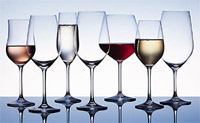 Advice columns this time of year frequently suggest wine gifts. Such columns often target the generalist reader who’s not that into wine but is looking for a gift to give to a wine-loving friend or relative. Flipping this model on its head, here’s what wine geeks need to give their friends and relatives who are marginally into wine: good stemware.
Yes, there’s certainly a strong argument to give them a bottle of wine itself–we certainly need plenty of it at this time of year. But wine itself can be a hit or a miss and, either way, it’s here today, empty tomorrow and, all too often, forgotten when the recycling bin is emptied. Certainly books have a tendency of sticking around longer and as the author of two wine books, I highly recommend giving the gift of wine books. A good corkscrew (such as pulltaps) is a nice touch, but really not essential since even the dreaded butterfly corkscrew can get the job done.
Thus, glasses. I think this even came up in the Bible: give a friend a bottle of wine, and you give him or her enjoyment for just one evening. But give him or her good stemware (or a good wine book for learning more about how to choose good wine!), and you will will elevate your friends’ wine enjoyment for months if not years to come. Many are under $10 a stem. Riedel makes handsome stems but, in my experience, I have found them very easy to break. Ravenscroft also has solid stems, starting at $7.50 each. And the Tritan forte Schott-Zwiesel makes a titanium infused line of crystal glasses that really does reduce breakage. And, no, you don’t need to give a different glass for each grape variety.
So go crazy and help your friends say cheers with style this holiday season with some good stemware, the best non-wine book gift that you can give to your friends and relatives who are getting into wine.
Dec
20
2010
Most pointless product ever? A bottle opener for screwcaps
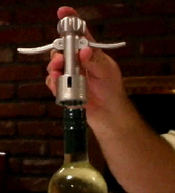 From site reader Jim:
It’s opportunities like this that make me wish I did indeed have a blog, but I don’t, so I’m passing it to you. Go to butterflywineopener.com for the most asinine, pointless product ever: an opener for screwcap wines. If you look at the video, all you do is seal it over the screwcap…and then turn the top of the opener, just as you would the screwcap itself.
I discovered it in a full-page ad in Tasting Panel [home of the “exposure package“–ed.]…strangely, as you’ll see on the website, the only press they’ve received is in the Tasting Panel, who’ve mentioned it at least twice in different issues.
Dec
4
2009

Wine Maps
Monthly Archives
Blogroll
Categories
- American wine
- announcements
- Argentine wine
- auctions
- Australian wine
- Beer
- best wines
- Bling
- books
- Bordeaux
- bottled water
- Box wine
- Burgundy
- business of wine
- Celebrity wine
- Champagne
- Chicago
- China
- cocktails
- cognac
- corks
- corkscrews
- dining
- eco wine
- events
- foie gras
- food and wine
- French wine
- German wine
- giveaway
- grapes
- green wine
- guest post
- highlights
- how to
- Italian wine
- leaders and liters
- Mature wine
- meetups
- New York City
- On notice!
- photo captions
- podcasts
- Polls
- Port
- Portuguese wine
- power list
- reader mail
- rose
- sake
- Sommeliers
- South Africa
- Spanish wine
- spirits
- tasting sized pours
- The real wine world
- TV and movies
- Uncategorized
- videos
- vinexpo
- Weather
- wine and health
- wine and sports
- wine and tech
- Wine Blogging Wednesday
- wine blogs
- wine classes
- wine collecting
- wine gifts
- wine in india
- wine labels
- wine picks
- wine politics
- wine quizzes
- wine random
- wine science
- wine scores
- wine shops
- wine technology
- wine travel
- Wine under $10
- wine writing
- winemaking
- winespeak
 Blog posts via email
@drvino on Instagram
@drvino on Twitter
Advertise

quotes
One of the “fresh voices taking wine journalism in new and important directions.” -World of Fine Wine
“His reporting over the past six months has had seismic consequences, which is a hell of an accomplishment for a blog.” -Forbes.com
"News of such activities, reported last month on a wine blog called Dr. Vino, have captivated wine enthusiasts and triggered a fierce online debate…" The Wall Street Journal
"...well-written, well-researched, calm and, dare we use the word, sober." -Dorothy Gaiter & John Brecher, WSJ

Saveur, best drinks blog, finalist 2012.
One of the "seven best wine blogs." Food & Wine,
One of the three best wine blogs, Fast Company
Books for wine geeks
Wine books on Amazon: