Dr Vino's wine blog
wine talk that goes down easy
Wine maps are all the rage
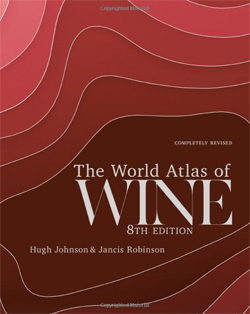 “Wine is geography in a glass,” Hugh Johnson said recently. He and Jancis Robinson were in town to promote the new edition of the World Atlas of Wine. He said that back in 1970, the publisher was unsure if a book of wine maps would really fly. So he had to impress upon the publisher how wine and maps were a natural fit. The market shouted a reply: by 1973, the book had sold 500,000 copies. Lifetime, he said, the volume has sold more than 5 million copies.
The book gained a new lease on life when Jancis Robinson became a co-author in the fifth edition. Jancis and her team do the heavy lifting now and this eighth edition has been fully revised. The tome has added new areas of coverage such as the Savoie and the Judean Hills. In all, it has 300,000 words, 230 maps, 400+ pages and weighs almost five pounds. Even with all this heft, it is admittedly not going to be the last word on any region. But, because of its breadth, it is often the first word for many readers, particularly on far-flung regions.
Someone recently asked me what is the one wine book I would recommend: this is it. If you are trying to generally to learn more about wine and have a slightly more than casual interest, and are not looking for a edge-of-your-seat narrative, this is the one for you. I consult to a restaurant where I put together the wine list and work with the staff. I have this book on the shelf there. It is essential. I use it all the time to show where wines hail from. It’s useful to drill down from a country map, to a regional map and then even villages to let the staff and even some guests see where the wines come from.
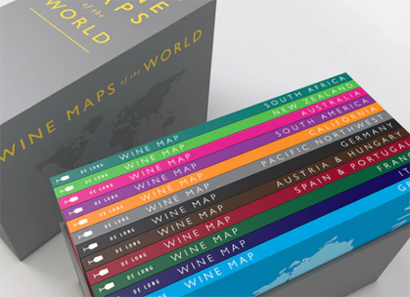
There is really a ton of interest in wine maps. Many are available on the internet, but it is fun to really pore over a map in your hands, such as this World Atlas of Wine, or hang them on the wall. Steve DeLong has been making the latter for a decade now, blending his architect’s visual sensibility with his love and knowledge of wine. He has a kickstarter going now for a new product, “Wine Maps of the World.” This set of foldable maps blend cartographic precision with a good design aesthetic. His kickstarter campaign has raised/sold $50,000 and has four days to go.
Nov
22
2019
2
How Scratch and Sniff wine soared to the NYT bestseller list
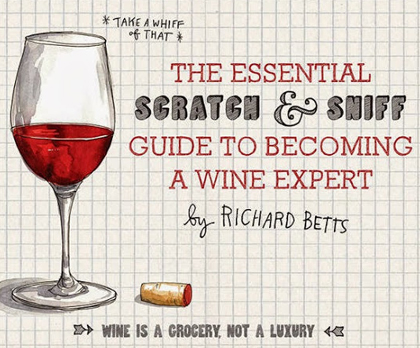
The hottest wine book of 2013 might take you by surprise: it’s a scratch and sniff wine guide that’s printed on the stiff pages of a board book. The book has caught fire and reached #13 overall in book sales on Amazon and #10 in the “Advice, How-To, and Miscellaneous” portion of the NYT bestseller list. As you would expect, it is both skimmable and sniffable but it is also brilliant in its own small way; kudos to author Richard Betts for writing what might well be the shortest wine book in history.
To find out more about how “The Essential Scratch & Sniff Guide to Becoming a Wine Expert” came about and the vertiginous rise on the sales charts, I caught up with Betts by phone as he was driving in the Northern Rhone. Read more…
Dec
9
2013
The Drops of God [beach reading]
“Dad’s reading a comic book!”
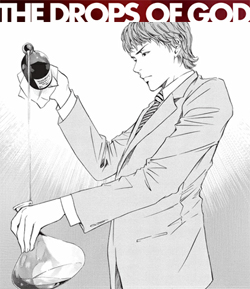
My kids thought it hilarious to see me reading Drops of God, the Japanese manga sensation that swept through Asia. Its alluring powers were even on display on the beach where my younger son wanted to me to read it to him though eventually he wandered off and resumed building sand castles. But if you are old enough to enjoy wine, the innovative, enthralling, soap opera for wine geeks will lure you in no matter if you’ve just cracked your first moscato or if you were weaned on Meursault. And it is perfect beach reading (as I can testify having selflessly read it in situ on your behalf).
The story’s protagonist, the young Shizuku Kanzaki, embarks on a quest laid out in his father’s will: to correctly identify twelve “apostles,” or heavenly wines that are the “drops of God” in title. Shizuku turned his back wine while his father was alive, rebuffing the beverage that made his father into a legend of the wine world as a critic as well as a fortune (he bought a lot en primeur and consulted to wineries, neither of which damaged his reputation as a critic, apparently). But his father always offered him things to smell and taste, which honed his sensory perception for his quest. Or contest, more aptly: Shizuku is pitted against Issei Tomine, just the sort of young, suave, arrogant, know-it-all who makes the perfect rival for Shizuku’s more passionate approach as he evolves swiftly from wine newbie to master. At stake, is the entire collection that the elder Kanzaki amassed over a lifetime, as well as the family’s grand house.
Along the way, wines are praised rapturously, both in two-page illustrated spreads as well as with lavish descriptions. Consider this one for the first of the “twelve apostles:”
I wander deep within a forest thick with pristine primeval growths,
As the humid scent of life wafts from the moss-covered trees,
I walk toward the heart of the forest in search of solace.
The bounteous blessing of nature suits a virgin forest unsullied by human hands
Ah, behold, a pair of violet butterflies, tangling in flight!
Perhaps this little spring is your Holy Land.
The two contestants parse the words and embark on a method of arriving at an answer to the riddle. Shizuku’s approach is more fun as he discusses it with friends, finagles ways to taste rarified wines, closing in on the region and village to ultimately make his pick. Along the way, he helps a woman with amnesia recover her past through a glass of wine, gets a tutorial from an eccentric wine expert who literally stores rarefied Burgundy in a hole in the ground, and squares off with a business rival in a blind tasting.
It’s easy to see how the books drove wine sales across Asia more than any wine critic who merely assigns anodyne point scores to wines. Drops of God succeeds at the highest level: not only does it inform and engage the reader through the narrative and illustrations, it makes you yearn to start your own quest, to research regions and producers while pulling some corks on fine bottles to share with friends.
Drops of God, Volumes 1 – 4, now available on Amazon in English. (aff link)
Jul
5
2012
The Finest Wines of Rioja and Northwestern Spain
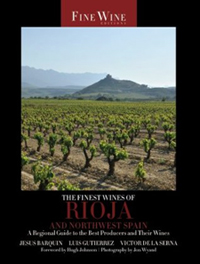 After so much discussion of the Parker-Miller-Campo imbroglio (see a thorough recap from Monday here), it’s refreshing to read about the wines of Spain again without thinking of “no pay – no Jay.”
The new book, The Finest Wines of Rioja and Northwestern Spain, made me do just that. Up-to-date, with gorgeous photos, the book is by a trio of writers and tasters, well-known in Spain and possibly outside: Jesus Barquin, a criminology professor and sherry lover whose passion led him to co-found Equipo Navazos, a boutique producer of excellent sherries; Luis Gutierrez who recently started contributing to jancisrobinson.com; and Victor de la Serna, deputy editor of El Mundo, a leading Spanish daily, who heads El Mundo Vino.
Although the book is largely a collection of 85 producer profiles, the authors open the book with several good discussions, one about the grape varieties (they acknowledge the resurgence of indigenous varieties in the northwest) and another about traditional versus modern winemaking. This latter discussion is of most importance in Rioja where modern style has been ascendant. The authors dispute the notion that the modern style of dark, extracted, fruity wines has been a “curse” for the region and are surprisingly accommodating of it saying that the best of the moderns “will in turn become classics.” I guess it would have been a short book if they didn’t adopt a non-partisan, ecumenical stand on the modern-traditional issue. They also admit that their personal collections have many examples of traditional producers from the best vintages.
The profiles bring the producers to light in one to six pages and include traditional producers (Lopez de Heredia and La Rioja Alta), modern (Roda), mixed (Muga) and up-and-coming (Olivere Rivière). They also discuss Txakoli, Albarino and wines from Ribeira Sacra and Bierzo. Throughout the book, they highlight a top wine from a producer with a star; I agreed with enough of their starred wines that I will look for some other of their suggestions to try. They also tuck in a list of restaurants and shops with good supplies of aged Rioja (though how many will be modern?) that would be helpful to travelers to the region. In fact, with its wealth of practical information and advice, I wouldn’t head to the region without it.
Dec
14
2011
Wine Politics video from the New School
If you have 51 minutes that you just don’t know what to do with, you can now check out a video of a talk I gave at the New School recently. Andy Smith, editor of the Oxford Companion to American Food & Drink among many other book projects, had assigned my book to his class, “Drinking History.” It ended up becoming a public talk at the university, filling the room, and even being taped! So here it is, including a discussion of contemporary topics such as the primary source bill in New York. While I certainly don’t challenge Martin Luther King’s legacy of oratory, perhaps there’s a nugget or two of interest in there.
Jul
12
2011
A Year of Wine – get your personalized copy here!
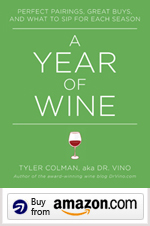
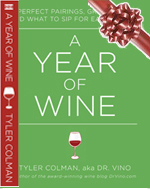 Are you wondering what to get your loved ones for the holidays? Why not get a personally inscribed copy of Dr. Vino’s guide to A Year of Wine: Perfect Pairings, Great Buys, and What to Sip for Each Season. Packed with wine picks and hailed as “witty, lively and loaded with common sense” by the Chicago Tribune, this brand new, mint condition hardback can be yours for $20–lower than the list price!
Orders are fulfilled from the Dr. Vino world headquarters and signed by yours truly. Yes, mortgage documents may have been signed by robo-pen but these books will be signed by my own hand!
Books ship via Priority Mail to domestic addresses; shipping is included. (For international shipping, please inquire about postage.) Use Paypal to send $20 per book with the destination address and recipient name to tyler @ drvino dot com and your order will be ship the next business day. You can use all credit cards on Paypal and it is super easy. So don’t delay for this personalized gift!
You saw the book on GMA. After the jump, see photos of illustrious people holding the book, blurbs, and a fuller description! Read more…
Nov
16
2010
Wine Politics, now in paperback! [giveaway]
 My book, Wine Politics: How Governments, Environmentalists, Mobsters and Critics Influence the Wines We Drink, is now available in a new version: paperback! Not as lightweight as the existing Kindle edition and about the same weight as the Korean translation, the paperback is at least lighter–and cheaper!–than the original hardback edition.
Get background information and analysis on important wine topics such as why French wine advertisements aren’t allowed to show women looking sultry, how appellations can strangle originality, and why it’s easier to ship a case of wine from Bordeaux to Berlin than from Napa to New Jersey.
I’m giving away three personally inscribed copies of the new paperback to three people here! To qualify, leave a comment on this post noting the state or country where you live and if you’re happy with the ability (or not) to have wine shipped to you. Fortunately, books can be shipped to all 50 states but we request domestic addresses only for the giveaway; leave your comment by midnight Thursday to qualify for the drawing of three random winners on Friday.
Nov
8
2010
Daring Pairings by Evan Goldstein
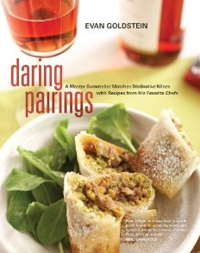 On this site, we love exotic food-wine pairings. And we often talk about grapes beyond the “big six.” So it should come as no surprise that I am a fan of Evan Goldstein’s new book, Daring Pairings. (In fact, I provided a blurb for the back cover.)
The highly skimmable book starts off with a worthwhile discussion of pairing food and wine. The goal, says Goldstein, a former sommelier, is to turn food-wine pairing from a lengthy, possibly agonizing process to simply picking a wine that will work and then sitting back and enjoying the pairing. The various charts and cheat sheets provide quick help toward this laudable goal. Further, he lays out five important elements of wine (acidity, sweetness, tannin, oak, and alcohol) and elaborates who they will work best with certain foods (salty foods are best with either high acid wines or slightly sweet wines but bomb with high alcohol wines). He also suggests how to tweak recipes to make them more wine friendly (e.g. varying cooking methods or replacing vinegar with verjus–juice from unripe grapes). Any given meal, he writes, will either highlight the food or the wine, which may seem somewhat controversial, but actually could be a great excuse for hosts who are wine enthusiasts to provide simple food.
Goldstein admits that most people start with food and then add a wine pairing. That said, the bulk of the book’s 364 pages discusses 36 grapes, their taste profiles, various winemaker interpretations of the grapes, and which pairings work and which will fail miserably. A recipe from a chef, often well-known, such as Charlie Trotter or Fergus Henderson, also follows each grape and if you have a lot of time and ambition, you can make the recipe that won’t overshadow the wine you’re probably trying to highlight. The mouthwatering photography certainly stokes ambition.
The grapes are probably not all that “daring” to many readers of this site. But I just led a tasting over the weekend that included Gruner Veltliner, Albarino, and Aglianico among others, and, astonishingly, there were people who had never tried these varieties! The book certainly can help casual drinkers who are reaching for a new wine by offering a range of food pairing tips. I like wine recommendations in context; in my own pairings book, I suggested adding seasonality to further round out the picture.
Daring Pairings provides a lot to chew on. Maybe Goldstein’s next book will crank up the degree of difficulty even further–“impossible pairings” anyone?
Jun
7
2010
Wine Maps
Monthly Archives
Blogroll
Categories
- American wine
- announcements
- Argentine wine
- auctions
- Australian wine
- Beer
- best wines
- Bling
- books
- Bordeaux
- bottled water
- Box wine
- Burgundy
- business of wine
- Celebrity wine
- Champagne
- Chicago
- China
- cocktails
- cognac
- corks
- corkscrews
- dining
- eco wine
- events
- foie gras
- food and wine
- French wine
- German wine
- giveaway
- grapes
- green wine
- guest post
- highlights
- how to
- Italian wine
- leaders and liters
- Mature wine
- meetups
- New York City
- On notice!
- photo captions
- podcasts
- Polls
- Port
- Portuguese wine
- power list
- reader mail
- rose
- sake
- Sommeliers
- South Africa
- Spanish wine
- spirits
- tasting sized pours
- The real wine world
- TV and movies
- Uncategorized
- videos
- vinexpo
- Weather
- wine and health
- wine and sports
- wine and tech
- Wine Blogging Wednesday
- wine blogs
- wine classes
- wine collecting
- wine gifts
- wine in india
- wine labels
- wine picks
- wine politics
- wine quizzes
- wine random
- wine science
- wine scores
- wine shops
- wine technology
- wine travel
- Wine under $10
- wine writing
- winemaking
- winespeak
 Blog posts via email
@drvino on Instagram
@drvino on Twitter
Advertise
quotes
One of the “fresh voices taking wine journalism in new and important directions.” -World of Fine Wine
“His reporting over the past six months has had seismic consequences, which is a hell of an accomplishment for a blog.” -Forbes.com
"News of such activities, reported last month on a wine blog called Dr. Vino, have captivated wine enthusiasts and triggered a fierce online debate…" The Wall Street Journal
"...well-written, well-researched, calm and, dare we use the word, sober." -Dorothy Gaiter & John Brecher, WSJ
Saveur, best drinks blog, finalist 2012.
One of the "seven best wine blogs." Food & Wine,
One of the three best wine blogs, Fast Company
Books for wine geeks
Wine books on Amazon: