Scan wine flash sale sites, at a glance

A surplus of wine in the past couple of years has led to closeouts, which, in turn, has led to the proliferation of daily deal wine sites. But there are now so many that it can be hard to keep up with them all. Thus the new site winehoarder.com.

Still in beta, the site aggregates offers from the leading “flash sale” sites. Beyond detailing the sales, the site also offers various “social” features, such as voting up the deals and discussion boards. Still embryonic, it could grow into something useful with more participants. But one thing that is useful now is that it provides a record of the wines offered a the various flash sale sites and usually those sites make it difficult to see what exactly they’re offering without clicking through.

Anyway, I like the idea since late one evening, probably after too much cru Beaujolais, I once thought about doing such a site myself! What do you think–obviously the site’s not much of a looker yet, but is this better than scanning 50 emails a day? Or is the flash sale world of wine sales so fast moving that such an aggregator site is not quick enough for you to score the deals you want?

Aging Muscadet on the lees – and a Melon de Meursault


Muscadet gives pleasure when it is freshly squeezed. But aging the best examples can be worth the wait.

Muscadet gains richness with time spent on the lees. Lees are neither Confederate generals nor blue jeans but rather spent yeast cells that fall to the bottom of the barrel or tank when their work is done. Stirring them can give a wine a broader, heftier feeling–without at all adding woodiness.

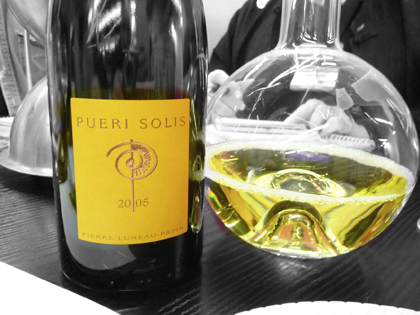
At Luneau-Papin, the wines not only highlight different soil types, but also different lees aging.The tasty “L d’Or” comes from both granite and gneiss soils and sees 11 months on the lees. (This wine can also do well with extended aging in bottle as the 1999 I recently tasted was fresh and delicious.) The golden “Excelsior” bottling, from schist soils, sees 36 months on the lees and is creamier and richer. Their structured “Peuri Solis” sees 42 months on the lees before bottling.

As the name of the grape (Melon de Bourgonge) suggests, it originally hailed from Burgundy. Some juice from Pierre Luneau-Papin’s vineyards recently made a trip back to Burgundy to be made into wine by none other than the maestro J-F Coche, making me wonder if it would be, in fact, be a Melon de Meursault. A call to Coche (he has no email or website I could find) divulged that he had, in fact, mad a “miniscule” amount of Melon de Bourgogne. Coche-Dury has been known to drive wine enthusiasts to the brink of their senses in seeking out his wines. Alas, this curiosity won’t ever be available commercially as Coche says it for “personal consumption.” But it sure would be fun to try! Read more…

Muscadet 2010 has the snap, the crackle, and the pop

Muscadet has had recent parallels to Goldilocks: The wine region near the mouth of the Loire River was hit by a reduced harvest in 2008, an abundant harvest in 2009, and a just right harvest in 2010 that has superb quality too.

Outside of hipster wine circles, Muscadet is not so well known among younger wine drinkers. That’s because of the wines are often indifferent at best; many of the growers sell their grapes to a duo of negociants, who in turn sell to British supermarket buyers. So when Mother Nature reduced the crop to 25 percent of the previous year’s levels in 2008, the short supply meant many growers raised prices to keep afloat financially. But that turned off the supermarket buyers, who walked and found another wine they could sell for that price point. Then with the abundance of 2009, prices fell. As a result of this turbulence, dozens of growers have gone out of business.

While that is sad, the best of the small producers have not had as difficult a time since they aim to make a distinctive wine at a slightly higher price point, rather than low-priced, high volume wine that supermarket buyers can more readily swap out for The Next Cheap White.

As to the quality of the vintages, the 2008s are mostly gone but the wines that did appear on these shores from the top growers were actually quite good. I have tasted many 2009s, including in a blind tasting in New York a few months ago, and while they are surprisingly rich and full, they are perhaps a vintage for Muscadet newbies rather than aficionados. In some of the wines, I have found the 09s somewhat innocuous, lacking that distinctive blend of brine, iodine, acidity and minerality.

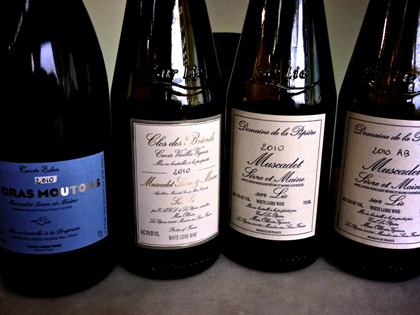
But the great news is that the 2010s have all that crunchy minerality in spades. I tasted some of the 2010s from Domaine de la Pepiere, Guy Bossard and Jo Landron in the Loire in February. They are delicious and even though the early samples of top wines are still tightly wound, they have recovered that nervy intensity that I found frustratingly lacking in many of the 2009s. While the entry-level wines from each of these producers will make the perfect accompaniment to many (outdoor) meals in my house this summer, the real magic will be in these producers’ top wines from the vintage. I’ll definitely be tucking away a few magnums since older Muscadet remains one of the affordable pleasures for wine enthusiasts.

2010 Muscadets to seek out: Read more…

Parker on Bordeaux 2010: great but not *the greatest*

Apparently the latest issue of Robert Parker’s The Wine Advocate came out yesterday with Parker’s reviews for the 2010 barrel samples and in-bottle tastings of 2008s. I say apparently because it is behind the eRobertParker.com paywall and there’s nary a mention of it on wine discussion boards. (Pin. Drop.) But Parker has given the general comment that 2010 ranks as one of “the three greatest Bordeaux vintages I have tasted in my career” alongside 2009 and 2005. The Liv-Ex blog provides his top scored wines. It will be interesting (at least in a detached, voyeuristic way) to see how some chateaux will price their 2010 wines in the event they received lower scores than in 2009 (and the weak dollar won’t exactly drive prices lower here in the US).

Liv-Ex also remarks on his downgrades of the 2008s:

Following the en primeur tastings two years ago, the general feeling amongst the trade and the critics was that the 2008 vintage was solid, if unspectacular. Against this backdrop then, it’s no surprise that the release of Parker’s generous ’08 scores met with a sizeable dose of cynicism. A couple of years on and it seems that Parker’s enthusaism for the vintage has dwindled significantly.

Related: “Traditional Rioja, the anti-en primeurs wine
Which reds would you cellar beyond Bordeaux?

Royal wedding champagne, best sommeliers, Bordeaux bubble – sipped & spit

SIPPED and SPIT: journalists at sommelier competitions
Alan Richman participated in several events of the Best Sommelier in America contest. During the course of it, he nearly sets his suit on fire and leaves such a mess trying to open a bottle that he says, “It looked like Freddy Krueger had entered the competition.” Oh, and the last graf reveas that Alexander Lapratt of db Bistro Moderne was the winner. [GQ]

SIPPED: Royal Wedding champage
A press release stated that magnums of Pol Roger brut reserve were poured at the reception following the Royal Wedding. Did English bubbly make an appearance at any of the festivities? If so, hit the comments.

SPIT: more Bordeaux bubble data
“[Simon] Staples has remortgaged his home three times in the last 10 years (in 2000, 2005 and 2009) to buy Bordeaux. Last year he recommended that his mother-in-law buy five cases of a particular Bordeaux at £2,400. These are now selling for £7,800.” [Guardian]

SPIT: corks
A winemaker from New Zealand eschews screwcaps and bottles his wines bound for China with corks. Why? “Prestige.” [Stuff.co.uk]

SIPPED: regime change
Bloomberg analyzes the impact on California wine of the recent changes at the Wine Advocate. One winemaker’s take on Parker’s departure: “I’m kind of sad to see him go. You know what he likes and doesn’t like, and it made things easier for us.”

The Suckling chronicles


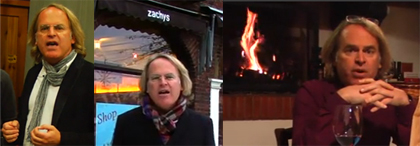
James Suckling, a critic for two decades at Wine Spectator, left the publication last year to start his own website of video reviews. Suckling wanders top vineyards of the world, bestowing scores on wines saying “I’m 90 points on that,” “I’m 94 points on that” all the way up to 100. Points are awarded in the presence of winemakers who made the wines (or winery owners). Suckling does not always interview those winemakers. Videos also include tastings with American retailers in a 90-point challenge wherein retailers select five wines under $30 for him to taste with them and hope he will rate the wines at least 90 points. No retailer has yet to fail.

In one video, Suckling fires back at critics who say that he pulls wine scores out of thin air by detailing exactly how he pulls them out of thin air. He explains on his iPad that things like color get 15 points.

Suckling has yet to detail on his iPad or elsewhere is a statement of ethics. Veteran wine writer, Tom Maresca, has called him out for it on his blog, offering a point-by-point critique of a recent Suckling column in Decanter magazine. The main point of Maresca’s critique is that Suckling uses the magazine to highlight producers participating in his for-profit tasting event in Tuscany, Divino. (Franco Zilliani posts on the exorbitant fees wineries must pay to pour.) Maresca concludes: “That isn’t journalism: it’s advertising.”

Pairing wine with civil disobedience

He’s not going to rank up there with Rosa Parks. But Terry Mulligan is trying to have his illegal actions make a larger point.

The Canadian “media personality” is willfully transporting wine across provincial lines. According to this story, he will stand on the border on May 13 and take a bottle of wine made in British Columbia into Alberta. Then he will take a bottle of wine made in Ontario back into BC with him. Such activity is illegal. But he will let the Mounties know in advance! The lack of intra-provincial shipping is “killing small, boutique wineries” and the Liquor Control Boards amount to “a cash grab” and are run by “bullies,” Mulligan says.

Sure, the event is choreographed. But just imagine if an American celebrity stood up for sanity in wine shipments in a similar way? Will Oprah have a case of wine sent to her condo in Chicago from an out of state retailer (which is illegal) and have the cameras rolling when it gets there? Or a chef like Grant Achatz? Or Martha Stewart who actually markets a wine? That would certainly bring a lot attention to the matter.

On a related note, the WSJ weighs in on HR 1161 with an editorial in today’s paper. Nugget: “CARE will reduce choices and raise prices for consumers.”

Garbage, scrap metal, and riesling? Terroir de South Side

Bill Lavicka doesn’t lack ambition. The Chicago resident has made wine in his basement laundry room for 35 years, after all, dubbing it Chateau Chicago. But now he wants to make an estate wine.

Lavicka seeks to turn an 1860s building on Chicago’s south side into a winery. And he wants to plant 5,000 vines around it of Riesling and Concord grapes. Here’s a report of the terroir of 5700 South Lafayette St:

Standing at what would be the John Raber House’s front steps — they’ve been removed to stymie squatters — it’s difficult to imagine much anything of beauty rising there.

A chopped-in-half grocery cart and plastic bags have been thrown or have tumbled into the vacant lot across from the 5700 block of South Lafayette Street, while plywood, a tire, construction materials and garbage bags have been intentionally dumped in the home’s backyard.

At 2 o’clock is a carwash that Lavicka, who often says everything is worth saving, says isn’t worth saving. And at 1 o’clock, across the street from the carwash, is an unsightly scrap metal yard.

The project has support from the local alderman but soil samples have yet to reveal whether the site is “steeped in lead.” If successful, Lavicka would propel Chicago to join Paris, Vienna, Madrid and New York as big cities with some area under vine. Bonne chance! Video, after the jump. Read more…


winepoliticsamz

Wine Maps


Monthly Archives

Categories


Blog posts via email

@drvino on Instagram

@drvino on Twitter


winesearcher

quotes

One of the “fresh voices taking wine journalism in new and important directions.” -World of Fine Wine

“His reporting over the past six months has had seismic consequences, which is a hell of an accomplishment for a blog.” -Forbes.com

"News of such activities, reported last month on a wine blog called Dr. Vino, have captivated wine enthusiasts and triggered a fierce online debate…" The Wall Street Journal

"...well-written, well-researched, calm and, dare we use the word, sober." -Dorothy Gaiter & John Brecher, WSJ

jbf07James Beard Foundation awards

Saveur, best drinks blog, finalist 2012.

Winner, Best Wine Blog

One of the "seven best wine blogs." Food & Wine,

One of the three best wine blogs, Fast Company

See more media...

ayow150buy

Wine books on Amazon: