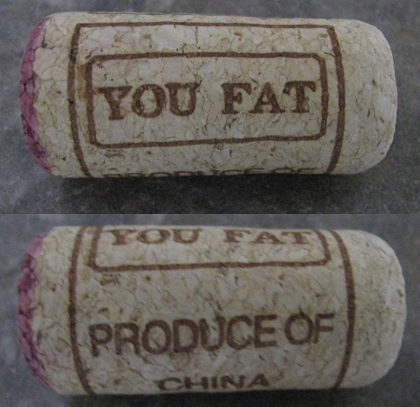
Chinese wine cork declares “you fat”

Rob, a site reader living in China, sent in these photos. He says he doesn’t drink Chinese wine (“for obvious reasons”) but this bottle was a birthday present (“tasted terrible and was definitely not made of 100% juice”).

Still, are the Chinese trying to send anglophone customers messages via corks a la fortune cookies? If so, cute idea but they may want to use a service other than Google Translate. Oh wait, maybe “You Fat in bed” sounds better? Hmm, not really.

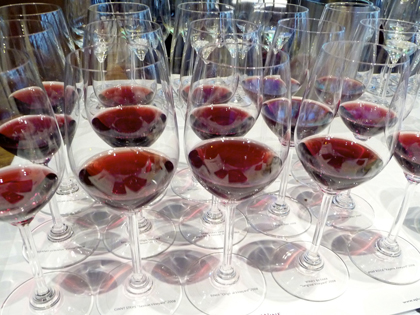
Why is a wine flight called a flight? [reader mail]

Reader question: Why is a flight of wines called a “flight”?

It’s tempting to say that the other names really didn’t take off.

But, in reality, a flight is a grouping of similar objects, like a flight of stairs or a flight of geese. Thus the same term applies to cabernets, pinots, or other small pours of wine, grouped together.

Are you happy with the term?

The other Spain, as imported by Andre Tamers


A couple of weeks ago, Robert Parker went to Spain to collect a medal for his contributions to Spanish wine. However one views his impact on Spanish wine, it’s worth noting that it was only the second time he had been to democratic Spain. And since his previous visit was only in 2009 after he had handed over the reviewing of Spanish wines to his associates, he never visited a vineyard during his tenure as Spanish wine reviewer. Certainly visiting a country is not a prerequisite for knowing a country’s wines, but it helps exploration, knowledge and discovery.

One American who relishes being on the ground in Spain is Andre Tamers. He imports a range of exciting wines from Spain (and France) exclusively from small, family-owned properties that include some of the best white wines from Spain. Andre started his wine career in the 1980s with a brief stint at the New York City wine story Sherry-Lehmann, followed that with five years working for a distributor in New York. Then he set off to Spain to pursue painting and, as so often accompanies Read more…

Disposition, acquisitions, dentists and alc levels — sipped & spit

SIPPED: running the numbers
With all the discussion about alcohol levels in wine, I’m pleased that the results of an extensive story I did for Wine & Spirits magazine is now online. (See our summary discussion.) In the story, we analyzed 84 randomly selected wines for alcohol levels and had some surprising findings.

SIPPED: Stiff upper lip
Foreign diplomats can brace themselves for a general downgrading of wine at British official functions. The Foreign Office has decided to dump the claret in the 39,500-bottle cellar and fund future wine purchases from it. The cellar is valued at about £800,000 ($1.3 million). But the most important question: will James Bond’s budget also be slashed from Angelus? [Guardian]

SIPPED: expense accounts
Sign o’ the times: the British may be selling but the Chinese are buying. Even if they’re not supposed to. Case(s) in point: officials at the state oil company, SINOPEC, splashed out $245,000 for bottle of Lafite and old Moutai. [WSJ]

SIPPED: judgment day?
Apparently the world is ending on May 21! Champagne and caviar tonight?

Drill, baby, drill! “Dentist Serves Beer and Wine to Anxious Patients” [NBC]

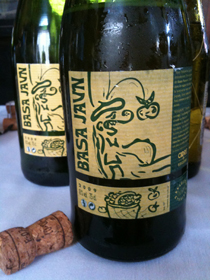
How bout them apples? Basa Jaun cider

Cider is fascinating. In Botany of Desire, Michael Pollan tracks the history of the apple. It turns out that because the apples that proliferated in early 19th century America were tart or mushy, they were cultivated to provide fruit for cider, a fermented (read: alcoholic) drink. This is why Johnny Appleseed was welcomed so warmly in every cabin in Ohio and beyond, Pollan says, calling him “the American Dionysus,” elaborating, “he was the guy bringing the booze.”

I’ll never be as into cider as I am into wine. But the diverse varieties of apples produce different juice–maybe there’s also a terroir of cider? And it is a pity, as Pollan points out that many of diverse varieties of (cider) apples have been crowded out in favor of a few, sweet apple varieties such as Delicious.

Enter Basa Jaun cider, which I tried the other day at the distributor tasting for de Maison Selections. Made in the French Basque country, it comes from 15 different varieties including Ondo Motxa, Eri Sagarra, Anisa, Gordin Xuri, Minxuri, Azau sagarra, Eztirotxia, Geza Xuria, Mandoburua, and Patzulua–how bout them apples? It’s really a fun drink, with apple-y notes (go figure), balanced between sweet and tart, with a faint sparkle and low in alcohol. I could see it working at a weekend lunch with some savory crepes (but who really has savory crepes at lunch in America?) or even chips and salsa. Oh, and Basajaun is apparently a hirsute, forest-dwelling protector of livestock, inron-worker and agricultural sensei in Basque legend.
Henschke Hill of Grace says goodbye screwcap, hello Vino-Lok

The 2008 vintage of Henschke Hill of Grace has not yet been released. But when it comes out, the wine that is arguably Australia’s finest single-vineyard wine, and priced at around $500, will be sealed with neither screwcap nor cork; It will be closed with Vino-Lok.

Stephen Henschke became enamored with the technology when he presented a paper at a conference in Germany in 2004. He brought some of the glass closures back to Australia and tested some bottles of Hill of Grace with Vino-Lok in collaboration with the Australian Wine Research Institute (AWRI). Now with five years of testing and bottle age, Henschke is pleased with the evolution and will convert half of the 2008 production of Hill of Grace to Vino-Lok. The past few vintages have been entirely under screwcap.

“We have always viewed screwcap as a transitional closure, poised between cork and, well, we don’t know what,” Henschke told me in New York yesterday.

Vino-Lok, known (if at all) as Vino-Seal in the US, is a glass stopper that has an inner elastic ring that forms a seal with the bottle. Over on the Vino-Lok site, they say that it opens with a “click.” Henschke says they look “cool.” He’s so pleased with the closure that he has just installed the first Vino-Lok bottling line in Australia at his winery.

Vino-Lok touts its ability to age wines. And Henschke agrees that the evolution is slow, akin to magnums that are considered the ideal size for cellaring. “I call a [750 ml] bottle under Vino-Lok a half a magnum,” he says. “That’s how well it ages.”

Is the world of fine and collectible wine ready for a new closure? We will find out in the next year or so with the release of the 2008 Hill of Grace.

This wine rox!! #tastingnotes #grammar #scores

Which of these two fictitious wine reviews is more likely to make you want to buy the wine?

Aromas leap from the glass, redolent of a barnyard packed with cattle after a summer rain, interwoven with a hint of desiccated blackberries. The mouthfeel is about as smooth as sandpaper, the new oak accosts your palate as if you met it alone in a dark alley. The finish endures so long that as much as you try to remember your grandmother’s apple pie, you can think of nothing other than a humus saturated barnyard for hours.

While someone else might describe the wine this way:

Got so much luv 4 this wine…funky…full throttle…awsum finish…this wine rox! will blow yer mind!

According to Panos Ipeirotis of NYU, the first one might actually be more convincing. Why? Drawing on his research on crowd-sourced hotel reviews, he writes on his blog: “A well-written review tends to inspire confidence about the product, even if the review is negative. Typically, such reviews are perceived as objective and thorough.” Thus companies like Zappos that depend heavily on user reviews are paying a lot of money to automagically correct the grammar of customer comments. It does raise some ethical and copyright concerns but hopefully, just the grammar, not the content are being modified by the program (known as Mechanical Turk).

An interesting phenomenon to be sure. While I could see grammar and readability in tasting notes–either user-generated or from critics–making a difference on sales, wine writing (for better or generally for worse) has its own Mechanical Turk for smoothing out all those pesky words: the score. Just imagine if that second review above had a “98 points” after it. I’m sure that would b gr8 4 sales…LOL GTG.

Madoff cellar, fines, Craiglist, “made in China” — sipped & spit

SIPPED: plunder
Bernie Madoff’s wines will be auctioned this week. In an otherwise banal (for a billionaire) collection two lots stand out: 1) Two-ounce bottles of vodka plundered from hotel minibars; 2) “One of the odder lots is a crystal decanter filled with a mysterious brown liquid.” [Bloomberg]

SPIT: Lafite on Craigslist
Somehow, after this, I doubt Craigslist will be selling a lot of Lafite en primeur.

SPIT: Chinese wine in “Chinese” wine
Q: What percent of a “Chinese wine” must come from China? A: only 15%.

SIPPED: Fines wines
Several big wine suppliers, including Diageo, Pernod Ricard, and Moet Hennessey have agreed to pay almost $2 million settle charges brought by federal regulators. The allegations charged that they paid “slotting fees” to get prime spots in Vegas–a practice not allowed in alcoholic beverages but common in other industries. The settlement (just don’t call it a fine!) is the largest in the TTB’s history of regulating the alcohol industry. If what happens in Vegas no longer stays in Vegas, perhaps the TTB will start a new wave of market enforcement nationally? [WSJ; TTB press release pdf]

SIPPED: TLC
An excellent, first-person account of planting a “vineyard”–eight Marquette vines in all–in Mt. Kisco, NY. [NYT]


winepoliticsamz

Wine Maps


Monthly Archives

Categories


Blog posts via email

@drvino on Instagram

@drvino on Twitter


winesearcher

quotes

One of the “fresh voices taking wine journalism in new and important directions.” -World of Fine Wine

“His reporting over the past six months has had seismic consequences, which is a hell of an accomplishment for a blog.” -Forbes.com

"News of such activities, reported last month on a wine blog called Dr. Vino, have captivated wine enthusiasts and triggered a fierce online debate…" The Wall Street Journal

"...well-written, well-researched, calm and, dare we use the word, sober." -Dorothy Gaiter & John Brecher, WSJ

jbf07James Beard Foundation awards

Saveur, best drinks blog, finalist 2012.

Winner, Best Wine Blog

One of the "seven best wine blogs." Food & Wine,

One of the three best wine blogs, Fast Company

See more media...

ayow150buy

Wine books on Amazon: