Baffled by a wine list? BYO Chateauneuf
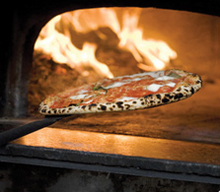
wood fire pizzaAfter visiting a Philly BYOB, Robert Parker once let an apparent deep-seated contempt for sommeliers flow free, dubbing them defenders of “vinofreakism.”

Perhaps trying to atone for his equivalent to a Howard Dean howl, Parker posted to his web site that he enjoyed his recent meal to A16, a pizza specialist in San Francisco with a long list of wines from Campania and the Mezzogiorno more generally. Even though he admits that after seeing the wine list he wished for a lifeline phone call to his Italian critic Galloni, Parker says the sommelier, Emily, was “very knowledgeable about the wines.”

So which wines did he then have? A Champagne and two 2007 Chateauneufs (one in magnum) that aren’t on the wine list. Oh, and perhaps the best-known wine from Campania, a Montevetrano, which he said was extremely closed. Chew on that…

Shelley Lindgren, wine director and one of the owners, wrote in her book A16: Food + Wine that a wine list based on Southern Italian wines was a tough sell when she opened the restaurant. But soon enough, she writes, “we had a dining room full of curious customers interested in expanding their wine horizons.”

Related: Pizza: a forbidden food-wine pairing?!?
Help Steve Cuozzo navigate a wine list

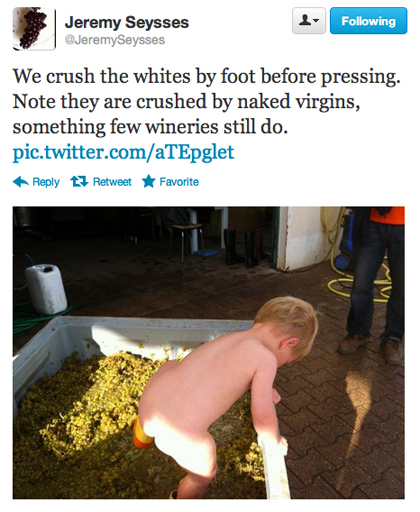
Burgundy 2012 – rain, hail and naked virgins


Burgundy 2012 via Twitter: Jeremy Seysses of Domaine Dujac posts what could be the wine tweet of the year!

Jean-Marc Roulot had a more apt image and caption for the season that has been beset by rain and hail, reducing usable crop to a minimum: Read more…

Amazon wine, the less ambitious sequel

While Amazon shoppers can click and add almost anything to their carts, one thing has eluded them: wine.

Amazon’s first foray into wine had the potential to change the way Americans buy wine, shaking up the archaic set of laws that limit wine choices and boost prices for consumers, particularly those in states that do not have a vibrant culture of wine retail and distribution.

But this sequel seems less than earth-shattering. While the details are still emerging, the Wall Street Journal builds on reporting from Wine Industry Insight to paint a picture of a glorified “marketplace” system. In it, Amazon will expose their enormous customer base to offers from wineries, which will fulfill the orders themselves with Amazon receiving a fee of 15%, according to the WSJ. There’s no mention of how much shipping will be, including whether the orders would qualify for Amazon’s “Prime” service that has free two-day shipping. If they do qualify, some wineries may turn to Amazon instead of flash sites to unload any surplus inventory.

Since wineries can ship to about three dozen states if they have the proper paperwork on file, this has the potential to affect a lot of consumers. But there are a lot of drawbacks too since consumers would apparently have to order from one winery at a time since there is no warehouse fulfilling the orders. Also, wines will likely be at a higher price to justify the shipping charges and there will be no imported wines available. (Retailers, by contrast, can only ship to about a dozen states legally.)

So while it is better than nothing, Amazon’s foray into wine this time seems less ambitious. That’s a pity since the retailer and logistics champion could have been the wine consumer’s greatest ally in the battle over interstate shipping. Perhaps one day…

What do you think–is this a big deal? Would you be more likely to order wine from California wineries via Amazon?

Related: “Amazon stops selling wine before it ever starts

Broadcasting Baroque to the vines at DeMorgenzon

Kobe beef cows may be jealous: the vines and barrel room at De Morgenzon winery in Stellenbosch have Baroque broadcast 24 hours a day.

The DJ is Hylton Applebaum, who owns the property with his wife Wendy (Hylton also owns the Classic FM radio station in Johannesburg). Hylton says that the mix includes no music “that annoys people,” ruling out harpsichord, energetic violin solos or organ, which sounded funereal. Opera and all human voice were excluded from the track because they could be too jarring for the staff and neighbors. The staff that I spoke with say the music has a calming effect. Only certain blocks have been wired for sound, including a block of syrah behind the winery.

Hylton says the vineyard with the music shows slower growth than adjacent vineyards that have no music. “We are able to achieve phenolic ripeness with lower sugars,” he said as we stood among the vines.

I asked him if techno would speed up the growth. He said that some experiments in central Europe had shown a variation in tomatoes with the type of music played; jazz worked well but heavy metal killing the plants.

De Morgenzon’s “DMZ” line represents good value at about $15 in the US; the standout of the line is the crisp chardonnay, which has just a hint of early Mozart on the nose. Their top wine, a 100% chenin blanc, presented a serious side of chenin. But more on that in a future post. Read more…

In South Africa for #CapeWine2012

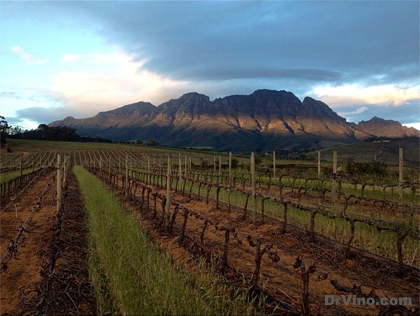
I’m in South Africa right now, attending a biennial trade show called Cape Wine 2012. Although wine was first made in 1659, the industry has confronted numerous challenges from the weather, economic crisis, economic boycott, and phylloxera over the years. In the almost two decades since apartheid ended, the industry has changed a lot in terms of grape varieties vinified and how they are grown, wines exported, labor practices, and arrival of international capital. Today, the Western Cape remains a stunningly gorgeous region that has exciting local vintners as well as an international flair: I been in and around Stellenbosch the past couple of days and have already bumped into Bruno Prats, Hubert de Bouard, Charles Banks, and the view above is from Glenelly, the winery built by May de Lencquesaing of Pichon-Lalande. I look forward to exploring the wines, meeting vintners, winemakers and other journalists, and delving into various themes at the show in the coming days. Is there anything you are particularly interested in? What is your take on South African wines now?

In the name of disclosure, and for those who think press trips are nefarious exercises in brainwashing, my trip is organized by Wines of South Africa.

Keep an eye on my Twitter feed for my latest updates (where wifi permits!) including commentary and pictures (instagram handle: drvino).

Bordeaux says no to American “chateaux”


Could sales of Chateau Buffalo spread like wildfire in wine shops on the banks of the Seine, elbowing French wine from consumers’ shopping baskets? That’s what a trade group from Bordeaux fears.

The EU is considering a proposal to allow American wines to export to Europe using the name “chateau.” In France, to have “chateau” on the label means that the wine must be 100% estate fruit whereas in the US, fruit can be purchased from other growers and the wine is not forcibly an estate wine. Laurent Gapenne, head of a Bordelais trade organization that protects appellations, hit the media, telling Le Parisien that he thought allowing the term would be the thin edge of the wedge. “There is a great danger that the notion of the chateau will disappear in France … the consumer is going to feel lost,” the Telegraph translated his remarks.

Really? A bit of history: the 2005 US-EU bilateral wine accord allowed US wineries to use “semi-generic” names, such as chateau, but the US agreed to prevent further issuance of the word chateau in winery names (all trade law experts out there, feel free to chime in if I’m remembering wrong). Then, in 2008, the EU prohibited the importation of US wines with “chateau” in the name (has the WTO weighed in on this?). If my recollection of the 2005 accord is correct, then we are left with fewer than 60 wines that could use the term. Like Chateau Buffalo. Or Chateau Manzanita. (Enjoy the full list after the jump.) Could French consumers really mistake these as French? I’m all for specificity, but do they know the terroir of Buffalo or even California well enough to discern estate wine from negoce wine from those regions?

And then there’s the issue of our exports to France. Half of all our exports are in containers greater than two liters. So that’s probably not estate wine nor would it be confused as such. In 2010, the US exported $441 million of wine to the EU and less than $16 million of that was to France. Even Gallo tried to target the French market a while back and found it a tough nut to crack. Coals to Newcastle and all that.

Thus Gapenne is swinging at shadows. He shouldn’t fight to preserve chateau as synonymous with an estate wine for American wine; the 2005 accord recognized the use of chateau. He should, however, fight to have estate wines from American “chateaus” labeled as such, regardless of the name on the label. It’s hard to argue against more precise labeling, in any language.

Read more…

The Wine Advocate speaks at $1,200 Antinori showcase

If [wine writers] are beholden to wine producers for the wines they taste, they are not likely to fault them…

While it is important to maintain a professional relationship with the trade, I believe the independent stance required of a consumer advocate, often not surprisingly, results in an adversarial relationship with the wine trade. It can be no other way. In order to pursue independence effectively, it is imperative to keep one’s distance from the trade. While this attitude may be interpreted as aloofness, such independence guarantees hard-hitting, candid, and uninfluenced commentary.

That’s from the boiler plate material on ethics that appears at the beginning of each edition of Parker’s Wine Buyer’s Guide, now in the seventh edition. Robert Parker set an admirable standard long ago. Read more…

SevenFifty drags the wine industry into the 21st century

Picture yourself at a wine trade tasting: there are hundreds of wines to taste but you have to juggle a bulky tasting notebook, a pen, and a wine glass while swirling, spitting and dodging fellow tasters who may be heading to the spit bucket. Wouldn’t it be so much easier if you could see the tasting book on your smart phone, sort by style or wine region, and take notes in a profile?

That’s what I did yesterday Read more…


winepoliticsamz

Wine Maps


Monthly Archives

Categories


Blog posts via email

@drvino on Instagram

@drvino on Twitter


winesearcher

quotes

One of the “fresh voices taking wine journalism in new and important directions.” -World of Fine Wine

“His reporting over the past six months has had seismic consequences, which is a hell of an accomplishment for a blog.” -Forbes.com

"News of such activities, reported last month on a wine blog called Dr. Vino, have captivated wine enthusiasts and triggered a fierce online debate…" The Wall Street Journal

"...well-written, well-researched, calm and, dare we use the word, sober." -Dorothy Gaiter & John Brecher, WSJ

jbf07James Beard Foundation awards

Saveur, best drinks blog, finalist 2012.

Winner, Best Wine Blog

One of the "seven best wine blogs." Food & Wine,

One of the three best wine blogs, Fast Company

See more media...

ayow150buy

Wine books on Amazon: