Trimbach Frederic Emile, 2001 – WBW 45
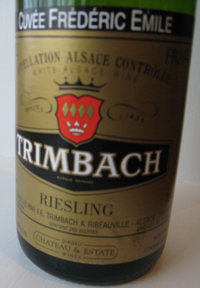
frederic emileThe Trimbach Cuvee Frederic Emile is one of the world’s great white wines. And at $35, it’s also one of the world’s great white wine bargains.

I had the 2001 recently with a friend and loved it. I tried the 2002 at a tasting last week and found it higher in acidity and not quite as subtle as the 01, so I went out and bought some more of the 01. I’ve never had the top wine from the Alsatian producer, the $120 Clos Ste. Hune (find this wine), but one of my friends who has had it describes the “Freddy” as “more than half the wine at a quarter the price.”

Although I prefer German Riesling on the whole to the Alsatian versions, this Freddy has a German-like precision, alluring aromas of lime zest, lemon grass, wet rocks and a touch of honey, while the palate has excellent richness while remaining dry and a long finish. I’d like to try a version of this wine with some age on it so I’ve stashed away a few bottles for just that purpose. Next time I’ll try it with pan-seared scallops.

The wine is from grand cru vineyards but still seems to have a production size that means that it actually can be found. Search for it now before it is all gone.

Why write about this wine today? Why, it is for Wine Blogging Wednesday #45, with a theme of Old World Riesling that Tim Elliott selected. Surf on over to Tim’s site to see a roundup of which other Rieslings people chose to explore. And thanks for the one day grace period, Tim!
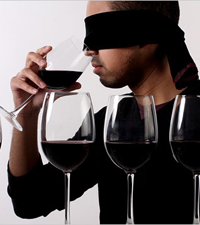
A call for context: wine’s pleasures all in your head?

blind tastingEric Asimov has a great piece in today’s Times about all the sensory inputs of wine–and he’s not talking about blackberries, leather, and tar but rather what makes us buy and ultimately enjoy a given wine.

The piece summarizes recent research into wine purchasing decisions, particularly two studies that have made consumers appear to be easily influenced by price. Obviously many other factors go into what makes you buy a wine including what you’ve read about it, the place of origin, the grape, the producer, the importer, and perhaps the bottle design and label (if you’re new to this site, have your say in our worst wine label contest while submissions are still open!).

I’m a huge fan of context for wine enjoyment and thanks to Eric for quoting me in the story with this perspective. Sometimes context can even elevate a humble bottle of wine to make it an all-time favorite. I remember Frank Prial, previously wine critic for the Times, saying that the best bottle of wine he ever had was some crappy wine he drank enthusiastically right after returning from a tour in the Korean War. It wasn’t the wine so much as it was the fact that he was home.

It’s amazing how often learned wine folk cite humble bottles as their faves when the experience was really so much about the mood and the moment. How has context influenced a great wine experience of yours?

Maybe there should be 100 point moments rather than 100 point wines. There’s no price tag on that, after all.

Related: “Wine’s Pleasures: Are They All in Your Head? [NYT]
A reduced-sized crop of the image attributed to Lars Klove that accompanies that piece is reproduced here.

Will Asian buyers refocus on Riesling?

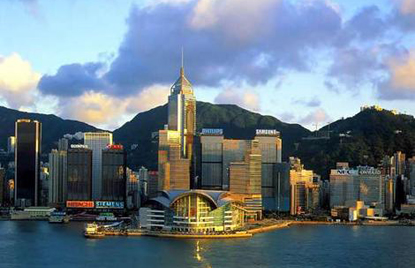
hong kongRobert Parker goes to China. It doesn’t quite have the same geopolitical impact as Nixon goes to China, but the magnitude for the wine world may be similar as Parker heads there later this month for the first time. Jancis Robinson stopped by earlier this year too. And two big auction houses have resumed wine auctions in Hong Kong this spring after a seven year drought. The removal of the wine tax in Hong Kong has driven a “thirst for top-level wines” in the city “is growing at an exponential rate,” according an auctioneer quoted in Bloomberg.
Apparently Asian buyers are getting much more wine savvy. It wasn’t long ago that they only bought wines with 100 point Parker scores, perhaps a sign of slavish following more than connoisseurship.

But now I am wondering if the locals are waking up to the joys of pairing Riesling with the cuisine. And the quality of German Riesling just keeps getting better and better. Perhaps they now have confidence to venture away from Bordeaux and cult Cali cabs.

Actually, since I am really getting into the sublime pleasure of German Riesling, dry and off-dry, young and mature, the thought of demand from Asia is something of a doomsday scenario for me. The last thing I need is to have investors pile in and run up the price in yet another category of wine!

To wine shops: add importer information

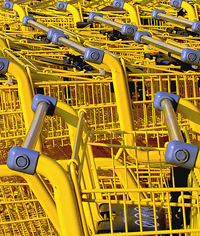
shopping cartsTO: wine shop managers and their webmasters
FROM: Dr. Vino
RE: adding importer information to e-shops

I was surfing the sites of a few online wine retailers today looking for some specific imported wines when I should have been working. Some of the sites generated other imported wines suggestions that sounded good but I hadn’t heard of the producers. Since you already list tons of information about the wine including the producer, region, vintage, possibly grape variety, and a critic’s opinion, how hard would it be to add a field to list the importer as well? I, for one, would be more likely to throw a bottle in my virtual shopping cart if I knew it was from one of my favorite importers. If I am in a shop I can look at the back label, which provides that info, but not online…

(image)

Kim chi – impossible food wine pairing?!

Site reader Sal sends in this query: “Can I submit an impossible food/wine pairing? How about Kim Chi? We’ve had it with Soju and it’s great but what if you like still wine (especially red)? Is a Kim Chi/wine pairing possible?”

Excellent question! Hit the comments with your thoughts. And in honor of Stephen Colbert’s rivalry with Korean pop sensation Rain to become the TIME most influential person of the year, as well as getting in the mood for an impossible food wine pairing, check out this hysterical video of Stephen singing in Korean.

The worst wine label – a competition

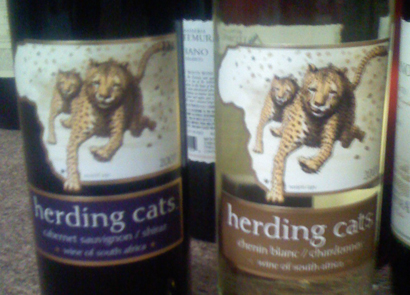
herding cats
We’ve all seen them–wine labels that are so ugly that they make us cringe or run to the next aisle in the shop out of horror.

So right here, on this blog, we’re going to “out” the worst wine labels you’ve ever seen. Channel your inner graphic designer and post a link in the comments or send me an image of a label that has rubbed you the wrong way by next Friday. Then our panel of experts (yes, perhaps more than just me) will review them and put a list of finalists for your vote.

Send images–even bad cameraphone images such as mine above–to tyler at drvino dot com and, if necessary, say why it rubs you the wrong way.

From Japan, observations about wine, carbon and classrooms

An MIT professor whose research focuses on energy and the environment is currently teaching Masters students in Sustainability Science at the University of Tokyo. He contacted my co-author and me about our research into the carbon footprint of wine since he wanted to assign his students the same task but tracking three bottles of wine to Tokyo instead of to Chicago, as we had done.
They tracked three hypothetical bottles from California, Australia and France and varied the mode of transport, with California going by air and the other two using shipping. Their results mirrored ours showing that the mode of transportation matters and that the mass of packaging also plays a role. Several students proposed that wine be shipped in bulk and bottled at the point of sale or consumption. He also added this detail:

The class discussion was concluded with an experimental component in which the students had the opportunity to sample a Yellowtail Cabernet Sauvignon (2005), Muscadet de Sevre and Maine (Loire, 2006), and a Ravenswood Zinfandel (2005, actually Sonoma + Mendocino but that is close enough to Napa). They agreed that (1) this made the assignment more interesting and (2) there are factors other than carbon emissions that should be taken into account when choosing wines.

I’m glad they enjoyed the research!

On a related note, the NYT ran a graphic with some of our findings in the excellent recent article, “Movable Feast Carries a Pollution Price Tag,” by Elisabeth Rosenthal.

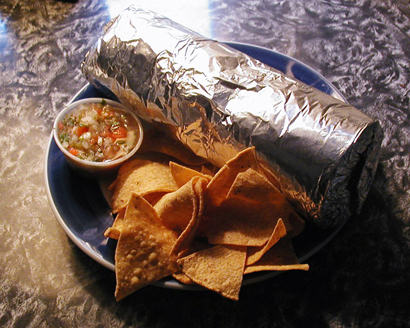
Burritos – impossible food-wine pairing!?

burrito

Cinco de Mayo is just around the corner. Can we wine lovers come up with a wine pairing that will have people put down their margaritas and Coronas for a glass of wine? Probably not. But which wine would you pair with: burritos! Let us know whether you are talking about a beef, chicken or bean with your suggestion. Or is it…impossible?

Related: “Impossible food-wine pairing: chips and salsa!
Impossible food-wine pairing: breakfast burrito!
(image; and yes, that was the best burrito photo I could find.)


winepoliticsamz

Wine Maps


Monthly Archives

Categories


Blog posts via email

@drvino on Instagram

@drvino on Twitter


winesearcher

quotes

One of the “fresh voices taking wine journalism in new and important directions.” -World of Fine Wine

“His reporting over the past six months has had seismic consequences, which is a hell of an accomplishment for a blog.” -Forbes.com

"News of such activities, reported last month on a wine blog called Dr. Vino, have captivated wine enthusiasts and triggered a fierce online debate…" The Wall Street Journal

"...well-written, well-researched, calm and, dare we use the word, sober." -Dorothy Gaiter & John Brecher, WSJ

jbf07James Beard Foundation awards

Saveur, best drinks blog, finalist 2012.

Winner, Best Wine Blog

One of the "seven best wine blogs." Food & Wine,

One of the three best wine blogs, Fast Company

See more media...

ayow150buy

Wine books on Amazon: