Regress with baby bottles at new fondue restaurant

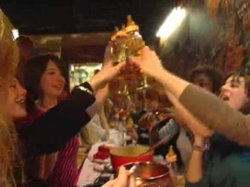
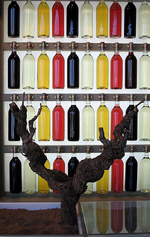
Earlier this year we talked about those juice boxes for adults aka wine in Tetra Pak. Now you can regress even further, straight past sippy cups. Yes, via Diner’s Journal we learn that the new fondue restaurant, La Cave des Fondus (20 Prince Street in Nolita) will offer red and white wine (and beer) in baby bottles. Perhaps the only thing scarier is the fact that this restaurant comes from Paris. Yes, Paris! Check out the video to see how much they love it there!

So when will Riedel get into the baby bottle market?

Website calculates drinks as food calories – “terrifying”

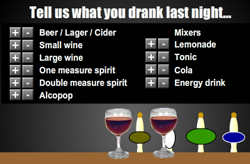
The excellent blog The Consumerist posted yesterday about a BBC web site that converts drinks into calories and then into their food equivalents. Meg Marco, the post author, called the results “terrifying.”

I plugged two “large glasses of wine” into the calculator, which suggested 335 calories, and this is what it generated as food equivalents: a slice of pizza, an onion bhaji, and two jaffa cakes. Well, yes, I suppose that could be terrifying if I knew what two of those things were! So I ran it again and it said that it was the equivalent of a hamburger and a jaffa cake! Wow, the jaffistas really control that widget!

Clearly, there are many variations of a slice of pizza, some more caloric than others; ditto for hamburgers (sliders?). And we’ve previously discussed how the calories in a glass of wine can change too. But the basic point remains true: wine has calories and those calories can be converted into potentially terrifying food equivalents! Or they could be translated into non-terrifying food equivalents: 335 calories of granola is not going to really scare anyone.

Make your own bubbly–water, that is

Perhaps this holiday season you will get the $5k winepod to make wine at home. For my birthday a few months ago, I got a gift that gave me the ability to make something a little less exciting: water.

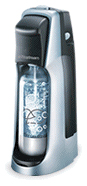
Well, not exactly make water, which, of course is free from the tap. But I received a carbonating contraption known as SodaStream that adds some sparkle to your H2O. Fill a one-liter bottle with water, twist onto the nozzle, press button three times and voila! Sparkling water! Just like an old-fashioned seltzer water maker. After making probably close to a hundred liters of such water now, I find it to be very good (though it is best to carbonate immediately before consuming) and convenient (no running out of sparkling water).

And, of course, it’s low carbon footprint! As an offset to my wine consumption, I gave up bottled water almost entirely last year and it was the sparkling water that I missed most. Now it’s great to have it back on my table. In fact, since grape fermentation produces both alcohol and carbon dioxide, I’ll be looking out for the first carbonation cartridge that comes from captured fermentation CO2!

As to the pricing, it’s about $100 for the Fountain Jet model that I got with two cartridges and a refillable bottle (but having extra bottles helps since you can just keep them full in the fridge; UPDATE–enter code SODAGIFT to get $25 off a new soda maker for the holidays). At 50-60 liters of carbonation per $15 cartridge, or $0.25 a bottle, it’s neither as cheap as tap water nor as cheap as I would like, but it’s less expensive than bottled water–and lower carbon footprint, clearly, without the trucks hauling glass bottles and water from Maine or the Alps.

Now if only I can get the courage up to try carbonating still wines, then I’ll really be undercutting the market price for bubbly!

Au revoir young wine drinkers! WSJ surveys Europe on drinks

If you had to guess, where would you find a third of the population doesn’t drink any alcohol: the USA, founded by Puritans, or Europe, largest producer of wine?

Well, if you guessed either (or both), you’d be right according to a comprehensive survey undertaken by market-research firm GfK for the Wall Street Journal and reported there on Friday.

But even more eyebrow-raising than the overall number of teetotalers in Europe is wine’s relative unpopularity, particularly among younger cohorts in wine producing countries. Consider Spain, the third largest wine producer in the world by volume. There, of respondents who drink alcohol, beer outstripped wine by a two to one margin.

But if you break it down by age, 48% of the youngest cohort (14-29 year olds) favors beer as their “preferred” alcoholic drink, with distilled spirits coming in second with 28%, cocktails third with 14%, and wine a distant fourth with only eight percent. Overall, the preferred drinks youngest Western Europeans in the survey are beer (44%), wine (22%), cocktails (17%), and distilled spirits (14%). The 14-29 year olds respondents in France and Italy, the two largest wine producing countries, both preferred beer to wine but the percentages preferring wine (24 and 29% respectively) were above the Western European average.

Interestingly, to round out what might be termed a rebellion effect, 14-29 year olds in the UK, a country that has historically had no wine production and taxes it particularly heavily when compared to beer, preferred beer and wine just the same with each drink getting 28%.

The next oldest group like wine more but it’s not until the 50+ year olds that wine comes out as the drink of choice at the Western European level. Overall, wine was the preferred drink of of those who drink alcohol 43 to 34 over beer, with spirits and cocktails getting nine and eight percent respectively.

European wine producers must love the Swiss who, along with the Italians, say the prefer wine the most with 62 percent of respondents in those countries favoring wine.

Of course surveys of attitudes toward drink can be fickle as the annual Gallup drinks survey has shown here in the US the past few years, but this one provides a lot of fine grained data with 17,000 respondents and and excel file available with detailed responses. Check it out and let us know what you find most surprising.
The geometry of wine and multidimensional Riesling

The best wines of any grape are multidimensional. But with Riesling, people often get caught up only on sweetness. In fact, there’s other stuff going on, such as acidity and sometimes minerality.

This fact came up in Monday’s panel discussion at the “Riesling Fellowship” In New York City. Held for only the third time ever, the event switched to the US, the largest market by value for Riesling, after two sessions in the UK, the largest market for Riesling by volume. Many top Riesling producers from Germany, Austria, Australia, France, Canada and the US poured their wares at this Riesling-palooza.

In the panel on how Riesling ages, Kirk Willie of Weingut Dr. Loosen mentioned how he thinks of Riesling as a tetrahedron, a three-dimensional geometrical shape akin to a pyramid, with four triangular sides. Afterward, he elaborated that the sides correspond roughly to acidity, sweetness, alcohol, and intensity.

Nik Weis, of Weingut St. Urbans-Hof in the Mosel thinks of Riesling more as a parallelogram with the four sides being acidity, sweetness, alcohol and minerality. Ideally, they are in balance but if one predominated, then the parallelogram became contorted. He had another way for mapping the flavors of Riesling on overlapping axes of length (body, viscosity, alcohol, sugar), width (flavor spectrum), and depth (minerality and acidity).

Although it’s probably easy to overthink this, it is helpful to break down the Riesling into multiple aspects and get away from simply thinking sweet. What works the best of me is to think of it as a part of hanging mobile made up of a of shapes–tetrahedrons and parallelograms if you want!–representing sugar, acidity, alcohol, intensity, minerality and terroir.

Which shape is a Riesling for you? And which shapes would you associate with other grapes? I’m going with a big ol’ cylinder for Cabernet Sauvignon.

Novello olive oil and Vin Santo from Capezzana

novelloGrapes, freshly pressed, often need a good bit of time to be enjoyed as wine. For olives, I was reminded the other day, freshly pressed is A-OK.
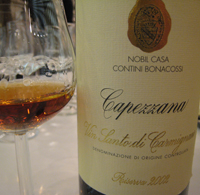
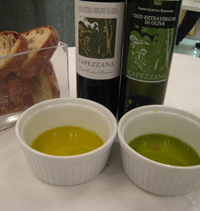
I tasted the “novello” 2008 oil from Tenuta di Caezzano in Tuscany, where 26,000 olive trees grow on 145 acres. As is visible in the photo, the new oil just popped with lively green compared to the one year old extra virgin on the left. The olives are hand harvested and pressed that evening to ensure freshness and a low acidity. Indeed, the novello has great intensity of flavor is a great treat. I briefly thought about becoming a modern day sharecropper when I learned that the harvest workers receive about half the oil made from olives they harvest. Hmm, how long to earn my weight in olive oil?

The property also has 100 acres of vines. At a tasting at the offices of the wine’s US importer, LVMH, I chatted with Beatrice Contini Bonacossi about their wine that particularly caught my fancy, the unctuous sweet 2002 vin santo (find this wine). The delicious, caramel colored wine is rich and thick, with notes of hazelnuts and sultanas, but surprisingly light given the 15.5% alcohol.

vinsantoThe grapes, mostly Trebbiano but wth some San Colombano and Canaiolo, are harvested in September and then dried on straw mats in their own, large climate controlled room until about March, when the concentrated juice is finally pressed pressed out of them. They ferment in chestnut and cherry casks and continue to age in barrel for five years.
She recommends having it by itself. But if you do pair it with food, she recommends biscotti, fruit tart, or a hard cheese like pecorino adding that panna cotta is a total flop. I’ll take her word since it seems like a lovely finish to a wintry meal to me all on its own.

Depardieu, auctions, Copia, Michigan – tasting sized pours

Buyers wanted
The IHT reports that fine wine buyers “are pushing back.” Separately, wine auction house Acker Merrall gives potential buyers come hither eyes and cuts their buyer’s premium to 18 percent; Zachys responds by going to 17 percent.

Adieu, Copia?
Copia, the wine, food and art museum and restaurant in Napa City, closed on November 21 and has filed for Chapter 11. The original $55 million in funding came at least half from Robert Mondavi. The NYT promises more coverage tomorrow. [Diner’s Journal]

Biodynamics is poop
In what promises to be a salty interview, French actor-vintner-restaurateur Gerard Depardieu–who once joked that his mother’s amniotic fluid was actually wine–disdains biodynamics claiming the vineyard treatment “doesn’t exist.” Then he claims that he uses biodynamics at his Chateau de Tigne property in Anjou only because he is “poor.” [Decanter]

Michigan: no delivery?
A federal court struck down Michigan’s law that prohibits out-of-state retailers from shipping to Michigan residents while allowing local wine stores to deliver. While the case is on appeal, a new bill in the legislature tries to create a level playing field–by preventing local wine stores from delivering! See the op-ed against the bill in Crain’s Detroit Business.

The bling of Christmas past: Beaute du Siecle Coganc

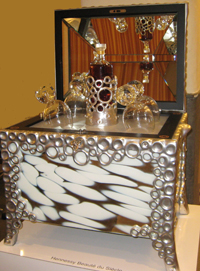
beaute_du_siecleWith little new wine bling rolling out for this holiday season, I had a brief encounter with the bling of Christmas past. No, it wasn’t the $10k white gold Dom Pérignon jerobaum we brought you (photographically, at least) last year.

Instead, a few days ago I stumbled on an actual bottle of the Hennessy Beauté du Siècle cognac (find this cognac). Introduced last year in its display case designed by ten artists using mirrors and molded aluminum (!), the cognac is supposedly hand delivered in a limousine by one of the directors of LVMH when a bottle is, in fact, purchased. I twisted the Baccarat crystal bottle around in its holder (I didn’t lift it because I thought it might trip a sensor and since I’m not Indiana Jones, I didn’t have a 750g bag of sand to put in its place). There’s no label, save for the government warning! Ah, the surgeon general’s reach escapes no one.

Perhaps there is an aluminum lining for those interested in purchasing: introduced at €150,000 last year, the price has gone down based on exchange rates alone!


winepoliticsamz

Wine Maps


Monthly Archives

Categories


Blog posts via email

@drvino on Instagram

@drvino on Twitter


winesearcher

quotes

One of the “fresh voices taking wine journalism in new and important directions.” -World of Fine Wine

“His reporting over the past six months has had seismic consequences, which is a hell of an accomplishment for a blog.” -Forbes.com

"News of such activities, reported last month on a wine blog called Dr. Vino, have captivated wine enthusiasts and triggered a fierce online debate…" The Wall Street Journal

"...well-written, well-researched, calm and, dare we use the word, sober." -Dorothy Gaiter & John Brecher, WSJ

jbf07James Beard Foundation awards

Saveur, best drinks blog, finalist 2012.

Winner, Best Wine Blog

One of the "seven best wine blogs." Food & Wine,

One of the three best wine blogs, Fast Company

See more media...

ayow150buy

Wine books on Amazon: