Dr Vino's wine blog
wine talk that goes down easy
Exciting times for Spanish wine – a story over on SevenFifty
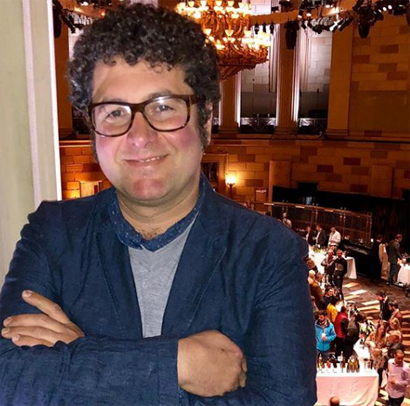
Spain makes a lot of wine. Overall, it’s the third biggest producer in the world. One problem the country has is that many of the country’s wines sell at low prices–don’t get me wrong, there are certainly some pricey ones too. Another problem is that as wine enthusiasts and producers around the world rejoice in delving into fiendish detail about vineyards, some of Spain’s region’s can keep an administrative lid on the terroir.
I examine how some producers such as Ricardo Pérez Palacios (above) and Raúl Pérez in Bierzo and Telmo Rodriguez in Rioja are doing to unlock the terroir in their regions. This process not only ties into what’s happening in the larger wine world, it can also serve as a way to raise the price of grapes, land and wine.
These are exciting developments. I sought to capture them in an article at SevenFifty daily, published today. Check it out and let me know your thoughts.
“Why Spanish Producers Are Seeking Burgundy-Style Classifications” [SevenFifty Daily]
May
10
2019
1
A visit to Lopez de Heredia
I’m in Rioja attending the Digital Wine Communicators’ Conference.
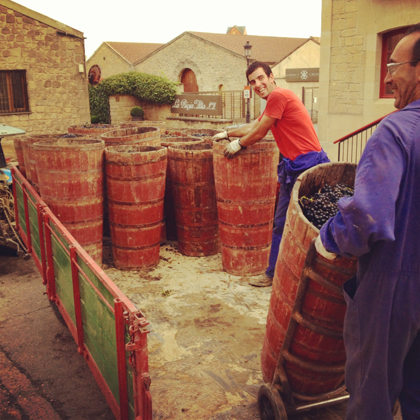
I got to stop by Lopez de Heredia, the shrine to fine wine in Haro. As the sun set and the last grapes of the 2013 harvest arrived, Mercedes Lopez de Heredia took a break from her duties to show a few of us around. Because the celebrated winery, a shrine to fine wine, has been around for over a century, it’s not exactly breaking news. But the mold-covered walls and the cellars where 13,000 barrels a phenomenal 2 million slumber should be on the bucket list for all wine geeks. Although I’ve tasted as far back as the 1945 vintage with collectors in New York, this was the first time I’d been to the bodega.
The last grapes from this late vintage were still trickling in (see above). The workers to this day bring them in via tall poplar baskets called “comportas.” The conical structure means that the wood bears the load and the grapes don’t start the crush on the way to the winery. Read more…
Oct
28
2013
Pepe Raventos on leaving Cava and making the new Conca
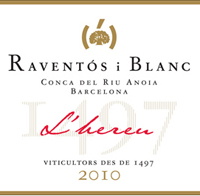 While he was pouring bubbly at the spring tasting of his his NY distributor (Skurnik), I spoke with Pepe Raventos of Raventos i Blanc. Late last year, Raventos announced that they had decided to withdraw from the Cava D.O. and will file for a new D.O. Conca del Riu Anoia. I asked him why.
Pepe Raventos: The motivation is a belief in the great potential of sparkling wines that have been produced in our conca, our valley, for the last 150 years. It’s one of the most historical wine regions of the world. I think that when you’re deep in typicity–pace, soil, climate history–then your wines start to become closer to art than to winemaking. Cava has become a winemaking wine rather than a viticultural wine. The whole Conca dream is to make it about place, to make it a viticultural wine.
How long will the D.O. process take to be formalized?
The first thing is we have to work well with the farmers in the region and get everyone excited, we need to get you, the wine writers excited, get the customers excited. The world needs a true alternative to grower Champagne because it doesn’t make sense… Read more…
Mar
13
2013
Reader mail: Parker’s selective Spanish reviews
A reader writes in:
I have just seen that Robert Parker has tasted the wines for Jorge Ordoñez and given points instead of Neil Martin. What is going on? I thought after the No Pay No Jay scandal they would be doing things by the book. Very disappointed as I was very happy how Neil Martin was doing things. I personal will cancel my web subscription. These points given can not have any creditability.
This is not the first time that Parker has reviewed the import portfolio of Jorge Ordonez separately from the Spanish critic: When Pierre Rovani reviewed Spanish wine, Parker kept the Jorge Ordóñez wines back to review those personally. This time, Parker uses the 25th anniversary of the importing business as a reason for singling them out. He also adds this line:
Jorge Ordoñez can sometimes annoy people, and he seems to have no shortage of competitors who are clearly jealous of his great success.
It’s an odd line, with more bitterness than a wine before microxidation; if he likes the wines, why not just leave it at that? To include this line in a short piece praising Ordonez seems spiteful and almost paranoid since nobody had said anything badly about Ordóñez, as far as I am aware. From my perspective, the Ordóñez wines appear less visible than they were a decade ago and there have been some notable wineries that have left his portfolio. Meanwhile, the rise of boutique importers of Spanish wines has been one of the more exciting stories out of the Iberian peninsula in the past decade. Given that Parker frequently mentions Ordóñez wines, and Miller had been the recipient of hospitality, I understand why the reader is irked.
Nov
13
2012
Talking dirty: Rioja soil map
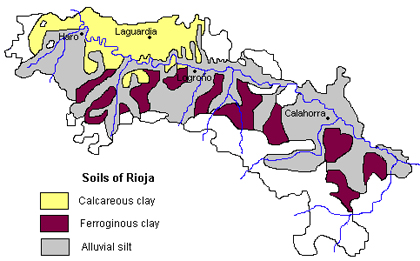
Mosel winemakers love to talk about the blue slate of their soils. A discussion of Chablis couldn’t be had without mentioning Kimmeridgian. Coonawarra has its terra rossa and Rutherford has its dust. But what about the soil in Rioja?
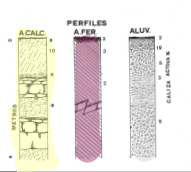 As Telmo Rodriguez recently discussed at length, to his lament, the Rioja winemaking process favors process over place. So as a companion to that post, here is a relatively little-known soil map that Don Manuel Ruiz Hernandez put together. (In a funny contrast to how some New World vineyard owners are obsessed with mapping vineyard soils, this one is from 1972, the blink of an eye geologically speaking, I guess.) It shows three types of soil: chalky clay soil (yellow); ferrous (or ferruginous) clay soil (maroon); and alluvial, silty soil. Describing the differences, he writes “the ones with the most moderate of yields, the Calcareous-Clay ones, are, thus, the lands from which the most special qualities is achieved.”
It’s hard to generalize since other factors, such as elevation and sun exposure, play a part in grape characteristics and the overall wine quality. But many of the structured, most age-worthy wines from Rioja come from vineyards in the calcereous soils.
It is worth noting that the official subzones (map below) don’t match the soil types. Instead, Read more…
Apr
13
2012
Telmo Rodriguez uncorks terroir in Rioja
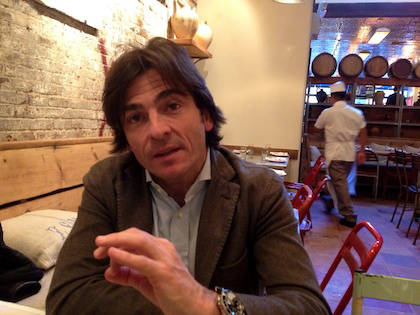
Telmo Rodriguez was in full cry when I met him in New York City recently. Although the 50-year-old “driving winemaker” studied enology in Bordeaux, worked a vintage at J.L. Chave in the Rhone, and for 25 years has made his own wines across Spain, what was on his mind when we spoke was Rioja:
“What do we know about Rioja? Just a few brands? Nobody wants to talk about site, or villages. Rioja is the next thing to discover. We don’t know Rioja. If you think you know Champagne and you only drink Moet et Chandon or Veuve Clicquot, you don’t know Champagne! You need to know the specific vineyards.”
Andre Tamers, who imports Rodriguez’ Remelluri wine, agrees: “This is the way that Spain has to move forward: away from brands and toward the land.”
Starting with the 2010 vintage, Rodriguez Read more…
Apr
10
2012
Scores on labels: what’s the point?
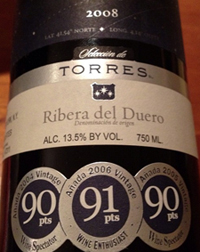 We all know that Spanish wineries looooove critics, so much so that they would pay extravagant fees for a “master class” by a point-wielding critic on “a freelance.”
The good folks at Torres have decided to wear their hearts on their sleeve by putting the score right on the front label! What, are they declaring war on shelf-talkers? If this practice becomes widespread, what will be left for uncreative retailers to use, a bunch of vapid descriptors running around in search of points?
Oh, and the scores are for previous vintages. It really answers any questions you might have when you dim the lights, sit down to dinner and wonder which scores the previous vintages of the wine received.
Message in a bottle to Spain: there is a score-free universe out there.
Dec
21
2011
The Finest Wines of Rioja and Northwestern Spain
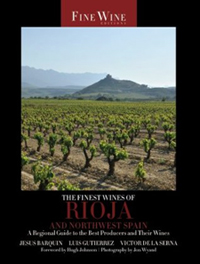 After so much discussion of the Parker-Miller-Campo imbroglio (see a thorough recap from Monday here), it’s refreshing to read about the wines of Spain again without thinking of “no pay – no Jay.”
The new book, The Finest Wines of Rioja and Northwestern Spain, made me do just that. Up-to-date, with gorgeous photos, the book is by a trio of writers and tasters, well-known in Spain and possibly outside: Jesus Barquin, a criminology professor and sherry lover whose passion led him to co-found Equipo Navazos, a boutique producer of excellent sherries; Luis Gutierrez who recently started contributing to jancisrobinson.com; and Victor de la Serna, deputy editor of El Mundo, a leading Spanish daily, who heads El Mundo Vino.
Although the book is largely a collection of 85 producer profiles, the authors open the book with several good discussions, one about the grape varieties (they acknowledge the resurgence of indigenous varieties in the northwest) and another about traditional versus modern winemaking. This latter discussion is of most importance in Rioja where modern style has been ascendant. The authors dispute the notion that the modern style of dark, extracted, fruity wines has been a “curse” for the region and are surprisingly accommodating of it saying that the best of the moderns “will in turn become classics.” I guess it would have been a short book if they didn’t adopt a non-partisan, ecumenical stand on the modern-traditional issue. They also admit that their personal collections have many examples of traditional producers from the best vintages.
The profiles bring the producers to light in one to six pages and include traditional producers (Lopez de Heredia and La Rioja Alta), modern (Roda), mixed (Muga) and up-and-coming (Olivere Rivière). They also discuss Txakoli, Albarino and wines from Ribeira Sacra and Bierzo. Throughout the book, they highlight a top wine from a producer with a star; I agreed with enough of their starred wines that I will look for some other of their suggestions to try. They also tuck in a list of restaurants and shops with good supplies of aged Rioja (though how many will be modern?) that would be helpful to travelers to the region. In fact, with its wealth of practical information and advice, I wouldn’t head to the region without it.
Dec
14
2011

Wine Maps
Monthly Archives
Blogroll
Categories
- American wine
- announcements
- Argentine wine
- auctions
- Australian wine
- Beer
- best wines
- Bling
- books
- Bordeaux
- bottled water
- Box wine
- Burgundy
- business of wine
- Celebrity wine
- Champagne
- Chicago
- China
- cocktails
- cognac
- corks
- corkscrews
- dining
- eco wine
- events
- foie gras
- food and wine
- French wine
- German wine
- giveaway
- grapes
- green wine
- guest post
- highlights
- how to
- Italian wine
- leaders and liters
- Mature wine
- meetups
- New York City
- On notice!
- photo captions
- podcasts
- Polls
- Port
- Portuguese wine
- power list
- reader mail
- rose
- sake
- Sommeliers
- South Africa
- Spanish wine
- spirits
- tasting sized pours
- The real wine world
- TV and movies
- Uncategorized
- videos
- vinexpo
- Weather
- wine and health
- wine and sports
- wine and tech
- Wine Blogging Wednesday
- wine blogs
- wine classes
- wine collecting
- wine gifts
- wine in india
- wine labels
- wine picks
- wine politics
- wine quizzes
- wine random
- wine science
- wine scores
- wine shops
- wine technology
- wine travel
- Wine under $10
- wine writing
- winemaking
- winespeak
 Blog posts via email
@drvino on Instagram
@drvino on Twitter
Advertise

quotes
One of the “fresh voices taking wine journalism in new and important directions.” -World of Fine Wine
“His reporting over the past six months has had seismic consequences, which is a hell of an accomplishment for a blog.” -Forbes.com
"News of such activities, reported last month on a wine blog called Dr. Vino, have captivated wine enthusiasts and triggered a fierce online debate…" The Wall Street Journal
"...well-written, well-researched, calm and, dare we use the word, sober." -Dorothy Gaiter & John Brecher, WSJ

Saveur, best drinks blog, finalist 2012.
One of the "seven best wine blogs." Food & Wine,
One of the three best wine blogs, Fast Company
Books for wine geeks

Wine books on Amazon: