Rating wine by health scores: who cares?
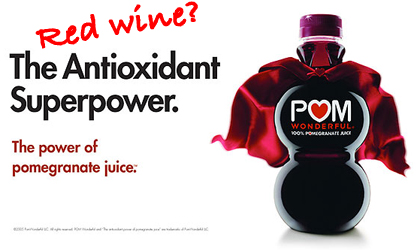

Vinopic, a new wine retailer in Britain has developed a way to rank wines based on their health-giving properties. Red wines are sold with an IQ score, or Intrinsic Quotient, devised by Roger Corder. The site says that the score rewards wines with “higher quality” and polyphenols while penalizing wines with higher alcohol, sugar, and sulfites.

While I am sure that the site will become a popular destination (particularly among Google searchers seeking the fountain of youth), my general reaction is: so what? Wine may play a part in a healthy diet. And I have met a lot of people (mostly over 50) who say they only drink red wine because of the resveratrol. But I would never buy a wine solely based on whether it’s healthier for me. I’d rather eat a high-fiber, low-cholesterol diet, go for a run, drown in a bowl of blueberries–something, anything–rather than drink a steady stream of Madiran, a wine high in polyphenols. Nothing against Madiran, its just that there are too many interesting Rieslings wines to be limited to reds. Buying wine for health reasons: It’s the kind of thing that makes me sick.

What do you think? Even though the US regulatory authorities prohibit selling a wine on health claims, would you buy one based on perceived health value?

“Petrol” is a flaw in young Riesling: Olivier Humbrecht

The petrol note sometimes found in young Riesling is a flaw according to Olivier Humbrecht. And we lack a better vocabulary for the petrol note that many Riesling aficionados cherish in older bottles.
The winemaker at Zind-Humbrecht in Alsace who makes 40 different wines a year commented in New York last week that the petrol note can be symptomatic of three things. The first is harvesting under-ripe grapes. Riesling needs 110 to 120 days to ripen, he says, and harvesting the grapes too early can lead to an undesirable aroma. Similarly, he says that machine harvesting can lead to off-aromas in the wine, generally called “petrol.”

Second, Riesling is prone to reduction, a condition devoid of fruit aromas, and this can be mistaken as “petrol.” Instead, it is simply not desirable. Winemaking decisions such as making the wine in airtight environments such as stainless steel or even old oak can, poor use of sulfur, or leaving the wine on the lees can make it prone to reduction. A good winemaker should be able to see these problems arising and take steps to mitigate them.

Third, there is a desirable form of “petrol” in mature Riesling but Olivier says the term is “ill-chosen.” Given the choice, he would describe an earthy character as truffle instead of mold, as it’s a more desirable to choose term. Similarly, he prefers to think of mature Riesling as having a character of wet stones, minerals, sea air, or iodine, all of which are more pleasurable than the bottom of a diesel tank.

“I hope to God that nobody would think that young Rieslings smell like petrol!” Wine drinkers should trust their gut instinct and if the wine’s aromas are off-putting, then it is bad. Another way to tell if it is reduction: drop a copper penny into the wine (or swirl a copper wire) and see if the off-aromas disappear and fruit reemerges. Or try decanting it.

Ontario to heavy bottles: keep out!


Remember those obnoxiously heavy bottles that were all the rage before the recession? Well, the Liquor Control Board of Ontario has told them they are not welcome. That’s right, to be sold monopolist’s stores that serve the 13 million residents of the province, bottles must be lightweight, tipping the scales at 420g maximum (as a reference point, the wine inside the bottle weighs 750g).

It’s good to light a fire under producers to lightweight bottles; wine lags other beverages, which have been constantly reducing the weight of their packaging over the past few decades. However, the LCBO is only applying this rule, applicable in 2013, to bottles selling for less than C$15.

Thus the new rule still valorizes heavy bottles: Producers may still try to position their premium wines with shelf-bending bottles under the false assumption that heavy bottles means better wines. But still, most of the wines at the LCBO sell for less than C$15 so the move will have a big impact from a volume perspective on reducing carbon emissions of the wine trade. Perhaps the move will encourage high-volume producers to opt for lighter bottles for all of North America, the same way Kleenex and other produces have French written on them when producers want labeling compliance for all US and Canada with a single package.

What do you think: brilliant move or despicable over-regulation?

[poll id=”20″]

War on boxes, fall of machines, Bordeaux, theft — sipped & spit


SIPPED: irony
On his bulletin board, Robert Parker calls a “courageous visionary” who will say “enough is enough” and drop Bordeaux prices 20% for the 2010 vintage from the previous year. He later shrugged off any personal responsibility in the rise.

SIPPED: moxie
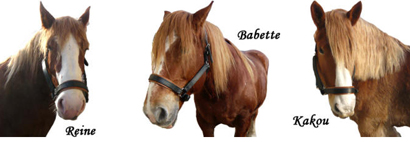
Chateau Pontent-Canet released their price for 2010 (about $140 a bottle at US stores) and it was up 39% over 2009 and 113% over 2005. Jancis Robinson tweeted: “Dio mio – crazeee. Those horses can’t be that expensive to feed?”

SWITCHED: How to get a $3,000 bottle of Petrus for just $3? Why, swap the price tags! #duh [decanter.com]

SIPPED: judging wine by its label
Grub Street has a lengthy breakdown on how mileage picking wine based on label designs will get you. My take: not much.

SPIT: glug glug
Minimum prices for box wine the land of plenty? A 300% tax increase in box wine Down Under might cut down on women glowing and men plundering (or, at least, chundering). #menatwork [smh.com.au]

RIP: machines
Wegmans pulls the plug on wine kiosks in Pennsylvania citing problems and consumer complaints. Is the sun already setting on this PLCB experiment? [Forbes]

Wine confidential: state dinner with Angela Merkel

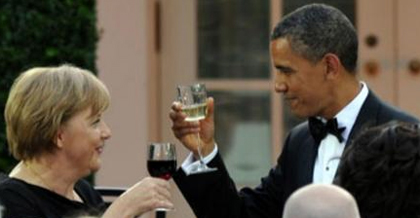
Last night the Obamas played host to Angela Merkel for a “State Dinner” (even though she is the head of government, not state–gasp!) in the Rose Garden. The meal included a salad from the White House vegetable garden; the full menu follows below. Oddly, the wine pairings were not announced! Has the usher at the White House grown tired of the slings and arrows from the blogosphere with each state dinner menu?

No matter–that leaves us a chance to do the pairings ourselves! Read more…

What women don’t want: perfume shaped wine bottles!

I’m going out on a limb here and say that women don’t really want their wine in perfume-shaped wine bottles.

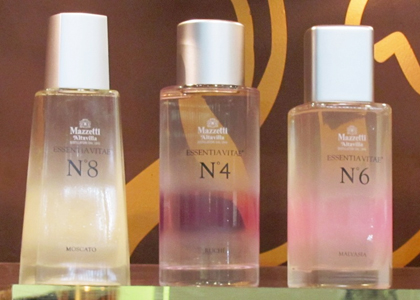
But that’s just what the grappa distillery Mazzetti d’Altavilla is making with their new “Essentia Vitae.” Here’s what someone who hailed it as the packaging innovation of the week had to say.

“While perfume-inspired wine may be an acquired taste, Essentia Vitae goes further than most to connect to female consumers. Its perfume-like packaging should break through the crowded product assortments that can often confound shoppers.”

Argh, those crowded product assortments confusing women wine shoppers! Apparently the wines come in three different flavors/aromas/varieties: No. 4 Ruche – jasmine scent, No. 6 Malvasia – rose scent, and No. 8 Moscato – violet scent. What that exactly means is not clear–are they for drinking or dousing?

My bold prediction: these will go the way of Beringer’s White Lie and the French WineSight. Dammit, marketers, gendered approaches to marketing are best left to important things like razors blades and deodorants!

Search for this wine at retail

HOW TO: cut a wine bottle and save $249

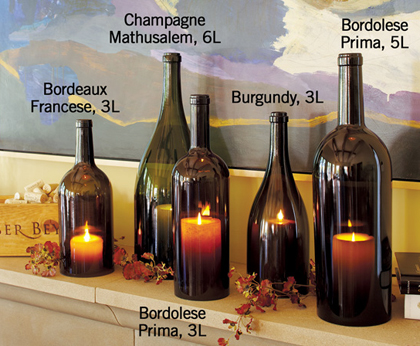
I got a catalogue in the mail the other day from something called Napa Style. I don’t know if it’s 100% from Napa or just sort of a Fred Franzia Napa style. But they had the item shown above listed as “big bottle wine hurricanes.” Yes, empty bottles, albeit big bottles, priced $99 – $249!

How hard is it to cut a wine bottle and make your own “hurricanes” with big bottles left over from your last party or gotten from a restaurant? Not hard, it turns out. Check out the video below for details. Or, to save you ten minutes of your life, score (no points!) the bottle with a tool like this, then pour boiling water from a tea pot over the score line and the glass has a super clean break, apparently.

Voila. Now, if you like this sort of decor and feel a tiny bit artsy-craftsy, you can spend the $249 on bottles that actually have wine in them, not candles. Read more…

Vintage 2011: wacky wine weather


Weather: it’s what you discuss in elevators or with the in-laws. But if you’re a winemaker or even a wine consumer, it can actually be pretty important.

And things are heating up in talking about weather in the wine world. Especially if you are in Bordeaux that is, since it is en fuego! Or something like that: The heat has been abnormally high and the rainfall is way below average. So if the drought-like conditions keep up, the reduced supply of grapes could push wine prices even higher! Is it 2003 all over again? The vintage in Burgundy is also advanced.

By contrast, cut to the Auction Napa Valley this past weekend and people were breaking out the umbrellas rather than the sunscreen. Weather has been cool across the state. Rhys Vineyards has vineyards in more of the marginal weather areas of California and therefore is rightfully weather-obsessed, so their Twitter feed is an excellent source of weather info. Temperatures at their Skyline Vineyard, perched at 2,300-ft elevation, hovered at 49.6 degrees Fahrenheit in May, making it one of the seven coldest Mays since 1931; their vine shoots are about two or three inches behind, they tweet. They say that weather in late June is key for the fruit set so they don’t mean to sound gloomy. And after California’s cool and damp 2010 vintage, the “high-octane,” “fruit-bomb” style is taking it from all sides these days.

Australia was in the headlines for the devastating Queensland floods earlier this year. But even some of the wine growing regions were hit by heavy, “seven year rains” that rotted unpicked grapes quickly and made for a lot of grape selection both in the vineyard and on sorting tables. The Sydney Morning Herald explicitly linked the “soggy” weather to lower alcohol levels.

It’s weird that California and France appear to have flipped weather so far for 2011–there’s something you can talk about in your next elevator ride. Just don’t let the Mayans know since I think that was part of their their 2012 prophecy…


winepoliticsamz

Wine Maps


Monthly Archives

Categories


Blog posts via email

@drvino on Instagram

@drvino on Twitter


winesearcher

quotes

One of the “fresh voices taking wine journalism in new and important directions.” -World of Fine Wine

“His reporting over the past six months has had seismic consequences, which is a hell of an accomplishment for a blog.” -Forbes.com

"News of such activities, reported last month on a wine blog called Dr. Vino, have captivated wine enthusiasts and triggered a fierce online debate…" The Wall Street Journal

"...well-written, well-researched, calm and, dare we use the word, sober." -Dorothy Gaiter & John Brecher, WSJ

jbf07James Beard Foundation awards

Saveur, best drinks blog, finalist 2012.

Winner, Best Wine Blog

One of the "seven best wine blogs." Food & Wine,

One of the three best wine blogs, Fast Company

See more media...

ayow150buy

Wine books on Amazon: