New Jersey wine law: half a case is better than none
What’s the first thing that comes to mind when you think of New Jersey? Surely, the local wine, right?!

That’s what state legislators were hoping when they voted a reform to New Jersey wine law this week. With the governor’s signature, which he has said he will provide, the state will become the 39th to allow the direct shipping from wineries to consumers. After Granholm, the 2005 Supreme Court decision that found it unconstitutional to allow in-state wineries the right to ship to consumers while out-of-state wineries were prevented, New Jersey was one of the rare states that didn’t open up shipments, but instead closed down.

The new law is certainly worth celebrating but don’t think about popping Champagne unless it is purchased at a store in NJ. The most glaring shortcoming is that the bill only legalizes shipments from wineries, not wine stores, thus disallowing free trade in over a third of the wine consumed in the US. For reasons of parity, that’s too bad. But since there are many innovative wine stores and the state has become one of the most competitive in the country, New Jersey residents are still well-served.

Anyhoo, not all wineries can ship to New Jersey under the new law, just wineries under 250,000 gallons (about 85,000 cases). These “capacity caps” are controversial and were struck down in Massachusetts (at a threshold of 30,000 gallons) as a form of discriminating against out-of-state wineries, which was what Granholm said was the big no-no. Further, wineries must purchase a license to ship, which is among the highest such fees in the country. Cathy Corison, proprietor of Corison in Napa Valley, tweeted “NJ opens up to direct wine shipment. $938 annual fee. Gee… thanks. #smallwinerytax.”

For an additional fee, licensed wineries are allowed to open more than a dozen tasting rooms for direct sales throughout the state, which also seems to advantage in-state wineries. But if an out-of-state winery opened a store, it would be a new and fascinating challenge to the three-tier system. (In this vein, Chateau Montelena just opened a “tasting room” in the Westin hotel in San Francisco; New Jersey also has many BYOB restaurants.)

So for NJ consumers, it’s a half-a-loaf law. It’s better than the status quo ante. But not ideal since buying wine from, say, NY wine stores is still illegal (and thus, I’m sure, never happens). New Jersey wineries may be the biggest beneficiaries of all as they can expand in-state (and out-of-state!) sales. Time to bone up on the terroir de Jersey Shore (although this map is much funnier).

What do you think? If you are a winery or New Jersey resident, are you excited or non-plussed by the change?
USA still #1, NJ, Hitler can’t get Burgundy 2010 — sipped & spit

SPIT: Burgundy 2010 allocations are harder than ever to get, per above video!

CHUGGED: USA remains the largest wine-consuming country for the second year in a row. China rose to the top five for the first time. [thedrinksbusiness]

SIPPED: Americans rejoice as they will soon be able to purchase NJ wines directly! Or that’s how they spun the bill’s passage to liberalize the state’s shipping laws. [NJToday.com]

SPIT: Chinese “8” no longer lucky for Lafite — 08 vintage has tumbled 45% in a year. [decanter]

SIPPED: Collateralized drink obligations. A little leverage with your wine? A NY lender offers loans with wine as collateral: borro.com

SIPPED: Mmm, maps. Parcel-by-parcel in Montrachet.

SIPPED: I offer some wine picks at Men’s Health. You’ll have to get the ab workout advice from them though…

Grilled cheese: impossible food-wine pairing?

Is food-wine pairing dead? Never! And the same is true of our “impossible” pairings. So by request, we kick off 2012 with an easy one for you: grilled cheese.

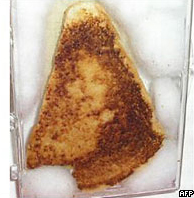
Yes, it’s comfort food. And, no, it’s not impossible as the bread-cheese duo is the basis of so many delicious staples from pizza to ravioli. So raise the degree of difficulty, if you so desire, by adding a twist to the classic by suggesting your favorite cheese. (Incidentally, Ruth Reichl gave some tips last week on Gilt Taste about how to make grilled cheese better, including grating the cheese and adding a thin layer of mayo!) Who knows, maybe your grilled cheese will be graced by a depiction of the Virgin Mary it and you can sell it for $28k on eBay!

Bryan, who asked the question originally, said he went with Australian cheddar and a Simon Bize Savigny-les-Beaune 2009. How would you spin it?

Some weekend reading – PARKENSTEIN!

In a series of post that will go directly into the Wine Blogging Hall of Fame, check out the return of the Hosemaster of Wine and his three-part series, PARKENSTEIN!

In the first installment, Parkenstein assembles his creation: “the more power I accumulated, the more I felt this feverish desire to transfer it to another being, to give power to a cipher of my own creation.” In the second, the creation is animated “the monster’s speech was made up of grunts and snorts and slurping sounds. I had succeeded beyond my wildest dreams—he already spoke like a critic.”

And in the rousing final installment, the creation wanders the earth…which only is big enough for either the creator or the creation.

Mary Shelley would be proud–if she were a wine geek. Hopefully there will be Young Parkensteen!

The vegetarian challenge for wine – and a tip of the toque to Charlie Trotter

My wife has a dilemma: she loves red wine and she is a vegetarian. Granted, by picking the right reds–lighter varieties such as pinot noir, gamay, or poulsard–or the right vegetables–mushrooms or lentils–the problems are surmountable and the results rewarding. Nonetheless, my wife represents what may well be a growing number of Americans who eat less or no meat, urged on by Michael Pollan (“Eat food. Not too much. Mostly plants.”) and Mark Bittman (who recently suggested eating a vegan diet once a week). Heck, there are even vegan bodybuilders! (I also eat a mostly vegetarian diet but enjoy whites more than my wife, which reduces the food-wine pairing dilemma.)

Many wine enthusiasts have drawn a line in the pomace and said no to wines over a certain alcohol percentage. But the changing food preferences of Americans may represent the greater challenge to high-octane reds since they generally make for lousy partners with seafood, lighter, or plant-based fare. And don’t forget spice. Much Indian food is vegetarian and spicy; dousing it with a 15% Chateauneuf du Pape sounds to me more like a recipe for pain, not pleasure. The big reds are easy to pair with the fat and protein of grilled meat but if Americans are feasting less on flesh, the treacly cabernet producers of the world face a challenge (as do the oak barrel makers of the world).

Charlie Trotter is one chef who put vegetarian cuisine literally on equal footing with meats since diners at his restaurant had a choice of either a meat menu or non-meat menu. So with news this week that he is closing his restaurant in August after 25 years, it seemed timely to broach the subject of how a vegetarian diet could impact the wine world. My wife and I have fond memories of Charlie Trotter’s since we lived in the adjacent building after we were married. One dinner we had there that highlighted the difficulties of vegetarian pairings was an all-tomato menu, a challenge for any wine, but particularly challenging to wash down with young Cabernet (unfortunately, I can’t recall what we had).

Anyway, with bacon-drenched everything appearing these days (ice cream, vodka, toothpaste, and the “explosion”), it’s not as if vegetarians are “occupying” the dining rooms of the world’s finest restaurants. But eating less meat appears to have taken hold in America and, for the wines that people actually drink wine (as opposed to collecting and flipping it), this will likely have an impact.

Points for all? Recent evidence of wine score inflation

Is inflation crippling wine scores? In the near future, will it take a wheelbarrow of points to sell a Moscato? Let’s hope Ben Bernanke–or, eegad, Paul Volcker!–doesn’t read this post or he might take the punch bowl away. To the recent evidence:


First, the Wine Advocate’s recent reviews of 1,061 “new releases from Napa Valley” came out. I haven’t crunched the numbers but Blake Gray did and found that new critic Antonio Galloni’s “midpoint” (not sure if this is the mean or median) was 92, up from 91 for Parker’s last set of reviews. Fully 123 of the wines received 95 or more points.

Second, an importer wrote this to me via email last month:

The dollars and points are obviously directly related but so is the timing. 90 means nothing today unless it’s under $10 really. 91 and 92 are no mans land. The difference btwn 93 and 94 at the $35 price point is also another important barrier causing significant sales swings (when it is 94). But the points are only valid for the issue in question. Once that issue disappears subsequent vintages of a wine that got a higher rating won’t cause sales.

Third, this recently appeared in retailer Daniel Posner’s daily blast from Grapes the Wine Company:

Every time I turn around, another 2007 Barolo is getting 96 points or higher. Sales sheets have been coming my way with loads of offerings and the points are nearly always the same. 96 points…96 points…97 points, and then, perish the thought, they try to sell me a 94 pointer! I mean really. Who is buying 94 point wine these days. 94 points is for chumps…losers…people that don’t really love Barolo. Because if you love Barolo, you are buying 96 points and up…

Leave the 94 pointers for the people that like Napa Cabs…

And the 90 pointers…White Zin drinkers drink 90 point wine!

Detox shmetox?


Some people try to start the new year with an empty glass: I know at least two wine writers who take all of January off from drinking any form of alcohol.

While that might be good for the brain, to know that there’s no addiction, apparently the liver is indifferent or confused. A story in yesterday’s copy of The Independent quoted a doctor as saying it is “medically futile” to stop drinking for a month thinking it can atone for previous overconsumption. The head of the British Liver Trust (the English BLT?) says “You are better off making a resolution to take a few days off alcohol a week throughout the entire year than remaining abstinent for January only.”

I try to take a day or two a week with no drinking or tasting. In part, it’s to spare my liver and in part because I am too busy running around. Whatever the reason, I feel it is a sort of reset, that makes me more excited to taste wine on those days that I do.

What are your steps to moderation? Have your say in the poll or the comments!

[poll id=”22″]

Will China buy more foreign wineries? 20 wine questions for 2012

The Mayans forecast a cataclysmic finish for 2012. My crystal wine glasses are not as clear, so instead of forecasts, I ask twenty questions relevant to the wine world in 2012.

Will dogmatism die? Sommelier Raj Parr disavows 14% as a litmus test for pinot; other somms say they are not into “natural” or organic wine movement as much as they are into the “good wine movement.”

Will prices of European wines fall if the euro weakens? Dream on.

Will India drink more wine? If import tariffs are significantly lowered, it can only help.

Will China go straight to the source and buy more wineries? The state-owned COFCO bought Biscottes in Chile in 2010, in part as a result of preferential tariffs; it could be a harbinger of things to come.

Will Americans put less wine on the table? Economic malaise could derail two decades of per capita growth in wine consumption; craft beer represents a real threat.

Will the Chinese embrace white wines? They go much better with the cuisine than reds.

Will Yao Ming’s small production wine boost all of California wine in China?

Will Bordeaux downturn morph into a free fall? Probably not but the top wines have already slowed notably.

Will box wines get better? In the category that producers and consumers like for the cost-savings, the trend is up but it has a long way to go.

Will wine writers disclose potential conflicts of interest? Transparency is key.

Will more wine blogs cease? The lack of a financial model still plagues the medium.

Will remaining wine blogs get better? Twitter and Facebook have siphoned off the “what I drank last night” posts; in order to break through the chatter, blogs have to have a strong voice, point of view, or original contribution relevant to the broader discussion about wine.

Will a wine newsletter fold? Charging anything limits audience size.

Will points self-destruct? Score inflation is rampant and remains the biggest threat to scores themselves.

Will more retailers become points-free zones? As Americans’ confidence with wine climbs, shops may not need to turn to third-party shelf-talkers.

Will freer trade in wine emerge within the US? New Jersey indicates a limited yes but the biggest unknown is what will happen with HR 1161 in the unpredictable lame duck Congress in November and December.

Will romorantin be the next hot grape variety? No, but it’s worth trying a good example.

Will malbec’s growth slow? Probably, if only because it can’t grow at 49% forever.

Will wine come from more far-flung parts of the world? Yes–crack a foreign pronunciation guide to unlock the frequent discount hidden behind unpronounceable or difficult words on labels.

Will wine remain fun? Oh yes.

Have questions of your own? Hit the comments and share them!


winepoliticsamz

Wine Maps


Monthly Archives

Categories


Blog posts via email

@drvino on Instagram

@drvino on Twitter


winesearcher

quotes

One of the “fresh voices taking wine journalism in new and important directions.” -World of Fine Wine

“His reporting over the past six months has had seismic consequences, which is a hell of an accomplishment for a blog.” -Forbes.com

"News of such activities, reported last month on a wine blog called Dr. Vino, have captivated wine enthusiasts and triggered a fierce online debate…" The Wall Street Journal

"...well-written, well-researched, calm and, dare we use the word, sober." -Dorothy Gaiter & John Brecher, WSJ

jbf07James Beard Foundation awards

Saveur, best drinks blog, finalist 2012.

Winner, Best Wine Blog

One of the "seven best wine blogs." Food & Wine,

One of the three best wine blogs, Fast Company

See more media...

ayow150buy

Wine books on Amazon: