Champagne — with a twist?

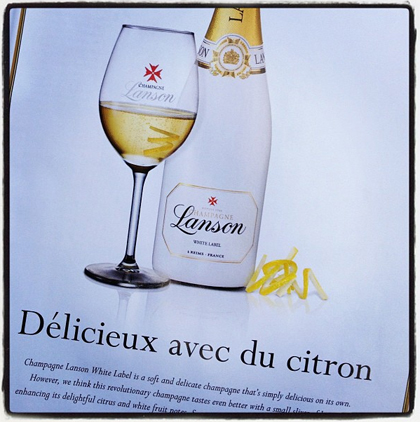
Forget the debates over terroir, dosage and disgorgement dates–Champagne Lanson is advertising their “white label” Champagne as going great with lemon. (photo thanks to David Lebovitz.)

Well, at least they don’t put the lemon in the drink for you: Courvoisier took the inconvenience out of mixing cognac and Moscato blending 18% abv “Courvoisier Gold” (I’ll take a pass on that Courvoisier, thanks).

Oh, and if you do want to talk about dosage, the “White Label” has 32g of residual sugar. Might want more than a lemon peel to cut that sweetness…

St. Emilion’s ho hum classification

The new, vintage 2012, St. Emilion classification was handed down from Paris last week. About the most unusual thing about it is that INAO actually put the materials on their website (Hooray! Even thought they show an unhealthy taste for pdfs and the media contacts still don’t have email addresses listed.)

There hasn’t been any controversy (though some did wonder what happened to Chateau Magdelaine, which Moueix merged into Bélair-Monange). The last update, in 2006, resulted in legal challenges and a court rendering the whole reordering invalid. Lat week, Chateaus Pavie and Angelus were promoted to the top, top tier, while some other modern-style wines also ascended. (Full list after the jump.) The new classification largely follows the market prices and Parker scores for the wines.

If the authorities wanted to do something bold, they could have promoted the excellent Chateau Figeac. It would have been a posthumous honor for Thierry Manoncourt who apparently always wanted to see the estate as a Premier Grand Cru Classé (A). Also, Parker has had a burr under his saddle about Figeac, giving only two of their wines scores over 90 points and going years without reviewing the wines, which are almost always under 13.5% alcohol. And forget quality, the last time around, Figeac was not promoted to the top, top tier because their prices were not high enough!)

Or the INAO could have classified vineyards instead of simply the chateaus themselves but that would be crazy talk! (On related note, Valandraud, which was promoted to the second tier, has expanded its modest vineyard holdings by a factor of 20 over the years.)

By rewarding many wineries that already receive high Parker scores and/or high prices, the classification is of little, stand-alone use to consumers and gives some producers the opportunity to raise prices further.

Related: “How Angelus became James Bond’s choice
Read more…

American Trousseau back on the table

Eric Asimov writes his column today (though it was posted online last week) about the tiny amount of Trousseau production in California focusing on Arnot-Roberts and a few others. I tried the wine last summer when I visited the winery and tweeted about it. Bryan Garcia raised the question of price, wondering if it was worth it when it cost more than the wines of the “Jura masters.”

A post here from last year generated interesting discussion around the question of relative value and whether if you’re a Trousseau lover, you feel obliged to support domestic efforts. Sam Herron commented then, “no I do not think I have any obligation to buy domestic wines, well priced or not…I wanted to jump on the Arnot-Roberts bandwagon after your posts because they excited me, but their prices are just too much.” Bob said, “I agree wholeheartedly with Sam. That being said, today I bought a Dolcetto from Bonny Doon for $20. I don’t even pay that much for an Italian Dolcetto.”

Uff the fluff opined: “For American wines one has to simply ignore QPR – sad, but true.” Evan Dawson said “No obligation. As a consumer, though, you’re limiting yourself if you don’t acquire a strong knowledge of what is available locally.”

Since Asimov didn’t address the question of value or who is buying it beyond a handful of winemakers, consider this a corollary and a chance to join the discussion from last year. What do you think–who’s buying domestic Trousseau? Would (relative) price drive your decision to do so, or your desire to support something domestic that’s different?

Politicians crush it, overseas

The former Soviet republic of Georgia has found an unusual labor source at harvest time: Former candidates for President and Vice President of the USA.
John McCain and Joe Lieberman picked grapes at the vineyard of the Georgian president and then crushed them underfoot. Mmm.

Which election year will we see current candidates for high office posing for the cameras and doing harvest work in the US? It will take a while for the perception of wine as some effete drink to wear off before it transforms into something that the coveted everyman voter likes to drink. I’ll go with 2032.

(Note: photo of McCain and Lieberman in action not available.)

Campaign booze paraphernalia

Forget soccer dads and hockey moms: there’s an even larger demographic that politicians can target. Drinkers! Gallup’s most recent poll pegged 66% of Americans as having some form of tipple.

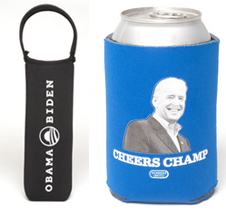
A couple of weeks ago in Iowa, Obama bought a round of Bud Light at the Iowa state fair, setting off chants of “Four more beers!” Then he gave out a bottle of homebrew from the White House and later revealed the recipe. Now, his campaign store is selling a campaign BYO wine bag and a beer soda cozy with Biden’s smiling visage on it.

Mitt Romney, a Mormon, does not drink alcohol (though Paul Ryan may like off-vintage Burgundy). Nor does the Romney campaign store have any alcohol-related paraphernalia. Beer and wine as a wedge issue? The issue may not be insurmountable for Romney–recall another teetotaler who managed to win “the guy you most want to have a beer with” in the 2004 election.

Box wine disguised as a handbag

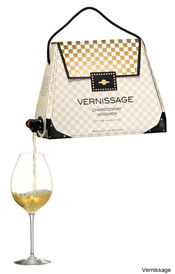
You may think you’ve seen it all, but get a load of this: box wine in the shape of a lady’s handbag.

While they innovators may be on the right track, their genteel Upper East Side/16e arrondissement styling is probably the wrong statement for those who want to haul 1.5 liters of Chardonnay/Vinognier around.

Probably better to collaborate with Camelback!

Will Q design a man’s briefcase version for 007?

No More Shame: Boxed Wine Now Comes In A High-End Fashion Purse [NPR Salt blog]

Sharing a birth year wine, 1983 edition

I always enjoy drinking a birth year wine, particularly if it is a wine from my birth year. But even if it is someone else’s and you are in their company, then the glass is full of not only a mature wine (that’s hopefully still good or great), but also a time capsule, rife with symbolism and memories.

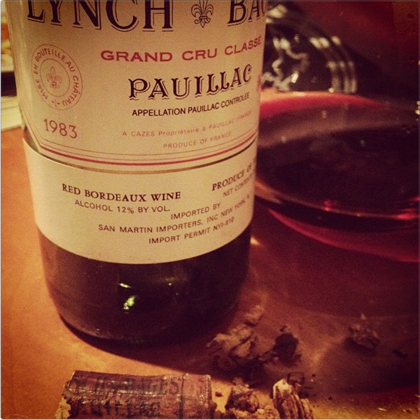
My brother stopped by our house for the first time since winning an around-the-world sailing race earlier this year. I had scored a bottle of 1983 Lynch Bages in anticipation of toasting his tremendous accomplishment at our next get together. So last weekend, I presented him with it, pulled the crumbly cork and decanted it. He was traveling with his girlfriend and we all savored the wine, which had really complex and enticing aromatics of tobacco leaves, a surprisingly spry and delicious midpalate, and a finish that tapered a tad too quickly. On the whole, the wine was in very good condition and, after polishing it off, my brother said he wanted to take the bottle home with him (he lives in France). Maybe he will put it on the shelf next to his race trophy?

Giving birth year wines as gifts for important achievements and milestones goes over really well. I haven’t done it a lot but I am going to try to give them more more since they can make for a really memorable gift. And with a bit of searching, it’s not too hard to find them. I got this one from a friend who had cellared it since release. But a few years ago, I wrote a story for Food & Wine on finding birth year wines and it can definitely be worth the effort–especially if you can pull the (crumbly) cork and share it together.

Sobering: wine shipping map

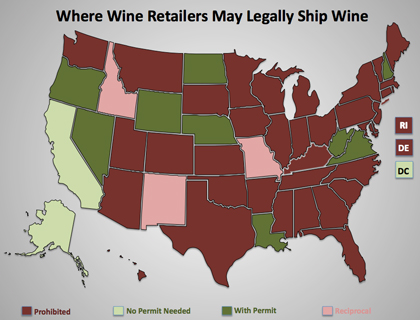
In the comments of our recent discussion of the rosé drought that was gripping the Hamptons, a commenter said that the easy answer was to have the wine shipped in (via Gulfstream jet, natch). But, seriously, couldn’t they order wine from an out-of-state retailer and have it sent via UPS?

Well, they could but it wouldn’t be legal. According to a rather sobering map from the Specialty Wine Retailers’ Association, New York is one of 39 states where it is illegal to have wine sent from an out-of-state retailer. A 2005 decision from the Supreme Court rolled back many barriers to shipping wine from wineries to consumers, as states had to strike down laws that discriminated against out-of-state wineries while allowing in-state wineries to ship and about three dozen of them have now leveled the playing field. It’s a no-brainer to me that this should apply to wine shops as well; however, I am not Chief Justice and it’s still an open legal question whether the 2005 decision applies to retailers. Free shipping from wines stores is much more important to the average wine consumer since it would lead to consumers being able to find the best price or provenance anywhere for a range of wines, including those under $20; winery-direct shipping tends to focus on wines north of $20.

Some states, like New York, have porous borders–no eight-foot fence to keep those wine shipments out. Others, such as Massachusetts and Pennsylvania, have found ways to keep wine shipments out or at least down by working with the main carriers, UPS and FedEx. (A New York retailer once told be that shipments to Massachusetts’ islands were often sent back because of the local shops tipped off UPS drivers to report any incoming packages about yay big weighing 40 lbs.) Whether there’s little enforcement or not, wine lovers across the country would be better served with free, legal trade. Sadly, with no consumer movement and the judicial efforts of the Specialty Wine Retailers stymied, there seems little to break the impasse.


winepoliticsamz

Wine Maps


Monthly Archives

Categories


Blog posts via email

@drvino on Instagram

@drvino on Twitter


winesearcher

quotes

One of the “fresh voices taking wine journalism in new and important directions.” -World of Fine Wine

“His reporting over the past six months has had seismic consequences, which is a hell of an accomplishment for a blog.” -Forbes.com

"News of such activities, reported last month on a wine blog called Dr. Vino, have captivated wine enthusiasts and triggered a fierce online debate…" The Wall Street Journal

"...well-written, well-researched, calm and, dare we use the word, sober." -Dorothy Gaiter & John Brecher, WSJ

jbf07James Beard Foundation awards

Saveur, best drinks blog, finalist 2012.

Winner, Best Wine Blog

One of the "seven best wine blogs." Food & Wine,

One of the three best wine blogs, Fast Company

See more media...

ayow150buy

Wine books on Amazon: