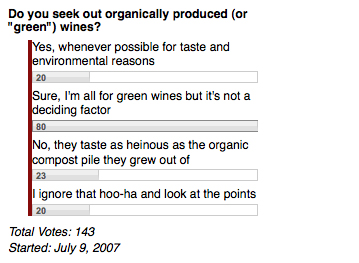
Poll: do you buy organic wines?

In my post-LiveEarth stupor, I decided to click an ad on a web site for The Green, a new TV program about environmental issues.

They have five “eco ideas for greener living.” Since the show is sponsored by Lexus, I found tip three amusing: “When choosing a chauffeur or a taxi service, consider a luxury car service that relies on a fleet of hybrids.” Uh, huh.

But tip number five was interesting in it’s claim: “Try an organic wine with dinner. These wines come from farms that practice eco-friendly techniques and produce superior results.”

Aside from the fact that it is difficult to legally call a wine organic (because of the addition of sulfites), what are “superior results”?

Have your say about “green” wine!*

democracy14
poll now closed

The Green, Sundance Channel.
* “Green” wine is my catch-all term for the various shades of green: sustainable, organic, and biodynamic wines.

After a seventy year hiatus, reintroducing a “Cuvee hermitagee”

What do you call a Bordeaux merlot blended with some syrah? Alexandre Sirech calls it a cuvée hermitagée. The French authorities also call it a vin de table.
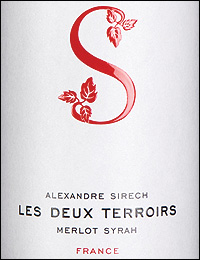
Sirech says that in the 17th and 18th centuries, some of the top wines of Bordeaux had some syrah from Hermitage in the Rhone added to them. With the rise of the appellation system in the early 20th century, this practice became forbidden if the wine was to be labeled with any of the Bordeaux appellations since 100 percent of the wine must come from the appellation.

He’s launching a new wine called “Les Deux Terroirs” that revives this tradition. (Chateau Palmer in Margaux has also experimented with the idea.) Since it is outside the appellation system it is thus labeled as a vin de table, theoretically the lowest rung on the French system. That means the wine cannot state on the label the place where it comes from (other than France) or the vintage.

Sirech, 40, has been in the wine and spirits business for almost 20 years. He’s had two long stints at Pernod Ricard interrupted by starting his own online wine retailer, ChateauNet, which he sold in 1999. Most recently he ran Havana Club rum for Pernod Ricard out of Havana.

I asked him via email how he saw a need for the wine through the marketplace or the terroir(s). Here’s his reply:

Quite frankly I had been thinking for a long time that the AOC decrees were too limiting. The AOC system has plenty of advantages but one big inconvenience: it prevents innovation. We need the AOCs but I think we also need a modern/free/hedonistic wine like “Les Deux Terroirs”.

Also, I had been selling a lot of Jacob’s Creek for Pernod Ricard in the UK and I had seen the merit of blending Syrah with Merlot or Cabernet, something that was unthinkable in France at that time (early nineties). When I had the idea back in Cuba, I did not know about the cuvées hermitagées. It is only when I started working on a formulation with the Rolland team in Catusseau that I found out about the whole story and I must say it confirmed my intention. I remember thinking that if they were doing this in the 17th, 18th and 19th century at a time when getting Syrah from Hermitage was surely a logistic nightmare, it had to be good for the blend!

Sirech is the buyer and blender of the wine and is advised by Jean-Philippe Fort of Michel Rolland’s winemaking team.

I haven’t tried the 80-20 merlot-syrah blend yet but it will be available in New York, Florida, and Illinois soon (search for this wine). Sirech wrote me that he bypasses the Bordeaux negociant system and maintains Southern Wine & Spirits as both importer and distributor to deliver greater value to the consumer. The wine will retail for $20 and is sold in wood case six packs.

More on French innovation:
Is Chamarré still trop francais?
Yellow jersey, Beaujolais in tin – new products from Boisset

Who’s threatening us now: BlingH20!!

bling.jpg
Keen readers of this site know my antipathy–nay hostility–for bottled water. I gave up the easily substitutable beverage for thirty days to offset my wine carbon footprint, allowing me to enjoy wine from all corners of the earth with a clearer conscience.

Now we wine drinkers can focus our animosity at BlingH2O. This new product apes wine by calling itself the “Cristal” of bottled water, is sold in glass bottles with wine-like sizing, a cork, and for a wine-like price of $20 a pop–and a 375ml pop at that! (The water is “bottled at the source in Dandridge, Tennessee.”)

BlingH2o, you and your Swarovski crystal-encrusted, frosted glass bottle, you’re on notice!!!

onnotice5.jpg

Related: blingh2o.com
More “On notice

Wine: you CAN take it with you when you go!

How much wine can you bring back from your foreign travels? More than I thought, it turns out.

I just got back from a great couple of weeks in France, first at Vinexpo, and then with my family. Of course, we found lots of great wines to drink while we were there and even bought too much, and were forced to bring some back.

But I was apparently mistaken about the limit on just how much we could bring back–I thought we were allowed only one liter each, so we were forced to drink almost all the wines we got while we were there. I’ve written up one already — more notes forthcoming.

It turns out that all that guzzling might have been avoided if I had studied up on the US rules first. Customs and Border Protection limits you to one liter of alcohol free of tax. But beyond the one liter, the useful “Know before you go” Customs pamphlet elaborates that “Federal regulations allow you to bring back more than one liter of alcoholic beverage for personal use, but, as with extra tobacco, you will have to pay duty and Internal Revenue Service tax.”

While they don’t mention the IRS tax rate, anyone care to guess what the Customs duty is? Three percent! That’s it!

Despite the inconvenience of traveling with wine, us wine geeks can revel in bringing back wines that are not commercially imported to the US or are much less expensive overseas! Consider these examples: Read more…

EU reforms, Lavaux preserved, perfection discovered, wine as Listerine — tasting sized pours

Uprooted
The Financial Times has extended coverage today of the controversial plans that Mariann Fischer-Boel, EU Agriculture Commissioner, has for the reforming the wine sector. The policy still must approved by the member states but if enacted as early as next year, it would lead to the uprooting of 500,000 acres of low-end vines as one measure to reduce the structural wine surplus. The whole policy would, in the words of the Commissioner, put European wines “back…on top of the world” (um, has she note been to Burgundy, Champagne, Bordeaux, or Piedmont to name a few regions that would be on the top of anyone’s list?) France, Italy, Spain and Portugal may oppose the plans. [Financial Times 1 and 2; Bloomberg]

Protected
On the northern shores of Lake Geneva some vines won’t be threatened by either development or the new EU plans, and that’s not just because Switzerland is not a member of the EU: the Lavaux wine region has just been designated proclaimed part of our world heritage by UNESCO. [Swissinfo]

Contextualized
Eric Asimov discovers the perfect food-wine pairing: a juice glass of aglianico with a pizza margherita at Una Pizza Nepoletana in the East Village. Three cheers for evaluating wine in context! [The Pour]

Gargled
Feel a strep throat coming on? Got some wine handy. Gargle. That could be the advice of some Italian researchers who say that wine “could be used to cure a sore throat.” [Telegraph.co.uk]

From reader comments:
JW sez re: Chamarre: “Where will it be in 12 months time – my view is that it will be the victim of the 3 R’s of marketing – redesign, relaunch and resign!”
Jay Miller sez: “Forgetting “emotion” for the moment, if Bob (or any other critic) rates a wine 95 (or 100) one day, will it get the same, or nearly the same score a week or a month later(under blind tasting conditions).”

Related: “To reform or not to reform…

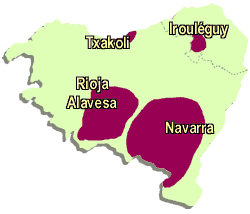
Arretxea, Hegoxuri, Irouléguy: unpronounceable words you should know

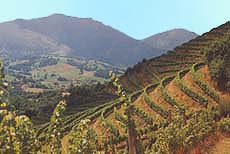
In the bit of the Basque Country that lies on the French side of the Pyrenees is the small appellation of Irouléguy. Don’t worry: I’d never heard of the steeply sloped vineyard area either.

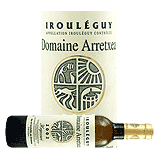
I was in the excellent little shop, La Derniere Goutte in the 6th arrondissement of Paris last week. I told Juan Sanchez, the American owner who seems to know everyone who comes into the shop, that I was looking for an interesting dry white and he pointed me to the Arretxea Hegoxuri from Irouléguy. It’s a blend of 50% petit manseng, 40% gros manseg, 10% corbu–and yes those are all grapes. It’s partially barrel fermented.

With wildly aromatic notes of tropical fruits–pineapple, melon–the dry wine has a wonderfully balanced acidity and mountain mineral verve on the palate. It’s no doubt makes it the best petit manseng you’ve ever had. And the vignerons, Therese et Michel Riouspeyrous, farm biodynamically.

But the story does not end there. Bottled as a humble vin de table yet sells for 20 euros, the wine was meant to be an appellation wine. According to the back label, the natural fermentation was slow in 2005 and when it came time to give a sample to the mandatory taste-test component of the residual sugar level was 0.2 grams above the appellation limit. So rather than mess with the wine, the Riouspeyrouses decided to bottle it as a vin de table. That explains why there’s no vintage or region on the wine. And why Juan Sanchez rolled his eyes about how the appellation system doesn’t always help natural wines.

Someone must import the wine to the US since it is available at Smith & Vine in Brooklyn for $28 (find this wine). The price is a little high–if it were $15 wine it would be a screaming buy–but with the dollar tanking, it’s not likely to get any cheaper, sadly.

Congratulations to Steve who correctly guessed this difficult, mystery vineyard location–we’d expect nothing less from the founder of the Wine Century Club!

Mrs. Vino cranks out number three

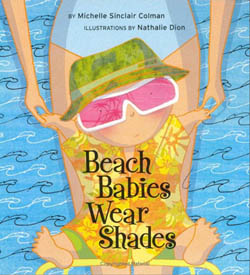
Now that summer is fully upon us, it’s time to think about the beach. And, of course, books. So why not Beach Babies Wear Shades?

At 16 pages and less than 100 words, it’s far too young for you, discerning wine reader. But perhaps you know someone under the age of two who might like the third installment in Mrs. Vino’s series of board books?

More on wine books for grown-ups after the holiday. Happy Fourth!

Related: Urban Babies Wear Black

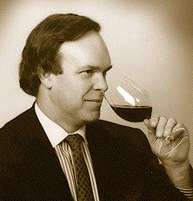
Robert Parker admits to “the emotion of the moment,” threatening the basis of wine scores!

OK, people, did you really think that numerical wine ratings were objective? This gem has just been transmitted to the Dr. Vino Mobile World Headquarters, from Robert Parker’s interview earlier this year with the Naples (FL) Daily News:

For most people, I think, giving 100 points is almost setting up a situation for the people who are reading it … to be disappointed because you have somebody who’s well-known and has credibility saying it’s perfection in wine. And there’s always the issue: Is there perfection in wine?

I’ve always tried to explain it saying that, you know, I’m a very passionate person and an emotional person. I really think probably the only difference between a 96-, 97-, 98-, 99-, and 100-point wine is really the emotion of the moment. (emphasis added)

He admits elsewhere to being a supertaster, but here he says he’s no cyborg! There you go: relativism in ratings! That’s what I just mentioned in the comments section to Jay Miller, a critic at the Wine Advocate. Join the fray with your comments! Or see Jay Miller’s comments on the science of olfactory analysis.


winepoliticsamz

Wine Maps


Monthly Archives

Categories


Blog posts via email

@drvino on Instagram

@drvino on Twitter


winesearcher

quotes

One of the “fresh voices taking wine journalism in new and important directions.” -World of Fine Wine

“His reporting over the past six months has had seismic consequences, which is a hell of an accomplishment for a blog.” -Forbes.com

"News of such activities, reported last month on a wine blog called Dr. Vino, have captivated wine enthusiasts and triggered a fierce online debate…" The Wall Street Journal

"...well-written, well-researched, calm and, dare we use the word, sober." -Dorothy Gaiter & John Brecher, WSJ

jbf07James Beard Foundation awards

Saveur, best drinks blog, finalist 2012.

Winner, Best Wine Blog

One of the "seven best wine blogs." Food & Wine,

One of the three best wine blogs, Fast Company

See more media...

ayow150buy

Wine books on Amazon: