Should a bigger better bottle bill include wine bottle deposits?
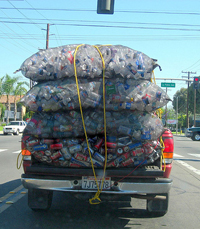 Have you ever tried to return beer bottles for a deposit in New York State? I have and it ain’t pretty. The last time I did it, I brought 12 bottles in to the supermarket and left after much grinding and crashing in the machine with six bottles and a receipt for a 20 cent credit. Woohoo! It made me want to drive to Michigan for their ten cent deposit a la Seinfeld!
Bottle or container deposits are a hot topic now. Eleven states require some sort of deposit, mostly on beer and carbonated soft drinks. But former New York Governor Spitzer and now Governor Paterson have now proposed a “bigger better bottle bill,” which would expand the five cent deposit system to single serving sport drinks and water. The goal of this policy proposal is to increase recycling–as well as revenues to the state.
I was not surprised to learn after my experience that there’s a lot of deposit money that is not collected. In fact, it was $100 million last year. But I was astounded to learn that that uncollected deposit money goes to distributors of beer and soda, not the state. Shocking! In the new legislation, these funds would go specifically to New York’s Environmental Protection Fund.
It’s funny that wine bottles have not been included in a bottle bill in New York. They aren’t included in Oregon either, which enacted the first container deposit laws in 1971. But reforms are afoot in Oregon, where many single-serve, noncarbonated beverages now have a deposit as of January 1 of this year. Further, a task force has just recommended adding all beverages except for milk by 2013. HB 2184 proposes changes to the bottle bill based on these recommendations and is scheduled for a hearing on Thursday.
What do you think: should wine bottles also have a deposit? As the program currently stands in New York, I don’t think so. Five cents might have been enough when the program was first enacted but now it would just be another tax, not an incentive to return any bottles. And the redemption process for beer is not very effective since not every store accepts bottles from every brand. Further, wine is mostly consumed at home or restaurants/bars, which tends to lead to high levels of recycling. Unless we all start drinking wine in the park, that is.
 In 2005, the EU and US reached a bilateral accord to end a round of negotiations that had lasted twenty years. One of the significant parts of the agreement was that American wines could no longer use place names such as Champagne, Chianti, or Port on new wine labels (for the complete list, see the
  Sales of three-liter box wine are
  Reading about wine may be fun but there’s a lot to be said for tasting it. Many wine stores offer tastings, which are always free in New York and may be the best priced tastings for our times. But if you can rub two shekels together, there are some other paid events that offer some good opportunities in the near future.
 Last Friday, there was a sleepy little site called
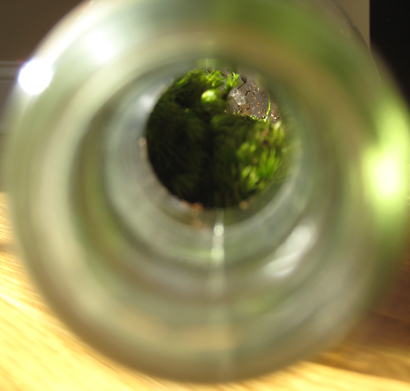
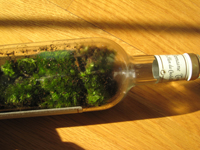 So I did my best to replicate her art using my own medium: wine. My five-year-old son and I went into the woods last fall and collected two kinds of moss. He made his own terrarium in a glass cookie jar; I made mine in a bottle of Domaine Tempier rose 2007, my favorite rose from last summer. Unlike most wine bottles, rose bottles are clear to show off the eye-popping color of the wine. This also makes them better terrariums!
 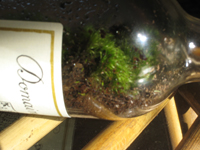 I first added dirt to the bottle. Then I ripped off chunks of moss, compressed them and shoved them through the wine bottle’s neck with a chop stick leftover from a previous takeout. A few pokes and prods later, I had them all lined up. The only problem was a bit of schmutz and condensation on the upper part of the glass; I’ll have to drop by Paula’s studio and ask for tips on terrarium schmutz removal. But now at least all the moss pieces have actually grown together to form a rich green carpet. And there you have it: mossage in a bottle.