Slate.com investigates the high-end wine market

It is rare to see long-form journalism on the web. It’s even harder to find superb investigative journalism in wine writing. Thus the department of fine and rare wine writing just got a path-breaking new entry: “What’s in the Bottle?” published on Slate.com.

In it, Mike Steinberger explores the rarefied and occasionally louche world of supremely expensive wines that the book The Billionaire’s Vinegar made widely known. The cast of characters includes Hardy Rodenstock and billionaire Bill Koch as before, but expands to include a prominent merchant, auctioneers, collectors, and the critical role of Robert M. Parker, Jr.

Consider the piece a must-read. Uncorking a magnum of 1921 Petrus while reading is optional, however.

Nuclear wine, tasting games, “celebrities” – sipped and spit

SPIT: going nuclear
Tired of sharing a name with a problematic nuclear facility, a French wine region opts for a new one that anglophones can’t pronounce. [The Independent]

SPIT: damned wine saloons
Some UWS residents fear a proposed (and, now, approved) wine bar at 25 Central Park West will bring “hookers,” “drugs,” “drunks” and “celebrities” to their neighborhood. The wine bar would have portraits of Ethel Merman and other famous erstwhile residents of the building. Check out their website–crack den, yes or no? [1010wins.com]

SIPPED: olde tyme bling
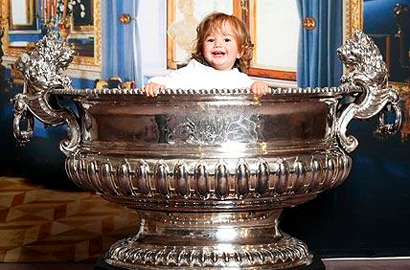
Today, we have plastic and Styrofoam for our wine cooler needs. Behold the above had bling bucket from the 18th century! Residents of 25 Central Park West–and beyond–can pick it up for an estimated £2 million at auction. [Telegraph; source of resized image]

SIPPED: a challenge
Blind wine tastings at this Paris shop involve some guessing. Would be fun to see in the States–especially for a prize! [Spring boutique]

VERBATIM
“”I am worried about pensions. I am worried about the debt of our countries. We will have less money. But we will always have the time to make love and drink champagne, and we will do it even more.” –Pierre-Emmanuel Taittinger [Reuters]

Three cheers for the judiciary!

Have you ever met someone and talked with her about a topic, only to find out that–unknown to you–she is a key player in that very topic ? That happened to me about a week ago.

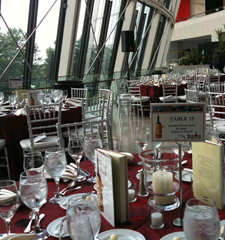
I gave the keynote talk to 250 attendees at the annual dinner of the Boston Patent Lawyers Association. The organizers wanted to tie it into my book, Wine Politics: How Governments, Environmentalists, Mobsters and Critics Influence the Wines We Drink. So for dinner I selected wines that tied in with the first three items in the subtitle and then used those wines to tell stories about the material in the book. (They were the William Fevre, Montmains, Premier Cru Chablis 2007; Domaine Huet, Le Mont, Vouvray (sec) 2007; and Ridge Geyserville 2007.) In the talking about the politics of American wine, I discussed many of the legal tussles, particularly around the issue of direct shipping.

It turns out that the patent lawyers were honoring Judge Rya Zobel of the U.S. District Court that evening. Born in 1931 in Germany, Judge Zobel was vibrant and lively and delivered funny remarks from the podium. Only at the dinner table did I learn that it was Judge Zobel who decided the case Family Winemakers of California v. Jenkins. In that case, she ruled that a Massachusetts law that essentially prohibited “large” wineries (over 30,000 gallons production) from selling directly to consumers was unconstitutional since it effectively barred 98% of out-of-state wine while allowing 100% of in-state wine from being sold directly. In January, that decision was upheld on appeal at the Circuit court; the decision will not be appealed to the Supreme Court.

I opened my remarks by raising my glass on behalf of wine lovers to Judge Zobel!

“Quickly emptied:” Rating wine on a drinkability scale

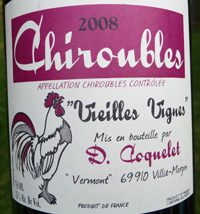
After surveying several dozen choices last night in my basement last night–too cool an evening for a rosé, never enough Pinot around–I settled on the 2008 D. Coquelet, “vieilles vignes” from the often-overlooked appellation of Chiroubles. Still in his twenties, Damien Coquelet is both the stepson of Georges Descombes, the Morgon vigneron, and a rising star of Beaujolais.

I chose the wine because I wanted a good wine with dinner. I did harbor a hope that my wife and I could enjoy it over two nights, thus extending what I hoped would be a good bottle. But something happened: it was so delicious, we drank it all!

Somehow, the best bottles always seem to disappear quickly. Put out a bunch of wines, invite friends over for dinner, and (all things being equal) the bottle most quickly emptied is likely the best that evening.

That made me wonder if this might be the best way for wine drinkers to rate wines, where the highest praise is a rating of “quickly emptied.” The rest of the scale might look like this: empty, half-empty, sipped…and spit.

Sure, it’s kind of goofy, not very precise and has some obvious flaws, such as discounting future improvements of the wine. It’s very here and now and unabashedly so. But it is a great tonic to what ails the point system, which aims for precision and objectivity but often lands wide of the mark. In his memoir, A Life Uncorked, Hugh Johnson wrote, “The weakness of [the 100-point system] is that it is based on tasting, rather than drinking.” Indeed.

A rating system for wine drinkers instead of merely wine tasters reshuffles the deck: suddenly, being an utterly drinkable Riesling or Beaujolais becomes a trump card, rather than the hindrance it can be in a blind tasting lineup. Moreover, it limits the number of wines that can reasonably be reviewed to a hundred or more a year–really, how many people need thousands of wine recommendations? Also, it brings context in to the evaluation: the food, the seasonal appropriateness, where the wine is in its evolution, if you’re drinking it on a vacation. With the wine drinker’s ratings, the best wines become memories in a scrapbook, rather than trophies traded at auction in Hong Kong.

Anyway, it’s not perfect. But it’s worth discussing. And maybe even worth raising a glass to!

Scenes from the Wine Media Guild 2010 dinner

“Numerical scoring has replaced the drama, joy, pathos and excitement of wine,” said Dan Berger last night at the Four Seasons in New York City. Berger was one of four inductees into the Wine Writers’ Hall of Fame of the Wine Media Guild, a 35 year-old organization. This was the third class of inductees, which included Michael Broadbent, Karen MacNeil, and Andre Simon (posthumously for Simon; see bios here). Over 100 attendees brought wines from their cellars to share and pair with the bison, duck and rabbit on the menu.

Berger, once a math major who has written for a lengthy list of publications over several decades, delivered prepared remarks lamenting the rise of scores and the decline of prose in wine evaluations.
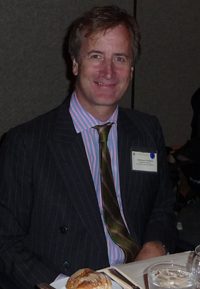
Bartholomew Broadbent (right) accepted the award for his father. He delivered some funny remarks about how his father had stopped drinking, except for putting champagne in his orange juice at breakfast, having a Madeira in lieu of coffee at 11 AM, drinking red and white wine with lunch (which didn’t count because it was with food), then having Madeira again instead of tea in the afternoon, more wines with dinner that, again, didn’t count, followed by some port. But because his doctor had told him to have a drink a day, he had some cordial before going to bed.

Broadbent praised the festive nature of the dinner while wistfully remembering the bygone dinners of Lloyd Flatt and others. He said that such dinners of fine and rare wines “don’t really happen any more because nobody thinks they are real.”

Ed McCarthy, a WMG member and previous inductee, reminded the crowd of the adage that nobody should die with a full cellar. Then he said that Andre Simon died with only two bottles of wine, very successful indeed. Peter Sichel, also a previous inductee, said that when Simon, the author of 104 books, hit 90 years old, a message went out to his friends alerting them to the fact that Simon had depleted his cellar and requested bottles to be sent.

The WMG also awarded three scholarships to students studying food and wine service at New York City College of Technology.

The wines flowed freely. Some bottles were off while others were on. I had ’71 Haut Brion that was drinking beautifully with the ethereal delicacy of mature cabernet. A Chateau Branaire ’75 from magnum was also in excellent shape. A ’97 Turley Old Vines was devoid of acidity, had residual sweetness and angular alcohol. I finished the evening with a glass of ’49 white port from Australia that was a ringer for Madeira. Other wines seen in the room ’66 Lynch Bages, ’74 Spanna, ’38 Niepoort, ’00 Hermitage, ’71 Beerenauslese, ’79 Ridge Lytton Springs and dozens more. More photos after the jump. Read more…

Daring Pairings by Evan Goldstein

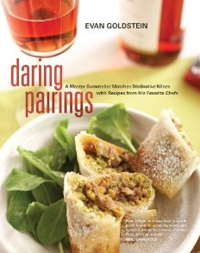
On this site, we love exotic food-wine pairings. And we often talk about grapes beyond the “big six.” So it should come as no surprise that I am a fan of Evan Goldstein’s new book, Daring Pairings. (In fact, I provided a blurb for the back cover.)

The highly skimmable book starts off with a worthwhile discussion of pairing food and wine. The goal, says Goldstein, a former sommelier, is to turn food-wine pairing from a lengthy, possibly agonizing process to simply picking a wine that will work and then sitting back and enjoying the pairing. The various charts and cheat sheets provide quick help toward this laudable goal. Further, he lays out five important elements of wine (acidity, sweetness, tannin, oak, and alcohol) and elaborates who they will work best with certain foods (salty foods are best with either high acid wines or slightly sweet wines but bomb with high alcohol wines). He also suggests how to tweak recipes to make them more wine friendly (e.g. varying cooking methods or replacing vinegar with verjus–juice from unripe grapes). Any given meal, he writes, will either highlight the food or the wine, which may seem somewhat controversial, but actually could be a great excuse for hosts who are wine enthusiasts to provide simple food.

Goldstein admits that most people start with food and then add a wine pairing. That said, the bulk of the book’s 364 pages discusses 36 grapes, their taste profiles, various winemaker interpretations of the grapes, and which pairings work and which will fail miserably. A recipe from a chef, often well-known, such as Charlie Trotter or Fergus Henderson, also follows each grape and if you have a lot of time and ambition, you can make the recipe that won’t overshadow the wine you’re probably trying to highlight. The mouthwatering photography certainly stokes ambition.

The grapes are probably not all that “daring” to many readers of this site. But I just led a tasting over the weekend that included Gruner Veltliner, Albarino, and Aglianico among others, and, astonishingly, there were people who had never tried these varieties! The book certainly can help casual drinkers who are reaching for a new wine by offering a range of food pairing tips. I like wine recommendations in context; in my own pairings book, I suggested adding seasonality to further round out the picture.

Daring Pairings provides a lot to chew on. Maybe Goldstein’s next book will crank up the degree of difficulty even further–“impossible pairings” anyone?

Herring Pairing: New Catch Holland Herring and wine?


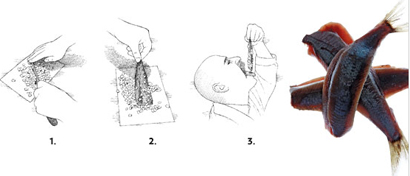
One cool June afternoon, standing by a harbor in Holland, I tilted my head back and lowered a fish covered in raw onions into my mouth. Frankly, I couldn’t stand it.

Granted, I was in college backpacking through Europe at the time and I admit that having scarfed down platters of sushi in the interim, the herring now sounds intriguing. Now is the time to find out if it is: New Catch Holland Herring, a short-lived seasonal treat, arrives in NYC June 9th. The epicenter of these fresh, briefly cured fishes seems to be Russ & Daughters (but they are available at other restaurants throughout the city). Joshua Russ Tupper recommends the traditional method of enjoying the herrings: dredging the fillets in freshly chopped onion, holding them by the tail and devouring without utensils.

Mixologists in the city are suggesting spirits pairings for this delicacy. But certainly wine should be on the table (assuming it’s not eaten while standing up). Help the Dutch and those around the world able to try the herrings: Which would you choose? Or is it…impossible?!?

The image here is a reduced size image from a NY mag post on the topic.

Do you want alcohol levels in reviews? [poll] & a comment from Joly

Last week’s New York Times reviewed some wines from Savennières, the Loire appellation that makes often-stunning, always dry versions of chenin blanc. The article noted the alcohol levels from the label of each wine alongside the newspaper’s ratings, comments and prices.

Would you like to see more reviewers noting alcohol levels? Although what’s written on the label is what we have to go on as consumers, it’s not always accurate given that federal regulations allow one to one-and-a-half percent wiggle room from what’s stated on the label. Have your say in the latest poll!

Also, just how did the NYT panel’s favorite wine, Nicolas Joly’s Les Clos Sacrés from the damp 2007 vintage, reach 15 percent alcohol? This is the Loire, not Lodi, after all. For perspective, I asked Nicolas Joly for a comment, which follows after the poll.

[poll id=”15″]
Read more…


winepoliticsamz

Wine Maps


Monthly Archives

Categories


Blog posts via email

@drvino on Instagram

@drvino on Twitter


winesearcher

quotes

One of the “fresh voices taking wine journalism in new and important directions.” -World of Fine Wine

“His reporting over the past six months has had seismic consequences, which is a hell of an accomplishment for a blog.” -Forbes.com

"News of such activities, reported last month on a wine blog called Dr. Vino, have captivated wine enthusiasts and triggered a fierce online debate…" The Wall Street Journal

"...well-written, well-researched, calm and, dare we use the word, sober." -Dorothy Gaiter & John Brecher, WSJ

jbf07James Beard Foundation awards

Saveur, best drinks blog, finalist 2012.

Winner, Best Wine Blog

One of the "seven best wine blogs." Food & Wine,

One of the three best wine blogs, Fast Company

See more media...

ayow150buy

Wine books on Amazon: