Dr Vino's wine blog
wine talk that goes down easy
Wine-place pairings: poolside
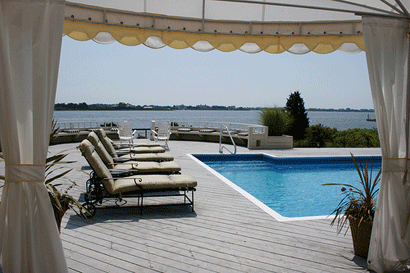
Those food-wine pairings get all the glory. But sometimes pairing wine and place is just as important. So if you were poolside in the Hamptons in the picture above, which wine would you pour?
If I were there, I’d pop open some Moscato d’Asti. With aromas of peach, a gentle fizz, sweetness balanced by acidity, I think it’s the ultimate wine for poolside. I’ve had one from Elio Perrone before that would fit the bill nicely (find this wine).
Jul
17
2008
11
Sipped and spit – all French edition
 SIPPED: Wine nationalism!
At the recent G8 Summit in the remote Hokkaido, wines from various of the countries (sorry, Russia and U.K.) were poured at the festivities, including: “Le Reve grand cru/La Seule Gloire champagne”; the Isojiman Junmai Daiginjo Nakadori sake; Louis Latour, Corton-Charlemagne 2005; Ridge California Monte Bello 1997 and Tokaji Esszencia 1999″ (Hungary–booyah! A non G8 country slips in.). The juxtaposition of the leaders’ banquets and global food shortages was not lost on The Independent. France won the vinous nationalism stakes with the most wines poured.
SPIT: Adolescent binge drinking!
France will debut it’s first ever anti binge drinking campaign on Friday. According to Decanter, it will run on TV, radio and in in movie theaters and “feature adolescents enjoying a ‘paradise-like universe’, which turns into a nightmare after they drink too much.” Whoa! Send in a clip if you see it.
SIPPED and SPIT: The St. Emilion classification!
Sweeping victory from the jaws of defeat (or, more likely, the other way around), the classification of St. Emilion producers that updates every ten years was thrown out by a judge last week–only to be reinstated on a temporary basis for three years by another authority later in the week. [Decanter]
SIPPED: summer all year!
Rosé surpasses white wine as the most popular in France. [Times.co.uk]
Jul
16
2008
Some wine blogs to check out
 They’re not all new, but here are some wine blogs worth checking out if you haven’t already.
Do Bianchi: The itinerant Jeremy Parzen seems to float between New York and San Diego but his wine home is clearly Italy. He has a PhD in Italian literature and worked for an Italian wine importer for a while in NYC. One posting among many interesting ones is how he came to appreciate new oak barrels (barriques) during a visit to Movia in Slovenia. Btw, the blog is pronounced “doh bee-an-kee,” which apparently means “gimme two cold ones” in Italy.
Grape Wall of China: Jim Boyce blogs from Beijing and does an excellent job showing us life through the lens of the wine glass in that exciting market. He seems to buttonhole every winemaker who comes through Beijing and has many interviews with notable wine personalities and even had a picture of himself with Robert Parker on the great wall! He also did a Q&A with some guy named Dr. Vino recently.
Blog Tablas Creek: Jason Haas is the general manager at Tablas Creek, a winery in California’s Central Coast winery specializing in wines from grape varieties from the Rhone. With good reason: the winery is a joint venture between Chateau Beaucastel’s Perrin family and the Haas family of the importer Vineyard Brands. Jason blogs about grapes, events, planting new vineyards, and also this excellent post about the hidden costs of direct shipping after the 2005 Supreme Court decision–wine politics!
On the Wine Trail in Italy Alfonoso Cevola keeps a quirky wine blog when he’s not tending to his daytime duties as Italian Wine Director at the distributor Glazer’s in Texas. He makes posting images look easy (it’s not, trust me) but he is good with words too, infusing his wine experiences in Texas. Since I’m a fan of off-beat wine pairings, check out which wine goes with searsucker.
Steve Heimoff, West Coast editor at Wine Enthusiast magazine and wine book author has turned his energy on blogging. He’s done a good job stirring the pot and, like us, he’s no fan of Styrofoam!
Wine sooth: Frequent commenter on this blog Arthur Przebinda started a blog just last month–so it has that new blog smell. He focuses on wines of Central Coast on his site but promises musings on other topics on his blog.
The image is a reduced size crop of an image that originally appeared in PC Magazine.
Jul
13
2008
Alcohol: can it be too low?
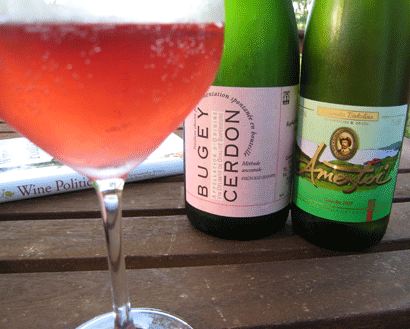
I recently had a Bugey de Cerdon, a sweet, pink fizzy wine from the Savoie region of France. It was $22 for 8 percent alcohol by volume. A few days later I had a lovely Txakoli, a white vaguely sparkling wine that was 10.5 percent abv that was also, coincidentally, $22 a bottle. I also remember having an easy-drinking Moscato d’Asti ($16) with five percent abv recently.
I generally prefer low alcohol wines. If the alcohol is over 14 percent, as happens all too often in this age of global warming, the number of glasses I can reasonably consume with dinner declines sharply. Since I enjoy drinking wine with food that makes me sad.
But drinking low alcohol wines can be expensive. The $16 for 750ml of five percent wine might make some drinkers switch to a microbrew that has more kick and costs less per ounce. There was a day in France when wine was sold from vats at the local market and people brought jugs to fill, paying more for a douze (12% abv) than for an onze (11%). So with many low-alcohol wines not pricing in such a discount today, if you pour only low-alcohol wines at a dinner party, you would wind up working through more bottles, thus raising the wine tab for the evening.
To dismiss low alcohol wines would mean never trying these types of wines, which is always too bad. Some types of wine, such as these three as well as Mosel Riesling, are simply low alcohol wines. I find low alcohol wines to work particularly well with spicy foods and warm weather. So they fill a definite void and do so well.
What do you think: would a low alcohol level stop you from buying a wine?
Jul
10
2008
Who’s threatening us now? Malicious mead!
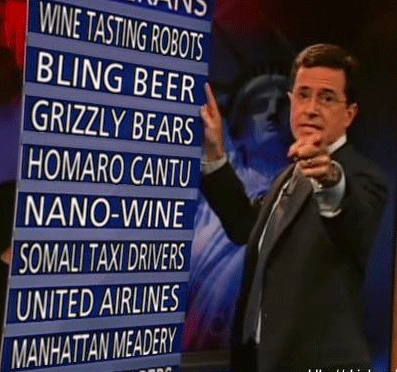 First it was a new winery in Manhattan. Now, word buzzes in about the new Manhattan Meadery, which promises to make “a distinctive honey wine” in NYC (though which borough will receive this honor is unclear since “Brooklyn buzz” is on the ad).
While we were just sitting here sipping our sauvignon, they have brought the fight to us wine geeks, touting their product as “wine,” and packaging it in 750 ml bottles with 13% alcohol. The audacity! And they continue that their measly mead is “a light and crisp dry white that is thoroughly wine-like, but unlike any wine you’ve had before.”
Oh yeah, which vintage is your honey from, Mister Meadery? Can you imagine, the meadery is exploiting the honey bees during their time of Colony Collapse Disorder! Drink real wine instead! There’s a global glut! Manhattan Meadery, you’re on notice!
Jul
9
2008
Ten independent winemakers on Forbes.com – and a Bloomberg story
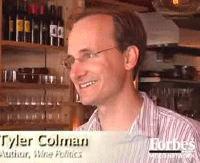 Last week I shot some video with Eric Arnold of First Big Crush fame, now also of Forbes.com fame. The first video–and my video debut–is now live! I pick ten independent American wines for Independence Day. Head on over to Forbes.com for the story (with slide show) or cut straight to the video.
What would be on your list of independent wines?
Also, check out this story from Bloomberg–who knew AVAs could be so fun! Regulatory columnist Cindy Skrzycki does a good job recounting the story that led the Feds to reject the petition for a Viticultural Area named Tulocay in Napa. Quotage from Dr. Vino.
Jul
2
2008
Prince Charles guzzles English wine, not fuel

In the name of reducing his carbon footprint, Prince Charles has retrofitted his 1970 Aston martin convertible to run on ethanol–made from “surplus” English wine.
Wait, surplus English wine? This isn’t France. I thought wine was a new thing in England and they were proud enough to serve it to world leaders? (In 2006 there were actually 365 English vineyards totaling 2,280 acres–not a lot, but more than I would have guessed.)
So just how fuel efficient is it for Prince Charles? I caught my carbon footprint research co-author, Pablo Paster, on chat and crunched the numbers. It turns out that the ethanol the Prince is putting in his car has three times the carbon dioxide emissions of regular fuel–not to mention that he’s soaking up a lot of English wine in the process! It takes about 500 liters of wine to distill into a tank of fuel.
But the exhaust must smell great–chardonnay with a whiff of irony!
Jun
30
2008
An $18 bubbly showdown: Puzelat vs Strohmeier
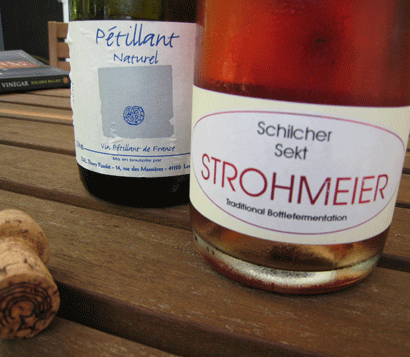
An $18 bubbly showdown! Well, it was and I didn’t even plan it. Some friends came over recently and we each had a bubbly ready to go. So what are wine lovers to do? Why, open them both, of course!
First up, from the Loire was Thierry Puzelat, naturalista wine maker who made it through to the quarterfinals in the Wine Madness tourney back in March. I was ready for Thierry to bring the shazam since I am a fan of his wines. But the cork on the Vin Pétillant de France Naturel Non-dosé released with a whimper rather than a bang. The mousse–the foamy part–was weak! This pétillant did not have the gas (literally) to keep it frothing! Upon tasting, it was more like cider than Champagne–that non-dosé stuff can be tough to make. A bummer! One person dumped her glass! (Ahem!) Puzelat, upended! Shades of Wine Madness all over again!
Then it was on to the Strohmeier…I mean come on, who’s ever heard of Strohmeier? They’re an Austrian producer founded in 1990, which is practically a New World time frame. And it’s not even from the esteemed Wachau–it’s from Styria! Some southern part of Austria that has produced, among other things, the Governator! And the grape in this Schilcher Sekt nonvintage–Blauer Wildbacher? Let’s get serious! Now to the pour: major mousse! Frothing all over the place. Bright pink effervescence in the glass! Now on to the taste. Oooh, it’s got hints of strawberry, it’s juicy, it’s got good acidity–in short, a delightful summer sipper on the deck! No glasses dumped on the geraniums! Strohmeier takes home the trophy in this spontaneous $18 bubbly showdown!
Find the Puzelat petillant
Find the Strohmeier Schilcher Sekt nonvintage
Jun
21
2008

Wine Maps
Monthly Archives
Blogroll
Categories
- American wine
- announcements
- Argentine wine
- auctions
- Australian wine
- Beer
- best wines
- Bling
- books
- Bordeaux
- bottled water
- Box wine
- Burgundy
- business of wine
- Celebrity wine
- Champagne
- Chicago
- China
- cocktails
- cognac
- corks
- corkscrews
- dining
- eco wine
- events
- foie gras
- food and wine
- French wine
- German wine
- giveaway
- grapes
- green wine
- guest post
- highlights
- how to
- Italian wine
- leaders and liters
- Mature wine
- meetups
- New York City
- On notice!
- photo captions
- podcasts
- Polls
- Port
- Portuguese wine
- power list
- reader mail
- rose
- sake
- Sommeliers
- South Africa
- Spanish wine
- spirits
- tasting sized pours
- The real wine world
- TV and movies
- Uncategorized
- videos
- vinexpo
- Weather
- wine and health
- wine and sports
- wine and tech
- Wine Blogging Wednesday
- wine blogs
- wine classes
- wine collecting
- wine gifts
- wine in india
- wine labels
- wine picks
- wine politics
- wine quizzes
- wine random
- wine science
- wine scores
- wine shops
- wine technology
- wine travel
- Wine under $10
- wine writing
- winemaking
- winespeak
 Blog posts via email
@drvino on Instagram
@drvino on Twitter
Advertise

quotes
One of the “fresh voices taking wine journalism in new and important directions.” -World of Fine Wine
“His reporting over the past six months has had seismic consequences, which is a hell of an accomplishment for a blog.” -Forbes.com
"News of such activities, reported last month on a wine blog called Dr. Vino, have captivated wine enthusiasts and triggered a fierce online debate…" The Wall Street Journal
"...well-written, well-researched, calm and, dare we use the word, sober." -Dorothy Gaiter & John Brecher, WSJ

Saveur, best drinks blog, finalist 2012.
One of the "seven best wine blogs." Food & Wine,
One of the three best wine blogs, Fast Company
Books for wine geeks
Wine books on Amazon: