Dr Vino's wine blog
wine talk that goes down easy
A visit to Lopez de Heredia
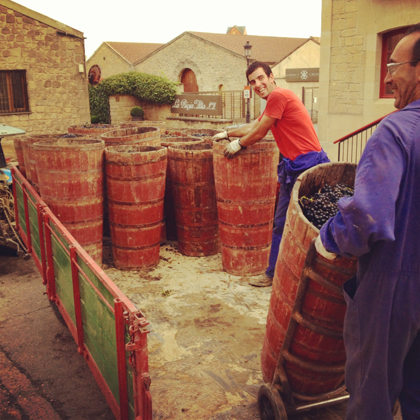
I’m in Rioja attending the Digital Wine Communicators’ Conference.
I got to stop by Lopez de Heredia, the shrine to fine wine in Haro. As the sun set and the last grapes of the 2013 harvest arrived, Mercedes Lopez de Heredia took a break from her duties to show a few of us around. Because the celebrated winery, a shrine to fine wine, has been around for over a century, it’s not exactly breaking news. But the mold-covered walls and the cellars where 13,000 barrels a phenomenal 2 million slumber should be on the bucket list for all wine geeks. Although I’ve tasted as far back as the 1945 vintage with collectors in New York, this was the first time I’d been to the bodega.
The last grapes from this late vintage were still trickling in (see above). The workers to this day bring them in via tall poplar baskets called “comportas.” The conical structure means that the wood bears the load and the grapes don’t start the crush on the way to the winery. Read more…
Oct
28
2013
4
Grand cru, says who? Nespresso edition
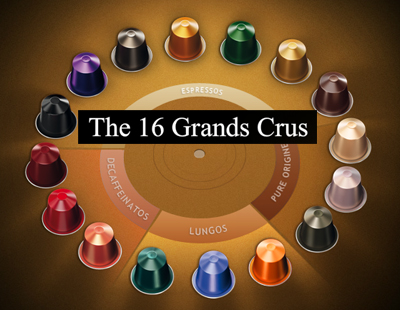
Ah, the power of wine terminology in conveying cachet to food, drink or other luxury products never ceases to amaze. Today’s case in point: Nespresso, pre-ground espresso beans encased in tin pods that stay fresh for a decade.
As I wandered out of Grand Central Terminal one day last week, I was accosted by a phalanx of men and women in black suits with white shirts and black ties. I feared for a moment that I had walked on to the set of the latest Men in Black movie and considered taking cover, lest they be in pursuit of aliens. But one garrulous steward trotted over to me and offered me a coffee. Since I rarely refuse coffee in any form offered me before 3 PM, I felt my eyes open wider as I nodded approval. He guided me over to bins containing the colorful pods of Nespresso. The instantaneous, one-touch coffee has been tremendously popular in Europe; if they hung out signs touting sales as McDonald’s does, I’m sure it would say “billions brewed.”
As a wine geek, the thing that struck me the most was that they bins offered selections from the “16 Grand Crus” of Nespresso. Grand cru, says who? While I have seen the term handwritten on bags of beans at boutique roasters, it seems to more tolerable and chuckleworthy there as the bags tout a single coffee plantation. But the Nespresso pods on display had no visible connection with the place(s) of origin and their “grand crus” simply evoked flavor profiles.
If the Champenois went nuts about the mere rumor of a champagne iPhone, shouldn’t a defender of the grand cru system be flipping out over Nestle’s brazen marketing?
Oh, and as to the quality of the Nespresso cappuccino itself? While the system may be long (lungo?) on convenience, the quality was more akin to vin de pays than grand cru.
Related: “Sea Smoke declares own vineyards “Grand Cru†on the label“
Oct
7
2013
Sunier, Fleurie, 2011
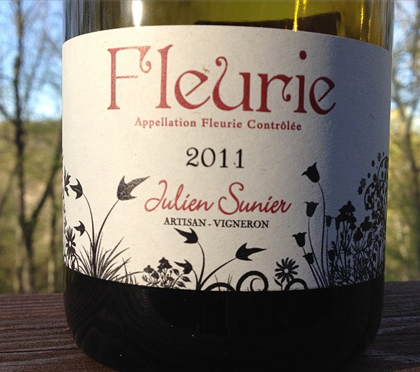
It’s going to be a cool and rainy Memorial Day weekend here in the Northeast–boooo! So I’ll spare you the dummer quaffers and hit you with something structured yet fun and gulpable at the same time: Sunier, Fleurie, 2011.
It turns out that although Julien Sunier is from Burgundy, he’s not from a wine family. In fact, his mother is a hair stylist. One of her customers was Christophe Roumier who allowed young Julien to to work at the Domaine, where he decided that the whole wine thing was pretty fun. After exploring the wine world’s corners in California and New Zealand he came back to Burgundy and later Beaujolais, starting making his own wines in 2008. He has parcels in Fleurie, Morgon and Regnié that have old vines, which he hand harvests and uses indigenous yeasts in the fermentations in concrete vats. After the fermentation, the wines are aged in older Burgundy barrels from… Christophe Roumier.
I bought the 2011 Fleurie for $25 (find this wine). It’s worth seeking out. I give it my highest (Beaujolais?) rating: quickly emptied.
May
24
2013
Alain Verset, Cornas, 2005
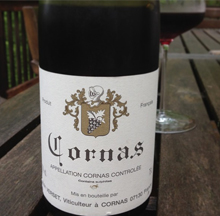 I was in Flatiron Wines last week and the staffer offered to sell me two bottles of Verset they were brokering from a collector. Verset? But didn’t he die a while ago? “Not Noël. They’re from his nephew Ira,” he joked.
He didn’t know that much about the producer (whose name is actually Alain but really is Noël’s nephew) and neither did I. Nonetheless, I bought the 2005 and said a quick prayer to Bacchus that it would actually be worth $49.95. Seemed like a reasonable bet given the quality of the appellation, the family name, and the store where I was buying it.
When I got home, I turned to The Wines of the Northern Rhone by John Livingstone-Learmonth. He writes that Alain has about one hectare (2.5 acres) of vines sprinkled over some to sites in Cornas–Reynards, Mazards, and Les Côtes, which is not enough to support his family of five children. Thus he works at a factory making garbage cans. Livingston-Learmonth writes that Alain Verset’s vinification is traditional–“whole bunches fermented for 10 – 15 days in concrete vats under the family home, and some pumping-overs.” Only indigenous yeasts power the fermentation and the wine is aged for up to two years in four- and five-year-old casks. Production is on the order of 900 bottles a year.
Curious and impatient, we uncorked the 2005 over the weekend. It was, indeed, a traditional Cornas, with little in the way of fruit notes, just stony minerals and a stiff backbone of tannin. Over a couple of hours it opened up but on the next day it had softened further. Savory and delicious syrah, the bottle was well worth the tariff. As M. Verset approaches retirement age from his factory job, perhaps he will make a few more bottles a year.
May
13
2013
Comments Off on Alain Verset, Cornas, 2005
Finger Lakes Riesling: what’s all the fuss?
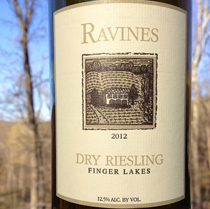 Finger Lakes wines, particularly Rieslings, have gotten a lot of recent attention. So I thought I would check in with them for a piece currently on wine-searcher.com.
One wine that came up repeatedly was the Ravines Dry Riesling (as well as their Argentsinger Vineyard one). I picked up two bottles of the 2012 for $14.99 each and poured them for discerning audiences. First, my wife, who is not generally a huge Riesling fan but she gave this one a thumbs up. I rated it a leading patio pounder for Summer of Riesling 2013. Then I opened the second bottle for my NYU class and poured it blind. Before revealing what it was, I asked them how many of them liked it. All hands went up. When the bag came off the bottle, they were all surprised and doubly impressed.
It seems to be a common reaction with the best Finger Lakes wines, as Thomas Pastuszak from NoMad shares in the piece.
Which are your favorite Finger Lakes wines? Do you think the region is overrated or underrated?
May
10
2013
Benjamin Leroux, Auxey-Duresses, 2010
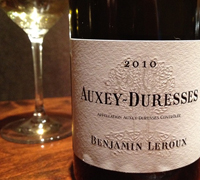 In honor of La Paulée de NYC happening this week, the wine pick this week is from, well, Burgundy. No, this isn’t a Bonnes Mares or a Chambertin, images of which have have been overtaking twitter feeds the past few days. In the language of a panel from La Paulée a few days ago, this is “outer borough” Burgundy, the 2010 Auxey-Duresses from Benjamin Leroux. By day, he’s the winemaker at Le Domaine des Epeneaux (Comte Armand) in Pommard. By night (or something like that), he has his own micro-négoce, meaning he sources grapes and vinifies them in to elixirs such as this.
The 2010 produced some amazing whites and reds in Burgundy and this wines comes from sites that border Meursault, so my expectations were high as I was twisting off the Stelvin closure. I wasn’t disappointed: the fresh acidity and stoniness give the wine a lean core with just a light top-dressing of Golden Delicious apple and a kiss of oak, that will likely become more integrated with some time in the cellar. It’s serious wine at a somewhat reasonable price (especially by Burgundy standards).
Mar
8
2013
Comments Off on Benjamin Leroux, Auxey-Duresses, 2010
Y not? Ygrec and Yquem 2011
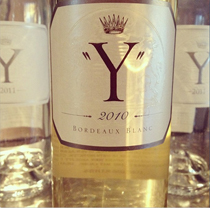 Pierre Lurton’s iPhone rang while he was talking to a bunch of journalists yesterday in New York City. He stopped and looked at it, and dismissed it saying, “It’s not important. But I had to make sure it wasn’t Bernard Arnault!â€
It’s not every winemaker who checks to see if it is France’s richest person on the line. But so it is with Lurton, who Arnault (head of LVMH) tapped in 1991 to manage Chateau Cheval Blanc and again in 2004 to take the reins at Chateau d’Yquem. That estate, maker of the famous nobly rotten Sauternes, was what Lurton was in town to discuss.
Chateau d’Yquem is not a one-trick pony. Read more…
Feb
22
2013
Tasting Chateau Margaux 16 ways
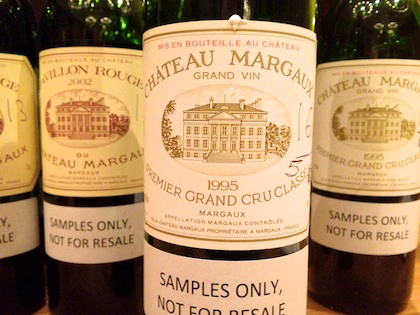
Paul Pontallier is a curious, open, and humble guy. All the more so since he is he managing director and winemaker at Chateau Margaux, where he has been for 30 years, crafting the sublime yet supremely expensive wines.
Pontallier was in New York City last week and he brought suitcase full of treats Read more…
Feb
5
2013

Wine Maps
Monthly Archives
Blogroll
Categories
- American wine
- announcements
- Argentine wine
- auctions
- Australian wine
- Beer
- best wines
- Bling
- books
- Bordeaux
- bottled water
- Box wine
- Burgundy
- business of wine
- Celebrity wine
- Champagne
- Chicago
- China
- cocktails
- cognac
- corks
- corkscrews
- dining
- eco wine
- events
- foie gras
- food and wine
- French wine
- German wine
- giveaway
- grapes
- green wine
- guest post
- highlights
- how to
- Italian wine
- leaders and liters
- Mature wine
- meetups
- New York City
- On notice!
- photo captions
- podcasts
- Polls
- Port
- Portuguese wine
- power list
- reader mail
- rose
- sake
- Sommeliers
- South Africa
- Spanish wine
- spirits
- tasting sized pours
- The real wine world
- TV and movies
- Uncategorized
- videos
- vinexpo
- Weather
- wine and health
- wine and sports
- wine and tech
- Wine Blogging Wednesday
- wine blogs
- wine classes
- wine collecting
- wine gifts
- wine in india
- wine labels
- wine picks
- wine politics
- wine quizzes
- wine random
- wine science
- wine scores
- wine shops
- wine technology
- wine travel
- Wine under $10
- wine writing
- winemaking
- winespeak
 Blog posts via email
@drvino on Instagram
@drvino on Twitter
Advertise

quotes
One of the “fresh voices taking wine journalism in new and important directions.” -World of Fine Wine
“His reporting over the past six months has had seismic consequences, which is a hell of an accomplishment for a blog.” -Forbes.com
"News of such activities, reported last month on a wine blog called Dr. Vino, have captivated wine enthusiasts and triggered a fierce online debate…" The Wall Street Journal
"...well-written, well-researched, calm and, dare we use the word, sober." -Dorothy Gaiter & John Brecher, WSJ

Saveur, best drinks blog, finalist 2012.
One of the "seven best wine blogs." Food & Wine,
One of the three best wine blogs, Fast Company
Books for wine geeks

Wine books on Amazon: