Dr Vino's wine blog
wine talk that goes down easy
G.D. Vajra in Barolo – “clean traditionalist”
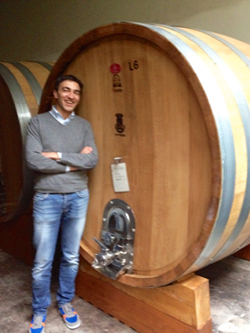 Giuseppe Vaira was caught in a fight when he was in elementary school. It wasn’t the sort of meet-you-at-the-bike-racks kind of thing. No, it encapsulated what might happen only to the son of a winemaker, or even the son of a Barolo winemaker. He was classmates with two other kids who were also from wine families. One said proudly that he was the son of a modernist winemaker while the other said proudly that she was the daughter of a traditionalist. No doubt, both the kids harrumphed, crossed their arms, and turned their backs to each other.
Giuseppe was flummoxed. Which camp did his family winery fall into? Read more…
Jul
10
2014
3
Burgundy gets hammered (by hail) — again
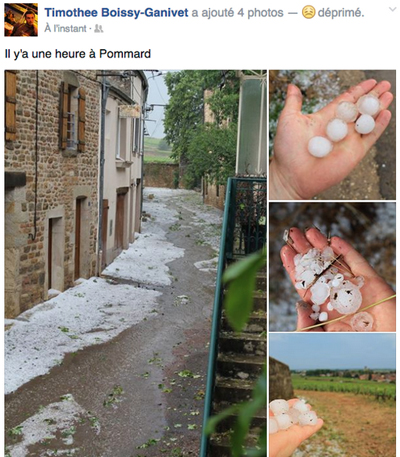
A violent hailstorm sprayed large hailstones over some Burgundy vineyards leaving many incipient grapes destroyed. Anne Parent of Domaine Parent in Pommard, described the violent storm as a “like a machine-gun attack” of the vines, even though it lasted only three minutes.
While the damage has yet to be tallied across the region, some initial assessments are putting the loss at 40 – 90 percent of the crop with Volnay, Pommard, Meursault, and Beaune getting hit the hardest. “It’s a catastrophe,†said Jean-Louis Moissenet, the president of the Pommard winemakers’ association was quoted in The Telegraph as saying. “We were heading for a good year, but now that has fallen through.†Last year, the region was also hit by a devastating hailstorm.
The effects were localized. Jeremy Seysses of Domaine Dujac in Morey St Denis tweeted: “At this point, impacted berries that should dry out and fall off. Canopy seems mostly OK in CdN [Cotes de Nuits].”
Some growers have tried to use “hail cannons” (a rudimentary one pictured below; others here), which fire silver iodide into the atmosphere in an attempt to turn the hailstones into rain. The effectiveness of these machines is debated.
In other parts of the world, growers put hail nets in place to protect fruit, including grapes and other fruit trees. Even though they are less pleasing to the eye than simply rows of vines, AOC rules sometimes disallow nets. Further, some skeptics of nets say that they reduce the amount of light the plant receives. But should they be allowed?
The hailstorm is very sad news that will undoubtedly make some growers re-think pinning their financial hopes on the roulette of Mother Nature. And it will likely reduce the crop from some of my favorite appellations, which will compound the problem of rising Burgundy prices. Read more…
Jun
30
2014
World wine consumption: USA up, France down
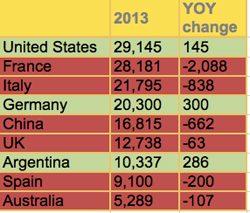 The OIV, an international wine organization based in Paris, released their annual report of the state of the wine world last week.
In it, they showed the US market becoming the largest in the world for the first time. Even though this got some play last week, we already broke out the foam fingers a couple of years ago when another organization declared the US the world’s biggest wine market. Of course, in per capita terms, we’re still a relative weakling.
Still, the trend in world wine consumption is clear: the US is one of the few big, growing markets in the world. France sagged a tremendous amount year-over-year (see chart), making one wonder if there was a methodological problem. Also of note in their report, China actually showed a decline.
Anyway, we’ll raise a glass to these statistics–all in the name of keeping the USA at the top of the list!
See the OIV report
May
21
2014
Blind taste test: Stradivarius
 We all know about the record of wine experts at blind tastings: decidedly mixed.
What if professional violin players played a 300-year-old Stradivarius worth millions of dollars and a newer violin (worth tens of thousands) under double blind conditions? Would they fare better than professional wine tasters? SPOILER ALERT: It turns out, no, the professional players picked the older violins as superior only on par with the odds in chance.
Check out the story on the most recent Planet Money podcast from NPR. And here’s a link to the one of the studies in PNAS.
May
12
2014
Comments Off on Blind taste test: Stradivarius
Mathieu Lapierre and 2013
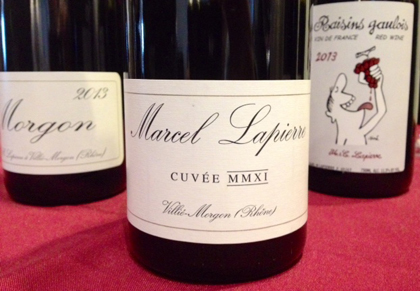
Mathieu Lapierre said that the 2013 showed more “Burgundy influence.†At the Kermit Lynch portfolio tasting in New York yesterday, he elaborated briefly that given the location of Beaujolais, vintages can oscillate between “Rhone-influenced†(e.g. 2009) and “Burgundy-influenced.†He said 2013 for him ended without hail, the grapes were healthy and they harvested as late as October 28, a record.
The Raisin Gaullois 2013 is a vin glouglou from the estate’s youngest vines, bottled en screw. (Too bad that the 5L bag-in-box is not imported!)
The Morgon, always a reference point for the region, has a beautiful poise between come-hither fruit of the semi-carbonic macerationo and tannic structure from the granite soils in the 2013 wine. The “Cuvée MMIX†(2009) was a tad ripe for me (Rhone-ish, if you will), but the “Cuvée MMXI” (2011) more successfully combines the ripeness of the wine with intriguing structure. Thing for my “to do” list: taste this MMXI with the Foillard Pi Morgon wine for a fuller understanding of their differences and similarities.
Asked if he prefers to drink the Morgons now or with some age on them, Mathieu replied that with friends he prefers young wines but that for more serious occasions, he’s currently drinking the 2007s. He invoked the late Henri Jayer, saying “a good wine must be good young and old for different reasons.”
Find these wines at retail
Visit the domaine’s improved website Read more…
Apr
30
2014
Put a Burg on it: d’Angerville Jura
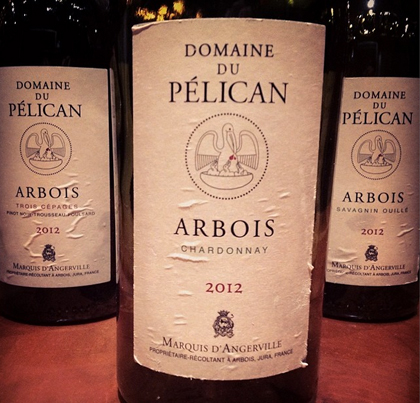
Guillaume d’Angerville has made sophisticated and elegant wines at his family domaine in Volnay since he took over in 2003. But recently, the story goes, his curiosity was piqued in the wines of the Jura: a Parisian sommelier poured him a chardonnay from the region blind and d’Angerville took it to be a white Burgundy. And we all know that happens with a successful and ambitious vintner who has his curiosity piqued: before long, d’Angerville had purchased two estates in the Jura.
He placed them under the name Domaine du Pélican complete with a pelican on the label. You might think that because the Jura is the ultimate wine for hipsters that, in deference to Portlandia, he had to “put a bird on it.” But apparently it is a reference to the coat of arms of Arbois, where the wines are made. Burgundy…Jura…is this a match made in sommelier heaven or what?
D’Angerville settled on the two properties after an extensive search. Even though Arbois is only an hour from Volnay, it gets twice the rainfall. Also, some of the plots can be quite windy, given the rolling countryside. Throw in his high standard for excellence and it’s no surprise that it took d’Angerville a few years to find the right spots. Wink Lorch has a detailed backgrounder (pdf) about the new domaine and writes that they are looking for yet another vineyard parcel in the area. They are also experimenting with the local “sous-voile” style of winemaking, wherein white wines mature under a natural yeast blanket giving them an oxidative quality.
The current wines are made in a Burgundian style, which is to say that the white barrels are topped up and not oxidative. The 2012 Chardonnay has a vibrancy and elegance with layers–strata?–of minerals and a lingering finish. The 2012 Savagnin Ouillé is richer, with a faint nutty character, and big dose of minerals (can’t vouch for vitamins). The red 2012 Trois Cépages is a blend of Pinot Noir, Trousseau, and Poulsard (60-35-5) that has the terrific acidity you would expect as well as lively, prickly tannins that give it good structure.
These exciting wines are hard to find but worth seeking out. (Find these wines at retail)
Apr
24
2014
This week in vineyard photos: drones, buds, caterpillars
Vineyards and wineries can post some photos to social media that let us know what’s going on in their corner of the world. Here are a few worthwhile ones:
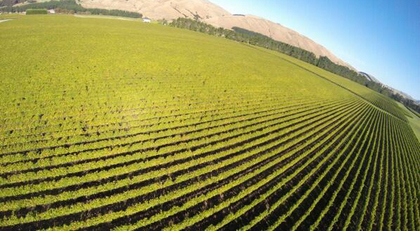
Starting in the southern hemisphere, this one is a photo of the Craggy Range Te Muna Road vineyard in New Zealand. It’s taken by drone and, since you know our love of all things drone and wine related, we had to post it for you. Queried via DM, the folks at Craggy Range said the drone belonged to an employee and was used for fun, not in any particular vineyard application. Read more…
Apr
5
2014
Comments Off on This week in vineyard photos: drones, buds, caterpillars
Which states drink the most wine?
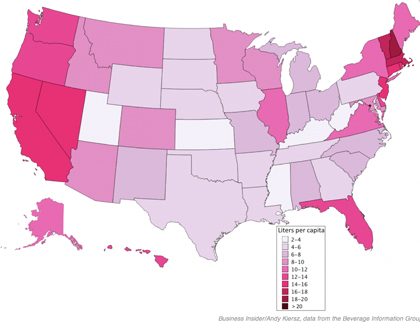
Which state is the thirstiest for wine? It’s a question we’ve noodled before as Washington DC is the thirstiest non-state in the nation! The good folks at Business Insider have taken the initiative to produce this handy map showing comparative wine consumption data, which they also list in a table. (Since the data relate to wine sales as opposed to pulling corks, some states with friendly policies to wine sales–such as New Hampshire–or places with a good selection next to lousy places–such as DC and adjacent the Montgomery County, MD–skew the results somewhat.)
Wine is popular across the country today. And it’s a non-partisan imbibing as the appeal of cabernet and Champagne spans party lines. Yet, after the jump, check out how the map of wine consumption correlates with the 2012 electoral returns: Read more…
Mar
7
2014

Wine Maps
Monthly Archives
Blogroll
Categories
- American wine
- announcements
- Argentine wine
- auctions
- Australian wine
- Beer
- best wines
- Bling
- books
- Bordeaux
- bottled water
- Box wine
- Burgundy
- business of wine
- Celebrity wine
- Champagne
- Chicago
- China
- cocktails
- cognac
- corks
- corkscrews
- dining
- eco wine
- events
- foie gras
- food and wine
- French wine
- German wine
- giveaway
- grapes
- green wine
- guest post
- highlights
- how to
- Italian wine
- leaders and liters
- Mature wine
- meetups
- New York City
- On notice!
- photo captions
- podcasts
- Polls
- Port
- Portuguese wine
- power list
- reader mail
- rose
- sake
- Sommeliers
- South Africa
- Spanish wine
- spirits
- tasting sized pours
- The real wine world
- TV and movies
- Uncategorized
- videos
- vinexpo
- Weather
- wine and health
- wine and sports
- wine and tech
- Wine Blogging Wednesday
- wine blogs
- wine classes
- wine collecting
- wine gifts
- wine in india
- wine labels
- wine picks
- wine politics
- wine quizzes
- wine random
- wine science
- wine scores
- wine shops
- wine technology
- wine travel
- Wine under $10
- wine writing
- winemaking
- winespeak
 Blog posts via email
@drvino on Instagram
@drvino on Twitter
Advertise

quotes
One of the “fresh voices taking wine journalism in new and important directions.” -World of Fine Wine
“His reporting over the past six months has had seismic consequences, which is a hell of an accomplishment for a blog.” -Forbes.com
"News of such activities, reported last month on a wine blog called Dr. Vino, have captivated wine enthusiasts and triggered a fierce online debate…" The Wall Street Journal
"...well-written, well-researched, calm and, dare we use the word, sober." -Dorothy Gaiter & John Brecher, WSJ

Saveur, best drinks blog, finalist 2012.
One of the "seven best wine blogs." Food & Wine,
One of the three best wine blogs, Fast Company
Books for wine geeks
Wine books on Amazon: