The Institute of Masters of Wine slowly opens up

How does soil influence wine quality? How does changing a trellising system affect vineyard health and yields? Following malolactic fermentation, what options are available to reduce alcohol levels in finished wine and how should they be deployed? Critically examine the extent to which the increasing emphasis on “natural wine” is a positive development for consumers.

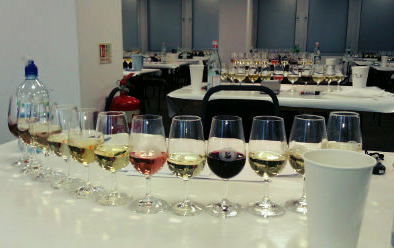
A record 98 candidates tackled questions like these two weeks ago in London, Napa, and Sydney. Then they had to dive into three blind tastings of twelve wines each, over two hours each, trying to parse differences in white, red, and sparkling (gah–with four moscato wines in the sparkling flight!). After passing the exams and submitting a 10,000-word research paper, the students would have their names added to the list of 298 current MWs worldwide. (Impressive as it is, some have wondered aloud if passing is little more than just a bragging right from a career perspective).

The Institute has posted the entire exam to their website and it is well worth checking out. Since there are no instructions, students had to respond to one question in each section A and two questions from each section B of the “theory” section. In the “practical” section, students must score 195 (out of a possible 300) to pass. It amounts to a really huge volume of wine knowledge that takes years to compile–students aren’t allowed to sit the exams until after two years of study. Richard Hemming, who took the exams this year, wrote on JancisRobinson.com that he has spent almost $10,000 this year in tuition, exam fees, and wine to prepare. He also spent 28 “working days” preparing since last September. Since it’s rare to sail through on the first try, each student has three tries to pass the exams, given annually.

A couple of months ago, the Institute of Masters of Wine took the bold step of investigating one of its members for violations of its code of conduct; the member resigned. Posting this year’s full exam adds to the transparency and relevancy of the Institute. Now, what’s left for the Institute to achieve its own Perestroika is to make available not only the titles of the 10,000-word research papers that candidates must pass to become MWs (called “dissertations”), but also the papers themselves.

In higher education in the United States, Ph.D. dissertations are archived and accessible via UMI and any student’s master’s thesis is likely found in their university’s library. Certainly much research in the US relies on government funding in some way, whether a grant or at a state university, so there’s a fiscal basis for the openness. But most importantly, it’s about sharing ideas and findings to advance our collective knowledge. While the Institute of Masters of Wine is a private institution, their students draw on the industry’s time and resources while doing their research. We all benefit from the fruits of the vine; making the successful candidates’ essays publicly available would be the best way to share the fruits of their research with both consumers the trade. Indeed, in this era of information openness and wikileaks, it’s hard to see it any other way.

Turley white zinfandel, more Cali new wave & Burgundy wine fraud

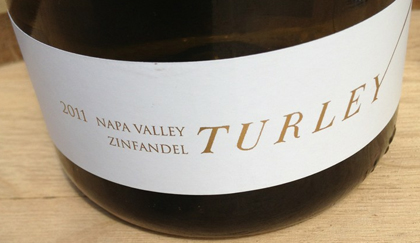
Remember wine in a can from a few weeks ago? Or the headline “”Beringer launches White Zinfandel Moscato”? Here’s something else to make your head spin: Turley…11.2% alcohol…pink wine…Yes, Turley, the icon of high-octane Zinfandel, has released a “white Zinfandel.” Jon Bonné tasted it and called it “refreshing…with surprising depth.” Bar Tartine in San Francisco tweeted that it was “so delicious.”

In other California low-alcohol news, Food and Wine as well as Eater highlight nouvelle vague microproducers making relatively affordable, atypical wines from California. That’s three articles this week, so it is officially a trend to write about the trend. As I mentioned on Wednesday, perhaps the most interesting part of the story is that these acid-hounds are casting aside the selling-wine-by-numbers approach that has served as the sales model for the industry for so long. The Eater story digs into that aspect.

And you may have heard about passing off cheap Burgundy as more expensive wine. But, unrelated to the story of Rudy Kurniawan, authorities have arrested four executives at Labouré-Roi on suspicion of fraud.

Movie rights sold for “A Vintage Crime”

Level 1 Entertainment has purchased the movie rights to “A Vintage Crime,” a story by Mike Steinberger about wine counterfeiting that appeared yesterday on VanityFair.com. Edward Milstein and Bill Todman Jr. co-founded Level 1, which has released two comedies (“Grandma’s Boy” and “Strange Wilderness”) as well as a thriller (“Rendition”) with houses 20th Century Fox, Paramount Pictures, and New Line Cinema.

Milstein has several ties to the story. He is a wine collector and overlapped with Kurniawan, who is at the center of the story and indicted, awaiting trial. Milstein is co-chairman of Emigrant Savings Bank; a previous suit alleged that Kurniawan defaulted on a $3 million loan to Emigrant. Milstein owns or has a stake in Remoissenet Pere et Fils, a Burgundy producer, as well as The Sorting Table, a Napa-based wine importer. He also heads his family’s real estate company with his brother.

“Eddie is a huge wine collector who knew Rudy, and likely bought a few bottles from him, and when we got a peek at this article, Eddie flipped for it and we bought it preemptively,” Todman told Deadline. “It has that Catch Me If You Can thriller aspect, where you can’t believe this guy got away with this for so long, ingratiating himself into this billionaire’s club and living the high life, at least for awhile.”

Since the project will need a screenwriter, a director, and casting decisions before it can start shooting (if, indeed, it ever makes it that far), that gives us plenty of time to weigh in with our choices. Who do you see in the leading roles? It will be interesting to see if they keep a young ethnic Chinese in the central role, or if they opt for more of a George Clooney, Johnny Depp, or Gary Oldman type. And how about Jean Reno as Laurent Ponsot? Or do you think the story is too narrow for the silver screen?

Jam is for toast…and points are for basketball

arnot roberts nathan

Alice Feiring has a piece on thedailybeast.com entitled “Big? Jammy? Not Anymore!” about the much-discussed turn in California winemaking toward lower-alcohol, higher-acidity wines. While she rightfully highlights a merry band of winemakers daring to be different, including Nathan Roberts (above) of Arnot-Roberts, she neglects to mention just how hard that alternate path is from a sales perspective. For decades, the basic sales model of California wine has been to make a wine, get a high score, then use that score to sell the wine through a distributor or a mailing list.

These nouvelle vague producers in the Sierra foothills and the outer reaches of Sonoma are not point chasers, by and large. Instead, they have emphasized the food-friendliness of this style of wine, cultivating relationships with sommeliers and using plum placements on restaurant wine lists to serve as a proxy for quality. They have gotten into key wine shops too and have a lot of buzz on them there Internets. Forging a new sales model is both risky and hard work. But it could be an even more important development for the American wine industry than the stylistic change.

The wine fraud story in Vanity Fair

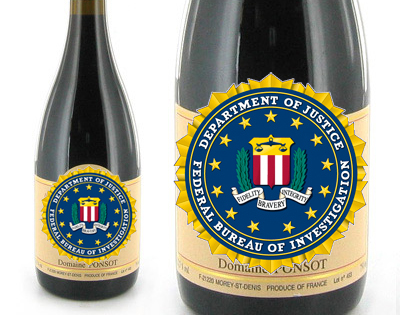
Mike Steinberger writes a nuanced, 5,000-word piece on Rudy Kurniawan and wine counterfeiting on VanityFair.com. Although it draws some material we have discussed here previous, such as the court documents including Kurniawan’s indictment on wine and mail fraud, the piece offers insights from numerous interviews of participants involved in the multi-million dollar saga. Lots of interesting details emerge: apparently Kurniawan purchased so much “unremarkable” old Burgundy from one negociant that he “emptied [their] cellars.” Also, the complexity of Burgundy may have been what tripped him up as early in his rise in the wine world, Kurniawan appears to have confused a Christine Ponsot Clos Saint-Denis for a Domaine Ponsot (unrelated) Clos Saint-Denis that didn’t even exist. Steinberger writes “If that is what happened, it is a mistake that now has Kurniawan facing up to 80 years in a federal penitentiary.”

If you are going to looking for a long, thorough piece on the wine fraud story, check out this terrific one. What part of the story do you find the most amazing?

“A Vintage Crime” VanityFair.com

Flatiron wines: my kind of shop

If I owned a wine shop, I’d stock it with wines from importers such as Kermit Lynch, Louis/Dressner, and Neal Rosenthal with a dollop of Burgundies from Becky Wasserman and a smattering of Spanish wines. I’d throw in some classic domestic wines and nouvelle vague ones too and aim for a few back vintages in the mix.

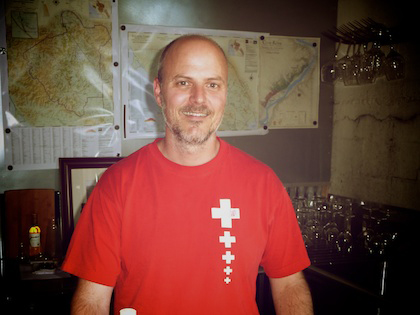
So I was like a kid in a candy store when I stopped by the new Flatiron Wines yesterday. Opened just over two weeks ago on Broadway between 21st and 22nd, the team comes from Uva Wines in Williamsburg. Uva is shop with serious natural wines chops, but manager Dan Weber told me “we’re passionate about terroir. We’re grower-driven and not dogmatic.” If he likes a wine, he stocks it, which is why he has all the wines of estates like Domaine de la Pepiere in Muscadet and Sylvian Cathiard in Vosne Romanée. Really, it’s the rare wine shop I walk into and would buy almost every bottle on the shelf but Flatiron is such a shop.

The large room in the front has various displays on custom wooden racks. The back room has Eurocaves and a farm table where Dan says they have official tastings Fridays, Saturdays, and Sundays–but unofficially, every day after five there will be something open. When I was there yesterday, there was the savory De Forville Langhe Nebbiolo 2009 available. Jeff Patten, owner of UVA, and Beau Rapier, buyer, were also in the store, offering good commentary and advice.

Check out the store before word gets out. Then you can score some of the mature wines available, such as seven back vintages of Domaine Tempier from Bandol, 1985 Huet Vouvray, 1991 Ridge Monte Bello, some coveted Clos Rougeard of Saumur-Champigny and more.

“We want to foster community,” Dan said. With wines like these, they’re on their way.

929 Broadway (bet 21st and 22nd), New York, NY 10010
flatiron-wines.com
212-477-1315

Drink like a hipster: pelaverga edition

Pelaverga. Never heard of it? That’s understandable. This is almost an heirloom variety in Piedmont that used to be grown in greater quantity (and even blended into Barolo before it had to be 100% nebbiolo). Now the grape is experiencing something of a resurgence as a handful of producers are bottling the grape on its own and some of those are making their way in minute quantities to our shores.

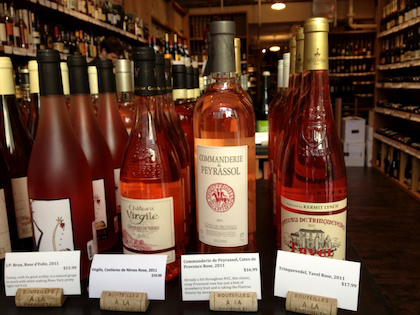
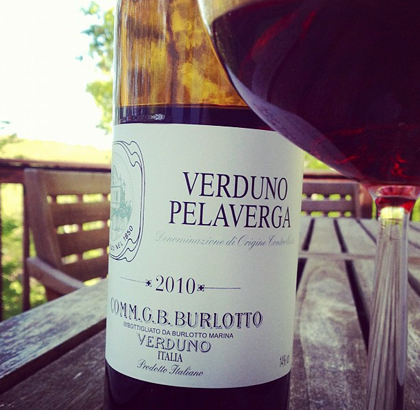
G. B. Burlotto, a producer in the town of Verduno more known for their Barolo, makes this 2010 Pelverga. The light color is akin to a pinot noir, but the mouthfeel is lighter and peppery tannins undergird bright fruit. It’s not complex as a Barolo but it doesn’t need to be: it’s food-friendly, with though brio to be a fun red this summer.

Find this wine at retail

Jay-Z in Burgundy, wines to “arouse,” Canada, artisanal – sipped and spit

SIPPED: matters of taste
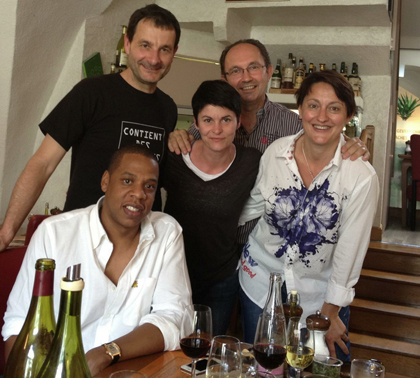
Pictures of billionaires in Burgundy are generally disturbing (don’t drive up prices any more!). But in this one, of Jay-Z at Ma Cuisine in Beaune, it is reassuring to see that the superstar has moved beyond his own Champagne Ace of Spades and is delving into Roulot. Fellow wine geek!?! Meursault nice…

SIPPED: profiting from passion
Dr. Ruth has launched a line of low-alcohol wines to “arouse”? Sounds like quite a brand extension…Also, isn’t almost all wine vin d’amour? [NY Post]

LIBERALIZED? A popular wine bill would allow Canadian citizens to carry wine across provincial lines! If it passes the Canadian parliament vote this Wednesday, it would go to the Senate and could be law by the end of the month. Free at last?!? [cbc.ca]

SKEWERED: wine blog awards [HoseMaster of Wine]

BREAKING: In Possible Gaffe, Romney Says Poor People ‘Go Best With White Wine’ [Andy Borowitz]

SPIT: Artisanal
The Atlantic has an obituary for the word “artisanal.” We already thought it jumped the shark in 2007 when we rooted out frauds, settling on “fartisanal.”

SIPPED: “Tres Brooklyn.”
Food trucks. Paris. Comment dit-on “hipster”? [NYT]

SPIT: Will the NYC ban on big sugary drinks include banning 750-ml bottles of Moscato?

New wine jobs: assistant beverage director, wine sales, summer internship and more.


winepoliticsamz

Wine Maps


Monthly Archives

Categories


Blog posts via email

@drvino on Instagram

@drvino on Twitter


winesearcher

quotes

One of the “fresh voices taking wine journalism in new and important directions.” -World of Fine Wine

“His reporting over the past six months has had seismic consequences, which is a hell of an accomplishment for a blog.” -Forbes.com

"News of such activities, reported last month on a wine blog called Dr. Vino, have captivated wine enthusiasts and triggered a fierce online debate…" The Wall Street Journal

"...well-written, well-researched, calm and, dare we use the word, sober." -Dorothy Gaiter & John Brecher, WSJ

jbf07James Beard Foundation awards

Saveur, best drinks blog, finalist 2012.

Winner, Best Wine Blog

One of the "seven best wine blogs." Food & Wine,

One of the three best wine blogs, Fast Company

See more media...

ayow150buy

Wine books on Amazon: