The five most influential people in NYC wine

mystery_manNew York City is the best wine city on the planet. The shops are amazing–if you want a wine, it’s almost always possible to find it. The sommeliers are in the vanguard of the sparkling young sommeliers across the country, creating long wine lists and short lists, all-American lists and all-Spanish ones and everything in between. The importers have scoured foreign lands and share their plunder, educating and sating the thirsty masses back at home. It’s also a center of wine journalism, with scribes swirling and spitting.

So who shapes minds or moves cases in the city today? It may seem like inside baseball–a trade story in one city. But the most influential people in New York City shape trends today that will affect consumers either tonight in a restaurant in town, tomorrow in a store or via a column, or a year or so down the road if you’re not as plugged in. There are certainly other deserving wine hubs in the US; perhaps we’ll tackle those in the future.

Rather than reclining in a Barcalounger, uncorking some bubbly and holding forth on who I thought deserved to be on New York City’s power list of wine, I decided to actually ask some elites in the wine world. I emailed three dozen industry movers and shakers and received 29 responses. I contacted the heads of big stores, big distributors and corporate beverage directors as well as some sommeliers, small shop owners and a few well-placed journalists and a couple of PR people. With their permission, a complete list of respondents follows below. Participants were asked to name their top five most influential people–living or dead, residing in NYC or not–with a request not to nominate themselves or anyone at their firm.

So who are the top five on the power list in New York City? Stay tuned next week as we roll out the responses in reverse order. But don’t let the fun wait until next week–feel free to nominate the five most influential people in the wine world as you see it. Or take a stab at guessing who were the consensus choices among the respondents. Read more…
Parker sues Galloni

Yesterday, Robert Parker posted to his site that the Wine Advocate is suing their former critic Antonio Galloni. They charge him with misappropriation of confidential information, defamation and fraud among other things. Courthouse News has a summary and Jeff Leve has published the full text of the complait to his site.

At the crux of the complaint, the Wine Advocate alleges that Galloni went to Sonoma on their dime and as the critic. (Apparently there are other pending reviews involving Burgundy, Brunello and Barolo.) I posted a few weeks ago that I thought Galloni should turn over whatever he had at that point and to withhold notes was petty and unseemly. In something of a defense, some people said that because he was an independent contractor, he might have been paid only upon submission of the material. However, the complaint states that he was paid a salary of $25,000 a month (plus $5,840 a month for expenses) for his duties to deliver certain material. The complaint alleges that he had a “secret scheme” to visit wineries “throughout the world” while developing his own wine reviewing business. In that business, the complaint alleges he will be using their “proprietary 50-100 point grading scale” and was authorized only to do so for their publication.

Since Galloni’s own web site has still not launched, it seemed a hasty decision to jump ship. As I mentioned in the comments of my last post, when he went to the Times to announce his departure from the Wine Advocate in February, it read to me like a giant “will work for food or Barolo” notice of his availability on the job market rather than an announcement of his own project. It will be interesting to see how this all plays out. But one thing is for sure: Parker & Co. are making Galloni’s life difficult. Galloni has yet to reply to the complaint.

As to the Wine Advocate, the new editor-in-chief noted on eBob that they will be taking on “3 new very talented reviewers.” She cited “varying notice periods” the writers had to give their current publications as the reason for the delay in announcing their identities.

Confronting climate change in Germany – four views

rieslingfeier1
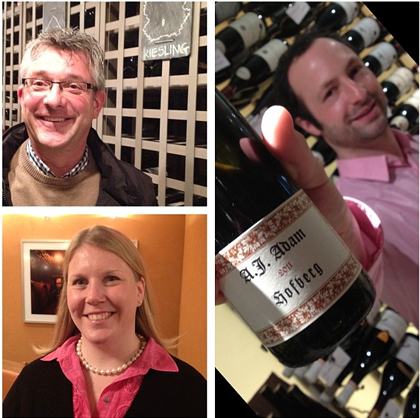
Thomas Haag of Schloss-Lieser, Andreas Adam of A.J. Adam, and Dorothee Zilliken of Zilliken.

Confronting a warming climate was one of the main topics at a panel discussion at the recent Rieslingfeier. Historically, Germany has been at the northern limits of wine production where the grapes struggled for ripeness. Now, warmer vintages are becoming more frequent as 2003, 2006, 2007, and the current releases from 20011 show.

David Schildknecht, perhaps the leading German wine critic in America, led the panel of four producers at Bar Boulud that included Florian Lauer, Dorothee Ziliken (Forstmeister Geltz-Zilliken), Andreas Adam (A.J. Adam), and Thomas Haag (Schloss Lieser). Mosel Riesling has historically had a reputation as a light, juicy, drinkable yet filigreed wine. The challenge with global warming is that rather than struggle for ripeness and sugar, the grapes can effortlessly tack on sugar, which can lead to higher alcohol wines, richer wines or elevated residual sugar in the wines–in the worst case, wines that might lose the élan of the cooler times. The producers spoke of different tools in the toolkit of vineyard management and winemaking that they use to adjust to global warming. Read more…

A flight of sommeliers, Tang auction, Bordeaux laxative – sipped and spit

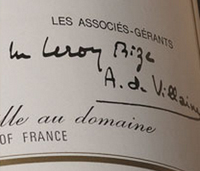
drc_1978_labelSIPPED: Sleuthing and spring cleaning
Don Cornwell raised questions about the authenticity of some lots at auction in Hong Kong including a 1971 Methuselah of DRC La Tache, which was withdrawn from the sale. The wines were from the collection of Henry Tang whose bid to become Hong Kong chief executive was derailed by a wine cellar at his Hong Kong home built without proper permits. Christie’s estimated the value of the sale at $3.7 million. In the end, the collection brought in $6 million. Cleared out some space in the basement, fo sho! [wineberserkers; Bloomberg]

SPIT (OR WORSE): There’s quite a, erm, moving discussion on wine berserkers about whether Bordeaux wine has a laxative effect. Serious rebranding possibilities!

SIPPED: somms We all know a gaggle of geese and a murder of crows. But what do you call a group of sommeliers? A flight, a swirl, a six-pack, an assemblage and a drunk came up on Twitter. What’s your thought? Bear in mind this advice: “The noun or phrase, whatever it is, has to be greater than the somm of its parts.”

SIPPED: rites of spring and stars “I know it’s spring when I get the annual press release about Mouton Cadet being official supplier to the Cannes Film Festival…” Jane Anson

SIPPED: grape origins
“I’ve looked into the origins of the Brangelina grape and can say that its history is the Pitts’.” Howard Goldberg

Jim Barrett and the Irish Order of the Wine Geese

Jim Barrett, who purchased Chateau Montelena in Napa Valley in 1972, died yesterday at the age of 86 (see bio). Chateau Montelena burst on to the international stage just a few years after Barrett purchased the property when its chardonnay outpaced other whites to win the Paris Tasting of 1976. This was captured (with a degree of artistic license) in the film Bottle Shock a few years ago. Bo Barrett, Jim’s son who took over the title of winemaker at Montelena in 1982 (which he yielded to Cam Perry in 2008), told me once that the film generated a huge amount of interest in visiting the property and sent tasting room sales soaring. The wines continue to be very good including restrained versions of both Zinfandel and Chardonnay as well as cellar-worthy cabernets.

In the press release about Jim Barrett’s death, one of his affiliations caught my eye: he was a member of the Irish Order of Wine Geese. What? That’s a new one to me. Thankfully, Senior Irish Wine Correspondent and now Master of Wine Mary Gorman-McAdams wrote a piece about it over at thekitchn.com. It turns out to be a loose collection of those with Irish heritage in the wine industry worldwide. Bordeaux famously had the Barton and Lynch families among others, Australia has Jim Barry as well as the Horgan family of Leeuwin Estate, and there are several in the US, including Concannon and Montelena.

So that gives a few wine options if you want to raise a glass of something other than green beer on St. Patrick’s Day. I’m sure Jim Barrett would approve.

A few NYC wine happenings

jancis_92Y
Even with the March weather here oscillating furiously between lion and lamb, it’s nonstop for wine events. Here are a few worth flagging.

Chambers St Wines holds an annual tasting of Louis/Dressner wines to benefit Partners in Health. March 16; reservations required.

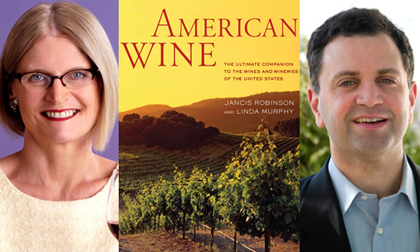
Mike Steinberger will lead a conversation with Jancis Robinson about her new book, American Wine, among other things. Two of my favorite wine writers! 92Y Tribeca – March 20

My next NYU wine class starts April 3 and runs six Wednesdays, 6:30 – 8:30. It will be fun-we will chew over some of the weightiest topics in the wine world and taste about six wines per session. Register online (best with IE or safari) or call (212) 998-7150.

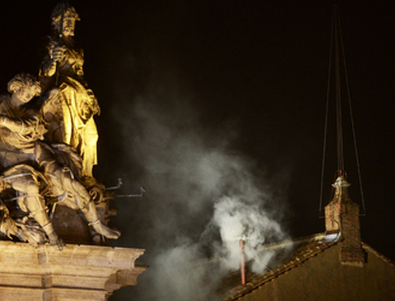
White Smoke – great name for a communion wine

white_smoke

In the inaugural year of a papacy, at least! And it sure beats Fumé blanc…

And as it came up over on the Twitter: “Pope Francis is only the second most famous Argentinian to know the hand of God.” Read more…

Pepe Raventos on leaving Cava and making the new Conca

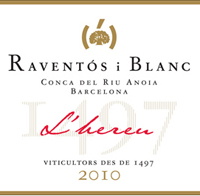
raventos_hereuWhile he was pouring bubbly at the spring tasting of his his NY distributor (Skurnik), I spoke with Pepe Raventos of Raventos i Blanc. Late last year, Raventos announced that they had decided to withdraw from the Cava D.O. and will file for a new D.O. Conca del Riu Anoia. I asked him why.

Pepe Raventos: The motivation is a belief in the great potential of sparkling wines that have been produced in our conca, our valley, for the last 150 years. It’s one of the most historical wine regions of the world. I think that when you’re deep in typicity–pace, soil, climate history–then your wines start to become closer to art than to winemaking. Cava has become a winemaking wine rather than a viticultural wine. The whole Conca dream is to make it about place, to make it a viticultural wine.

How long will the D.O. process take to be formalized?
The first thing is we have to work well with the farmers in the region and get everyone excited, we need to get you, the wine writers excited, get the customers excited. The world needs a true alternative to grower Champagne because it doesn’t make sense… Read more…


winepoliticsamz

Wine Maps


Monthly Archives

Categories


Blog posts via email

@drvino on Instagram

@drvino on Twitter


winesearcher

quotes

One of the “fresh voices taking wine journalism in new and important directions.” -World of Fine Wine

“His reporting over the past six months has had seismic consequences, which is a hell of an accomplishment for a blog.” -Forbes.com

"News of such activities, reported last month on a wine blog called Dr. Vino, have captivated wine enthusiasts and triggered a fierce online debate…" The Wall Street Journal

"...well-written, well-researched, calm and, dare we use the word, sober." -Dorothy Gaiter & John Brecher, WSJ

jbf07James Beard Foundation awards

Saveur, best drinks blog, finalist 2012.

Winner, Best Wine Blog

One of the "seven best wine blogs." Food & Wine,

One of the three best wine blogs, Fast Company

See more media...

ayow150buy

Wine books on Amazon: