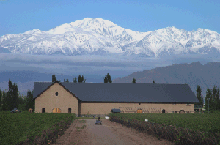
Value vino list fourteen

Crisp, racy whites

Simonsig, Chenin Blanc. 2004 $8.99 Find this wine

The rapid pace of change in the South African wine industry means that the country’s wines are a blend between old and new. Chenin blanc, for example, has been grown for centuries in the country and marketed under the name “steen” but has only recently been rebranded as Chenin
blanc. This Simonsig Chenin blanc is much more full flavored and lush than the traditional Loire style, but it still has that crisp acidity that makes it an excellent summer quaffer. Since the transition to democracy and the re-opening of the export markets a decade ago, Simonsig has worked to increase the quality of this wine and it certainly is apparent in the wine’s delicious fruit. (28,000 cases made; imported by Quintessential, Napa, CA)

Domaine des Cassagnoles, vdp Gascogny, 2003, $8. Find this wine
This bargain white is likely to become a summer staple around the Dr. Vino headquarters. Gascogny produces many great, rustic wines.
Winemaker and owner Gilles Baumann uses only fruit from his estate in this blend of three grapes that don’t grab the headlines (Colombard,
Ugni Blanc, and Gros Manseng). This crisp and refreshing white should be in everyone’s picnic basket as it matches well with warm weather
and lighter fare such as salads or sandwiches. Beat the exchange rate with this bargain! Importer: Weygandt-Metzler.

Dry rosés

Crios, rose, Mendoza, 2004. $9.99 Find this wine
The Malbec is fast on its way to becoming Argentina’s signature grape. The big, brawny red makes a great accompaniment to grilled meats, abundant in the Argentina. But it is rare that
Check out the extended profile of Susana Balbo in The Real Wine World

Malbec makes a rosé. Bleeding this wine off of her old-vine Malbec, Susana Balbo has crafted a serious rosé, dark in color, that would help the most devout red wine drinkers transition to summer. The wine is excellent with grilled calamari—in fact, anything grilled—and particularly great when consumed outdoors! Importer: Vine Connections.

Jean Luc Colombo, rose de Cote Bleue, 2004, $9.99 Find this wine
Summer is a great time to drink pink. It reached 90F (32 C) this week on the Dr. Vino deck and in that kind of heat it’s hard to drink red. So we often think red and drink pink in the heat of summer. Jean-Luc Colombo (who grew up in Provence but now makes most of his wines in the northern Rhone) has rehabilitated this Cote Bleue domain on the hills near Marseilles to make some quite savory rosés. This wine was one of two that struck me as being at the sweet spot in terms of value at a recent Provence rosé tasting. This Rosé de Côte Bleue is a blend of Syrah, Mourvedre and Counoise grapes, all hand-picked and goes great with salads and grilled white fish—under the shade of an umbrella of course! Importer: Palm Bay Imports (Syosset, NY).

Medium-bodied reds

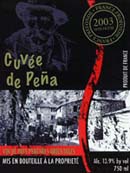
Cuvée de Peña, vdp Pyrenées-Orientales,
2003, $8. Find this wine
The label says Peña and the synthetic cork says Pène
(but the name could also be the Catalan “Penya”)—call it what you will, this wine is an excellent bargain. A balanced, medium-bodied blend of Syrah, Grenache and Mourvedre, this un-oaked and unfiltered wine from near Perpignan goes well with grilled meats. The hot 2003 vintage makes it clock in at 13.9% alcohol but it is silky smooth nonetheless. Buy this one by the case! Importer: Hand Picked Selections (Warrenton, VA).

Caparra & Siciliani, Ciro, Rosso Classico,
2002 $11.99. Find this wine
Are you tired of big reds, high in alcohol? Then this Ciro from Calabria in the boot of Italy is for you. Weighing in at an old-fashioned
12.5% alcohol, this red is light in color but that doesn’t shortchange the flavors of this 100% Gaglioppo. Soft tannins and a light acidity
complement the hint of red berries that make it an excellent and balanced food wine. In fact, I thought of the title of David Rosengarten and Josh Wesson’s Red Wine with Fish as some pan seared halibut would be a great accompaniment to this wine. Importer: Gregory Smolik (S Cubed Selection, Maverick Wine Co., Chicago).

Big reds

Cortes de cima, Chaminé, Vidigueira, 2002. $10.99. Find this wine
Portugal has long been known for Port but the quality of its table wines has been steadily improving over the last decade. There are many compelling examples made from indigenous grapes such as the Touriga, but this one has the unusual combination of blending Tempranillo (which has greater renown in Spain) and Syrah from Alentejo, in the south of Portugal. The result is a silky smooth and full bodied red with rich dark color and unctuous flavors, including notes of plum. The Jorgensen family owns and operates these vineyards using sustainable agriculture.
Importer: Tri-Vin (Mt. Vernon, NY).

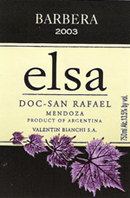
Elsa, Barbera, (San Rafael). 2003. $7 Find this wine

Barbera from Argentina? Yes, this classic grape of Piedmont has successfully relocated to the San Rafael district in southern Mendoza. Velvety smooth, with notes of strawberry and cherry and little of the acidity typical of Barberas, this new world interpretation of the old world grape is an excellent value. The single vineyard for this wine lies 2500 feet above sea level and the Bianchis practice sustainable agriculture and harvest the grapes by hand. If this is what Barbera can do in Argentina, Malbec should be shaking in its boots! Importer: Quintessential, LLC. (4,000 cases produced).
Chateau la Baronne, Corbieres, 2001, $9.99
If you have a hankering for the blends of Syrah, Grenache and Mourvedre from the south of France but have seen the prices rise above $10, then consider this wine currency relief. The 60% Carignan takes away the heft of Syrah and makes it a perfect transitional red for spring weather, lighter in color but full of spice, dark fruits and garrigue from the Corbieres in Languedoc. Hand harvested from a vineyard that practices sustainable agriculture and bottled unfined and unfiltered, this is one good red baronne. Importer: Louis/Dressner.

Ramon Cardova, Rioja, 2003 $11 Find this wine
Noah, Tevel, Judean Hills, 2002 (or 5762 in the Hebrew calendar). $14
About a decade ago Robert Parker reviewed a Spanish white lavishing praise in his prose and calling it “the best white wine
from Spain I have ever had.” Score: 88 points. I had similar feelings about these two kosher wines, which were both very good for Passover but I might not run to get them the rest of the year. However, those Passover-observing wine geeks who can’t bear the sight of Manischewitz ever again can rejoice that the quality of kosher wines has risen to the level on display here. The Ramon Cardova is a competent Tempranillo with traditional dark fruits, oak influence and soft tannins (importer: Royal Wine Corp). The Noah comes from the Judean Hills outside of Jerusalem and is a 60-40 blend of Cab and Merlot (importer Abaranel Wine Co). It is robust and full bodied despite being “mevushal,” a boiling process which previously meant something like “death to quality.” Advances in winemaking now mean simply that this wine can remain kosher even when served by non-Jews. L’Chaim! For more on kosher, click here.

Beyond the grade (but worth it):
Maison Bouachon, Vacqueyras, 2003. $18 Find this wine
Verget, Saint-Veran, “Terres Noires,” 2001. $18 Find this wine
Dehlinger, Syrah, reserve, 1997. $?? Find this wine

Target market: women! (part II)

Catching up on a story from last week, there is further segmentation of the market, this time the magazine market, with a new “wine magazine for women.” I’m not sure I understand the logic of limiting a magazine for wine-swilling, foodie, travel-junkies who don’t like numerical wine ratings to women–it seems there’d be plenty of men for that market too. The overt messaging of this magazine seems offensive to women–they don’t like/can’t do numbers nor do they want to get too serious. So while the idea seems good, the execution is too direct and blunt for my (male) taste. Given the high costs of launching a magazine, I wonder where they got their funding?

It is interesting even though the mag is billed explicitly “for women” that the interviews include all men as far as I can tell: Sideways director Rex Pickett, food and wine pairings by chef Bradley Ogden, a review of chef Anthony Bourdain’s latest book, etc. Why no interview with a woman winemaker such as Helen Turley or Susana Balbo? Oh wait, that’s too serious.

The First Wine Magazine for Women Launches July 2005; Wine Adventure Magazine to Feature Travel, Food, Lifestyle

SAN DIEGO–(BUSINESS WIRE)–June 23, 2005–Wine Adventure, the first wine magazine targeted to women, premieres in July. Wine Adventure, to be published bimonthly, focuses on the “softer” side of wine, with a lively mix of articles that will enhance readers’ knowledge and enjoyment of wine, without taking the subject too seriously. Read more…

Patricia Savoie, selling the wines of the world

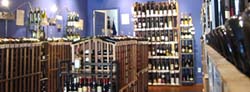
Big Nose, Full Body is celebrating its fifth year serving the Park Slope area of Brooklyn. Patricia Savoie started a new chapter in her life by purchasing the shop two years ago after a life-changing event: she lost her job.

Pat, a veteran of several large corporations including McKinsey, Nabisco, Cablevision and most recently IBM, specialized in strategy and marketing in her corporate life and contributed to IBM’s shift toward consulting and away from hardware. Ultimately, after several restructurings of the e-commerce consulting group, Pat was let go on September 10, 2001. She didn’t think her life could get any worse.

The trauma that New York and America felt that September left Pat doing some soul searching. She decided, as many Americans did after that fall, to pursue her passion. In this case wine had brought her much joy throughout her life. She and her former husband had joined several wine tasting groups in the 1970s and had even co-authored a book together, The Wine Tasting Course (1978).

A friend asked her to collaborate on an article for Wine Enthusiast and Pat started to think more about wine and writing. She then wrote two stories for Wine Business Monthly. But as her severance started to reach its end, she started to think more about cash flow as well as wine. Glancing through the New York Times business opportunities listings, she saw a wine shop for sale in Brooklyn. She thought, why not?

Two months later the shop was hers. The witty name and the décor of vivid blue walls and pressed tin ceiling are thanks to the original owners, a thirty-something Canadian couple who returned to Canada when they sold the shop.

But Pat has changed almost all the wines stocked in the shop, filling the store with the wines she likes, mostly from off the beaten path. The store will not have every wine from a given region, but it will have a few wines from almost any region, including Pinotage from South Africa, wines from Turkey and Slovenia, and a 100% Xarelo white from Spain.

“We have breadth not depth,” Pat told me on the phone recently. She currently has between 300-350 different wines, which makes for a lot of wine per square inch given that the shop is a mere 400 square feet (37 square meters). And with 80 wines under $10, free tastings on Saturdays, and occasional $5 bottles, it is a good place for readers of DrVino.com.

This selection and the service that Pat and her knowledgeable staff provide have led to a glowing write-up in the New York Sun, the Village Voice called the shop “the best neighborhood wine shop” in November 2004, and Saveur declared it their “favorite wine shop name bar none” in January 2005. “Now people in Manhattan may say ‘oh I’ve heard of that shop,'” Pat proudly proclaims.

Pat particularly likes two aspects of owning the shop: the customers and the opportunity to taste. The neighborhood feel means “we almost always have a baby stroller in the shop.” When a customer comes back to the shop and says “the wine was perfect,” she could not be more pleased. And being a good New York shop, they also deliver—free in the immediate neighborhood and for a fee elsewhere.

Being a shop owner means that wine distributors come and parade their wines in front of her on a regular basis. As a member of the trade, she also attends the numerous trade tastings in New York, always trying new wines. “My wine knowledge has increased a lot in the past two years,” she says.

But with the shop open until 9PM on weeknights and during the day on Saturday, Pat finds it difficult to keep up her wine writing—not to mention her social life.

I look forward to talking with Pat in the coming year about consumer preferences, labels, the role of critics and shelf-talkers, and wines off the beaten path among other subjects. I also look forward to watching her in action at a trade tasting. Should be fun stuff. Check back regularly.

www.bignosefullbody.com

Gregory Smolik, importing artisanal wines of Italy

Gregory Smolik has taken the plunge. In January 2004, at age 36, he left Sam’s Wines and Spirits, the large Chicago wine retailer, and went off on his own to import artisanal wines from Italy. He’s still in the start-up phase of his new life as a wine importer but his chances of success are good given his background, his philosophy, and ultimately, his wines. In the year ahead, Greg aims to add more producers and more US states that carry his wines.

During his six years as Italian wine buyer at Sam’s Greg presided over one of the largest selections of Italian wine under one roof. Sam’s had one 25,000 square foot store on the north side of Chicago with about 9,500 different wines in stock when Greg left (they have added a suburban location since then), so this is no corner shop. Greg built the Italian wine portfolio from 350 wines to about 2000 through several buying trips to Italy.

Greg was most excited about introducing new wines to consumers. He found many small scale producers in Italy, arranged to have them imported and sold at Sam’s. Some of these wines are no longer around but others have grown to multi-million dollars in sales.

Having visited numerous wineries, talked with hundreds of producers and sold wine to legions of customers, the transition to importer was an easy one. Greg knew what kind of wines he wanted to have in his portfolio and what kinds of labels would appeal to American consumers. “I didn’t want to have corporate wine that says ‘made in Italy’ but could really have been made anywhere. I care about where wine comes from, not a tank or a barrel. I have a story to tell and there’s a lot of passion behind that story,” Greg told me on the phone last week.

Fans of the big and oaky wines known as “super Tuscans” will be disappointed as rustic authenticity best summarizes what Greg looks for in a wine. He only works with family-run wineries in four regions of Italy: Lombardy, Campania, Basilicata, and Calabria. One of his producers, Cabanon is biodynamic. “I seek wines with the least amount of altering of the grape and the soil.” He describes his wines as “clean but expressive.” The wines in his portfolio retail in the $7 -$25 price range. Amazingly, he imports only about 1,200 cases of wine a year from four producers, but is looking to scale up.

An amateur musician, Greg also says that he is artistic and enjoys designing labels. But the bureaucratic side can be frustrating, as label approvals from the government authorities can take months. “I’m just starting out and can’t afford lawyers to rush them through,” he laments. “Label approval alone gives me gray hair.”

His wines are mainly available in Chicago, but he has recently picked up distribution in Nevada and Wisconsin. (Greg sells his wines to distributors who then sell them to retailers. His Illinois distributor, Maverick, has provided financial backing for him as well as a sales team.) Given his view that Chicago is “the most competitive wine market in the country,” he has cut his teeth on the hardest location and laid a good base for his expansion. He plans to add a dozen states over the next year including New York, Florida and Texas.

He is a passionate cook and the only thing he likes better than finding the right wine is finding the right food. The crisp white Falanghina paired with greens sautéed in garlic and olive oil, the fruity red Aglianico with the salt of veal—these are pairings that elevate the food and the wine, and drive him to keep finding good wines.

His wines have appeared not only in the leading shops in Chicago but also in some leading restaurants. Alinea, a cutting-edge new restaurant from chef Grant Achatz with a 25 course tasting menu, has included Greg’s I Portali wine with the squab. “A perfect match,” Greg declares with satisfaction.

In the next year, I look forward to seeing Greg in action, as he sells his wines, talking with him about logistics and labels, the financial side of the importing, and how he finds new producers for his portfolio. He’s off to Sicily and Campania for a week so we’ll check in with him when he gets back. Stay tuned!

What would you like to know about Greg? Send in your questions.

Greg currently has no website. That’s something on his plate for the near future.

> 6/30: Question from Terry in New York
I am fascinated with Greg Smolik’s venture, as I am now writing for the Italian wine blog Aristide and plan to help the owner of the blog do an English-language version based here in NYC. My main question for Greg (now): where does he think the US market for vitigni autoctoni (indigenous Italian varieties) will be in 5 years?

> 7/1: Greg’s reply
(Great timing for this question) What’s happening is a resurgence and/or a realization that good old fashioned wholesome quality can not only be attainable but that consumers are becoming more educated and particular in food AND wine especially in the U.S. where there is the drive to be authentic. Statistics prove that Americans love to travel especially to Italy and take as much of it in as they can, Appreciation for the culture, the uniqueness of the wines and confidence in themselves as far as pairing food and wine are all ways that can help me describe why I think indigenous wines will prosper in the next five years. I see indigenous or traditional flavors in wines catching up to all the great chefs who have been making food this way for some time, after all its not the presentation its the quality that goes into food and wine that makes someone come back, but I’m being wordy, I don’t think these types of wines will double in the next five years due to the fact that there are just so many Italian wines out there also there are too many financially powerful, over-marketed wines that leave the market bloated but I do believe that they have certainly taken root and will prove themselves as people are understanding more and more about the nuances and the essence of tradition, culture and genuinity.

Susana Balbo, making wine in Mendoza

balbobig.jpg

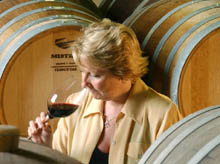
It was 25 degrees (-6C) in Mendoza on the morning that I reached Susana Balbo by phone last week. Nestled in the foothills of the Andes, the vineyard was dotted with workers pruning the vines down to stumps she said. But the winery itself was in its annual hibernation as the grapes were harvested two months ago and the wines were quietly fermenting.

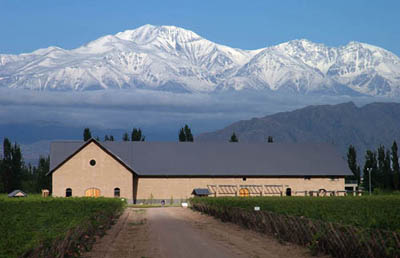
Although she and her husband, Pedro Marchevsky, started making their own wines in 1999, it wasn’t until 2001 that their striking winery, Dominio del Plata, which Susana designed, opened for making her three lines of wines. The wines include Malbec, Argentina’s signature grape, as well as more unusual offerings including Syrah-Bonarda, a rosé from Malbec, and the white Torrontés. They range from about $10 to $35 retail in the US and can be found in 17 countries.

Export markets have been essential for Susana since the concept stage of the winery. Her first winery, a short-lived venture in the early nineties, targeted the large domestic market in Argentina. Since then, exporting has become not only easier but essential. For example, when the Argentine peso collapsed in 2002 losing 75 percent of its value against the dollar, wineries with strong exports profiles actually saw their sales rise in peso terms (see my backgrounder).

A graduate in enology in 1981, Susana honed her winemaking skills during nine years in the Cafayate province. She returned to Mendoza in 1990 and refined her export skills as export manager during the mid-to-late nineties at Catena, one of the locomotives of the Argentine wine industry. She also designed the new Catena winery, a useful base for later designing her own. And she also met her husband there, since Pedro was the long-time vineyard manager at Catena, and the two were married in 1995. But they both left Catena to pursue their own winery together.

Susana is careful to draw on her experience at Catena but not the contacts that she made there. Her American exporter, Vine Connections, is a different importer than Catena’s American importer, an important point for Susana. She also maintains different importers in Europe than Catena. “All professionals want their own boats, to be their own captain,” she says.
The popularity of the wines abroad is having ramifications at home. In one way, Susana is starting to see more demand from the domestic market. As Argentines travel abroad again now that the economy is on a firmer footing, they are seeing her wines overseas and then come home and look for them. Further, foreign consumers are increasingly traveling to Argentina and the winery gets many calls for visits, but can hardly accommodate any of them. That’s something that Susana would like to work on more in the next year.

She also aims to do more experimentation in the vineyard. The 25 acres of vines are managed according to sustainable agriculture practices. But the real wild card in grape growing in Mendoza is the risk of hail storms that can erupt without warning just before harvest time, pound the plump grapes, and leave the vineyard owner with no crop. Thus Susana is trying strategic placements of nets of various colors and densities.

The winery is a family affair with Susana making the wines, while Pedro and his son manage the vineyards. Pedro’s daughter-in-law is an artist and designs all the labels. Susana’s son is currently a student at the University of California at Davis, the premier school for winemaking and viticulture in the US. One of the wines is called “Crios,” which means offspring and the label depicts two small hands in a big one symbolizing Susana and her two (now grown) children.

Susana is headed to Davis to visit her son and then take some time relaxing on the beach in northern Brazil. We’ll check in with her American importer next month. Over the coming year, I’ll talk with Susana more about the making and selling of wine and hopefully meet up with her in Argentina or America to see her doing one of the two.

www.dominiodelplata.com.ar

New Reality Project Tracks “a Year in the Life of” Three Wine Industry Participants

June 29, 2005

New York, NY – What does it take to be a wine producer? Or an importer? Or a retailer? Discover the inside scoop through a “year in the life of” three accomplished wine industry professionals. The new initiative, The Real Wine World, launches today on DrVino.com.

Taking a page from the reality TV playbook, the project will track three industry participants for a year. Susana Balbo makes wines in Mendoza, Argentina. Gregory Smolik of Chicago imports artisan Italian wines. And Patricia Savoie, owner of Big Nose, Full Body, who sells wines from all over the world at its neighborhood location in Brooklyn, NY.

Over the course of the year, the project will track the participants as they make or sell wine. They will offer insight into the industry, whether on technical winemaking questions or what works for selling wine. Further, the two non-producers will serve as an example of how to start-up professionally in the wine industry without owning or working at a winery.

The project is conceived and written by Tyler Colman (Ph.D., Northwestern). Colman is working on a book about the politics of wine in France and America. As a freelance wine writer with articles in consumer and trade publications, he writes about the business and politics of wine. He currently teaches classes on wine and politics at both University of Chicago and New York University.

Welcome to The Real Wine World

June 29, 2005

What does it take to be a wine producer? Or an importer? Or a retailer? Discover the inside scoop through “a year in the life of” three accomplished wine industry professionals. In this space, we will track one year of making and selling wine in three different parts of the world and watch how they do their business and overcome challenges.

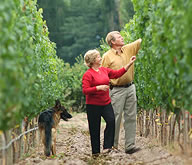
From Argentina, Susana Balbo brings 25 years of winemaking experience to her wines in Mendoza. She and her husband, Pedro Marchevsky, the vineyard manager, started their winery in 1999. The practice sustainable agriculture and export 90 percent of their wines to 17 countries. The winery is currently running near its capacity so how the manage their production, and the increasing number of tourists the wines attract, are key challenges for the coming year.

Susana Balbo, Making wine in Mendoza 6/29/05

In America, Gergory Smolik started his own wine importing company in Chicago in January 2004. He imports wines from four regions of Italy all from family-run wineries that produce only limited amounts of wine each year. Smolik believes in rustic authenticity. Prior to starting his own business, Greg was the Italian wine buyer for six years at Sam’s Wines in Chicago. In the coming year, he expects to grow his list of producing wineries and expand the availabillity of his wines in the US.

Gregory Smolik, Importing artisanal wines from Italy 6/29/05


Big Nose, Full Body is a wine shop in the Park Slope area of Brooklyn, NY. The shop is celebrating its fifth anniversary this year; Patricia Savoie, the current owner, purchased the shop two years ago. Since then it has won various accolades as well as a loyal following in the neighborhood. The small, smart shop stocks around 350 wines from around the world mainly in the $8 – $15 price range. With wines from off the beaten path places such as Turkey and California Charbono, Pat says “we have good breadth, not depth” to describe her store’s offering.

Patricia Savoie, Selling the wines of the world, 6/29/05

New York state of wine, part ii

Here at Dr. Vino world headquarters last night, we pulled a cork in celebration of the new wine law in New York. For the first time since Prohibition was imposed in 1919, wine consumers will be able to buy wines directly from out of state wineries. The Supreme Court ruled last month the New York system discriminated against out of state wineries in May. Yesterday, a mere 38 days after the Court’s ruling, the NY legislature passed the bill removing the barriers to interstate commerce. (story)

Legislators took on the state’s distributors and shops who stand to lose fractionally as some, mostly expensive, wines bypass these traditional channels. But the legislators had the support of the state’s 200+ wineries, third most in the country behind California and Washington. The wineries appear sold on the idea that people outside of New York will actually order their wines in sufficient quantity to make up for the loss of in-state sales as NY consumers shift their boutique wine budgets to the small wineries of Washington, Oregon and California. That may just be putting a brave face on the situation since the only other option for the legislature would have been to shut down all sales, which would severely impact the state’s wineries for the worse.

The new law, currently headed for Governor Pataki’s desk for an assured signature, will place a high limit of 36 cases per winery per year for consumers. (That’s right, 3 cases a month per winery.)

So which wine did we choose to celebrate here in New York? Why a Dehlinger Estate Pinot Noir 1999 from the Russian River Valley, a winery that we could “import” from in the future.


winepoliticsamz

Wine Maps


Monthly Archives

Categories


Blog posts via email

@drvino on Instagram

@drvino on Twitter


winesearcher

quotes

One of the “fresh voices taking wine journalism in new and important directions.” -World of Fine Wine

“His reporting over the past six months has had seismic consequences, which is a hell of an accomplishment for a blog.” -Forbes.com

"News of such activities, reported last month on a wine blog called Dr. Vino, have captivated wine enthusiasts and triggered a fierce online debate…" The Wall Street Journal

"...well-written, well-researched, calm and, dare we use the word, sober." -Dorothy Gaiter & John Brecher, WSJ

jbf07James Beard Foundation awards

Saveur, best drinks blog, finalist 2012.

Winner, Best Wine Blog

One of the "seven best wine blogs." Food & Wine,

One of the three best wine blogs, Fast Company

See more media...

ayow150buy

Wine books on Amazon: