Wherefore art thou: wine blog maps

Put a pushpin where you are!

Check out our Frappr!
Wine bloggers
(If you want to put a link back to your site, put in the full URL, e.g. http:// )

Check out our Frappr!
And another map for readers of this site! Granted, I’m not sure why anyone would want to do this, but hey, why not?! Google maps are cool.

Technorati tags: | |

Wine aromas: Ginestet perfumes


If you’re a wine lover, chances are you’ve thought about diving in a wine lake. Or maybe just splashing some wine aromas on you.

Well that is Christian Delpeuch is hoping. General director at negociant house Ginestet and head of the Bordeaux Wine Council (CIVB), Delpeuch has just launched a new line of wine perfumes. Her “Botrytis” is for Sauternes-ophiles who love the noble rot. “Le Boisé,” a unisex offering for oak enthusiasts, comes in a wood case (natural cross-marketing potential to American Chardonnay lovers). Now smell this, a perfume blog, reports that le boise has a blast of “very strong, very spicy cedar” that dwindles to oak and sandalwood. The perfumes retail for €53 per 100ml (but have been seen on eBay for $8.25 buy-it-now price).

But will she market her Sauvignon Blanc with pi-pi du chat? Or fresh cut grass?

How about the alluring musty cellar? Wet dog? Herbaceous or vegetative? Spin that aroma wheel, baby! A woman’s neck is certainly a more dignified place for surplus wine to end up than a gas tank.

Technorati tags: | |

Empire state, supersized

An AP story out today and a triumphant one in the NYPost report on an economic analysis that claims the wine industry adds $6 billion to the New York state economy. Really?

According to the news reports of the state-sponsored study:

Winery sales: $412 million. OK. With 31,000 acres of vineyards, 212 wineries, and 1,384 grape farms that sounds reasonable.

“…but the state industry’s multiplier impact on the economy came to $3.4 billion in 2004.” Whoa! I gotta get me one of those multipliers!

“That was topped off with $2.6 billion in direct and indirect economic benefits from the wine-and-grape industry in other states and countries.” Whoa-ho!

Talk about value-added!

Technorati tags: | |

Halliday launches a bomb

Robert Parker, criticus maximus, may be known for admiring wines that he calls “hedonistic fruit bombs.” But it is Australian wine writer James Halliday who has launched a verbal bomb at Parker that started a squabble among the world’s top wine critics.

In a speech in Sydney last week, Halliday lit the fuse as Decanter summarizes: “He said the trophy results of the last six Sydney Royal Wine Shows showed that Australian judges clearly preferred wines with finesse, such as Clare Valley Rieslings, to the ‘monstrous red wines so beloved of Robert Parker’, from regions like the Barossa Valley.”

Halliday then turned to Matt Kramer, who writes a column for Wine Spectator, calling Kramer “even more misguided than Robert Parker.”

Parker shot back on his bulletin board calling the style of wine that Halliday likes from Australia to be “Euro-imitations” that are “vapid, innocuous and in truth no better than very minor wines (and much cheaper)of Europe…all made by the formulas laid out by Brien Croser(add acid, then add more acid to denude any texture or trace of a wine’s place of origin).” He underscored his admiration for the “old-vine shiraz and grenache treasures” of Borossa, McLaren Vale, and Clare Valley.

Jancis Robinson then posted the Halliday speech on her site as well as a full-throated defense of Parker by his co-author David Schildknecht. Pierre-Antoine Rovani, another co-author in the Wine Advocate, accused Robinson of not being even-handed (among other things). Robinson has put some of this back and forth behind her paid subscription barrier but there is a free 15-day trial.

Yikes. While Parker does like some odd, almost freakish Australian wines such as the disjointed and unbalanced Connor Park, The Honour, Shiraz, 2002 (17% alcohol, 95 points; find this wine) he also gave 45 Australian Rieslings in his latest newsletter 90 or more points. Will all parties heed a call for balance in criticism of other critics?

**UPDATE
For what it’s worth, I was just doing a review of the NYT and WSJ columnists and was surprised that Asimov had written not one article on Australian wines in the last year while Gaiter and Brecher had written only one (trashing cheap Aussie Chardonnays). Are they steering clear of the Aussie thicket?

Technorati tags: | |

Crush Wine Co

You’ve probably read about it. Or seen it. If not been there. Crush Wine Co: New York’s hottest new address for wine.

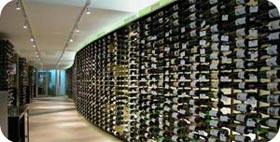
The most stunning feature is no doubt the display, an undulating 73-foot wall of backlit wines, all lying on their side. The Rieslings catch your eye as you walk in the door and it’s hard not to shuffle down the wall, head cocked to the left, taking in all the great wines, organized by varietal, as they often are on restaurant menus.

But the shop has two other eye-catching features: a sleek tasting room shaped like a large barrel on one side and a temperature controlled storage area with glass walls called “the cube.”

In the tasting room, tasting happens. While many wine shops have free tastings on Saturdays or pop open a bottle or two after 5 PM, the staff at Crush stand ready to pour at any hour (I recently stopped by at noon on a random Wednesday and was offered a taste). The tasting glasses are stylish Ravenscroft crystal vessels that you can squeeze two fingers into and not warm up the wine. On special events, such as a recent book signing or the debut of a new Mumm champagne, the stylish furniture and tables are removed from the tasting room and Riedel glasses brought in.

In the cube, a selection of hard-to-find wines runs deep, in the case of Opus One when I was there the other day, about five feet deep of six-bottle cases. With their big points and high prices, it’s nice to know this room exists but the value vino runs along the serpentine main wall.

I thought that all this cool and chic would come at a price, but there is a solid selection of wines under $15 (they claim 150) and an excellent selection between $15 and $25 (bargains for NYC). I searched the web and found their prices to be very competitive for wine shops in New York City.

Thanks to the store’s relationship with the Myriad Restaurant Group, the shop is able to score some hard to find wines. A staff member told me that Luddite Vineyards of Sonoma sold half its microproduction Pinot Noir rose to the shop and the other half to the French Laundry. Now that’s good company–but what do you expect when Drew Nieporent is a co-owner and he owns Montrachet, Tribeca Grill, and Nobu among other restaurants.

Wunderkind Lyle Fass is the wine director and rumor has it that he could be assuming more of the restaurant duties since Daniel Johnnes went to Daniel after twenty years at Montrachet as sommelier.

The shop is not an on-premises facility although if you live in the area, you might be tempted to treat it the same as a restaurant. The shop has a clever “delivery menu” with wines arranged by different types of take-out food. One call for the food, the other for the wines. Let your fingers do the walking.

www.crushwineco.com 153 E. 57th (bet 3rd and Lex) 212-980-WINE

UPDATE: See my map of New York wine shops.

Technorati tags: | |

French twist?

The French government may mandate labels with a health warning for wine bottles the BBC reports. France is the world’s largest wine producer by value so this comes as the latest blow in what is has been an Annus Horribilis for the French wine industry.

While it’s hard to be against government labels suggesting common sense things like warning pregnant women of the dangers of alcohol consumption it does seem awfully, uh, American. How about a French twist on the labels and remind consumers about the health benefits of wine? They could start with the ingredients of the Mediterranean lifestyle.

WS scores Parker

I guess the Wine Spectator’s annual top 100 list is out–I just got three emails from wine retailers touting their availability of wines from the list. While I haven’t seen the whole list, I was interested to see from one retailer that Beaux Freres 2003 Pinot Noir (95 points), a winery partially owned by Robert Parker, was #17.

The big question: will Bob use a WS score to promote the wine?!?!?

Value vino list sixteen

Whites
Burgans, Albarino, Rias Baixas, 2004. $11 Find this wine
Just because the summer is winding down doesn’t mean that you have to abandon this crisp white from northwestern Spain. A cooperative formed 20 years ago in Galicia, Martin Codax makes this custom cuvee for the American market. The steel tank fermented Albariño had notes of peaches and green apples and is great for impressing lovers of kiwi Sauvignon Blanc—at a lower price. Try with grilled white fish or cheeses, consumed indoors or out. Importer: Eric Solomon.

Simonsig, Chenin Blanc, Stellenbosch, 2005. $9.99 Find this wine
Having sampled the 05 vintage from Beaujolais, I’m getting my “freshly squeezed” wine from the southern hemisphere for now. This Chenin Blanc is crisp and clean with neither too much acid (though there’s a great zip) nor too much floral/sweet notes that can be annoying in the grape. Surprisingly, cheese wasn’t much of a food pairing but it was great with grilled fish with Asian glaze. Hmm, a butternut squash soup with a grind of pepper would be good too I bet. Yum, I think I’m going to have to find another bottle of this one. (Importer: Quintessential, Napa, CA. 28,000 cases made)

Hugel, Gentil, 2003 $10. Find this wine
This wine recently stumped my class in a blind tasting. A Gewurtz? A Riesling? A Pinot Gris? In fact, it is all three with a bit of Muscat and Sylvaner thrown in too. If that sounds like a hodge podge, it actually makes for a great bit of value vino. It has the lush mouthfeel you might expect from an American Chardonnay but none of the oak. Floral notes leap from the glass and the light sweetness is not cloying is balanced with acidity that makes it an excellent match for Asian food or seafood. Not bad for a family who has been making wine since 1639! Importer: Frederick Wildman.

Basilium W., Pipoli, Chiaro, IGT 2004. $8 Find this wine
This wine has an identity problem—it drinks like a red but looks like a white. It is actually a white wine made from red grapes but the skins were removed immediately from the fermentation process to lighten both the tannins and the color. But the substance remains, which along with the low 12% alcohol, makes it an excellent match for the cuisine of late summer and early fall. It’s never been easier to discover Italy’s “indigenous varietals” here in the US so try something different. (Gregory Smolik Selection, Sauvage Selections, Bensenville, IL) Read more about Gregory Smolik and this winemaker.

Medium-bodied reds

Fontaleoni, Chianti, Colli Senesi, 2004. $11. Find this wine
The theme at this week’s Wine Media Guild lunch was “Out of the Zone: Chianti NOT from the Classico Zone.” I went because I am generally lost when it comes to Tuscan wines. Two wines really stood out from the 25 or so that we tasted, this wine and another one. When I realized that this wine was around $10, I said “booyah!” (well, not out loud). The other standout was a Super Tuscan from Castello di Poppiano, so, alas, it was no value vino. This Fontaleoni, however, a blend of Sangiovese and Canaiolo, is a great food wine—and I don’t mean that to be derogatory. The high acidity characteristic of the wines from this area just goes great with food, especially cheese or other fatty foods. The acidity in the wine is balanced with supple tannins, dark fruit aromas and an excellent, long finish. Yum, this wine is an excellent value! I’ll be stocking this one in the Dr. Vino cave for the holidays. Importer: Michael Skurnik, Syosset, NY.

Scala Dei, Negre, Priorat 2002. $11. Find this wine
This fall I have enjoyed tasting many wines from Priorat, the craggy, inaccessible wine-growing corner of northeastern Spain. The vertiginous hillsides produce powerful and, sadly, prodigiously expensive wines. One of my favorites from the “reasonably” priced wines was the Scala Dei Cartoixa Reserva 2000 (about $26; find this wine), which is complex and brooding thanks to old vines and a good helping of Cabernet Sauvignon. Fortunately, the monastery-turned-winery (see photos at BK wines) has a value vino priced offering in its Negre 2002. This young red wine has a light sweetness that’s typical of Grenache and pairs well with food,
such as a salad with grilled salmon and a hunk of rustic bread. Scala Dei means ladder to heaven—see if your ascension starts here. Importer: Vinum International, Napa, CA.

Chateau de St. Cosme, Little James Basket Press Rouge, $10 Find this wine
This light-hearted label has six light-hearted images—but no vintage and no varietals. Sound like a stunning lack of information even by French standards? Well, that’s because it is a lowly vin de table, a category that dwindles in production volumes every year. Chateau de St Cosme is a well-reputed Gigondas producer owned by Louis and Cherry Barroul who have made this vat-aged Grenache in honor of their son James. Vin de table rules don’t allow a vintage but this current batch is from the 04 vintage. The light sweetness of Grenache and the fruit-forwardness of the wine make it a good match for autumnal foods. This is good example of what clever winemakers can do inside the bottle and out—French wine makers in distress should use this as a point of reference. Imported by Stacole Fine Wines, Boca Raton, FL.

MontGras, Reserva Carmenere, Colchagua, 2001. $9.99 Find this wine
This wine is built for the long haul. It’s not just that it came all the way from Chile, but in the under $10 universe, it’s one of the rare performers that can be as good on day 2 as it was on day 1 (assuming, that is, there’s anything left after day 1). The winery is only a little more than a decade old and Paul Hobbs, superstar flying wine maker from Sonoma, consults. Inky purple in color, aromas of dark fruits, leather and spice leap out of the glass and the wine is lush and balanced with smooth tannins on the palate. This “forgotten” Bordeaux varietal of Carmenere has found a good home in Chile. Try this excellent value vino with smoked meats or firm goat cheeses. Importer: Palm Bay Imports.

Full-bodied reds
Elsa, Syrah, Mendoza 2004. $9 Find this wine
This value vino comes in a new package. The second vintage of Syrah for the Bianchi family of southern Mendoza sports a new, larger bottle and a swanky redesign of the label (a big grape leaf background.) Fortunately this bottle need not be judged by its cover since it what’s on the inside is more important. More in the style of the northern Rhone than a brash shiraz from down under, this elegant wine punches above its weight. Although I didn’t have the Barbera, I found this syrah to be the strongest of the Elsa line at a recent tasting. Pair with autumnal foods-I’m thinking anything with a mushroom sauce would be good. Imported by Quintessential (Napa, CA).

Cousino-Macul, Cabernet Sauvignon, Antiguas Reservas, 2002. $12. Find this wine
This wine combines two of the most overused and underspecified wine terms: “old” and “reserve.” At Cousino-Macul, the line was developed originally at their Macul vineyard in what is now downtown Santiago using old vines. But this current bottling comes from their newish vineyard in the Maipo Valley’s region of Buin. As opposed to the regular Cab, this wine sees 12 months of aging in French oak and a further six months bottle aging. Those dark fruits, tobacco, leathery notes of Cab shine through in the wine—a comparable wine from California would be at least double the price. Importer: Billington Imports.


winepoliticsamz

Wine Maps


Monthly Archives

Categories


Blog posts via email

@drvino on Instagram

@drvino on Twitter


winesearcher

quotes

One of the “fresh voices taking wine journalism in new and important directions.” -World of Fine Wine

“His reporting over the past six months has had seismic consequences, which is a hell of an accomplishment for a blog.” -Forbes.com

"News of such activities, reported last month on a wine blog called Dr. Vino, have captivated wine enthusiasts and triggered a fierce online debate…" The Wall Street Journal

"...well-written, well-researched, calm and, dare we use the word, sober." -Dorothy Gaiter & John Brecher, WSJ

jbf07James Beard Foundation awards

Saveur, best drinks blog, finalist 2012.

Winner, Best Wine Blog

One of the "seven best wine blogs." Food & Wine,

One of the three best wine blogs, Fast Company

See more media...

ayow150buy

Wine books on Amazon: