Value vino list seventeen

Vinum, Chenin Blanc, Stellenbosch, 2004. $11 Find
this wine

As spring approaches and the weather improves, Chenin Blanc makes for a great spring transitional wine. And with temperatures in the high 60s today, spring is in the air. In the past week, I tried five Chenins and this cheapest one (and only new world one) stood up well, perhaps because the non-interventionist team in South Africa is headed by Frenchman Edouard Labeye. Light notes of flowers,
a squeeze of lime, and faint vanilla infuse this snappy value vino. Serve it with fish or appetizers or wherever you would have had American Chardonnay 5 years ago. Importer: Vinnovative Imports, Charlotte, NC. 5,000 cases produced

Bodegas Naia, Las Brisas, D.O. Rueda, 2004, $9. Find this wine
Not so long ago white wine from Spain was dismissed as industrial plonk but several regions have been coming along and raising the country’s profile.
Rueda, a region on the Castilian plain (where it doesn’t rain all that much actually), has started making some crisp and lively whites based on the Verdejo grape. In this Las Brisas, Sauvignon Blanc and Viura blend with Verdejo to make a wine that has crisp acidity with floral notes–think orange blossoms. It’s a great wine for summer weather but even in the winter, it pairs well with soft cheeses or grilled white fish. Importer: Jorge Ordonez.

Quinta do Dorado, Auratus, Alvarinho/Trajadura, 2004. $13 Find this wine
Snappy and crisp, this refreshing wine has a certain softness to it that makes it more appealing than many Sauvignon Blancs from the New World-or
even albariños from north of the border in Galicia. This is a cross-border wine: Spaniard Marcial Dorado crossed into Portugal to find a 70 year old vineyard planted with the Albariño/Alvarinho grape. He started to farm the vineyard organically, reduced the yields, and hand harvested the grapes, which preserves them intact better than machine harvesting. He also built a winery that relied on the flow of gravity to run the juice through the various stages of fermentation and maturation. The resulting wine is the best white wine I have ever tasted from
Portugal, granted a small category, but it really is an excellent wine. Try with seafood or stir-fry. Importer: Vieux Vins, Vinesbrug, CA.

Casa Castillo, Monastrell, Jumilla, 2003. $10 Find this wine
Murcia once was a region known for its sausages. Now the wines are giving the sausages a run for their money. Located on the Mediterranean coast just below Alicante, the wine growing region of Jumilla lies inland at an altitude of 2,000 ft with hot summer days and cool nights. This red, dark in color and rich in flavor, definitely punches above its featherweight price tag. Try with sausage (from Murcia?). See pictures of the arid vineyard here. Importer: Jorge Ordonez.

Falesco, Vitiano rosso, IGT 2004. $9 Find this wine
Readers of this web site sometimes write in that they have trouble finding the wines I recommend (but a lot less since I started adding a link to online retailers) but that shouldn’t be a problem with 200,000 cases of Vitiano produced. This bargain red blend-equal parts Cabernet Sauvignon, Merlot, and Sangiovese-is made by Ricardo Cotarella at his own winery though his fame as a consulting winemaker
led Robert Parker to call him “Italy’s answer to France’s Michel Rolland. . .” The resulting wine is a great pizza wine that is light in color and
in alcohol with crisp, clean notes of dark fruit. While still a good bargain, it was an even better bargain a couple of years ago when it was a couple of dollars cheaper. Importer: Winebow, Montvale NJ.

Domaine Lafond, Roc-Epine, AOC Lirac,
2003. $12 Find this wine
Located where the southern Rhone drifts into Provence, Lirac proves to be good ground for this wine that resembles a Chateauneuf-du-Pape but at a fraction of the price. (yes, it is over $10 but hey, it’s only about 5 US Postal stamps more.) This wine has a terrific complexity for the price with balanced notes of dark fruit and tannin and a long pleasant finish. An excellent mushroom-chard
pasta was a great food match. Jean Pierre and Pascal Lafond of Lirac, you rock! Importer: Wines of France: Mountainside NJ.

Terrazas de los Andes, Malbec 2004. $9. Find this wine
Polyphenols, they’re all the rage. No, they’re not a chemical additive dumped into wines by industrial wine makers; instead they are chemical compounds, high in antioxidants, that may fight cancer. Since polyphenols occur naturally in red wines, enthusiasts and the producers of red wine have been quick to make tout the health benefits of red wine (yes, something we enjoy doing may
actually be good for us). According to a 2001 study in the magazine Nature, the high elevation of the Argentine vineyards gives their reds more exposure to ultraviolet rays and raises the polyphenol level. So don’t reach for a bottle of POM pomegranate juice, reach for an Argentine Malbec. This Terrazas is a great place to start. After tasting through a half a dozen entry-level Malbecs, I found this 100% Malbec
grown at 3,000 ft above sea-level to be the most attractive. Dark in color, with notes of blackberry, plum, cassis, and saddle leather, and the tannins in the finish were smooth. The obvious food pairing is a steak but would also be good with burgers. Importer: Schieffelin & Somerset, NY.

Le Petit vin d’avril, NV $9. Find this wine
Father and son team of Paul and Vincent Avril of Clos des Papes make great wines. The only trouble is that their 2003 Chateauneuf du Pape is about $40-for a half bottle! If you can find it, that is, since it snagged the #2 WS wine of the year (yoink–not as if that means anything to us). The Avrils have made this excellent nonvintage “table wine” that is exemplary in two ways: a light-hearted
label and punching well above its weight. The wine is light in color and has the gentle sweetness that is characteristic of Grenache as well as dark berries and a faint spice. It is balanced with a mere 13% alcohol—I’m heading back to the store where I got it and stocking up! Importer: Wines of France, Mountainside, NJ.

Tres Picos, Garnacha, D.O. Campo de Borja, Spain, 2004, $9.99. Find this wine
Like rivals the Capulets and the Montagues, Grenache and Tempranillo have been duking it out, in this case, for red grape domination in Spain. With an old-vine Grenache value like this, it would be shocking if the Tempranillos
didn’t just lay down their swords. From the obscure Campo de Borja region comes this beauty with notes of red berries and earthiness. I included it in a recent tasting with wines three times the price and it had no problem keeping up. The heavy glass bottle makes for a nice presentation — rate this one a great value gift wine! Importer: Jorge Ordonez, Dedham, MA.

Bouvet
signature Blanc Saumur, NV $8. Find
this wine

Sparkling wine is a contentious issue. Not for consumers who
gladly sip the stuff at weddings and graduations. But for producers from outside
the Champagne region who chafe to free ride on the term Champagne. (While such
usage has been stamped out in the EU, a recent accord has let the issue bubble
in America.) In France, there are several sparklers from other areas beyond Champagne
and this is a particularly attractive price-to-quality ratio from the Loire. A
pale yellow color and a fine bead appear in the glass with pleasant crispness
and surprising depth. The grape is almost all Chenin Blanc, which adapts very
well to the methode champenoise that Bouvet employs. While dyed-in-the-wool Champagne
enthusiasts will no doubt recoil at the thought of a sparkler not from the sacred
region, this is a choice that is easy on the palate and on the wallet—a welcome
relief for the party host or the father of the bride. Importer: Kobrand, NY.

Still value vino,
but higher prices

See Making
a case: 12 gift wines

Capcanes, Costers del Gravet 2001 $20. Find
this wine
Allende, Rioja, 2001. $25 Find
this wine

Honig, Cabernet Sauvignon, 2002, $30 Find
this wine

See previous list of value vino

Great on the palate and on the wallet

Whoever says that you have to spend a ton on each bottle to have a great evening is wrong. However, moving out of the “cheap and cheerful” under $10 category when you have guests over certainly does pay rewards. We had some non-wine friends over a couple of weeks ago here for a late afternoon/evening meal at the Dr. Vino World Headquarters and assembled this line-up:

Domaine de Baumard, Clos du Papillon, Savennieres, 2002. $25 (find this wine) Importer: Ex-Cellars, Solvang, CA.
What a wine to lead off with. Delicate yet intense, floral and almost sweet with an invigorating minerality and a long finish. Everyone was blown away. It was gone quickly.

Vignoble Guillaume, Pinot Noir, vin de pays Franche Comte, 2004. $17 (find this wine) Importer: Fleet Street, Moorestown, NJ
A clean pinot that is Burgundian in style with a great balance of acidity and fruit. One pinot lover with an admitted preference for new world styling admitted to disappointment. But I found it a great transition wine to the reds. It was still light out at this point, so I didn’t really want anything too heavy.

Clos Roche Blanche, Cabernet, AOC Touraine, 2004. $15 (find this wine) Importer: Louis/Dressner.
Mmm, terroir. This Cabernet (Franc and Sauvignon) from the Loire has great balance between acid and tannin, mineral and fruit. Some people were scratching their heads at first but paired with quince and manchego they attacked it with gusto.

Honig, Cabernet Sauvignon, 2002. $27 (find this wine)
A more familiar style for some with a lush, rich mouthfeel of tobacco, leather, dark fruits, and vanilla. It’s like a 700 thread count of California Cab.

Macallan, 18 year old whisky. (find this whisky)
Going out in style. This bottle had done some additional aging in our cabinet because we drink whisky at a slower drip than any IV. I think this bottle had been with us for three moves in fact. One friend who loves whisky saw it and insisted on a round. I’m glad he did. Once I got over the straw aromas and the burning in my throat the finish was very smooth. Much more smooth than the Knockando 12 year that we had to try in comparison apparently.

Who knows, we might even get some whisky glasses? Otherwise everything we had was in Tritan Forte stemware. Unbreakable! And like the wines here, they were easy on the wallet.

tags: | |

The old Astor

Astor Wine and Spirits, a Greenwich Village New York institution is no longer on Astor Place. After 40 years on the corner of Astor and Lafayette, a case of greedy landlord raised the rent too high for the wine store. CVS will soon occupy the space.

But Astor lives! They have moved down the block to Lafayette and 4th and will retain the name Astor Wines. The old space was admittedly looking a little dingy but it had huge storage capacity in the basement. The swanky new space has 50 percent more floor space but less storage space. More to follow on the new space tomorrow…

tags: | |

Hot Chile

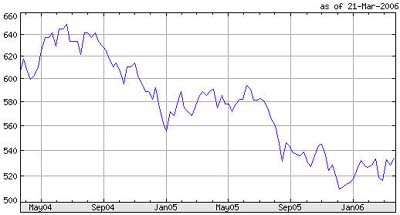
Fifty protestors crashed a harvest festival in central Chile that the Minister of Agriculture was attending. (link) Their gripe? Grapes, and the declining prices thereof. A rise in the Chilean peso by about ten percent over the past year has crimped the margins of Chile’s wineries, which rely on strong exports. The wineries are paying less this year for grapes, sometimes as much as 50 percent less. My question: will Chilean wines lose the cost advantage they have enjoyed in the US?

1 USD in pesos
Peso’s gain, growers’ pain

tags: | |

Check out the size of those…


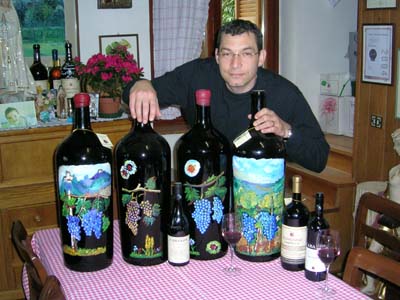
…bottles! Greg is in Italy now visiting Cabanon, a biodynamic producer in Lombardy whose wines he imports. The cousin of the wine maker painted each of these 12 liter bottles (16 normal 750ml bottles! Each must weigh 50 pounds). These massive bottles contain the 2001 La Botte 18, cuoredivino. Greg writes that this Bonarda is only made in “exceptional vintages.”

So does the price per ounce go up in a bottle like this I wonder? One would assume but how often do you need 16 bottles of the same wine? But then again, who wouldn’t want to cackle, “ha! I spit on your little magnum!”

We’ll ask him the prices when he comes back and we catch up with him in The Real Wine World!

tags: | |

Better know an AVA – Texoma

Name: Texoma

Date of birth: January 6, 2006 (link to pdf of birth announcement)

Size: 3,650 square miles (2.3 million acres)

Includes: Currently 55 acres under vine (out of the 2.3 million) and four vintners. The area includes Montague, Cooke, Grayson, and Fannin Counties.

Parent’s comment (TTB): “We designate viticultural areas to allow vintners to better describe the origin of their wines and to allow consumers to better identify wines they may purchase.”

Somewhere along on the Texas-Oklahoma border one of America’s newest AVAs, or American Viticultural Areas, was recently born. It was found along the banks of the Red River and the 89,000 acre Lake Texoma, built in the 1940s by the Army Corps of Engineers and now known as a recreation area with power boating and bass fishing (more).

Despite it’s hefty size, the AVA weighs in only at eleventh in AVAs (list). Like all infants, it trades more on future promise than past results. It currently has four wineries in the 2.3 million acres: Texoma Winery, Grayson Hills, and Homestead Winery’s two locations.

Let’s give ’em a big welcome!

(Homage a Colbert)

tags: | | |

Tasting sized pours

Trader Joe’s grocery store opens in New York City today! The address of the wine store, not yet open, 138 E. 14th Street (it won’t stock any beer). I’ve added it to my map of NYC wine shops.

Wine domain names (internet domains that is) shoot up in value… [Decanter]

…while French wine estates (brick and mortar) in Languedoc decline [IHT]

But why even bother with a winery? Not a problem for a new wave of wine makers [Bloomberg]

Wine for the jet set? Airport wine bars on the rise [Upgrade]

Jon Bonne muddles through red Burgundies from the 2003 heat wave. I also like his top pick, the Tollot-Beaut 2003 Aloxe-Corton Premier Cru ““Les Vercots” (find this wine, about $43, imported by Diageo Chateau & Estate) [MSNBC]

Wine Sediments, a group blog, emerged from the fermentation tanks last week. Mark Fisher leads five “sedimentarians” with fresh, daily posts [Wine Sediments]

And a hilarious, totally non-wine photo journal of how to maximize your ROI at the Pizza Hut salad bar [link]

tags: |

Wireless message in a bottle

Riders of public transport in Chicago or Oslo know RFID technology. Bump your wallet at the turnstile and off you go–no fumbling to swipe cards. Same with skiers at some ski resorts. And drivers in the Northeast know the technology as well through E-ZPass toll collection.

The same technology is coming to wine. Through an RFID sensor placed in the (synthetic) cork, importers, stores and consumers can now give each bottle a unique ID. While barcodes SKUs work for all the bottles of a certain wine as a group, this technology gives each individual bottle a unique–and unchangeable–ID. And unlike bar codes, boxes don’t have to be opened nor bottles taken off shelves to see more info about the wine. You just need to wave an RFID reader, which even comes in some Nokia phones, about 2 inches from the bottle and voila, all the info gets displayed.

The implications for consumers could be big. At the cost of $0.50 each though to the winery, it’s most likely impact will be on higher-end wines. Given the problem of fraud at auction, this would put an end to wondering if you bought the real deal or not. Optional fields could trace the bottle’s previous owners and even track the hammer prices. Sadly though the technology is difficult to put into real corks and the uptake of synthetic corks in cult wines remains almost nonexistent. It is currently available in one wine, the Contemporare from Arnaldo-Caprai, an excellent sangiovese (find this wine).

But it could have an important impact on everyday drinking wines too. An optional setting could add a temperature sensor that tracks max and min temperatures during shipping. If consumers could buy a bottle with the knowledge that it hadn’t been cooked in transit, that’s something to which we could all raise a glass–and our RFID readers!

tags: | |


winepoliticsamz

Wine Maps


Monthly Archives

Categories


Blog posts via email

@drvino on Instagram

@drvino on Twitter


winesearcher

quotes

One of the “fresh voices taking wine journalism in new and important directions.” -World of Fine Wine

“His reporting over the past six months has had seismic consequences, which is a hell of an accomplishment for a blog.” -Forbes.com

"News of such activities, reported last month on a wine blog called Dr. Vino, have captivated wine enthusiasts and triggered a fierce online debate…" The Wall Street Journal

"...well-written, well-researched, calm and, dare we use the word, sober." -Dorothy Gaiter & John Brecher, WSJ

jbf07James Beard Foundation awards

Saveur, best drinks blog, finalist 2012.

Winner, Best Wine Blog

One of the "seven best wine blogs." Food & Wine,

One of the three best wine blogs, Fast Company

See more media...

ayow150buy

Wine books on Amazon: