Tasting sized pours

St. Emilion announced the brand new 2006 clasification yesterday (see my backgrounder). Stephen Brook, author of Bordeaux: People, Power and Politics, sums it up for Decanter.com. The garagistes were excluded.

In a twist, W. R. Tish critiques the critics and rates the magazines that rate wines. Wine and Spirits ends up smelling like a rose–with a hint of pipe tobacco and blackcurrant. Oh wait, points! He rates it a 91. [Wines & Vines]

With 14.8 million visitors in 2003, tasting rooms are bulking up the bottom line for California wineries. More evidence that wine by the glass is highly profitable to those doing the pouring. [SF Chron]

Does Sonoma mean Sonoma? Jess Jackson and the California legislature say yes; Korbel and the Wine Institute say no. It’s up to Gov. Schwarzenegger to sign the bill, as he should. [Press Dem]

UPDATE: Pete Wells, James Beard Award-winning author and NOT on the staff of the NYTimes, has been named the new editor of the Dining section of the Times. An outside hire? A great writer? Sounds excellent to me! [Eater]

tags: | |

Free wine, last call!

Win a half-a-case of wine (better than none!) in the quiz–ends tonight!

http://www.drvino.com/winequiz2006.php

And don’t forget to join me tonight for tapas and vino starting at 6:30 PM. Alas, no free wine though. So take the quiz!

Bar Carrera
175 Second Ave @ 11th
Review here
Map here

tags:

Bad Boy, the table wine

Jean-Luc Thunevin is a “bad boy.” So says Robert Parker. The maker of the vin de garage Valandraud may have turned heads thus far in his brief career as a vintner but now he’s turning tables–table wine, that is.

This vintage will be the first vintage of “Bad Boy,” the table wine, produced by Thunevin. Making a quality wine in the administrative category vin de table is a rarity in France.

“The appellation system is still very important for the French consumer,” Jean-Luc Thunevin told me recently. But he is willing to forego it for this wine in order to radically experiment with this wine.

Bad Boy will be a blend of 70-30 blend of merlot and grenache. The grapes for this unusual blend will come from St. Emilion and Thunevin’s property in the Roussillon, respectively. Michel Rolland will be the consulting enologist. “He’s the best blender,” Thunevin told me. The wine has not yet been priced.

The wine will have a picture of a black sheep on the label and Bad Boy in large font.

Vin de table is rare in France since restrictions prohibit producers from stating either the region or even the vintage on the label.

Related: “Merlot-grenache” [Dr. V]

tags: | | |

St. Emilion, revised edition

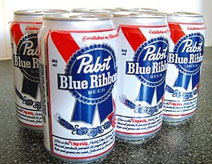
Pabst Still Coasting On 1893 Blue Ribbon Win
-The Onion

So what’s wrong with the 1855 classification of red wines from the Medoc? We can sum it up succinctly: the Pabst problem. It’s resting on its laurels.

The classification was a snapshot and not a moving picture. Several houses riding high in 1855 have since plummeted or been acquired by others. One chateau, Mouton-Rothschild, headed the other way and was promoted to first growth status as recently as 1973, the first and only change to the system cast on parchment.

But over on the Right Bank, they’ve got a moving picture. Granted, we’re talking one frame per decade but at least that’s more dynamic than over in the Medoc.

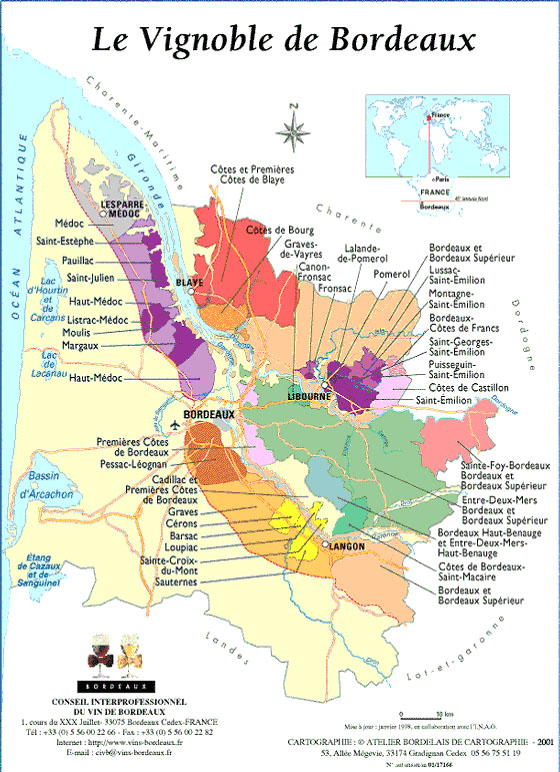
The wines of St. Emilion (see dark purple on map) were first classified only in 1954. Unlike the 1855 classification with 61 properties distributed over five “growths,” or classes, the St. Emilion classification divides 55 proprties into two categories of average and above average. Actually, that would be too humble: the two categories are mere “great growths” (42 chateaus) and “super great growths” (13).

Well, tomorrow is the big day for the announcement of the next revision. The big phenomenon in the region in the 1990s was the emergence of ultra-premium vins de garage that were not included in the last revision in 1996. More garagiste wine makers than you could shake a gigot d’agneau at have hit their stride since then. If the revision is truly dynamic, it should expand beyond the current 55 members and include some of the garagistes. Stay tuned for part deux tomorrow…

St. Emilion Classification, 1954 (1996 edition)

FIRST GREAT GROWTH CATEGORY A

* Château Ausone
* Château Cheval Blanc

FIRST GREAT GROWTH CATEGORY B

* Château Angélus
* Château Beau-Séjour Bécot
* Château Beauséjour (Duffau-Lagarosse)
* Château Belair
* Château Canon
* Château Figeac
* Château La Gaffeliere
* Château Magdelaine
* Château Pavie
* Château Trottevieille
* Clos Fourtet

GREAT GROWTHS

* Château Balestard La Tonelle
* Château Bellevue
* Château Bergat
* Château Berliquet
* Château Cadet Bon
* Château Cadet-Piola
* Château Canon La Gaffeliere
* Château Cap De Mourlin
* Château Chauvin
* Château Clos Des Jacobins
* Château Corbin
* Château Corbin-Michotte
* Château Curé Bon
* Château Dassault
* Château Faurie-De-Sauchard
* Château Fonplégade
* Château Fonroque
* Château Franc Mayne
* Château Grand Mayne
* Château Grand Pontet
* Château Guadet Saint-Julien
* Château Haut Corbin
* Château Haut Sarpe Saint-Christophe Des Bardes
* Château L’arrosée
* Château La Clotte
* Château La Clusiere
* Château La Couspaude
* Château La Dominique
* Château La Serre
* Château La Tour Du Pin-Figeac (Giraud-Belivier)
* Château La Tour Du Pin-Figeac (J.M. Moueix)
* Château La Tour Figeac
* Château Lamarzelle
* Château Laniote
* Château Larcis Ducasse Saint-Laurent Des Combes
* Château Larmande
* Château Laroque Saint-Christophe Des Bardes
* Château Laroze
* Château Le Prieuré
* Château Les Grandes Murailles
* Château Matras
* Château Moulin Du Cadet
* Château Pavie Decesse
* Château Pavie Macquin
* Château Petite Faurie De Soutard
* Château Ripeau
* Château Saint-George Cote Pavie
* Château Soutard
* Château Tertre Daugay
* Château Troplong-Mondot
* Château Villemaurine
* Château Yon-Figeac
* Clos De L’oratoire
* Clos Saint-Martin
* Couvent Des Jacobins

St. Emilion producers’ union web site

tags: | |

Parker reshuffles, but is it too full a house?

The news is out: Robert Parker’s “Team America” (who knew?!) has been expanded. We made the odds and the number four most likely, Antonio Galloni, was hired. With a non-American “super-taster” yet to be announced, keep an eye on the short list where two of the top three are non-American.

In brief, David Schildknecht gets the biggest role and the promotion was enough to make him give up his importing business, an ironic twist since the man he is replacing, Pierre-Antoine Rovani, is going back into the wine trade. In addition to the Teutonic wines that he currently covers, Schildknecht will add the following regions: Alsace, Burgundy, the Loire Valley, the Languedoc-Roussillon, Champagne, New Zealand and South Africa.

Antonio Galloni must be as thrilled as the founder of a technology start-up being bought by Microsoft. His two-year old Piedmont Report will be folded into the eRobertParker database and he will assume responsibility for all the wines of Italy, a hugely diverse wine country with hundreds of indigenous grape varieties. Let’s hope he tries some falanghina.

Dr. J. Miller edged out a woman dentist from Bordeaux to join “Team America.” He will be responsible for the Pacific Northwest, Port, and South America but most interestingly Spain and Australia, which were in the firm grasp of RP himself. Mark Squires will cover the dry wines of Portugal.
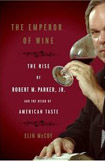
Will too many cooks spoil the successful broth that is “Robert Parker’s Wine Advocate”? Yes and no. The coverage will be expanded with the team of commentators–who knows, the brown ink-on-manilla-paper newsletter may even shift to run color images in the publication and try to target a broader audience? Doubtful. The way Parker has added new staff by focusing on regions rather than say, grape variety or food pairing, underscores that he wants to build on the base of being a publication for serious wines and serious wine buyers.

But this expanded coverage is also precisely where the strength of adding more reviewers becomes a weakness. More tasters means more palates. Will they bring more diversity? On the one hand, that would be refreshing since otherwise Parker could have added wine tasting robots.

But diversity would dilute the newsletter’s market power since a WA score could no longer presume to be objective, since it would vary with each reviewer. Since so many buyers buy simply based on Parker points, this would, in effect, remove the most important yardstick of quality for the auction market and throw it into disarray. How would collectors and investors know which wines to bid up?

But the wine auction market thrives mostly on Bordeaux and California, the regions that are still firmly in Parker’s grasp. When he ultimately gives those up, then the WA scores will be put to the test.

Related: “The best laid plans” [Dr. V]

tags: | | |

Dr. Vino live!

I want to meet YOU! I hope you can join me this Thursday at Bar Carrera for some tapas and vino. Some people who took my wine classes at NYU last year will be there too so drop by, say hi, and meet some fellow wine enthusiasts.

Bar Carrera
175 2nd Ave @ 11th St
6:30 PM start
Review here
Map here
Let me know if you think you might be able to drop by!

If just hanging out and eating tapas is not enough Dr. Vino for your taste, or if you demand more structured Dr. Vino sighting opportunities, check out one of my classes at NYU. We’ll be looking at the exciting regions of the Pacific NW, Napa/Sonoma, Argentina, the Loire and Bordeaux. We will focus on the hot-button issue of how producers blend innovation and tradition in their winemaking. I’ll pour at least five wines in every class from the region we’re discussing that day. Some will be organic, some will be conventional, and some will be biodynamic (eegads). By the end, you’ll be able to identify wine made with oak chips versus oak casks from 50 paces. OK maybe 49. Sign up–it will be fun!

Blending Innovation and Tradition, 5 weeks, Sep 21 – Oct 19

tags: | |

“They only drink 100-point Parker wines”

…The biggest collector in Asia is probably Hong Kong’s financial secretary, Henry Tang. His personal cellar is reputed to stand at around 12,000 blue chip cases, which he keeps in Hong Kong, the UK and the US. The wine and cigar merchant Thomas Bohrer once described Tang as being “in a category all by himself. He doesn’t have to visit chateaux or go to wine merchants. They come to him.”

Tang may be able to have merchants come to him personally, but the top French houses are making more visits to Asia in general. In a fascinating story in the Financial Times “How to Spend It” magazine (love that name), John Stimpfig reveals these factoids about the Asian market for wine:

* Asia’s wine consumption is expected to grow at twice the world average for the next two years with sales rising to $5 billion. China alone is expected to rise to $1.76 billion.

* French wines have a 40 percent market share. (Funny, I would have thought that it would be more, but then again, the Chinese have been getting a lot of wine from Australia)

* Exclusive wine clubs are all the rage in Hong Kong and Singapore. Ditto for wine dinners, wine schools, and wine magazines.

* There’s a new wine museum outside Beijing.

* Japan has 200 wineries and several thousand accredited sommeliers.

* South Korea has increased wine consumption 150 percent over the past five years.

* The 96-page wine list at Robuchon a Galera at the Lisboa Hotel & Casino in Macau has verticals of top names such as Latour, Yquem and “more ’61 Palmer than possibly anywhere else in the world.” (Indeed, representatives from Palmer went to the Hotel for a recorking of the 1961 wines on the premises.)

But why are so many Asian wine drinkers/collectors driven to the top wines? Serena Sutcliffe offers two explanations. The first is that “they tend to stick to brands they can pronounce.” Um, OK. So all the first growths of Bordeaux are easier to pronounce than the unclassed chateaus?

“The second is to do with the time-honored custom of ‘face.’ This means that if they serve anything other than one of the world’s greatest bottles, their guest will not be honored and might be offended.”

Wow, “face” sounds like a concept that all luxury goods producers might want to try to implement on a broader scale!

Check it out:
http://www.ft.com/howtospendit

tags: | | |

Who’s threatening us now: robots!

If you’re at a loss for words when it comes to describing wine, you now have another choice besides reading a book or good old-fashioned trial and error: robots!

Yes, the 2-ft tall creature to the right claims to be able to tell good wine from bad and even discern particular wine brands. How about that for your next party trick?

There are only two problems standing in the way of this robot annhilating sommeliers and wine geeks in general. One: price. The AP reports one of the researchers who developed the robot as saying it costs “about as much as a new car,” though they are trying to get that down to a more manageable $1,000.

Second: errors. From the AP story:

Some of the mistakes it makes would get a human sommelier fired — or worse.

When a reporter’s hand was placed against the robot’s taste sensor, it was identified as prosciutto. A cameraman was mistaken for bacon.

We’re safe for now! But we must not let our guard down against these cyborgs in the cellar.

Image: AP


winepoliticsamz

Wine Maps


Monthly Archives

Categories


Blog posts via email

@drvino on Instagram

@drvino on Twitter


winesearcher

quotes

One of the “fresh voices taking wine journalism in new and important directions.” -World of Fine Wine

“His reporting over the past six months has had seismic consequences, which is a hell of an accomplishment for a blog.” -Forbes.com

"News of such activities, reported last month on a wine blog called Dr. Vino, have captivated wine enthusiasts and triggered a fierce online debate…" The Wall Street Journal

"...well-written, well-researched, calm and, dare we use the word, sober." -Dorothy Gaiter & John Brecher, WSJ

jbf07James Beard Foundation awards

Saveur, best drinks blog, finalist 2012.

Winner, Best Wine Blog

One of the "seven best wine blogs." Food & Wine,

One of the three best wine blogs, Fast Company

See more media...

ayow150buy

Wine books on Amazon: