A bipartisan meal

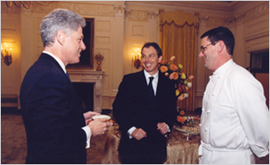
Last night I ate a dinner made by “cookie.” Or at least that’s what the President called him. Yes, that President.

Walter Scheib, Executive Chef at the White House for 11 years, gave a talk at NYU interspersed between three courses about his time in the White House.

In 1994, his wife saw in the newspaper that the White House chef had resigned. Chef Scheib was then at the Greenbrier in West Virginia and he saw no reason to apply. As he told the story, he and his wife were on a plane and he couldn’t escape her enthusiastic encouragement for the whole flight. The next morning when he left for work, his wife presented him with his resume and a cover letter to sign and send to 1600 Pennsylvania Avenue. Smart woman.

With 4000 applicants whittled down to 30 finalists and 10 who were ultimately brought in to cook a test meal, Scheib described it as a American Idol before there was American Idol.

Hillary Clinton was the one doing the hiring. She said that she wanted a chef who cooked American cuisine, a break with the tradition with French chefs. He cooked an audition lunch for the then-First Lady and her staff. Even though he called that one of the three most important meals he cooked during his tenure he neglected to save the menu from that day. But whatever it was, it got him the job.

He described the White House kitchen as a cramped at 30′ x 30′ and it had not been updated since 1976. There were two septuagenarian French chefs on the staff. Scheib put in all new appliances from stainless steel, high BTU ranges to extractor hoods. And he told the chefs that he would be bringing in a new style of food with spices ranging from curry to habanero. They said “that’s great!” And then they retired.

The meal that Chef Scheib prepared last night at the NYU Torch Club was bipartisan. The first dish was sweet potato and red curry soup with kefir and lemon grass, a favorite of Chelsea Clinton’s. I expected not to like it. But it was excellent, a blend of light sweetness followed by a gentle heat of the curry. It’s amazing to have a food that has a tasting arc like a wine. Apparently Tony Blair smelled Chelsea having it at Camp David one time, tried it, and asked the chef to prepare it for him as a sauce for his lobster the next time he visited the White House.

The second course came courtesy of the Bush twins. One time the family was away from the White House and Jenna and Barbara decided to come back. And have 40 friends over. Chef Scheib thought they would want to do a cookout and arranged for a drop shipment of beef. Only at 2:30 that Saturday afternoon, the twins told him they wanted to have a mini state dinner, in the main dining room with fancy china, and their friends would be dressing up. Deep six the cookout grub he wondered? Oh no, they twins replied that they would have it in the main dining room.

So knowing their love of margaritas, he prepared a lime-tequila sauce and reduced it to a mere glaze for the beef. Fried plantain chips soared over the meat, which was served on a bed of fresh mango and banana. That was our course number two. Scheib said that the Bush twins remarked after the meal that it was a pity to waste that much tequila.

Finally, we had a bipartisan dessert, honey-lavender ice cream and peach-berry cobbler. The Bushes apparently like Blue Bell ice cream from Texas. But Chef Scheib and his crew wanted to make their own. So they ground real vanilla beans, replaced half the sugar with honey and added lavender blossoms. The result was an amazingly intense ice cream that was gooey thanks to the honey and beautifully delicate with the lavender. The cobbler was fairly standard. But Bill Clinton likes it so much that he wants to have it at Chelsea’s wedding.

As your Senior Wine Correspondent I had to ask about the White House wine during the Q&A. Scheib joked that the White House has a great cellar: it’s called the state of California. Seriously, he said that the White House cellar is actually quite small, only about 300 bottles. Whenever they had an event that called for wine they would work with a winery to obtain their best wines–often from the personal collections of the vintners themselves. They rotate the wines very often so no one wine is considered a house wine. And they do draw from states beyond California too.

All in all it was a nourishing meal on many levels. This election day, vote for good food.

Related:
The American Chef, Chef Scheib’s web site, complete with recipes.
The list of food and wine offerings at NYU/James Beard Foundation

tags: | | |

BREAKING: resveratrol extends life and promises free gluttony

Watch out wine lovers, we’re going to be getting some competition. Pills.

We’ve known for a long time about the health benefits of red wine. In fact, hardly a week goes by without some new health news.

Now researchers at Harvard and the National Institutes of Aging have found that reserveratrol, found in red wine, can in “very large doses” slow down aging. Moreover, it can offset many of the negative effects of a high fat diet including the onset of diabetes. Lab mice with the equivalent amount of resveratrol as found in 10 – 20 bottles a day for human consumption, fed the same diet as others fared much better in agility tests and health later in life.

“They had all the pleasures of gluttony but paid none of the price,” as this story in today’s NYT summarized.

Wow, fountain of youth. Free gluttony. This stuff should be illegal! (oh wait, it is for people under 21) So give up the calorie restricted ascetism. And don’t go for the pills, we know there’s only one way: cabernet for all!

Read the excellent story in the Times summarizing the study from today’s journal Nature by David Sinclair and Richard Hodes.

tags: | |

Here’s to you Ms. Robinson!

In the NYT today, Eric Asimov interviews HRH Jancis Robinson, MW, OBE aka Jancis. Perhaps the HMS Indefatigable would be a better name given the amazing number of wine projects she has from the new Oxford Companion to Wine to her FT column, to her web site.

In her most recent column, she brings up an excellent point: mid-priced wines are the hardest to sell and offer the best value. Cut to the tape:

Very, very roughly the price bracket I would argue represents the best value today is about £8-£15, or $15-$30, a bottle. Into this bracket fall typically the finest wines produced by the least celebrated producers. They lack the reputation that allows them to ask for higher prices but the price reflects distinctly superior grapes, often grown at deliberately restricted yields in vineyards that have recently been planted or upgraded, using very similar techniques to those used for far more expensive wines.

I would agree that it is a sweet spot. But it’s sort of a puzzle why this is overlooked. I guess it is like mid-grade gasoline–either you want the cheap stuff or premium.

While wines below this range offer good value, it can be frustratingly hit or miss. Moving up a notch does offer more consistency. But it also cranks up your tab if you like popping a cork every evening. Consider it sage advice for the weekend from Jancis.

Related: “The Oxford Companion to Wine, third edition” [Dr. V]
Tasting Pleasures, confessions of a wine lover by Jancis Robinson.

tags: | |

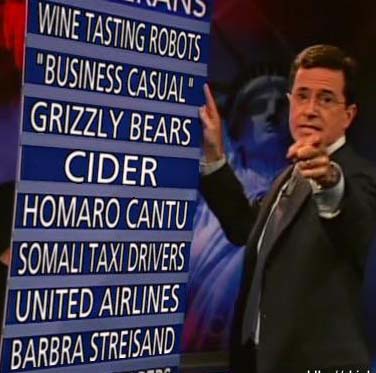
Who’s threatening us now: United Airlines!

Do you travel with wine? I did recently. And according to today’s NYT, there are a lot of wine professionals who do.

As if the Global War on Toiletries weren’t cramping our style enough by prohibiting us from carrying cabernet in the aircraft, now it is surfacing that United may be preventing wine from being checked in the hold.

According to a thread on Flyertalk, one passenger was denied checking wine in his luggage at the Los Angeles airport, LAX. The traveler put a “fragile” sticker on his bag and the staffer checking him in (wait, they have people doing that at LAX?) asked him why, he said he was taking a nice wine to a friend’s wedding. No go said the staffer. “She just started shaking her head and informed me that if UA “knows” that you are checking wine, they must ask you to remove the wine from your suitcase,” he wrote.

The traveler chucked the $90 cab in the trash. He must have decided not to chug it like this guy.

United, what are we supposed to do? Even though it doesn’t appear to be your official policy, this inconsistency is bad. Vintage variation? Fine, we can live with that. But travel policy variation? Nope. I’m putting you on notice, United Airlines!

Thanks for the tip, Mark at Upgrade: Travel Better!

Related: “Who’s threatening us now: Homaro Cantu!” [Dr. V]

Ales Kristancic uncorks Movia


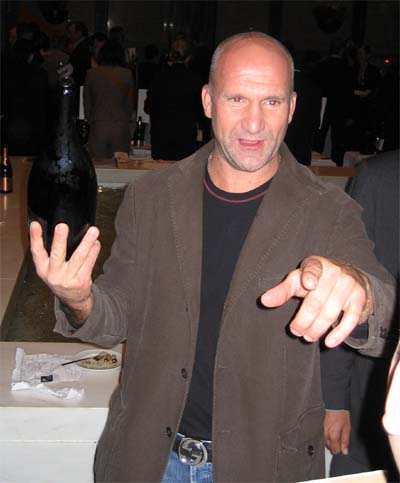
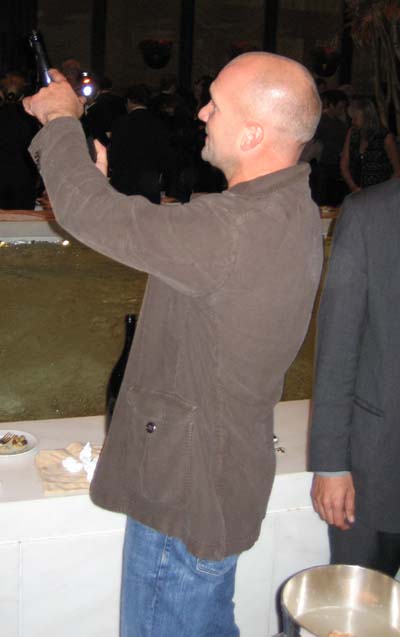
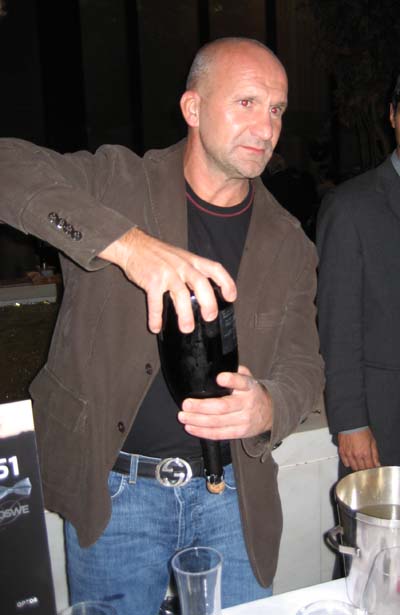
These photos show Ales Kristancic uncorking his sparkling wine at a recent tasting in NYC. Ales runs his family’s estate, Movia, in the part of Friuli that crosses into Slovenia. The wines are all made through biodynamics, the process of “organic plus” winemaking that blends in a shot of moonlight. If you’re looking for unusually refreshing, exciting, vibrant wines, keep an eye out for the wines of Movia–start scouring since they are hard to find though not outrageously expensive, about $25 – 35 for most of them (but the strong Vila Marija line is around $12; search).

Ales bottles his sparkling wine unfiltered. So in the third picture above he is coaxing the final sediment toward the cork. In the second photo he is pointing it out. Then he plunged it into the water bucket cork down, eased the cork out, and the sediment followed. Anybody want a taste? (photo 1) I did.

The sparkler, a 1999 from magnum, is amazingly fresh and clean. There is none of that bready, yeasty note that is common to champagne and not unpleasant. This was just so fresh, fruit and bubbles and totally dry.

The ribolla gialla is a sort of flagship wine from the estate. Made from 80 year old vines, the 2004 that I tasted was beautifully balanced between fruit, acidity and minerality. It is aged on the lees (more sediment!), which give is depth and roundness. Apparently its age-worthiness is legendary, lasting 50 years or more. But it is drinking great now.

But I liked his 04 sauvignon (blanc) a tad more. I have been paying attention to serious sauvignon blanc recently and this one definitely qualifies. A great mouthfeel, poised between acidity and creaminess, this wine has fantastic weight and intensity. The 04 pinot grigio was also very good and favored crushed stone notes over crushed flowers.

The 2004 Vila Marija merlot at $12 is an absolute steal. Bland be banned! This merlot has the great characteristics of the variety that are not hidden under layers of oak. How refreshing.

Try a wine from Movia this fall. But with only 13,000 cases made at the estate, the only trouble is finding a bottle.

Lucarelli Primitivo 2004

Lucarelli, Primitivo 2004 from Puglia. $6.97 (find this wine)

In the heel of the boot that is the Italian peninsula, the hot plains of Puglia have typically produced prodigious quantities of wine. Quality is creeping in now as the effects of the world wide glut are being felt. This Lucarelli Primitivo is an intersection of the two themes: good quality at a low price. These 60 year old vines yield primitivo, a grape that is a relative of zinfandel. The resulting wine is a real crowd pleaser with round fruit followed by persistent, faintly spicy finish. It’s light enough to try with pasta, but would love some grilled meat. What are you waiting for? Start searching for this value vino!

tags: |

Tasting sized pours

Catch Jancis Robinson on her last NYC stop tonight at Astor Wine for a free tasting and signing of the new Oxford Companion to Wine. 6-8 PM.

In the most punchy writing ever seen on Decanter, a review calls “A Good Year” starring Russell Crowe “an absolute dog.” Russell Crowe’s character, an investment banker turned vintner in Provence, intones such lines as “I want a bottle that tastes like you and a glass that is never empty…” The screenwriter, Marc Klein, said that he “knew nothing about wine or Provence.” [Decanter]

Jay-Z, who announced a boycott of Cristal early in the summer, has declared his new house champagne: Ace of Spades, from boutique producer Armand de Brignac. No word on the price of the wine. But you can watch him wave off a bottle of “cris” in his new video and take a bottle of Ace! [Decanter, YouTube]

Acker-Merrall, the NY auctioneer and high-end retailer, set a record with a $24 million auction last weekend. A methuselah (6L) of 1978 Romanée-Conti went for $125,475–$608 an ounce!

Want 10 million liters of French wine? Bid before November 10, probably pennies per ounce. [Scotsman]

“I love writing about wine. It’s like being paid to date models.” –Jay McInerney [Observer]

A Good Year,” [Dr. V]

tags: | | |

Quality guaranteed?

I always love the rare opportunity of tasting older wines. One thing that makes me reluctant to buy them is that they can be so hit or miss. Quality today depends not only on whether the wine itself was built to last but also the storage conditions of the bottle. Indeed, excellent storage is part of why bidders recently paid 75 percent over the auction estimates for the wine collection of Paris City Hall.

Last week at a trade tasting I had a chance to taste some 20+ year old white wines from Austria. I tasted the 1986 Roter Veltliner Scheiben and the 1983 Weissburgunder Auslese both from the producer Leth in Wagram. The Roter Veltliner is a local variation of the Gruner Veltliner and is generally subdued in its youth relying on good acidity and minerality to carry it through to a more mature age. The example I had tasted incredibly fresh with delicate notes of white flowers, slight sweetness, richness, and crushed stones on the palate. The long finish made it stunning. (find this wine, about $80)

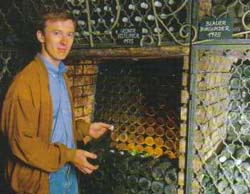
Weissburgunder is the local name for pinot blanc (and if you want to really one-up your Sideways buddies, Blauburgunder is pinot noir). The 1983 vintage (find this wine) was hot and dry like 2000 according to Franz Leth (pictured, right) who poured me the wines. The wine had a rich, honeyed nose that was complemented by a youthful acidity making the wine taste very vibrant. Maybe this should be the unofficial wine of Hollywood since all movie stars would like to be described as seeming much younger than they are.

I asked Franz how he would explain this? He had two reasons.

Franz personally uncorks all of the older vintages as they are withdrawn from the winery’s cellar. If they are bad, he discards them. If they are good, he tops them up with the current vintage, adds a shot of SO2 and recorks them.

On the one hand, this is amazing for the consumer since it brings the risk of buying an older vintage of Leth to near zero. This is as close as you get in the wine biz to a guarantee. Buyers would no doubt be willing to pay a premium for it. And Leth probably demands it since they must pour lots of wine down the drain that other wineries might be happy to sell to consumers who didn’t know any better.

But on the other hand, how true is it to the vintage with the shots of SO2 and the current vintage? Is this adulteration? Or just delivering the best that Leth can give? Adding a less expensive current vintage could devalue the older bottling.

After tasting the vitality and freshness of the wines, as a consumer I would prefer the almost-sure-thing that Leth provides, especially if I were planning to drink it in the near future. But would I pay the premium?

Weingut Leth

tags: | |


winepoliticsamz

Wine Maps


Monthly Archives

Categories


Blog posts via email

@drvino on Instagram

@drvino on Twitter


winesearcher

quotes

One of the “fresh voices taking wine journalism in new and important directions.” -World of Fine Wine

“His reporting over the past six months has had seismic consequences, which is a hell of an accomplishment for a blog.” -Forbes.com

"News of such activities, reported last month on a wine blog called Dr. Vino, have captivated wine enthusiasts and triggered a fierce online debate…" The Wall Street Journal

"...well-written, well-researched, calm and, dare we use the word, sober." -Dorothy Gaiter & John Brecher, WSJ

jbf07James Beard Foundation awards

Saveur, best drinks blog, finalist 2012.

Winner, Best Wine Blog

One of the "seven best wine blogs." Food & Wine,

One of the three best wine blogs, Fast Company

See more media...

ayow150buy

Wine books on Amazon: