Ask Peter Meltzer your wine collecting questions

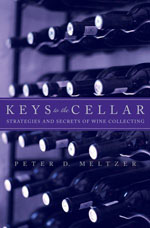
Peter Meltzer, author of Keys to the Cellar: Strategies and Secrets of Wine Collecting, joins us this week for a Q&A about wine collecting. In Keys to the Cellar, Meltzer draws on his twenty years as Wine Auction Correspondent for Wine Spectator to craft a thorough book about the ins and outs of collecting, storage and investing.

Meltzer will respond to your questions just as the auction market heats up for 2007. After a record year of $167 million worth of wine auctions last year in the US, the auction market kicks into gear with a big auction at Hart Davis Hart in Chicago this weekend. Next weekend, Sotheby’s and Morrell have auctions in NYC. In fact, almost every auction house has one in the next month or so.

So post your questions on auction strategy, wine cellars, and general wine collecting here in the comments. I’ll close the comments at 3PM Eastern on Wednesday. Peter Meltzer will then reply here on this blog later in the week.

UPDATE: here’s the link to his replies

Tasting sized pours

Buyers of cellars: BusinessWeek reviews home wine cellars. Cut straight to the photos.

Buyers and buyers: “Bidders shattered last year’s $12.2-million, single-day record when they hit lot No. 49, with 23 lots still to go.” Naples Winter Wine Festival brings in $16.5 million for charity through the sale of wine–and a Rolls Royce and trips on private jets [Naples News]

Buying more: Americans buy 300 million cases of wine in 2006, a new record. [Sonoma PD]

Sancerre, food pair [Mariani–Bloomberg]

The half-bottle may not be full enough: Landmarc, the very wine-friendly restaurant in Tribeca that has an extensive list of half bottles, moves uptown and upscale to the TimeWarner Center–but are they in over their heads? [NYM]

Pitch it or pour it? Jerald O’Kennard of the Beverage Testing Institute peers into the liquor cabinets of the Trib staff. Some of it is not pretty. [Chicago Tribune, thanks U:TB]

On a roll: Have you ever had a California roll? Or teriyaki chicken? You can now report it to Japanese sushi “police” who are on the prowl, seeking out fraud maki–outside of Japan! [Financial Times]

Some like it hot–spicy and circular: “The United Nations food and health agencies are to lay down international standards for how the poppadum can be manufactured.” [TimesOnline]

The next edition of Wine Blogging Wednesday will focus on New World syrah. Taste, then blog it on Feb 7! [WineCast]

Many sales are happening now–check your local wine shop and stock up!

tags: | |

The colors of Cognac


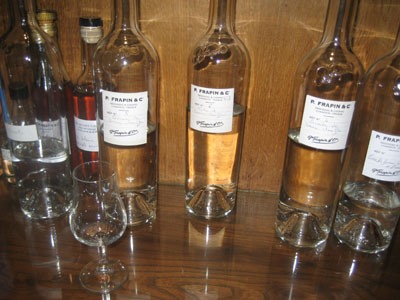
When a distilled spirit is 70 percent alcohol, can you taste the difference? In Cognac, the answer is yes. The cellar master receives the samples of the distillate and smells them for their aromatic qualities. I did it and it was, well, mostly alcohol. But then he adds water to the raw spirit, which, surprisingly to me, greatly amplifies the aromas. Suddenly there were many more aromas and it was possible to distinguish between two distillations from different vineyard sites. In the photo above, distillations from different areas are on the tasting table at Frapin.


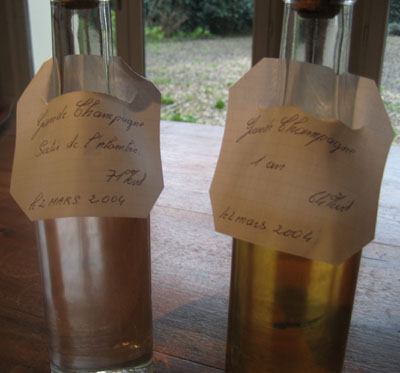
All the spirits are clear immediately after distillation–it’s only the oak aging that adds the enticing golden hue. The photo above shows the distillate fresh out of the alembic and, on the right, after one year of aging in an oak barrel.


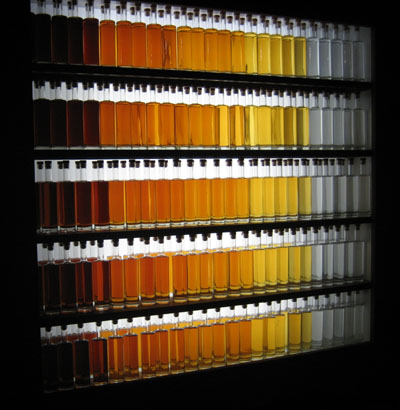
The longer in the barrel, the richer and darker the colors become. The Cognac house Camus has a beautiful demonstration of the progression on display. The just-distilled spirits are on the right moving all the way to fifty-year-old samples from oak casks the left.

tags: |

Barrel sample, cognac style

Domique Touteau, cellar master at Delamain, draws a sample from a 1967 barrel of Cognac. Instead of a pipette, more common in the wine world, he uses a “prouvette.” The prouvette is a glass vial tied to a string that he drops in the barrel. If you listen you can hear the bubbles as it fills up. Unfortunately the only light we had in the cellar was one light bulb. Even thought the video is dark, you can still see the golden color in the glass. And the chalk markings on the outside of the barrel indicate its origin, harvest date and the alcohol strength. No barcodes here…

tags: |

Cognac word of the day: alembic


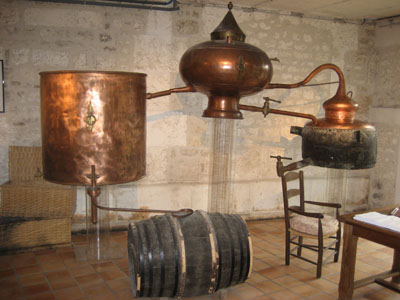
The word of the day from my Cognac trip is: alembic. It’s the distinctive still that the wine must pass through–twice–to become the eau-de-vie that is cognac.

Known in French as the alambic charentais, it is made out of copper, which gives the distillate a distinctive flavor. The wine, a thin acidic wine almost entirely from the ugni blanc grape, goes into the boiler on the right in this miniature, antique example. The vapors, mostly alcohol, rise into the onion-shaped dome on top of the boiler. The lightest ones escape down the bent pipe called the “swan’s neck” and into the cooling tower on the far left. (The thing in the middle simply captures any warm wine to return to the boiler as a measure of economy.) The cooling tank can have a copper coil 60 meters long running through cool water in order to bring the vapors back down to liquid form.

When the distillate comes out of the cooling tower it goes into a cask and then is passed through the still again for the double distillation that makes cognac different (armagnac, for example, gets one distillation usually while vodka can go through the still eight times). The liquid coming out at the end of the second distillation is clear and about 70 percent alcohol. It takes about 9 liters of wine to make one liter of the distilled spirit at the end.

I visited a distillery, which runs 24 hours a day this time of year. All the distillation has to be completed by March 31. The stills can only be 2500 liters for the second distillation, or “la bonne chauffe,” and it takes 12 hours for the process to be completed. Surprisingly, you really can taste a difference in the distillates, potent as they may be.

tags: | |

Take my next wine class. It’s a fountain of youth.*

Check out my next wine class at NYU starting Feb 1.

But also check out this NYT story from a couple of weeks ago. It turns out researchers think education–yes, education!–is phenomenally important in having a long life. Roll the tape:

The one social factor that researchers agree is consistently linked to longer lives in every country where it has been studied is education. It is more important than race; it obliterates any effects of income.

Year after year, in study after study, says Richard Hodes, director of the National Institute on Aging, education “keeps coming up.”

And, health economists say, those factors that are popularly believed to be crucial — money and health insurance, for example, pale in comparison.

Now couple that with the recent studies on resveratrol and the class may just be the fountain of youth! Ponce de Leon, come hither and enroll!

We will be talking about and tasting cool things like what the heck is going on in these posts.

* Results may vary. Not guaranteed.

tags: | |

Cognac Q&A with Eric Felten

Eric Felten is the author of the “How’s Your Drink?” column in the the Wall Street Journal. I enjoy his spirits writing and, in particular, his story “Cognac and its cognoscenti” from last June. So I thought I would ask him for some orientation on how to enjoy cognac as I embark on a trip to the region. Hopefully I can avoid any egregious faux pas while there–and know how to make a sidecar when I return!

From Eric Felten:

I choose to finish a meal with whisky or cognac purely as a matter of mood and whatever my tastebuds might be wanting at the moment — just as one might choose, at dinner, between steak or veal. But whichever I choose, I have a couple of personal rules:

1) Wait until after dessert for the spirit. This, I admit, is a matter of my own preference. I simply do not like the combination of sweets and spirits. There have been a lot of people urging the pairing of chocolates with after-dinner spirits. Others may like that, but I find it to be just awful.

2) Do not warm your cognac. Silly tradition.

3) Avoid ridiculously oversized balloon snifters. Even sillier tradition.

4) As for mixing cognac, just be sure that the brandy is not overwhelmed by the other ingredients. The classic cognac cocktail — the Sidecar — is now regularly ruined as all one tastes is orange liqueur and (ugh) sweet-n-sour mix. To make the drink properly, use 4-6 parts brandy to one part Cointreau and one part (or slightly less) fresh lemon juice. That way you taste the cognac, which then makes it worthwhile to use a decent (VSOP) bottle.

XO XO from Cognac with love


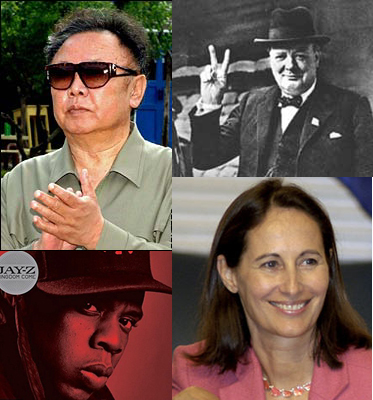
Winston Churchill. Kim Jong-Il. Jay-Z. Segolene Royal. What’s probably the one thing they have in common? Cognac!

With fans as diverse as this, how could I not know more about this distinctive beverage? Samuel Johnson threw down a challenge to us wine geeks more than 200 years ago when he was offered a glass of claret. “No, Sir, claret is the liquor for boys; port, for men; but he who aspires to be a hero must drink brandy,” according to Boswell.

Well, I don’t know if I aspire to hero status, but I’m not going to settle for being a mere “boy!” So when the Bureau National Interprofessionnel de Cognac, the trade group representing ALL producers and distillers in the region invited me on a press trip, how could I refuse?They asked me what I know about cognac. I said nothing. They said, “Fine!”
So what do I know about cognac? Let me think out loud:

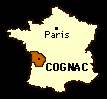
  • Like Champagne, Cognac is both a drink and a place. Fancy that. It’s north of Bordeaux, touching the Bay of Biscay and runs inland.
  • Also like Champagne, Cognac favors brands over growers. That’s evidenced by the fact that the cognac Hennessey is the best known wine and spirits brand according to Business Week magazine. And the second? Moet.
  • Cognac is made from grapes! The humble ugni blanc is grown with yields almost three times that of quality table wines. Then it is distilled. Twice.
  • Production is 95% exported.
  • Hip-hop artists want to “pass the Courvoisier.” Cognac is also known as “yak.”
  • One cognac comes in a Baccarat crystal bottle and costs over $1,000.

Actually I do know one more thing: there are various grades of cognac. Here’s my initial impression, pending further research:

  • VS = blending
  • VSOP = blending or sipping
  • XO = sipping, big bling factor

For the late, great R. W. Apple Cognac, “properly made and aged, is the best brandy in the world.” The decisive factor in setting cognac apart from other brandies is not the unique climate or soil. Appple ascribed its difference to the humans, saying “the decisive factor is the skills in distilling, blending and maturing that have been perfected over 300 years.”

But with almost all the production exported, looking at who and where it is consumed is arguably just as important as where it is made. In his excellent story “Cognac and its Cognoscenti” in the Wall Street Journal last June, Eric Felten wrote about the rich history of brandy and American musicians, particularly African-American musicians such as Billie Holliday or Dexter Gordon all the way to P-Diddy. Felten observed this change:

With Lady Day and Dexter, cognac was a way to cultivate and project a worldly, savvy and civilized image. By contrast, the hip-hop brandy trend has been more about sheer expense — especially the stuff that sells for four figures and comes in Baccarat bottles. Even so, I suspect that cognac’s appeal to the hip-hop crowd is about more than conspicuous consumption. The authors of the “thug” lifestyle seem to think a glass of cognac is like “a gat in the hand.” Rap’s celebration of yak is an embrace of the venerable notion that cognac is the drink not only of the rich, but of the powerful.

How open are the cognac producers to this embrace? After all, when the Economist asked a representative of Roederer about the house’s top wine, Cristal, being a favorite of the hip-hop crowd he made comments that were interpreted as racist and led to a boycott of the bubbles.

It seems to me that the cognac producers are likely more relaxed about their “cognoscenti.” Their beverage is, after all, a distillate, potent and concentrated. They’re used to blending or just playing it straight.

So next week I’ll be reporting on this and more from the region. I hope to be able to post from the region but that depends on two things. First, internet access, which can be spotty in France. And second, if I can keep my tasting volumes below the “heroic” levels of Churchill.

What I’m reading to get up to speed on Cognac:
Cognac, by Nicholas Faith (2005, Mithcell Beazley)
Cognac, the Seductive Saga of the World’s Most Coveted Spirit, By Kyle Jarrard (2005, Wiley)
“From the Thinnest of Wines, the Richest Spirit: Cognac,” R. W. Apple, NYT, September 25, 2002.
“Cognac and its cognoscenti,” Eric Felten, WSJ June 3, 2006
Cognac-world.com
Cognac.fr, the BNIC site

PS bonus points for anyone who can say who Segolene Royal is. And double bonus for why she is relevant to cognac!

winepoliticsamz

Wine Maps


Monthly Archives

Categories


Blog posts via email

@drvino on Instagram

@drvino on Twitter


winesearcher

quotes

One of the “fresh voices taking wine journalism in new and important directions.” -World of Fine Wine

“His reporting over the past six months has had seismic consequences, which is a hell of an accomplishment for a blog.” -Forbes.com

"News of such activities, reported last month on a wine blog called Dr. Vino, have captivated wine enthusiasts and triggered a fierce online debate…" The Wall Street Journal

"...well-written, well-researched, calm and, dare we use the word, sober." -Dorothy Gaiter & John Brecher, WSJ

jbf07James Beard Foundation awards

Saveur, best drinks blog, finalist 2012.

Winner, Best Wine Blog

One of the "seven best wine blogs." Food & Wine,

One of the three best wine blogs, Fast Company

See more media...

ayow150buy

Wine books on Amazon: